This site is supported by our readers. We may earn a commission, at no cost to you, if you purchase through links.

The first time I watched a seventh grader hold a ball python without flinching, I understood why these snakes work so well in classrooms. They’re calm by nature, manageable in size, and patient with clumsy young hands. But that calm only holds up when the enclosure behind it does its job too.
Building ball python enclosures for classrooms takes more than a tank and a heat lamp. You’re managing student safety, hygiene protocols, and an animal’s specific biological needs, all under one roof. Get the setup right, and you’ll create a space where curiosity and responsibility grow side by side.
Table Of Contents
- Key Takeaways
- Plan Safe Classroom Snake Care
- Build a Secure Ball Python Enclosure
- Set Heat, Humidity, and Enrichment
- Top 5 Classroom Enclosure Supplies
- Frequently Asked Questions (FAQs)
- Are ball pythons good classroom pets?
- What kind of enclosure do ball pythons like?
- How much do ball python enclosures cost?
- Is 70 degrees too cold for a ball python at night?
- How long can ball pythons safely fast?
- Can other classroom pets share the same room?
- What should students know before Harrys birthday visits?
- How often should the enclosure be deep cleaned?
- Whats the average lifespan of a classroom ball python?
- Conclusion
Key Takeaways
- Before a snake ever enters your classroom, you need signed policy approval, a curriculum tie-in, and parental consent forms on file.
- Safety comes down to daily habits like thorough handwashing, gloves, and keeping the snake’s tools and cleaning supplies separate from other classroom pets.
- A secure enclosure means getting the size right (36×18 inches with room to grow), fitting childproof locks, and providing steady 6-12 air changes per hour.
- Harry thrives on a warm-to-cool temperature gradient (88-92°F down to 78-82°F), 50-60% humidity, and two snug hides so he can regulate his own comfort.
Plan Safe Classroom Snake Care
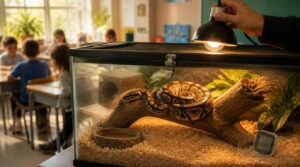
Harry the ball python taught a whole classroom that a snake can be more than just a pet in the corner—he can be part of the family. But before any classroom welcomes its own scaly guest star, some groundwork needs laying. Here’s what you’ll want to sort out first.
Setting up cozy, secure hideaways matters more than most teachers expect, and this guide to choosing the best ball python hides for classrooms makes it easy to get right.
Review School Animal Policies
Before your snake ever meets a classmate, your principal needs to meet the paperwork.
- Policy approval signed off first
- Educational justification tied to curriculum
- Parental consent forms archived for every student
Schools also require record keeping standards and clear supervision requirements, so animal handling guidelines stay documented and enforceable, not just verbal promises.
The building principal must provide pre-approval for any animal brought into school facilities under Policy 2580 guidelines.
Choose Age-appropriate Student Access
Once policy paperwork clears, decide who actually gets to hold Harry. Younger grades should stick to supervised handling only, watching or briefly touching under direct teacher guidance. Older students can take on more independent turns.
Think of it like age-based access rules for classroom tech: younger kids get limited, teacher-led interaction; older ones earn broader privileges as trust and maturity grow.
Set Handling and Hygiene Rules
Trust doesn’t skip hygiene. Before anyone touches Harry, hands get washed with soap and warm water for at least 20 seconds. Gloves prevent cross-contamination, no rings or bracelets, no touching your face mid-handling.
Sick students sit out, no exceptions. Afterward, wash again before touching desks or friends.
Simple handwashing protocol, followed every time, keeps zoonoses (germs animals pass to humans) from spreading.
Prevent Habitat Cross-contamination
Washing hands stops germs traveling to Harry. Keeping his terrarium separate from other class pets stops germs traveling between them. Give his tank its own space and airflow, with dedicated tools and disinfectant used nowhere else.
Try color-coded cleaning: one sponge, one spray bottle, one zone. Cross-contamination hides in shared rags more than you’d guess.
Plan Weekend and Holiday Care
Fridays worry teachers most: three empty days with no one watching Harry. That’s why solid weekend and holiday care means a weekend staff rotation, twice-daily checks, and a posted emergency contact for a herpetologist.
Your plan needs:
- A holiday feeding plan using pre-killed prey only
- A backup power strategy for heaters
- A digital log tracking every reading
Build a Secure Ball Python Enclosure
Once Harry outgrew his old tank, building him a proper home became the next project on the list. A secure enclosure isn’t just four walls and a lid, it’s a series of small decisions that add up to real safety. Here’s how each piece comes together, starting with getting the size right.
Coconut fiber bedding keeps humidity levels steady for Harry, but knowing how often to change snake bedding is just as essential for keeping his enclosure healthy.
Size The Enclosure Correctly
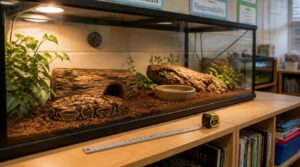
Ball pythons grow fast, so undersizing now means rebuilding later. Aim for a 36 by 18 inch base, adding 20 percent beyond your gear’s footprint for movement room. Keep 2 inches of clearance around hides and shelves. Reserve back-wall space for cords and heat mats. Sizing generously today saves you from a costly, disruptive upgrade once your snake outgrows a cramped classroom home.
Cut PVC Wall Panels

Grab a fine tooth handsaw for straight runs, or a cordless jigsaw for curved notches, then mark lines with a straight edge. Score thin sheets with a utility knife for clean snaps.
Deburr every edge with sandpaper, wear goggles and a mask for dust, and keep blades sharp to avoid melt marks.
Install Sliding Front Doors
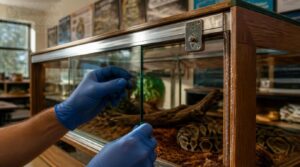
A snake that pushes past a pencil-width gap deserves a door that won’t budge. Mount the header track level, keep side tracks plumb and parallel, then seat rollers so panels glide without binding. Test smoothness before tightening hardware.
Run a bead of sealant along the frame for weatherproofing, and mount childproof locks at least 36 inches up.
Add Safe Ventilation
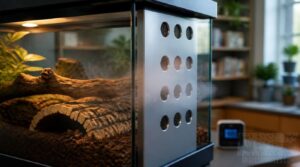
An enclosure that can’t breathe turns dangerous fast. Aim for 6 to 12 air changes per hour, blending intake and exhaust so air reaches hides and branches evenly. Place vents away from direct drafts across your snake, and balance airflow against humidity, since ventilation prevents condensation on glass and PVC while thermostats keep temperatures stable between 88 and 92 degrees.
Fit Childproof Door Locks
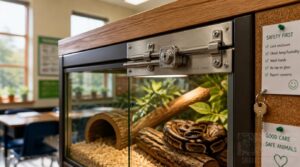
A pencil-width gap is all a determined ball python needs to escape, which is why childproof door locks matter as much as glass thickness.
A pencil-width gap is all it takes to escape, so childproof locks matter as much as glass thickness
Mount locks at least 36 inches high, choose sliding bar or reinforcement plate styles, and keep a spare key handy for emergency access without sacrificing daily classroom pet safety.
Set Heat, Humidity, and Enrichment
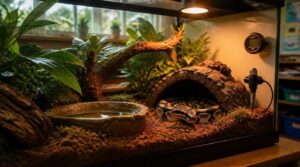
Once Harry’s enclosure is built, the real work of keeping him healthy begins with getting the environment inside just right. A ball python’s body depends on specific temperatures, humidity, and hiding spots to feel safe and stay active for classroom visits.
Here’s how to set up each of those elements so your enclosure works the way it should.
Create Warm and Cool Zones
Think of the enclosure as two rooms in one house. The warm zone should cover 25 to 40 percent of the floor, holding 88 to 92°F on a non-slip tile surface. The cool zone stays around 78 to 82°F, shaded and calm.
That 10 to 12-degree gradient lets Harry choose his comfort, moving freely between hides.
Connect Heaters to Thermostats
Getting those zones right means nothing without dependable wiring. Wiring heaters in parallel keeps each unit fed independently, run a thermostat compatibility check first, then set up the relay circuit for line-voltage control. Add overcurrent protection sized to total wattage, and finish with parallel load testing.
- Check thermostat rating
- Wire heaters parallel
- Install relay
- Add breaker
- Test load
Maintain Proper Humidity Levels
Wiring solves temperature, but ball pythons also need 50 to 60 percent humidity, spiking to 70-80 during sheds. Place a water dish near the warm side, use coconut fiber substrate for moisture retention, and keep ventilation breathable.
| Season | Target RH | Adjustment |
|---|---|---|
| Winter | 45-55% | Add misting |
| Summer | 50-60% | Increase airflow |
| Shed cycle | 70-80% | Cover vents briefly |
Add Snug Hides and Foliage
Every ball python needs two snug hides—warm side and cool side—each at least 6×9 inches, walls touching its body. This thermal hide benefit cuts stress during handling and shedding.
Cover 60-70% of floor with anchored, non-toxic foliage:
- Broad leaves for cover
- Fine branches for texture
- Secured bases (no tipping)
- Clear student observation gaps
- Washable, sanitized materials
Secure Sturdy Climbing Branches
Watch a ball python explore, and you’ll notice it climbs before it settles. Choose branches 1.5 to 2 inches thick, rated for 5 pounds of moving load. Rough hardwood beats smooth plastic for grip. Anchor with brackets, not glue alone, and check monthly for wobble.
Slope branches slightly downward, positioned away from hides, so students see a snake that actually explores.
Top 5 Classroom Enclosure Supplies
Once you know the numbers behind heat, humidity, and enrichment, the next step is picking materials that actually hold up in a classroom setting. Not every product on the shelf is built for the daily bumps, curious hands, and heavy use a school enclosure sees.
Here are five supplies worth having on your list before you start building.
1. DYCacrlic Clear Acrylic Sheet 24×36
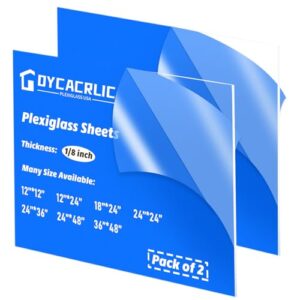
Your snake’s front-row seat to classroom life starts with what students see through: DYCacrlic’s 24×36 cast acrylic sheet, cut clean with no burrs. Each pack ships two sheets, 1/8" thick, with protective film on both sides guarding against scratches.
That optical clarity matters here, since fourth-graders pressing close for birthday visits deserve a clear view, not a scratched, cloudy window. Cast acrylic resists yellowing indoors, stays rigid under normal classroom temperatures, and won’t shatter if bumped.
| Best For | classroom terrariums, DIY wedding signage, picture frames, and display panels where a lightweight, shatter-resistant, glass-like panel is needed. |
|---|---|
| Material | Cast Acrylic (PMMA) |
| Color | Optically Clear |
| Primary Use | Display Panels |
| Reptile Suitability | Tank Paneling |
| Installation Ease | Cut To Size |
| Package Quantity | 2 Sheets |
| Additional Features |
|
- Clean, burr-free edges make it easy to cut and shape for enclosures or frames
- Optically clear Grade A finish with protective film on both sides to prevent scratches during handling
- Lightweight and shatter-resistant compared to glass, making it safer around curious students
- Actual thickness may run slightly under 1/8 inch in some batches, so precise-fit builds should double-check measurements
- Not rated for continuous use above 160°F, so it’s unsuitable near heat lamps in a terrarium setup
- Protective film must be fully removed before use to get true optical clarity
2. Stainless Steel Circular Soffit Vent 20 Pack
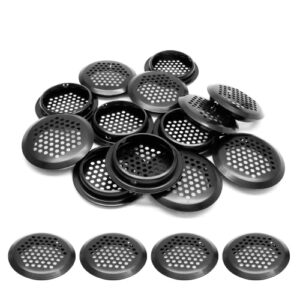
Fresh air matters more than you’d think in a sealed acrylic box.
These stainless steel soffit vents snap into 2-inch mounting holes with three retaining buckles, no screws needed, and their honeycomb mesh keeps airflow moving without letting dust or debris drift in.
The matte black finish resists rust even with humidity swings from shedding cycles.
At 6.4 ounces for 20 pieces, you’ve got plenty for multiple enclosures, though double-check your hole saw size since fit can run tight.
| Best For | Reptile keepers and pet owners who need reliable, corrosion-resistant ventilation for enclosures, cabinets, or storage spaces prone to humidity and odor buildup. |
|---|---|
| Material | Stainless Steel |
| Color | Matte Black |
| Primary Use | Ventilation |
| Reptile Suitability | Enclosure Airflow |
| Installation Ease | Snap-In Mount |
| Package Quantity | 20 Pieces |
| Additional Features |
|
- Tool-free snap-in installation with three retaining buckles for a secure hold
- Honeycomb mesh design allows steady airflow while keeping dust and debris out
- Matte black stainless steel finish resists rust, even with humidity swings
- Actual outer diameter runs slightly larger than 2 inches, so standard holes may not fit without modification
- May require a 2 1/16 inch hole saw rather than a standard 2-inch one
- Some users need to trim or bend retaining clips to get a proper fit
3. Natural Coconut Fiber Liner 12×80 Inch
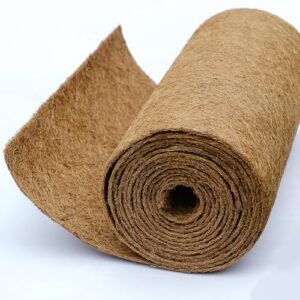
Line the enclosure floor before anything else goes in, and Harry’s classroom stayed noticeably calmer for it. This coir liner is 100% natural coconut fiber, bonded with latex, at 1/4 inch thick, so it breathes, wicks moisture, and won’t turn soggy underfoot.
The 12×80 roll cuts easily to fit your PVC footprint, and rough edges just need a quick trim. It resists mold when dried between cleanings, giving students a low-mess, low-odor habitat to observe.
| Best For | teachers, hobbyists, and reptile owners who need a natural, breathable liner for classroom habitats, planters, or cages. |
|---|---|
| Material | Coconut Fiber |
| Color | Natural Brown |
| Primary Use | Enclosure Liner |
| Reptile Suitability | Cage Liner |
| Installation Ease | Cut To Fit |
| Package Quantity | 1 Roll |
| Additional Features |
|
- 100% natural coconut fiber with a latex backing that resists mold and holds up well between cleanings
- Breathable and moisture-wicking, keeping enclosures or planters from getting soggy
- Easy to cut to custom sizes for different containers or footprints
- Feels stiff right out of the roll until it softens with use and moisture
- Cut edges can fray and may need trimming or sealing
- Shouldn’t be left submerged in water for long periods, as it will degrade over time
4. Riare Coconut Fiber Reptile Substrate 10LBS
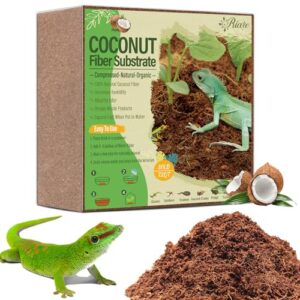
Once that coir liner’s down, this brick becomes your top layer, and it’s the difference between a dry, dusty pen and one that actually breathes. One 10 lb brick expands to 5.5 gallons when soaked, giving you loose, diggable coverage without added dyes or fillers.
Rehydrate every 5–7 days to hold humidity steady, and always inspect for stray debris before adding it to Harry’s enclosure.
| Best For | Reptile, amphibian, and invertebrate owners who want a natural, burrow-friendly substrate that holds humidity for tropical or humidity-sensitive pets. |
|---|---|
| Material | Coconut Coir |
| Color | Natural Brown |
| Primary Use | Terrarium Substrate |
| Reptile Suitability | Terrarium Bedding |
| Installation Ease | Soak And Expand |
| Package Quantity | 1 Brick |
| Additional Features |
|
- Expands to 5.5 gallons from a single 10 lb brick, giving generous, loose coverage for digging and burrowing
- 100% natural coconut coir with no dyes, chemicals, or added fillers, keeping the enclosure odorless and low-dust
- Doubles as garden compost once it’s done its job in the terrarium
- Needs soaking (about 5.5 gallons of water) and 5–10 minutes to expand before you can use it
- Requires rehydration every 5–7 days to keep humidity levels steady
- Occasional stray debris like plastic shreds means you’ll want to inspect it before adding it to the enclosure
5. Plastic Closet Rod Holders for 1 3/8 Inch Poles
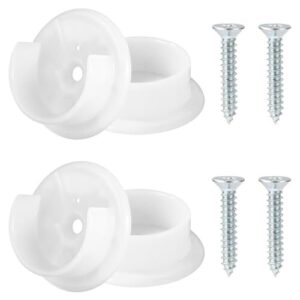
Rounding out your supply list is something surprisingly ordinary: closet rod holders. These plastic clips grip 1 3/8 inch poles securely, making them perfect for mounting climbing branches inside Harry’s enclosure without drilling extra holes.
Each holder holds 5 to 8 pounds, plenty for branches, and the moisture-resistant plastic experiences classroom humidity well. Mount two per branch for a snug, symmetrical fit that won’t wobble when your ball python climbs and explores.
| Best For | Homeowners or renters who need a simple, tool-light way to mount closet rods, wardrobe tubes, or shower curtain rails in bathrooms and closets. |
|---|---|
| Material | Reinforced Plastic |
| Color | White |
| Primary Use | Rod Support |
| Reptile Suitability | Not Applicable |
| Installation Ease | Screw Mount |
| Package Quantity | 4 Holders |
| Additional Features |
|
- Comes with 4 plastic rod holders and matching screws, so you have everything needed for installation
- Pre-drilled holes and lightweight plastic construction (just 40 grams total) make setup quick and easy
- Fits rods up to 1 3/8 inches in diameter, covering most standard closet and curtain rods
- Plastic build may warp or weaken under heavy loads or extended stress
- Won’t work on concrete or masonry walls unless you add anchors or adhesive
- Limited to rods no wider than 1 3/8 inches, so larger poles won’t fit
Frequently Asked Questions (FAQs)
Are ball pythons good classroom pets?
Yes, with supervision. Their calm, slow-moving nature makes handling low-stress, and predictable routines suit classrooms well. Ball pythons tolerate gentle contact from older students, though proper hygiene and consistent care remain essential for both snake and student safety.
What kind of enclosure do ball pythons like?
An 8-square-foot floor beats height every time: ball pythons crave horizontal stretch room, not climbing space. They like snug hides on both ends, stable humidity, and minimal clutter, an enclosure built for security, not decoration.
How much do ball python enclosures cost?
Budget for 150 to 400 USD on a PVC enclosure, plus 25 to 150 USD for heating, humidity gear, and hides. Total setup often lands between 200 and 600 USD, depending on materials and enrichment choices.
Is 70 degrees too cold for a ball python at night?
Seventy degrees sits right at the edge of safe territory. Anything colder, held consistently, risks slowed digestion and stress. Aim for a nighttime cool zone of 75–80°F instead, letting your snake thermoregulate naturally without dipping into that riskier range.
How long can ball pythons safely fast?
Fasting is fairly forgiving in healthy adults: 1 to 6 months poses no real risk if body condition stays good. Juveniles tolerate far less, often just 4 weeks, so watch weight closely and call a vet if refusal drags past six months.
Can other classroom pets share the same room?
Yes, with careful zoning. Give each species dedicated space with physical barriers, since conflicting humidity, temperature, and noise levels can stress animals and increase pathogen cross-contact risk between habitats sharing the same room.
What should students know before Harrys birthday visits?
Before holding Harry, students should know gentle, slow movements matter most, supporting his body rather than gripping tightly. They should recognize stress signs like retreat or rapid tongue flicking, and always wash hands afterward to prevent contamination.
How often should the enclosure be deep cleaned?
A house needs a spring scrub, not just daily tidying. Same logic here: deep clean every 4 to 6 weeks, sooner (within 2 weeks) if substrate gets soiled, or after illness strikes the classroom.
Whats the average lifespan of a classroom ball python?
With proper care, these snakes usually live 20 to 30 years, some reaching their mid-30s. Genetics, diet, and steady husbandry drive that range, so a well-tended classroom python could easily outlast several student generations.
If you’re curious how that lifespan applies to this morph, the banana ball python care and morph guide covers what to expect from these calm, colorful snakes.
Breeders created the bumblebee morph in 2001 by pairing pastel and spider genes, and this bumblebee ball python genetics guide explains how those traits combine.
Conclusion
A well-built terrarium is like a quiet classroom itself: sturdy walls holding space for curiosity to roam safely.
That’s the real purpose behind ball python enclosures for classrooms, giving students a secure window into biology without risking a bite or a bacterial slip-up.
Lock the doors. Check the thermostat. Wash your hands. Do that consistently, and the snake becomes less a novelty and more a steady, scaled teacher nobody saw coming.