This site is supported by our readers. We may earn a commission, at no cost to you, if you purchase through links.

Drop the temperature 8°F in one night and your boa won’t just get sluggish, it can stop digesting a meal entirely, leaving it to rot in the gut. That’s the reality of thermoregulation for a snake with no internal thermostat of its own. Darkness doesn’t pause its need for heat; it just removes your ability to see problems developing.
A reliable nighttime heat source for boa constrictor enclosures has to work invisibly, holding steady gradients while you sleep. Ceramic emitters, ignoring bulbs, and ways to pair them with proper thermostats each solve this differently, and picking wrong means either a chilled snake or a burned one.
Here’s what actually holds up overnight, and how to set it up so you’re not guessing.
Table Of Contents
- Key Takeaways
- Top 10 Nighttime Heating Products Reviewed
- 1. Simple Deluxe Dual Reptile Light Fixture
- 2. REPTI ZOO 75W Basking Heat Lamp Bulb
- 3. Etekcity Infrared Laser Temperature Gun
- 4. Lucky Herp 150W Ceramic Heat Emitter
- 5. Repti Zoo Ceramic Heat Emitters
- 6. REPTI HOME 150W Ceramic Heat Emitter
- 7. Ceramic Heat Emitter for Reptiles
- 8. Reptile Heat Lamp Fixture With Thermostat
- 9. DXOPHIEX 5.5 Inch Reptile Heat Lamp with Thermostat
- 10. Repti Zoo 100W Night Heat Bulb Purple
- Compare Nighttime Heat Source Types
- Set Safe Nighttime Temperature Gradients
- Install Night Heating Equipment Safely
- Monitor Night Heat and Boa Health
- Frequently Asked Questions (FAQs)
- What temperature should a boa constrictor be at night?
- Can I turn my snakes heat lamp off at night?
- Do rosy boas need heat at night?
- How hot is too hot for a boa constrictor?
- Do boa constrictors need light at night?
- Can red or blue bulbs disturb sleep cycles?
- How long do ceramic heat emitters typically last?
- Should heating run during brumation or fasting periods?
- Is background noise from heat equipment normal or concerning?
- Conclusion
Key Takeaways
- Ceramic heat emitters are the go-to overnight solution since they radiate steady infrared warmth without any light, keeping your boa’s sleep cycle and digestion undisturbed.
- Always pair your heat source with a proportional thermostat and dual-probe monitoring, since unregulated heat can swing between a chilled snake and a burned one.
- Keep nighttime drops gentle, no more than 5-7°F below daytime highs, letting the warm side settle around 68-75°F for adults without ever falling below 68°F.
- Watch for warning signs like refusing food for three nights, prolonged stillness in the cool zone, or open-mouth breathing, since these signal it’s time to call a vet.
Top 10 Nighttime Heating Products Reviewed
Choosing the right nighttime heat source keeps your boa’s gradient stable without disrupting its natural darkness cycle.
A ceramic heat emitter or low-wattage nighttime bulb can maintain that gentle drop without light disruption, though watching for common boa health issues helps you catch temperature-related stress early.
Some products excel at steady, lightless warmth, while others work better as backups or monitoring tools.
Here’s a closer look at ten options worth considering for your setup.
1. Simple Deluxe Dual Reptile Light Fixture

Two bulbs, two switches, one fixture — that’s the whole appeal of the Simple Deluxe Dual Dome. Independent controls let you run a heat bulb and a UVB or nighttime bulb side by side, then shut off daytime lighting without killing your heat source.
Each ceramic socket aids up to 100 watts, and the polished aluminum reflector pushes warmth downward efficiently. At 9.7 x 5.3 x 6.9 inches with a 6-foot cord, it mounts easily over most boa enclosures.
| Best For | reptile owners keeping bearded dragons, turtles, or similar terrarium pets who need both basking heat and UVB light from one compact fixture. |
|---|---|
| Base Type | Ceramic Sockets |
| Wattage | 100W max |
| Reptile Suitability | Bearded dragons, turtles |
| Light Emission | UVB + visible |
| Enclosure Use | Terrarium |
| Safety Distance | 30 min cool-down |
| Additional Features |
|
- Independent switches make it easy to run separate day and night lighting schedules
- Polished aluminum reflector directs heat and UV output efficiently into the enclosure
- Compact size and 6-foot cord make it simple to mount over most terrariums
- Each socket is capped at 100W, so it won’t work with higher-wattage bulbs
- Bulbs need a 30-minute cool-down period before they can be safely replaced
- Built for terrarium use only, so it’s not suited for outdoor or aquatic setups
2. REPTI ZOO 75W Basking Heat Lamp Bulb
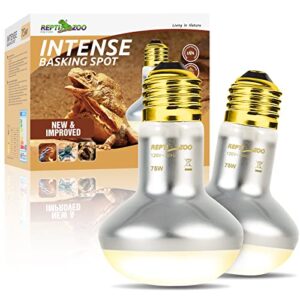
If the Simple Deluxe fixture takes care of the hardware, the REPTI ZOO bulb controls the heat. This 75-watt basking bulb uses a flat-bottom reflector design that focuses about 35% more heat into the beam than standard bulbs deliver.
An updated vacuum-aluminizing process stretches lifespan to 2,000-3,000 hours, and the standard E26 base fits fixtures you already own. It runs quiet, without buzzing or flickering, though it lacks UVB, so don’t rely on it for D3 synthesis.
| Best For | Reptile owners who need a reliable, high-heat basking bulb for bearded dragons, geckos, turtles, or brooder setups requiring consistent thermal output. |
|---|---|
| Base Type | E26 |
| Wattage | 75W |
| Reptile Suitability | Bearded dragons, geckos, turtles |
| Light Emission | UVA + visible |
| Enclosure Use | Terrarium/brooder |
| Safety Distance | Fixture rated 75W+ |
| Additional Features |
|
- Flat-bottom reflector design concentrates about 35% more heat and light into the beam than standard bulbs
- Extended lifespan of 2,000–3,000 hours thanks to an updated vacuum-aluminizing process
- Runs quietly with no buzzing or flickering, and fits standard E26 fixtures without adapters
- Does not emit UVB, so a separate UVB light is still needed for vitamin D3 synthesis
- Glass envelope is fragile and can shatter from water exposure or sudden temperature changes
- Not designed for continuous use beyond normal basking cycles, so overheating is a risk if left on too long
3. Etekcity Infrared Laser Temperature Gun
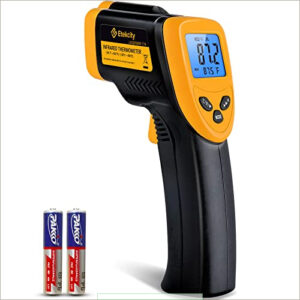
A bulb only helps if you can trust the numbers behind it, which is where this laser gun earns its spot. Point it at the basking surface and it reads in under 0.5 seconds, with adjustable emissivity from 0.1 to 1.0 for accurate readings on wood, stone, or substrate.
Keep it at the recommended 14-inch distance for its 12:1 spot ratio. The backlit display and max-temp function make nightly spot checks fast, even in a dark room.
| Best For | Reptile and pet owners who need reliable, non-contact surface readings to keep basking spots and terrariums at the right temperature. |
|---|---|
| Base Type | N/A |
| Wattage | N/A |
| Reptile Suitability | Reptiles, hairless cats |
| Light Emission | N/A |
| Enclosure Use | Multiple environments |
| Safety Distance | 12:1 distance ratio |
| Additional Features |
|
- Adjustable emissivity (0.1–1.0) allows accurate readings across different surfaces like wood, stone, or substrate
- Rapid sub-0.5-second response time makes quick nightly checks easy
- Backlit LCD display and max-temp function improve readability, even in low light
- Not suitable for measuring human body temperature
- Accuracy depends on maintaining the recommended 14-inch, 12:1 distance ratio
- Readings reflect an average surface area rather than a precise single point
4. Lucky Herp 150W Ceramic Heat Emitter
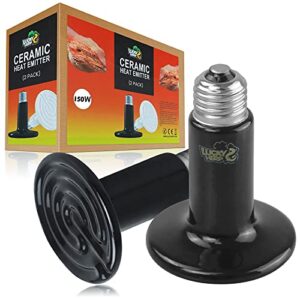
Once you’ve got your readings dialed in, you need a heater that actually delivers on them, and the Lucky Herp 150W does that reliably. Its thick ceramic shell hits full temperature in about four minutes and runs light-free, so your boa’s sleep cycle stays undisturbed.
Rated for 10,000 hours, it fits standard E26 fixtures at 120V. Just keep it 30cm from your boa and paired with a thermostat.
| Best For | Owners of nocturnal reptiles, amphibians, or small mammals who need steady overnight warmth without disturbing their pet’s natural sleep cycle. |
|---|---|
| Base Type | E26 |
| Wattage | 150W |
| Reptile Suitability | Reptiles, amphibians, mammals |
| Light Emission | None |
| Enclosure Use | Terrarium/outdoor |
| Safety Distance | >30cm from pets |
| Additional Features |
|
- Emits heat without visible light, keeping nocturnal pets’ circadian rhythms undisturbed
- Reaches full operating temperature in about 4 minutes thanks to its thick ceramic construction
- Built to last up to 10,000 hours, offering solid long-term durability
- Surface can get hot enough to burn, so it must be at least 30cm from pets and used with a heat-resistant fixture
- Needs a cool-down period before it can be turned back on, so it’s not ideal for setups needing instant reactivation
- Frequent on/off cycling shortens its lifespan, making it better suited to continuous use than intermittent heating
5. Repti Zoo Ceramic Heat Emitters
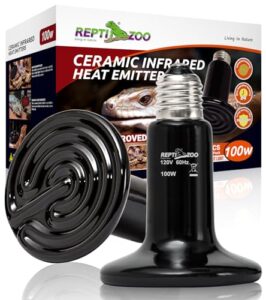
Consistency matters more than flash when you’re heating a boa’s enclosure overnight, and Repti Zoo’s ceramic emitters deliver just that. The sealed ceramic housing resists moisture damage, making it a smart pick for humid setups running 60-80%.
If floor space is tight, pairing this setup with ceiling-mounted heat lamps designed for apartment living keeps warmth steady without crowding the enclosure.
You’ll get true light-free infrared, so nocturnal cycles stay untouched. Screw it into any standard porcelain socket, pair it with a proportional thermostat, and keep it clear of substrate contact to avoid scorch marks during those long, quiet nights.
| Best For | Reptile and amphibian keepers who need reliable, round-the-clock heat for pets like bearded dragons, geckos, snakes, and turtles without disrupting their natural day-night cycle. |
|---|---|
| Base Type | E26 |
| Wattage | 100W |
| Reptile Suitability | Reptiles, amphibians |
| Light Emission | None |
| Enclosure Use | Terrarium |
| Safety Distance | Standard clearance |
| Additional Features |
|
- Emits infrared heat with no visible light, so it won’t interfere with nocturnal sleep patterns
- High-purity ceramic housing resists cracking and holds up well in high-humidity terrariums
- Long 10,000-hour lifespan backed by CE and RoHS safety certifications
- Only provides heat, not light, so a separate fixture is needed for illumination
- Requires a compatible E26 socket, and works best when paired with specific Repti Zoo fixtures
- No built-in thermostat, so it should be paired with one separately to prevent overheating
6. REPTI HOME 150W Ceramic Heat Emitter
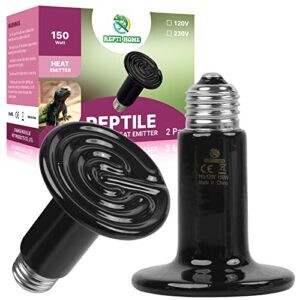
When larger enclosures need serious overnight warmth, the REPTI HOME 150W emitter earns its spot through sheer output. It fits standard porcelain sockets and throws enough infrared to raise basking surfaces even in big vivariums, though results shift with enclosure volume and distance.
No thermostat comes built in, so you’ll need one paired with a temperature probe near the basking zone. Mount it clear of substrate, add a reflector for concentrated heat, and you’ve got dependable, light-free warmth for digestion-focused nights.
| Best For | Keepers with larger reptile or amphibian enclosures, like leopard geckos, ball pythons, and other pets that need strong, round-the-clock, light-free heat overnight. |
|---|---|
| Base Type | E26 |
| Wattage | 150W |
| Reptile Suitability | Geckos, ball pythons |
| Light Emission | None |
| Enclosure Use | Terrarium/vivarium |
| Safety Distance | 30cm minimum |
| Additional Features |
|
- Solid ceramic construction rated for a 10,000-hour lifespan
- Delivers 100% heat efficiency with zero light output, so it won’t disrupt sleep cycles
- Well-suited for large vivariums and terrariums needing directional infrared warmth
- Requires a high-quality ceramic lamp holder and a separate thermostat with a temperature probe, since none is built in
- Must be kept at least 30cm from animals to avoid burns, limiting placement options
- Shouldn’t be switched on/off frequently or restarted right after shutting off
7. Ceramic Heat Emitter for Reptiles
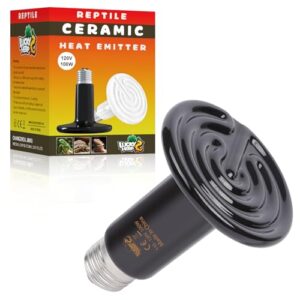
When you want a no-frills emitter that just works, this generic ceramic heat emitter delivers exactly that. It emits no visible light, so your boa’s day/night cycle stays undisturbed while warmth radiates steadily overnight.
Rated for roughly 10,000 hours, it reaches temperature within four minutes. Screw it into a proper ceramic socket, keep it 30cm from your snake, and pair it with a thermostat. If you notice a burning smell, that’s your cue to replace it immediately.
| Best For | Reptile, amphibian, and poultry keepers who need steady overnight or incubation warmth without disrupting natural light cycles. |
|---|---|
| Base Type | E26 |
| Wattage | 100W |
| Reptile Suitability | Reptiles, amphibians, poultry |
| Light Emission | None |
| Enclosure Use | Terrarium/brooder |
| Safety Distance | 30cm minimum |
| Additional Features |
|
- Emits heat with zero visible light, keeping day/night cycles intact
- Long-lasting operation, up to 10,000 hours
- Reaches full temperature quickly, within about 4 minutes
- Requires a high-quality ceramic lamp base for safe use
- Must be positioned at least 30cm from animals to avoid burns
- A burning smell may signal aging or malfunction, requiring replacement
8. Reptile Heat Lamp Fixture With Thermostat
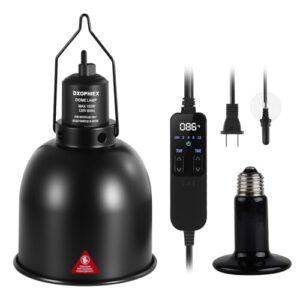
Why juggle a separate thermostat and lamp when one fixture can handle both jobs? This dimming thermostat unit modulates heat in real time, holding your setpoint steady even as room temps drift after dark.
With a sensing range around 68-122°F and support up to 150W, it suits most boa enclosures. The PID-style control curbs overshoot, so you won’t see wild swings. Built-in safety thresholds cap output before things get dangerous—one less thing to worry about overnight.
| Best For | Reptile and amphibian keepers—such as bearded dragon, leopard gecko, snake, tortoise, frog, and turtle owners—who need steady nighttime heat without disrupting their pets’ natural light cycle. |
|---|---|
| Base Type | E26 |
| Wattage | 100W max |
| Reptile Suitability | Bearded dragons, geckos, snakes |
| Light Emission | None |
| Enclosure Use | Terrarium |
| Safety Distance | Thermostat regulated |
| Additional Features |
|
- Built-in thermostat offers precise control across a wide 40°F to 131°F range
- Flexible 24-hour cycle timer with 2, 4, 8, and 12-hour scheduling for automated heating
- Comes with a 100W ceramic heat emitter that warms without emitting light
- May not hold steady temperatures in larger tanks (like 40-gallon setups) when room conditions are cool
- Some users notice readings running 2–3°F below the actual setpoint, requiring manual tweaks
- A few reports of the unit failing after roughly a month of use
9. DXOPHIEX 5.5 Inch Reptile Heat Lamp with Thermostat
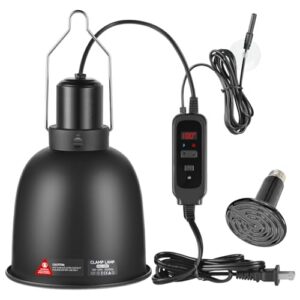
Small dome, big precision: this 5.5-inch fixture pairs a PID inverter thermostat with a polished aluminum reflector for tight temperature control in cramped setups.
It controls 20-45°C (68-113°F) and up to 100W, including the included ceramic emitter—no light, just heat. Two modes matter here: constant temp or a day/night cycle that drops output 4°F automatically after dark, echoing natural cooling.
Some users report flakiness above 77°F, so pair it with an independent gauge to verify readings before trusting it overnight.
| Best For | Reptile owners with bearded dragons, turtles, snakes, or lizards who need precise, space-saving heat control in smaller enclosures. |
|---|---|
| Base Type | E26 |
| Wattage | 100W included |
| Reptile Suitability | Bearded dragons, turtles, snakes |
| Light Emission | None |
| Enclosure Use | Terrarium |
| Safety Distance | Suction sensor placement |
| Additional Features |
|
- PID inverter thermostat allows precise temperature control from 20-45°C (68-113°F)
- Day/night mode automatically mimics natural temperature cycles for better reptile circadian health
- Durable 1mm polished aluminum alloy dome with ventilation holes supports E26 bulbs up to 100W
- Some users report inconsistent heating and error flashing above 77°F
- Thermostat readings may not always be accurate, so an external gauge is recommended
- Ceramic emitter provides heat only, so separate UV or visible lighting is needed if required
10. Repti Zoo 100W Night Heat Bulb Purple
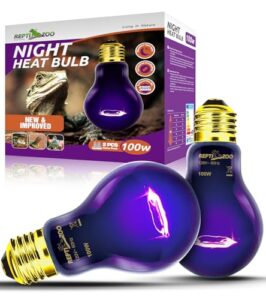
A purple bulb doesn’t sound like serious heating gear, but this 100W option delivers real infrared warmth without the glow that disrupts sleep cycles. No UVA, no bright light—just gentle nighttime heat for your boa’s cool zone.
The E26 base fits most standard fixtures. Rated for 2,000-3,000 hours, though some owners report earlier failures.
Cool to the touch it isn’t—give it 30 minutes minimum before handling post-shutoff, and always pair it with a thermostat.
| Best For | Reptile owners who need gentle, low-light nighttime heat for boas, bearded dragons, geckos, or turtles without disrupting their natural sleep cycles. |
|---|---|
| Base Type | E26/E27 |
| Wattage | 100W |
| Reptile Suitability | Bearded dragons, geckos, turtles, snakes |
| Light Emission | Minimal purple light |
| Enclosure Use | Terrarium/vivarium |
| Safety Distance | 30 min cool-down |
| Additional Features |
|
- Delivers real infrared warmth with no disruptive glow or UVA, ideal for cool zones after dark
- Standard E26/E27 base fits most existing terrarium fixtures without extra hardware
- Rated for a solid 2,000-3,000 hours of use, with a 2-bulb pack for backup or replacement
- Some owners report bulbs failing well before the rated lifespan, sometimes within weeks
- The purple coating can still emit a faint glow that may bother light-sensitive species
- Gets extremely hot during use and needs at least 30 minutes to cool before handling
Compare Nighttime Heat Source Types
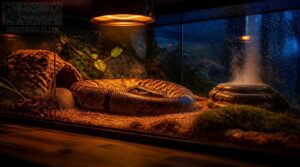
Not every heat source works the same way once the lights go off. Some warm the air, some warm the surface below, and a couple only earn a spot as backup. Here’s how the main nighttime options stack up against each other.
Ceramic Heat Emitters
When darkness falls, your boa still needs warmth, just without the glow. Ceramic heat emitters deliver infrared heat with no visible light, making them ideal for nighttime temperature control.
- No light disruption to sleep cycles
- Broad, consistent heat output
- No glass to shatter
- Long service life with minimal maintenance
- Pairs well with any thermostat
Always pair CHEs with a thermostat—unregulated heat invites disaster. Proper ventilation is essential to prevent overheating from poor ventilation.
Deep Heat Projectors
Ceramic emitters cover the basics, but Deep Heat Projectors go deeper—literally, using infrared A and B to warm tissue, not just air.
| Feature | Deep Heat Projector |
|---|---|
| Wattage | 50-80W |
| Wavelength | Infrared A/B |
| Best For | Thermal gradient design |
Pair with dimming thermostats for gradual, efficient heat delivery that mimics natural warmth without disrupting your boa’s sleep.
Radiant Heat Panels
If DHPs warm tissue, radiant heat panels warm the whole room evenly. Mount them at ceiling height for broad infrared radiation coverage without hotspots.
Surface emissivity efficiency keeps heat output calibration steady, supporting gradual nighttime temperature drop. They pair well with thermostats for balanced thermal comfort—ideal overhead heat source placement for larger enclosures needing consistent temperature monitoring.
Colored Night Bulbs
Panels handle broad warmth, but what about ambiance? Colored night bulbs add sleep-friendly illumination without disrupting your boa’s circadian rhythm.
- Choose amber or red, 2000-3000K
- Verify smart bulb compatibility
- Confirm blue light reduction
- Keep wattage under 10W
- Check UL safety certification
Placement matters: mount away from water, monitor gradient nightly, and never treat these as your primary heat lamp.
Heat Mats as Backup
A few boas do fine with overhead heat alone, but most keepers keep a heat mat as backup for cold nights.
Place it under the substrate, never against glass, and always run it through a thermostat with a probe.
Check cords weekly, use GFCI outlets, and log nightly temps to catch drift before it becomes a problem.
Set Safe Nighttime Temperature Gradients
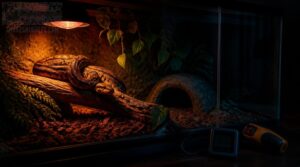
Once your heat source is picked, the real work is dialing in the numbers. Your boa’s safety depends on precise ranges, not guesswork, whether you’re housing an adult or a juvenile. Here’s how to set those targets zone by zone, night after night.
Adult Nighttime Temperature Targets
Your adult boa doesn’t need a warm bedroom at night, she needs a controlled dip.
Target 68-75°F, letting temps fall 5-10°F below daytime highs. Never drop below 68°F.
This nighttime cooling mirrors natural cycles without stressing her system. Use a thermostat to hold that floor steady while you sleep.
Juvenile Nighttime Temperature Targets
Young snakes run hotter engines. Keep the night ambient zone at 24-28°C, with basking surfaces cooling to 25-28°C.
Your juvenile’s cooling rate should slide gradually, 2-4°C below daytime highs, supporting metabolic rest without shocking her system.
Hold the cool zone between 18-22°C. Watch this thermal gradient balance closely, since rapid basking surface drops slow growth and raise morbidity risk.
Safe Overnight Temperature Drops
Think of nighttime cooling as a slow exhale, not a slammed door. Cap drops at 5-7°F (3-4°C), falling gradually, 2-3°F hourly.
Nighttime cooling should feel like a slow exhale, not a slammed door
- Avoid sudden dips below 60-65°F
- Log nightly minimums for patterns
- Place sensors at basking and cool zones
Fluctuations signal heater failures. Stable gradients protect digestion and prevent respiratory stress.
Hot and Cool Zone Balance
A good gradient works like two rooms in one house, warm den, cool porch. Keep the hot zone at 32-34°C and the cool zone between 24-28°C, spaced 20-40cm apart. This separation curbs heat creep. Insulating barriers hold nighttime warmth.
Your boa moves freely between zones, self-regulating digestion and rest through simple temperature control.
Seasonal Temperature Adjustments
Your boa’s enclosure shouldn’t run on autopilot year-round.
During Winter Gradient Expansion, widen the cool zone by 1-2°C for safer retreat space.
Spring Mild Adjustments and Fall Change Settings ease set points gradually, while Summer Gradient Compression prevents overheating.
Sync humidity with Seasonal Dew Point shifts, and keep temperature monitoring consistent as your temperature control systems adapt.
Install Night Heating Equipment Safely
Buying the right bulb is only half the job. Where you mount it, how you wire it, and what sits beneath it matter just as much for your boa’s safety. Here’s what to get right before you flip that heat source on for the night.
Choose a Proportional Thermostat
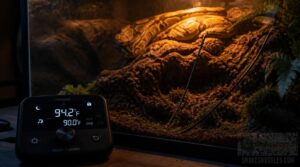
One device decides whether your boa thermoregulates safely or bakes overnight: the proportional thermostat.
Choose one with:
- Accuracy within ±0.5–1.0°C
- Dual-probe compatibility
- Modulated (not on/off) output
- High-limit safety cutoffs
These features regulate heat sources precisely, cut energy waste, and prevent overheating—non-negotiable for nighttime safety.
Position Overhead Heat Correctly
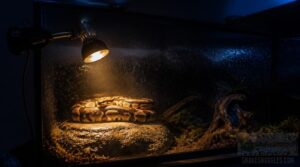
A great thermostat means nothing if the fixture above it is aimed wrong. Mount your heat source at a 6 to 12 inch height above the basking surface, with a clear line of sight and no obstructions blocking infrared transfer.
Secure it firmly at one end of the enclosure, targeting an 85–90°F basking surface temp, leaving the opposite side cooler.
Protect Cords and Outlets
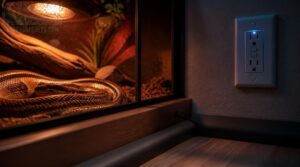
With your fixture aimed right, the cord running to it deserves the same attention. Use a cord protector along the floor, route cords away from the basking zone, and plug into a GFCI outlet with surge protection. Avoid daisy-chaining devices. Inspect weekly for cracks, warmth, or fraying before they become failures.
- Install cord covers along baseboards
- Route cords away from heat and traffic
- Plug into GFCI, surge-protected outlets
Keep Heaters Away From Water
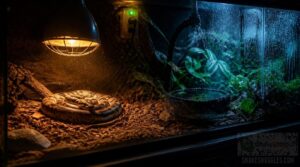
Cords protected, now think about moisture. Never place heaters near misting systems, water bowls, or humidifiers. Keep 3 feet of clearance from standing water, and skip bathroom-style humid setups entirely.
Choose a dry enclosure setup with good airflow. GFCI outlets matter most here, they’ll cut power fast if splashes reach a heat lamp guard or wiring.
Prevent Burns and Hotspots
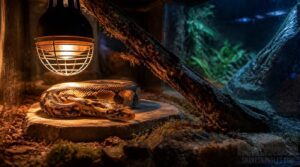
When wattage outpaces enclosure size, hotspots follow. Match heat source wattage to your tank, add a thermal barrier like flagstone, and mount lamps with a guard at manufacturer-recommended distances.
Check electrical connections for arcing risk, avoid porous substrates that trap heat unevenly, and monitor temperatures nightly.
Proper heat source placement keeps burns rare and thermoregulation safe.
Monitor Night Heat and Boa Health
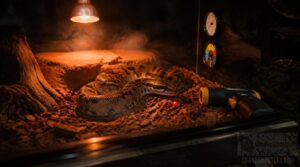
Installing your heat source correctly is only half the job. Once the equipment’s running, your boa’s safety depends on what you track night after night. Here’s what to watch for, measure, and log to keep those temperatures where they belong.
Check Both Temperature Zones
One thermometer tells half the story. You need Zone A monitoring and Zone B tracking running together, since a gradient only works if both ends check out.
- Zone A: 28-32°C
- Zone B: 24-28°C, never below 22°C
- Gradient Check: 4-8°C difference
- Sensor placement: away from direct heat
Log both nightly for real thermal gradient confidence.
Measure Basking Surface Temperatures
Where your boa’s belly meets the platform is where accuracy matters most. Aim your infrared thermometer at that exact spot, emissivity set to 0.95, calibrated beforehand against a known surface.
| Reading | Zone A Target | Zone B Target |
|---|---|---|
| Surface | 28-32°C | 24-28°C |
| Ambient | Slightly lower | 22°C floor |
Log surface versus ambient gradient nightly—that gap reveals whether your heat source is truly working.
Log Daily Minimums and Maximums
Numbers tell the truth your eyes might miss. Each night, record Tmin and Tmax from both zones between 9 pm and 6 am, noting date, sensor, and location.
Calibrate probes monthly. Compare readings against safe thresholds, flag outliers immediately, and keep twelve months of logs.
Trends reveal seasonal drift before it becomes a crisis—adjust gradually, never abruptly.
Watch Overheating and Chilling Signs
Your boa can’t tell you it’s overheating, but its body will. Watch for dry, warm skin near the basking spot, restlessness, or open-mouth breathing paired with high ambient heat.
Chilling shows differently: sluggish movement, huddling, shallow breathing, or a bluish tongue tip. Either extreme signals thermal stress—address heat source failures and fluctuations before they trigger dehydration or slowed digestion.
Know When to Call Veterinarian
Some signs cross the line from "watch closely" into "call now." Refusal to eat for three nights, a boa gone motionless in the cool zone past four hours, or hidden six hours running all warrant a vet call.
So do rapid color change to dull gray, loud hissing without cause, or breathing changes tied to temperature fluctuations and heat source failures.
Frequently Asked Questions (FAQs)
What temperature should a boa constrictor be at night?
Your boa isn’t auditioning for a snowman costume, so skip the arctic vibe. Keep the warm side around 80-85°F overnight, cool zone near 68-75°F, with a gentle nighttime drop maintaining safe thermal gradient throughout.
To keep tabs on those temperatures, mount one probe at snake level near the heat and use reliable snake thermometers for quarantine setups to confirm your gradient holds overnight.
Can I turn my snakes heat lamp off at night?
Yes, if it emits visible light. Switch to a thermostat-controlled ceramic heat emitter instead, since it skips light entirely, keeps sleep cycles intact, and maintains a safe overnight gradient without disturbing your boa’s natural rhythm.
Do rosy boas need heat at night?
A controlled drop works better than total darkness. Aim for a 65-75°F range so digestion continues and brumation stays avoidable. Use a thermostat-regulated heat lamp on one side, then check activity levels with an infrared thermometer nightly.
How hot is too hot for a boa constrictor?
When your boa’s basking spot turns from cozy to scorching, you’ve crossed a line. Anything past 90°F overnight or 95°F by day risks thermal injury—watch for lethargy, gaping, or refusal to eat as overheating symptoms.
Do boa constrictors need light at night?
No — their night vision copes darkness just fine, and constant light disrupts circadian rhythm. Keep a true dark period, use heat sources (not bulbs) for the nighttime temperature gradient, and let natural nocturnal behavior patterns guide their rest and digestion.
Can red or blue bulbs disturb sleep cycles?
Like flipping a light switch on your own circadian clock, color matters more than you’d think. Blue bulbs cause stronger melatonin suppression and delay sleep onset, while red wavelengths keep thermal regulation steady without disrupting rest.
How long do ceramic heat emitters typically last?
With quality materials and steady electrical safety, a ceramic heat emitter runs 5-10 years, or 10,000-20,000 hours. Usage patterns, temperature monitoring, and maintenance tips matter—watch for cracking, uneven heat retention, or dimming as failure signs.
Should heating run during brumation or fasting periods?
Cranking the heat during dormancy would be like shaking a sleeping bear awake. Keep temps low for metabolic suppression, offer only minimal warmth against dangerous chilling, and monitor daily—this protects dormancy warmth balance without disrupting fasting or triggering unwanted arousal.
Is background noise from heat equipment normal or concerning?
A steady low hum, usually 40-60 decibels, is normal noise level for most heat lamps. Watch for grinding, screeching, or banging vibrations—these signal electrical or mechanical faults needing immediate temperature control and safety inspection.
Conclusion
Night is a thief; it steals warmth without asking permission, and your boa can’t argue back. Choosing the right nighttime heat source for boa constrictor enclosures means standing guard while your eyes are closed.
Pair a ceramic emitter with a proportional thermostat, check both gradients nightly, and you’ve built a system that breathes steady warmth into darkness. That’s not just equipment, it’s quiet trust, held at a constant 78°F, night after night, year after year.