This site is supported by our readers. We may earn a commission, at no cost to you, if you purchase through links.

Ball pythons spend up to 90% of their time hidden. That’s not a quirk, it’s a biological necessity, and your hide setup either meets that need or undermines it.
How many hides a ball python needs depends on more than guesswork. A missing cool-side hide triggers defensive posturing. A missing humid hide turns a routine shed into a veterinary problem, with retained eye caps and constricted skin.
Two hides is the bare minimum. Three is the functional standard. Get the count, placement, and sizing right, and you’ll see a calmer, healthier snake.
Table Of Contents
- Key Takeaways
- How Many Hides Does a Ball Python Need?
- Where Should You Place Ball Python Hides?
- What Makes a Good Ball Python Hide?
- Top 5 Ball Python Hides and Humid-Hide Supplies
- Frequently Asked Questions (FAQs)
- How many hides do ball pythons need?
- How cold is too cold for a ball python?
- What is the best hide for ball pythons?
- Do snakes need two hides?
- How many hides should a ball python have?
- Does a ball python need a hide?
- Can you use DIY hides for ball pythons?
- How often should ball python hides be cleaned?
- What materials are safest for ball python hides?
- Should you rotate or move hides regularly?
- Conclusion
Key Takeaways
- Two hides is the bare minimum for a ball python, but three — warm, cool, and humid — is the functional standard that prevents feeding refusal, stuck sheds, and chronic stress.
- Hide placement matters as much as count: the warm hide belongs beside the heat source, the cool hide at the opposite end low and cornered, and the humid hide mid-enclosure near the water dish.
- A snug fit isn’t optional — if your snake can turn freely inside the hide, it’s too large, and you’ll need to scale up the size as your snake grows.
- For a humid hide, sphagnum moss packed two-thirds full and dampened with distilled water reliably locks in 80–90% humidity, cutting the risk of retained eye caps and skin constriction during shed cycles.
How Many Hides Does a Ball Python Need?
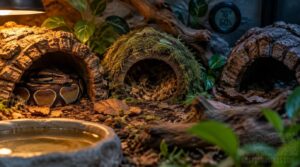
Most ball pythons need a minimum of two hides: one warm side hide and one cool side hide. Smart hide placement along the thermal gradient gives your snake full temperature control without forcing it to cross exposed ground.
Mimicking the underground burrows ball pythons rely on in the wild—as detailed in this guide to ball python natural habitat conditions—helps explain why snug, fully enclosed hides outperform open cave-style ones.
But two isn’t always enough. A third humid hide during shedding season makes a real difference, reducing stuck shed and stress a lot. Position it between both zones and line it with damp sphagnum moss.
A third humid hide during shedding season cuts stuck shed and stress significantly
Where Should You Place Ball Python Hides?
Once you’ve got your hide count settled, placement determines whether your snake actually uses them.
Warm side hide placement goes beside the heat source, not above it. Correct thermal gradient use lets your snake retreat to warmth without crossing open ground.
Place the cool side hide at the opposite end, low and substrate-supported. Keep it cornered and well away from enclosure doors to cut draft.
Humid hide positioning works best mid-enclosure, angled near a water dish. The proximity boosts moisture retention during shed cycles. Filling it with sphagnum moss for humid hides helps lock in that extra moisture right where your snake needs it most during a shed.
A strong hide placement strategy covers:
- Warm hide close to heat source, not directly over it
- Cool hide cornered and substrate-level, opposite end
- Humid hide mid-zone, angled near water
- All hides placed to minimize open-ground exposure
What Makes a Good Ball Python Hide?
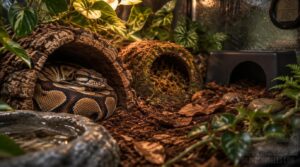
With placement sorted, quality is what separates a hide your snake uses from one it ignores.
A snug fit is non-negotiable. If your snake can turn freely inside, it’s too big. Entrances run roughly 1.5 to 2 inches. Track size with a hide sizing chart and apply growth stage scaling as it matures. Consulting a ball python hide size guide takes the guesswork out of upgrades as your snake moves through growth stages.
Position each hide along the thermal gradient. Keep humid hide placement mid-zone near water for shed cycles. Solid plastic blocks light well. Textured entry, smooth interior.
Top 5 Ball Python Hides and Humid-Hide Supplies
Not every hide on the market is worth putting in your enclosure. The five options below cover warm-side hides, cool-side hides, and humid-hide supplies that meet the sizing, material, and stability standards your ball python actually needs. Pick based on your snake’s current size and your enclosure setup.
1. Galapagos Sphagnum Moss Terrarium Substrate
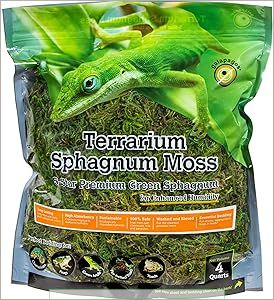
Sphagnum moss can hold four to six times its weight in moisture, which is exactly why it’s the go-to liner for any humid hide. A bad shed means a stressed snake, and stressed snakes will stop eating.
Galapagos’s 4-quart resealable bag gives you more than enough to pack your humid hide two-thirds full. Wring it damp, not dripping, and it’ll lock in 80 to 90% humidity right where your snake needs it during shed cycles. The moss is washed and cleaned to cut down on dust, sustainably sourced, and non-toxic, so you’re not introducing contaminants into the enclosure.
One heads-up: sort through it before use. The bag occasionally contains sticks and debris. Re-wet with distilled water when the surface dries, and swap the whole batch out every two to three weeks before mold becomes your problem.
| Best For | Reptile and amphibian owners who need a reliable, natural-looking substrate that holds humidity well, especially during shedding season. |
|---|---|
| Price | $10.49 |
| Material | Sphagnum moss |
| Animal Suitability | Snakes, geckos, frogs |
| Ease of Cleaning | Moderate; requires maintenance |
| Humidity Support | High; retains moisture |
| Size Limitation | May need multiple bags |
| Additional Features | Resealable 4qt bag, sustainably sourced moss, garden use compatible |
| Best For | Reptile and amphibian owners — especially snake keepers — who need a natural, humidity-retaining substrate to support healthy shed cycles. |
|---|---|
| Material | Sphagnum moss |
| Price | $10.49 |
| Animal Suitability | Snakes, geckos, frogs |
| Humidity Support | High; 80–90% |
| Ease of Cleaning | Moderate; requires maintenance |
| Size Limitation | May need multiple bags |
| Additional Features |
|
- Holds moisture well, helping maintain the 80–90% humidity snakes and amphibians need during shedding
- Comes in a convenient resealable 4-quart bag, giving you plenty of material for humid hides
- Washed, cleaned, sustainably sourced, and non-toxic — safe for sensitive animals and enclosed environments
- Some users report dye bleeding and color transfer when the moss gets wet
- May dry out faster than expected, requiring frequent re-wetting with distilled water
- Occasionally contains sticks and debris that need to be sorted out before use
2. Leoterra Reptile Hide Snake Lizard Gecko
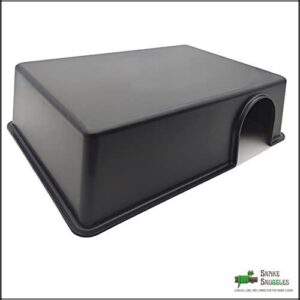
Most keepers at this price point expect some kind of compromise, but the Leoterra hide delivers where it counts. Its top-seal design traps humidity around your moss layer without extra effort, and the smooth, rounded edges eliminate injury risk entirely.
At 9.45 by 7.09 by 2.36 inches, it fits comfortably inside a 20-gallon tank and suits snakes in the under-150g range. The entrance measures 2.75 inches wide by 2.36 inches high, so check that against your snake’s girth before ordering. If yours is pushing past 200g, size up to a Large or XL.
The one real catch is weight. At just 5.11 ounces, a motivated snake will flip it easily. Anchor it with substrate or wedge a decor piece against it to hold it in place.
At this price, it’s a genuinely functional, clean pick for any keeper of small to medium reptiles.
| Best For | Keepers of small to medium reptiles — including corn, milk, and king snakes under 150g — who want a clean, functional hide with solid humidity retention at an accessible price point. |
|---|---|
| Material | Odor-free plastic |
| Price | N/A |
| Animal Suitability | Reptiles under 150g |
| Humidity Support | High; top-seal design |
| Ease of Cleaning | Easy; odor-free plastic |
| Size Limitation | Not for 200g+ snakes |
| Additional Features |
|
- Top-seal design traps humidity effectively around moss layers with no extra effort
- Smooth, rounded edges eliminate any risk of injury to your animal
- Easy to clean, odor-free plastic construction holds up well over time
- Lightweight at 5.11 ounces, so an active snake can flip it — requires anchoring with substrate or decor
- Entrance dimensions (2.75" x 2.36") need to be checked against your snake’s girth before ordering
- Not suitable for snakes over 200g; you’ll need to size up to a Large or XL
3. Natural Coconut Hideout for Reptiles
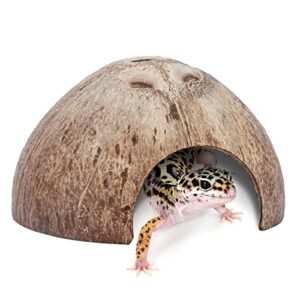
For hatchlings and small juveniles, the Niteangel Natural Coconut Hideout delivers both natural aesthetics and function without breaking the budget. Each pack includes two coconut-shell hides with a smooth interior and naturally textured exterior, no chemicals or lacquers applied. The dark, enclosed space mimics a burrow, and ball pythons respond to it immediately.
At roughly 5 inches across, it fits hatchlings and small juveniles well. Adults will outgrow it fast, so size up as your snake grows. Before first use, sand the entry edges lightly to remove any sharp spots that could abrade your snake. It works in wet or dry setups, making it a solid option for a humid hide too.
Coconut shell is biodegradable, so inspect it weekly and replace it the moment cracks appear. It won’t last forever, but few hides match the natural look and two-pack value at this price.
| Best For | Small reptiles, amphibians, and invertebrates, especially hatchlings and juveniles who need a snug, stress-reducing hide. |
|---|---|
| Price | Not listed |
| Material | Coconut shell |
| Animal Suitability | Geckos, lizards, amphibians |
| Ease of Cleaning | Moderate; boil before use |
| Humidity Support | Moderate; wet or dry use |
| Size Limitation | Not for larger species |
| Additional Features | 2-piece pack value, 100% natural material, aquarium safe option |
| Best For | Hatchlings and small juvenile reptiles, amphibians, and invertebrates that need a snug, natural-feeling hide to reduce stress. |
|---|---|
| Material | Coconut shell |
| Price | N/A |
| Animal Suitability | Geckos, lizards, amphibians |
| Humidity Support | Moderate; wet or dry |
| Ease of Cleaning | Moderate; boil before use |
| Size Limitation | Not for larger species |
| Additional Features |
|
- Comes as a two-pack, offering solid value for the price
- Made from 100% natural coconut shell with no chemicals or lacquers, safe for wet or dry setups
- The dark, enclosed space closely mimics a natural burrow, encouraging instinctive hiding behavior
- Too small for larger species like bearded dragons or adult ball pythons, so you’ll need to replace it as your animal grows
- Being a natural material, it can crack or degrade over time and requires regular inspection and eventual replacement
- Some units arrive already cracked or damaged, so check carefully before placing in your enclosure
4. Zoo Med Small Reptile Cave
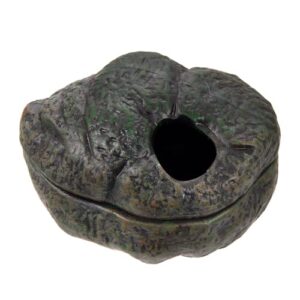
Picture a small snake pressed into a dark, damp pocket, humidity sealing against its scales as it works through a shed. That’s what the Zoo Med Reptile Shelter 3-in-1 does best, and at $17.48, it’s one of the sharper buys in this category.
The durable resin body holds up to weekly disinfection without cracking or warping, and the removable lid means swapping moss takes under two minutes. Interior dimensions run 5" x 4" x 3", snug enough for juveniles below the 500g mark. Fill it with damp sphagnum moss and it holds 80 to 90% humidity reliably, which keeps shedding clean and stress low.
Size is the one real drawback. Your ball python will outgrow it fast, so plan to upgrade before it hits 500g. For price and ease of cleaning, it’s a solid choice for small juveniles.
| Best For | Small reptile owners keeping hatchlings or juveniles like leopard geckos, corn snakes, or ball pythons who need a reliable humid hide for shedding and laying eggs. |
|---|---|
| Price | $17.48 |
| Material | Resin |
| Animal Suitability | Leopard geckos, ball pythons |
| Ease of Cleaning | Easy; washable, sterilizable |
| Humidity Support | High; fillable moist hide |
| Size Limitation | Small; outgrown quickly |
| Additional Features | Removable top lid, egg inspection access, burriable design |
| Best For | Small reptile keepers raising hatchlings or juveniles — leopard geckos, corn snakes, or young ball pythons — who need an affordable, reliable humid hide for shedding and egg laying. |
|---|---|
| Material | Resin |
| Price | $17.48 |
| Animal Suitability | Leopard geckos, ball pythons |
| Humidity Support | High; 80–90% |
| Ease of Cleaning | Easy; washable, sterilizable |
| Size Limitation | Not for 500g+ snakes |
| Additional Features |
|
- Durable resin construction holds up to repeated washing and sterilization without warping
- Removable lid makes refilling substrate or checking eggs quick and easy
- Maintains 80–90% humidity reliably when packed with damp sphagnum moss
- Small interior outgrows quickly — not suitable for ball pythons over 500g
- Lid fit can be loose on some units, potentially disrupting humidity retention
- Risk of cracking if placed on the hot side of the enclosure
5. Zilla Terrarium Rock Den
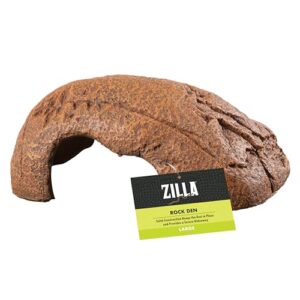
The Zilla Rock Den looks like it was carved from a canyon wall. That textured faux-rock finish earns its place in a desert or forest setup, and the heavy construction holds its position when your snake moves inside.
At 5"D x 9.5"W x 4"H, it fits juvenile ball pythons and similarly sized reptiles comfortably. The non-porous plastic cleans up fast with warm soapy water. One thing to check before you place it: some units arrive with sharp entry edges that need a quick sand before use.
It’s a dry hide, so run a separate humid hide alongside it for shedding.
| Best For | Juvenile ball pythons, leopard geckos, desert setups |
| Price | $18.56 |
| Material | Rigid plastic |
| Animal Suitability | Leopard geckos, juvenile ball pythons |
| Ease of Cleaning | Easy; warm soapy water |
| Humidity Support | Low; dry hide only |
| Size Limitation | Too small for adult snakes |
| Additional Features | Heavy build, desert aesthetic |
Best For: Reptile keepers housing juvenile ball pythons, leopard geckos, or similarly sized desert-dwelling species who want a natural-looking hide that’s easy to clean and stays put.
| Material | Non-porous plastic |
|---|---|
| Price | N/A |
| Animal Suitability | Terrestrial and aquatic reptiles |
| Humidity Support | N/A |
| Ease of Cleaning | Easy; warm soapy water |
| Size Limitation | Too small for large snakes |
| Additional Features |
|
- Realistic faux-rock texture blends naturally into desert and forest terrarium setups
- Heavy, stable construction stays in place even when active reptiles move around inside
- Non-porous plastic surface wipes clean quickly with warm soapy water
- Some units arrive damaged with chips, cracks, or sharp entry edges that need sanding before use
- Functions only as a dry hide, so a separate humid hide is required for proper shedding
- Too small for adult snakes or larger reptiles, limiting its long-term usefulness as pets grow
Frequently Asked Questions (FAQs)
How many hides do ball pythons need?
Your ball python needs two hides: a warm hide sitting directly over the heat source and a cool hide positioned on the opposite side. That combination actively reduces stress and keeps your sheds on track.
How cold is too cold for a ball python?
Brief dips do happen, but sustained temps below 76°F aren’t safe long-term. Keep your cool-side minimum reliably at 78°F; anything consistently lower disrupts thermoregulation, slows digestion, and eventually shuts down your python’s feeding response entirely.
What is the best hide for ball pythons?
A coiled snake completely sealed in solid darkness is a truly stress-free one. The best hide gives a snug fit, a smooth interior, and humidity compatibility so it easily doubles as a proper humid hide.
Do snakes need two hides?
Most snakes don’t strictly need two hides, but ball pythons benefit greatly from both a warm hide and a cool hide. Correct hide placement actively helps thermoregulation and reduces overall stress during shedding or digestion.
How many hides should a ball python have?
Your python needs at least two hides: one on the warm side and one on the cool side. This minimum gives your snake reliable access to temperature gradients and keeps chronic stress from building up.
Does a ball python need a hide?
Want a stressed, constantly glass-surfing ball python? Skip the hide. It’s simply not optional. Without one, feeding motivation drops and settling stops. A snug hide gives your ball python the security it needs to thrive.
For bioactive vivariums, a naturalistic option like these ball python hides for bioactive setups blends right in while still giving your snake that snug, secure fit it craves.
Can you use DIY hides for ball pythons?
Yes, DIY hides absolutely work well. Build them from food-safe materials like PVC or sealed resin, sand every edge completely smooth, and always size each one for a snug fit around your snake’s full girth.
How often should ball python hides be cleaned?
Don’t wait to spot clean hides when you see waste or debris. Deep clean every one to two weeks with reptile disinfectant, and increase your hide cleaning frequency for humid hides during active shedding cycles.
What materials are safest for ball python hides?
Bacterial infections rank among the top causes of captive reptile illness.
Plastic and resin are your safest material choices. These nonporous materials resist bacteria and mold, smooth edges prevent injury, and they’re easy to clean.
Should you rotate or move hides regularly?
Don’t fully relocate hides monthly. Instead, shift them just a few inches. Small positional changes introduce subtle microclimate variation along the thermal gradient without disorienting your snake or disrupting established territory and normal hiding patterns.
Conclusion
A keeper once skipped the cool-side hide just to save space. Within a week, their ball python refused food and spent every daylight hour pressed into a corner.
How many hides does a ball python need? Three, and placement matters as much as count. One for heat, one for cool, one for humidity. Get those three things right, and you’ll have a snake that feeds reliably, sheds cleanly, and uses every part of its enclosure.