This site is supported by our readers. We may earn a commission, at no cost to you, if you purchase through links.

Cedar shavings smell clean and look neat in the bag. But inside a neonate enclosure, those aromatic oils irritate the airway within hours, and in snakes under 30 grams, that irritation can cause irreversible airway damage.
The right substrate materials for juvenile snakes aren’t a comfort preference. They regulate humidity, determine impaction risk, and shape every feeding outcome. A wrong pick at six inches of snake can mean a blocked gut the animal cannot pass.
The ten substrates reviewed here span tropical, desert, and burrowing setups, each matched to the physiology that makes juvenile snake care genuinely unforgiving.
Table Of Contents
- Key Takeaways
- Why Substrate Matters for Baby Snakes
- Dangerous Substrates You Must Avoid
- Choosing Substrate by Species and Habitat
- How to Prevent Impaction in Juveniles
- Top 10 Juvenile Snake Substrates Reviewed
- 1. Zilla Jungle Mix Terrarium Substrate
- 2. Riare Natural Coconut Fiber Substrate
- 3. Flukers Premium Cypress Reptile Bedding
- 4. ZeeDix 2 Pack Coconut Fiber Substrate
- 5. Riare 2 Pack Coconut Husk Chip
- 6. Exo Terra Coco Husk Terrarium Brick
- 7. BNOSDM Reptile Soil Substrate 5L Bag
- 8. ZeeDix 10lb Compressed Coco Chip Substrate
- 9. Halatool 2-Pack Reptile Coconut Substrate
- 10. Halatool 6 Pack Coconut Fiber Substrate
- Keeping Juvenile Snake Substrate Fresh
- Frequently Asked Questions (FAQs)
- What is the best substrate for a snake?
- What not to use for snake bedding?
- What material can snakes not bite through?
- What substrate for children’s python?
- How does substrate affect juvenile snake shedding?
- Can different substrates be safely mixed together?
- How should unused substrate be stored properly?
- What substrate suits a quarantined juvenile snake?
- How do I transition my snake to new substrate?
- Conclusion
Key Takeaways
- Cedar and pine shavings release aromatic oils that can cause irreversible airway damage in neonate snakes under 30 grams within hours, while crushed walnut shells and fine silica sand carry serious impaction and toxicity risks.
- Substrate choice is the single most consequential decision in juvenile snake care because it controls humidity, shedding success, thermoregulation, and impaction risk, so match the material to your species’ native habitat.
- Prevent impaction by keeping substrate 2–3 cm deep for tropical juveniles, removing wet or matted bedding within 24 hours, feeding in a separate container, and choosing friable materials with 0.5–3 mm particles for burrowers.
- Maintain a strict cleaning schedule—daily spot cleaning, weekly top-layer replacement of 1–2 cm, and full changes every 2–4 weeks—since ammonia from soiled substrate can reach dangerous levels within 72 hours.
Why Substrate Matters for Baby Snakes
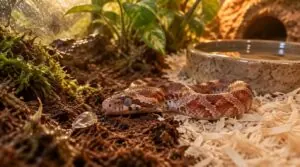
Because your substrate choice shapes every environmental variable in the enclosure, it’s the single most consequential decision in neonate snake care. It governs humidity regulation, directly affecting whether your juvenile sheds cleanly or retains patches that tighten around the eyes and tail tip.
Choosing wisely from the start pays dividends for years, and this guide to substrate options ranked by ease of cleaning can help you weigh humidity retention against weekly maintenance demands.
Substrate also controls thermoregulation. A material that holds excess moisture against a heat source creates thermal instability, stressing a snake whose digestive enzymes depend on precise belly heat.
Substrate ingestion during feeding poses serious impaction risk in juveniles. Their small gut diameter tolerates almost no particulate load. Choose a material with reptile substrate compatibility matched to your species, and you reduce that risk immediately.
Dangerous Substrates You Must Avoid
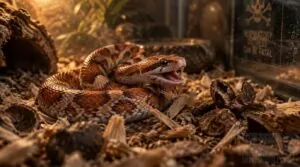
Several materials marketed for reptile enclosures pose immediate risks to juveniles. Cedar and pine shavings release toxic oils that trigger respiratory irritation within hours, sometimes causing irreversible airway damage in neonates under 30 grams.
Watch for these warning signs your substrate is actively harming your snake:
- Wheezing or open-mouth breathing shortly after enclosure setup
- Labial swelling or mucus discharge after contact with sharp or chemically treated particles
- Bloating and refusal to feed, signaling early impaction risk from particulate ingestion
Crushed walnut shells and fine silica sand introduce substrate toxicity your juvenile’s gut and respiratory tract simply can’t handle. Reptile enclosure safety starts with what you keep out.
Choosing Substrate by Species and Habitat
No single substrate suits every juvenile snake. Species origin and native habitat determine the humidity range, texture, and depth your setup must deliver. The sections below break that down across three distinct categories.
Tropical and High-Humidity Species
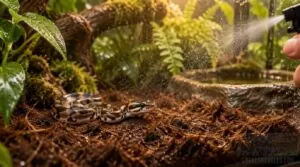
Think of your enclosure floor as a sponge; it’s there to hold moisture, not pool it. For tropical neonate snakes, coconut fiber is your best anchor for humidity regulation, keeping relative humidity between 60 and 80% without compaction.
Mist 2 to 4 times daily. Keep substrate depth at 2 to 3 cm to limit impaction risk and preserve humidity retention.
Desert and Dry-Environment Species
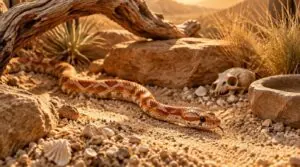
Desert snakes don’t need what tropical species crave. Switch from moisture-holding particles to fast-draining, dry substrate that releases surface water immediately.
Your safest picks for arid snake care:
- Dust-free sand-loam mix
- Crushed shell-limestone mix
- Inert calcium-based sand
- Commercial desert granules
- Dry coco-fiber mix
Impaction risk rises with fine dust particles during shedding. Aim for low humidity control and spot-clean weekly.
Burrowing Juveniles and Depth Needs
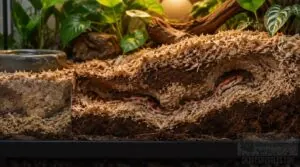
When burrowing juveniles fail to dig properly, substrate depth in your juvenile snake housing isn’t meeting their actual needs. Aim for 2-3 times the snake’s girth minimum, with 30-60 cm for tropical species.
Particle size matters equally: 0.5-3 mm grains let juveniles excavate without ingesting dangerous mouthfuls. Aspen shavings suit dry-environment burrowers but collapse without a firmer substrate layer beneath.
How to Prevent Impaction in Juveniles
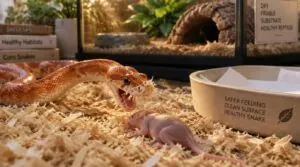
During feeding, a juvenile snake’s mouth contacts the substrate directly, and loose, clumping bedding sticks to moisture near the rostral area before being swallowed with prey. That’s how prey impaction starts, not from one event, but from repeated small ingestions.
Prey impaction rarely strikes once; it builds through repeated small ingestions swallowed alongside every meal
Your juvenile snake housing must stay clean between feedings. Soiled or wet bedding binds into clumps the gut can’t easily pass, especially in animals under 12 inches.
For snake impaction prevention, follow these practices:
- Remove wet or matted substrate within 24 hours
- Feed in a separate container to limit substrate safety risks during strikes
- Choose the best substrate for snakes that stays friable, never powdering or pelletizing
Top 10 Juvenile Snake Substrates Reviewed
Each substrate below was evaluated against the safety and humidity benchmarks this article has outlined.
The ten options span coconut fiber, cypress, and mixed media, covering the range of juvenile needs from arid hatchling setups to high-humidity tropical enclosures. Cypress stands out for its natural moisture retention, making options like this cypress substrate for juvenile snakes especially well-suited to tropical and semi-humid setups.
Pick the one that matches your species, your maintenance schedule, and the depth requirements your snake demands.
1. Zilla Jungle Mix Terrarium Substrate
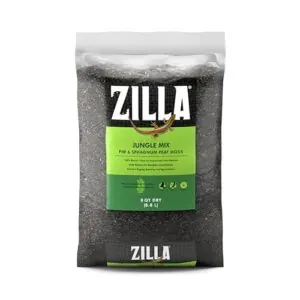
Zilla Jungle Mix blends aged Douglas fir bark with sphagnum peat moss to produce a soft, earthy substrate that holds humidity without compacting into an airless, indurated layer.
The 8-quart bag covers a modest juvenile enclosure easily. Set it at 1 to 2 inches deep and don’t go any deeper.
It suits tropical species well, but it’s the wrong call for any dry-environment juvenile. Plan on daily waste removal and a full monthly replacement to keep mold from taking hold.
| Best For | Tropical reptile and amphibian keepers housing frogs, toads, rainforest geckos, or snakes in humid, bioactive enclosures. |
|---|---|
| Organic Material | Yes |
| Moisture Absorption | High |
| Snake Safe | Yes |
| Burrowing Support | Yes |
| Odor Control | Daily cleaning needed |
| Garden Reuse | N/A |
| Additional Features |
|
- Blends aged Douglas fir bark with sphagnum peat moss for a soft, natural texture that holds humidity without compacting
- Supports natural behaviors like digging, nesting, and egg incubation, making it a solid fit for bioactive setups with live plants
- The 8-quart bag is easy to work with and provides good coverage for juvenile enclosures at a 1–2 inch depth
- Dry material can splinter during handling, so care is needed when setting up or refreshing the substrate
- High moisture retention can push humidity too high for dry-environment species, making it a poor choice outside tropical setups
- Requires daily spot cleaning and a full monthly replacement to prevent mold buildup
2. Riare Natural Coconut Fiber Substrate
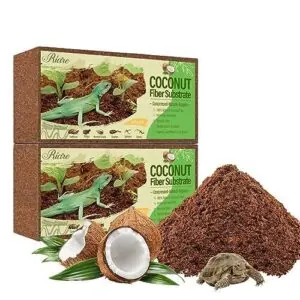
Humidity sits at the center of most juvenile snake health failures. Riare’s bricks, two per pack with each measuring 7.8 x 3.9 x 1.97 inches, expand into loose, odorless fiber after soaking. It absorbs waste without pooling and holds moisture steadily, making it a practical fit for tropical juvenile species.
Monitor fiber fragmentation when damp; finer particles can irritate a hatchling’s eyes or skin. Let the surface dry between mistings and refresh the substrate regularly to prevent mold from forming.
| Best For | Tropical juvenile snake keepers who need a substrate that holds humidity consistently without pooling or releasing strong odors. |
|---|---|
| Organic Material | Yes |
| Moisture Absorption | High |
| Snake Safe | Yes |
| Burrowing Support | Yes |
| Odor Control | Absorbs waste |
| Garden Reuse | Compostable |
| Additional Features |
|
- Expands from compact bricks into a loose, fluffy substrate that holds moisture steadily — ideal for tropical species that need consistent humidity
- Odorless and absorbs waste without creating wet spots, keeping the enclosure fresher between cleanings
- Biodegradable and compostable, so used substrate can go straight into the garden as a soil amendment
- Bricks need several minutes of soaking before they’re ready to use, adding a prep step before each setup
- Drying time after soaking can be unpredictable, and some keepers find it difficult to get the moisture level just right
- Separating the expanded fibers by hand is labor-intensive, and fine particles can irritate a hatchling’s sensitive eyes or skin
3. Flukers Premium Cypress Reptile Bedding
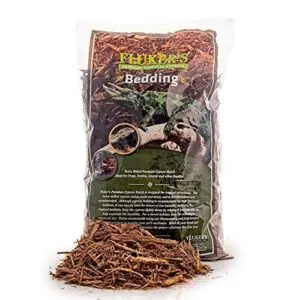
Cypress works when your setup demands real humidity control. Flukers’ twice-milled cypress mulch produces a uniform particle size that absorbs moisture without logging it, keeping tropical juveniles comfortable without creating the swampy conditions that invite mold. Rinse it before use; pre-packaged dust levels drop noticeably with a quick flush.
At ten pounds per bag, it’s enough substrate to cover multiple enclosures. Breeders actively recommend it, though some customers report the actual weight runs light. Always verify your depth before stocking.
| Best For | Reptile and amphibian keepers who need reliable humidity control for tropical setups housing frogs, snakes, lizards, or tortoises. |
|---|---|
| Organic Material | Yes |
| Moisture Absorption | Moderate |
| Snake Safe | Yes |
| Burrowing Support | Yes |
| Odor Control | N/A |
| Garden Reuse | N/A |
| Additional Features |
|
- Twice-milled for uniform particle size, absorbing moisture evenly without becoming waterlogged
- Versatile enough for both tropical and desert habitats
- Trusted and recommended by experienced breeders
- Actual package weight reportedly comes in lighter than the advertised ten pounds
- Moisture retention performance is inconsistent according to some users
- Package size feels smaller compared to competing brands
4. ZeeDix 2 Pack Coconut Fiber Substrate
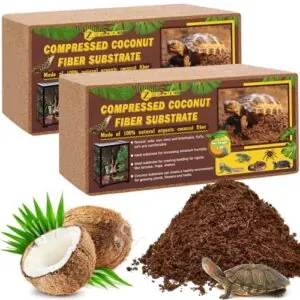
Two compressed bricks, each weighing 1.4 pounds, expand into a fibrous, moisture-retentive bed your tropical juveniles can actually use. The hydrated fibers split into 2-5 mm strands, creating a soft, low-dust surface that absorbs waste and holds up to 30% of its weight in moisture.
That retention is exactly what high-humidity species need, but it’s also the trade-off: drying time is slow. Avoid it for desert-adapted juveniles.
The balanced pH and high-temperature purification make it chemically safe for sensitive hatchlings.
| Best For | Tropical and high-humidity juvenile reptiles, amphibians, and invertebrates that need a moisture-retentive, naturalistic substrate for burrowing and digging. |
|---|---|
| Organic Material | Yes |
| Moisture Absorption | High |
| Snake Safe | Yes |
| Burrowing Support | Yes |
| Odor Control | Breaks down waste |
| Garden Reuse | Plant growing |
| Additional Features |
|
- Expands from compact bricks into a soft, low-dust fiber bed that supports natural digging and burrowing behaviors
- Chemically safe for sensitive hatchlings thanks to high-temperature purification and balanced pH
- Effectively absorbs waste and moisture, helping control odors over time
- Holds moisture for extended periods, making it a poor choice for desert-adapted species
- Not safe for bearded dragons or crested geckos due to impaction risk
- Requires multiple washes before use when housing worms, adding prep time
5. Riare 2 Pack Coconut Husk Chip
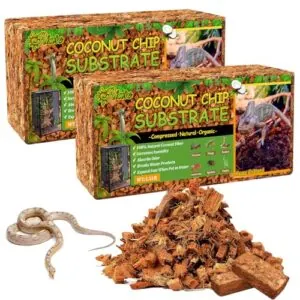
Where ZeeDix gives you fine fibers, Riare steps up to medium husk chips, and that textural shift changes how juveniles burrow and explore. The two-brick pack weighs 2.13 pounds total; each compressed brick measures 8.2 x 4.1 x 2.2 inches. Add roughly 30 liters of water for full expansion.
Chunk size ranges from fine ground material to half-inch pieces, so consistency across the enclosure isn’t guaranteed. Customer reports flag mold growth within days; make sure to have strong airflow before placing a juvenile.
| Best For | Keepers of tropical reptiles and amphibians who want a natural, moisture-retaining substrate with some burrowing texture. |
|---|---|
| Organic Material | Yes |
| Moisture Absorption | High |
| Snake Safe | Yes |
| Burrowing Support | Yes |
| Odor Control | Absorbs odors |
| Garden Reuse | Soil amendment |
| Additional Features |
|
- Expands significantly from a compact brick, giving you a good volume of substrate from a small package
- Porous texture holds humidity well while draining excess water, which suits tropical species
- Naturally neutralizes odors, keeping the enclosure fresher between cleanings
- Mold can develop within days, so strong airflow is essential before introducing a juvenile
- Chunk size is inconsistent, ranging from fine powder to half-inch pieces, making even coverage difficult
- Mixed reports on scale rot prevention mean it may not be reliable for moisture-sensitive species
6. Exo Terra Coco Husk Terrarium Brick
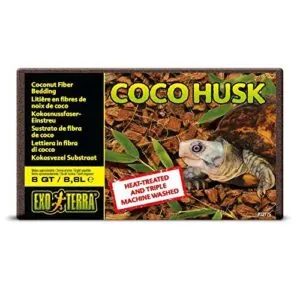
Exo Terra’s coco husk brick compresses 100% natural coconut husk into a single 1.1-pound block that expands to 8 QT once fully hydrated.
Soak it overnight and let it dry partially before placing your juvenile; skipping that step leaves firm chunks that block burrowing. The expanded substrate suits ball pythons well but runs too coarse for very small species.
Mold reports exist here too, so strong airflow isn’t optional. At 8.8 liters finished, one brick covers most juvenile enclosures adequately.
| Best For | Ball pythons, Russian tortoises, hamsters, and tropical plant growers who need a natural, moisture-retaining substrate for medium to large enclosures. |
|---|---|
| Organic Material | Yes |
| Moisture Absorption | High |
| Snake Safe | Yes |
| Burrowing Support | Yes |
| Odor Control | Easy cleaning |
| Garden Reuse | Growing medium |
| Additional Features |
|
- Made from 100% natural compressed coconut husk, making it a safe, chemical-free option for reptiles, amphibians, and burrowing animals
- Expands to 8 QT from a single compact brick, giving you plenty of substrate for most juvenile enclosures
- Retains moisture effectively while still allowing for straightforward enclosure cleaning
- Requires overnight soaking and partial drying before use, so it’s not ready right out of the package
- Chunk size runs too coarse for smaller reptile species, limiting its versatility
- Some customers have reported mold issues, meaning good airflow in the enclosure is essential
7. BNOSDM Reptile Soil Substrate 5L Bag
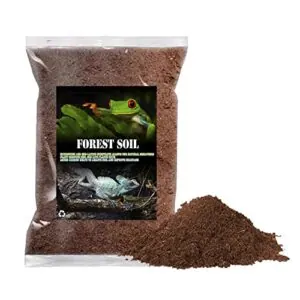
Where coconut husk bricks rely on bulk hydration, BNOSDM works differently. Its soil-based loam texture holds structure without soaking, and the 2-5 mm particle size suits humid-environment juveniles that need a firm medium for burrowing.
At just 5 liters, one bag won’t cover a large enclosure, so plan for multiple bags upfront. Rinse the contents before use; dustiness is a real concern.
One reported bacterial infection in toads after three weeks underscores why you should replace substrate every 4-6 weeks.
| Best For | Hobbyists keeping humid-environment reptiles, amphibians, or invertebrates — especially juveniles that need a firm, burrowable substrate. |
|---|---|
| Organic Material | Yes |
| Moisture Absorption | High |
| Snake Safe | Yes |
| Burrowing Support | Yes |
| Odor Control | Decomposes waste |
| Garden Reuse | Fertilizer |
| Additional Features |
|
- Soil-based loam texture holds structure and moisture without becoming waterlogged, making it well-suited for burrowing species
- Breaks down liquid waste and excrement naturally, helping keep enclosures cleaner between changes
- Spent substrate can go straight into the garden as fertilizer, reducing waste
- At 5 liters per bag, a single bag won’t cover larger enclosures — budget for multiple bags from the start
- Dustiness is inconsistent between batches and can be a real issue; rinsing before use is strongly recommended
- One reported bacterial infection in toads after three weeks of use highlights the importance of replacing substrate every 4–6 weeks
8. ZeeDix 10lb Compressed Coco Chip Substrate
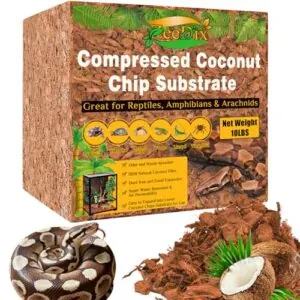
Where BNOSDM limits you to 5 liters, the ZeeDix 10lb brick delivers real volume. One compressed block expands into loose chips measuring 10–35mm, giving juveniles genuine air gaps for burrowing without the compaction risk of finer mediums. Hydrate to a pliable, not muddy texture; excess moisture invites fungal growth.
The substrate remains stable for 2–4 weeks under typical terrarium temperatures. Some users report stringy fibers and dust despite dust-free labeling, so inspect each batch before placing it in the enclosure.
| Best For | Reptile, amphibian, and invertebrate keepers who need a high-volume, breathable substrate with larger chip sizes for burrowing species like snakes and tarantulas. |
|---|---|
| Organic Material | Yes |
| Moisture Absorption | High |
| Snake Safe | Yes |
| Burrowing Support | Yes |
| Odor Control | Breaks down odors |
| Garden Reuse | Compostable |
| Additional Features |
|
- Expands into generous 10–35mm loose chips that create natural air pockets and support burrowing behavior
- Biodegradable and compostable, making it an eco-friendly bedding choice for indoor enclosures
- Helps maintain balanced humidity while absorbing waste and neutralizing odors
- Requires a large container and soaking time before it’s ready to use
- Some batches contain stringy fibers and dust despite the dust-free claim, so inspection before use is recommended
- Moisture retention results are inconsistent according to customer reviews, which may complicate humidity management
9. Halatool 2-Pack Reptile Coconut Substrate
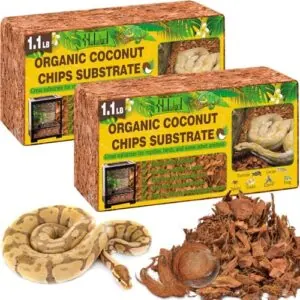
Drop each compressed 1.1 LB brick in water and it expands into coarse 0.4-to-1.5-inch chips that hold moisture without turning soggy. The neutral pH and soft chip texture protect juvenile skin during shedding.
Breathability is a real strength here. The coarse chip structure resists compaction while maintaining consistent airflow through the substrate bed. Pre-wet before placing your snake to cut down on dust. Don’t over-mist; saturation invites mold fast. Skip it if your species needs fine, loose digging material altogether.
| Best For | Reptile keepers housing snakes, lizards, tortoises, frogs, or tarantulas who need a moisture-retaining substrate that supports shedding and odor control. |
|---|---|
| Organic Material | Yes |
| Moisture Absorption | High |
| Snake Safe | Yes |
| Burrowing Support | Yes |
| Odor Control | Neutralizes odors |
| Garden Reuse | N/A |
| Additional Features |
|
- Expands from compact bricks into coarse 0.4–1.5 inch chips that hold moisture without becoming waterlogged
- Neutral pH and soft texture are gentle on reptile skin, especially during shedding
- Coarse chip structure resists compaction and maintains consistent airflow through the substrate bed
- Releases dust when dry bricks are broken apart, requiring pre-wetting before use
- Prone to mold growth if over-misted or kept too saturated
- Not suitable for species that need fine, loose substrate for digging
10. Halatool 6 Pack Coconut Fiber Substrate
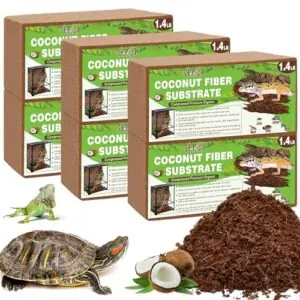
A six-brick bulk pack gives you long-term substrate coverage without constant restocking. Each compressed brick measures 7.87 by 3.94 by 1.97 inches and absorbs up to 10 times its weight in water once fully soaked. Don’t skip that step since expansion is substantial and uneven dry fiber can stress juveniles.
Humidity retention remains stable, making this well suited for tropical setups. Larger fiber pieces can pose an impaction risk for very small juveniles, so break them down carefully before use.
| Best For | Reptile, amphibian, tarantula, and hermit crab keepers who need a reliable, long-lasting tropical substrate that also works as a growing medium for plants. |
|---|---|
| Organic Material | Yes |
| Moisture Absorption | Very High |
| Snake Safe | Yes |
| Burrowing Support | Yes |
| Odor Control | N/A |
| Garden Reuse | Growing medium |
| Additional Features |
|
- Absorbs up to 10 times its weight in water, maintaining stable humidity in tropical enclosures
- Six-brick bulk pack reduces how often you need to restock
- Organic and free of dirt or foreign substances
- Must be soaked before use, which adds a step before setup
- Fiber pieces may be too large for small juveniles and could pose an impaction risk without breaking them down first
- Customer opinions on ease of cleaning are mixed
Keeping Juvenile Snake Substrate Fresh
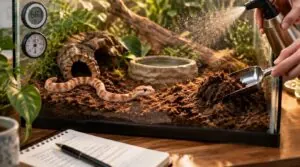
Ammonia spikes inside a juvenile enclosure can exceed safe thresholds within 72 hours of soiled substrate going unaddressed. For neonate snakes, that’s a fast path to respiratory stress.
Spot cleaning daily removes feces and shed detritus before bacteria establish. Replace the top 1-2 cm weekly; full substrate sanitization every two to four weeks keeps ammonia near zero and cuts mold growth substantially.
Humidity retention becomes a liability if you’re not monitoring. Aim for species-correct ranges and let surfaces dry between light mistings. Document each substrate change, noting date, humidity, temperature, and any mold-like odors. That log tells you when your protocol is slipping before your snake does. A digital reptile hygrometer placed inside the enclosure makes it easy to catch humidity creeping out of range before it fuels the mold growth your log is meant to prevent.
Frequently Asked Questions (FAQs)
What is the best substrate for a snake?
Take a corn snake hatchling: it needs coconut fiber substrate that retains humidity without fine particles it can ingest. For most juvenile snakes, inert coconut fiber is the safest, best substrate for snakes you’ll find.
What not to use for snake bedding?
Cedar and pine shavings release aromatic oils that burn mucous membranes. Loose beach sand and silica-heavy soils drive ingestion risks and impaction. Lime-based substrates alter gut pH. None of these belong in a juvenile enclosure.
What material can snakes not bite through?
Snakes can’t bite through compressed coconut husk bricks at 2-3 cm depth. Density and fibrous compression are what make this safe substrate for pet snakes resistant to juvenile puncture. Nothing loose or granular comes close.
What substrate for children’s python?
What does your children’s python need from its floor? Coconut fiber is the safe substrate for pet snakes, and it’s excellent for humidity retention. Aspen shavings work well as reptile substrate for baby snakes too.
If you’re weighing other bedding options, our guide to the best substrate for boa constrictors breaks down what works and what to skip.
How does substrate affect juvenile snake shedding?
Like a chrysalis, your snake’s shed lives or dies by its substrate. Humidity retention loosens and releases skin completely within 24 to 72 hours; dry, fine-grain particles trap and tear it, leaving retained ocular scales.
Can different substrates be safely mixed together?
Yes, but only when particle size and substrate moisture level align closely. Mismatched mixes create humidity pockets and raise serious ingestion risks. Coconut fiber pairs well with bark; never combine fine sand with organic substrates.
How should unused substrate be stored properly?
Store unused substrate in an airtight, labeled container in a cool, dry room, 50–70°F. Confirm it’s fully dry before sealing, inspect for pests, keep it away from food and feed, and rotate oldest stock first.
What substrate suits a quarantined juvenile snake?
Nothing beats paper towels in a reptile quarantine. You’ll monitor feces instantly, eliminate substrate toxicity risk, and sanitize in seconds. Once clearance comes, switch to cypress mulch or coco fiber.
How do I transition my snake to new substrate?
Switch gradually: replace 25–50% of substrate every 3–5 days. Monitor weight and stool quality for two weeks. Maintain stable temperature and humidity throughout, since sudden changes trigger stress, regurgitation, or respiratory problems in juveniles.
Conclusion
A keeper once lost a 22-gram ball python to cedar exposure in under a week. That outcome is preventable.
Your choice of substrate materials for juvenile snakes controls humidity, feeding response, and impaction risk from the first meal forward. Match the material to your species’ native habitat, keep depth appropriate for burrowers, and spot-clean on a fixed schedule.
Do those three things consistently and your hatchling grows on schedule. Substrate isn’t bedding. It’s infrastructure.