This site is supported by our readers. We may earn a commission, at no cost to you, if you purchase through links.

A reptile that won’t shed properly is often a reptile that’s slowly suffering—and nine times out of ten, humidity is the culprit. Too dry, and your ball python ends up with retained skin around its eyes. Too wet, and scale rot starts quietly beneath the surface before you notice anything wrong.
The margin between "thriving" and "struggling" can be as narrow as 10% relative humidity. That’s why tracking moisture levels isn’t optional gear for reptile keepers—it’s the foundation everything else builds on.
Choosing the right reptile humidity gauges for beginners means knowing what accuracy actually looks like, where to place the sensor, and which features matter when you’re still learning the ropes.
Table Of Contents
- Key Takeaways
- Why Reptile Humidity Matters for Beginners
- Key Features in Beginner Humidity Gauges
- How to Use a Humidity Gauge Correctly
- Top 6 Reptile Humidity Gauges for Beginners
- Common Beginner Mistakes With Humidity Gauges
- Frequently Asked Questions (FAQs)
- Are inexpensive hygrometers accurate?
- What humidity level do reptiles need?
- How to measure humidity in a reptile enclosure?
- What is the best hygrometer for reptiles?
- Are cheap digital hygrometers accurate?
- How often should I calibrate my humidity gauge?
- Can I use household hygrometers for reptile enclosures?
- What humidity level is best for shedding reptiles?
- Do humidity gauges need battery replacement or maintenance?
- How do I increase humidity without a misting system?
- Conclusion
Key Takeaways
- Humidity swings as small as 10% can tip your reptile from thriving to struggling, making a reliable gauge one of the most essential tools you’ll buy—not optional gear.
- Digital hygrometers beat analog ones for beginners because they offer auto-stored min/max readings, faster refresh rates, and far less calibration drift over time.
- Sensor placement matters as much as the gauge itself—mount it two inches above substrate on the cool side, away from heat lamps and water bowls, to get readings that actually reflect what your reptile is breathing.
- Even a solid gauge becomes unreliable without regular upkeep: recalibrate every six months, swap batteries before they dim, and account for seasonal shifts that quietly push your enclosure’s humidity off target.
Why Reptile Humidity Matters for Beginners

Humidity isn’t just a number on a gauge — it’s one of the biggest factors in keeping your reptile healthy and stress‑free.
Getting it right matters more than most keepers realize, especially during shedding season — this ball python humidity and temperature guide breaks down exactly what levels to aim for and why.
Get it wrong, and you’re looking at shedding problems, respiratory infections, or worse.
Here’s why it matters, and what you need to know before picking the right gauge for your setup.
Health Benefits of Proper Humidity
Humidity isn’t just a comfort factor — for reptiles, it’s a survival tool. Proper humidity control for reptile health facilitates everything from clean shedding to strong immunity.
See what happens when snake humidity is wrong to spot risks before they affect shedding, breathing, or hydration.
For reptiles, humidity isn’t comfort — it’s survival
When moisture levels stay balanced, your reptile benefits in ways you might not expect:
- Mucous Membrane Protection keeps airways moist and functional
- Respiratory Defense Enhancement helps natural airway mechanisms clear bacteria
- Skin Hydration Support prevents dryness and shedding problems due to low humidity
- Eye Comfort Improvement reduces irritation in sensitive species
- Immune Function Boost is stronger when humidity stays in the 40–60% range
Effects of Incorrect Humidity Levels
When humidity tips too far in either direction, the effects show up fast — and they’re hard to miss.
| Problem | Too Low | Too High |
|---|---|---|
| Shedding Issues | Stuck shed, crusty eyelids | Skin stays soggy, scale rot develops |
| Respiratory Infections | Dry nasal passages, wheezing | Mold growth in humid enclosures worsens breathing |
| Stress & Appetite | Dehydration risk in reptiles spikes | Bacterial load rises, feeding drops |
| Reproductive Failure | Egg incubation disrupted | Parasite and fungal pressure increases |
Species-specific Humidity Needs
Every reptile lives by its own rulebook — and that’s especially true for moisture. Here’s a quick breakdown of species-specific humidity requirements for reptiles that’ll shape how you set up your humidity gauge:
- Green tree pythons – 70–90% (Arboreal Humidity, high airflow essential)
- Emerald tree boas – 70–90% (Tropical Rainforest Levels, Juvenile Shedding Humidity spikes matter)
- Ball pythons – 50–60% (stable, steady reptile enclosure humidity monitoring)
- Leopard geckos – 30–40% (Desert Species Needs, brief shed spikes only)
- Bearded dragons – 30–40% (Microclimate Zoning helps avoid respiratory stress)
accurate humidity control is as essential as temperature for reptile health.
Key Features in Beginner Humidity Gauges
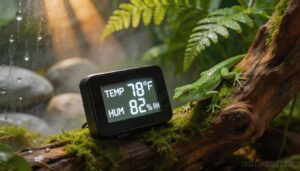
Not every humidity gauge is built with beginners in mind, so knowing what to look for saves you a lot of guesswork. The right features make the difference between a tool that actually helps you and one that sits in the corner collecting dust.
Here’s what matters most when you’re choosing your first reptile humidity gauge.
Accuracy and Reliability
Not all humidity gauges are created equal — and a reading that’s off by 10% could mean the difference between a healthy shed and a trip to the vet. Look for hygrometer accuracy within ±3–5%, and always run basic humidity calibration methods before first use.
Sensor drift, battery influence on reliability, and response time all matter. Reference validation against a trusted second unit keeps your readings honest long-term.
For the most accurate baseline, follow proven snake heating pad placement techniques before running any drift or battery comparisons.
Digital Vs Analog Options
When choosing between a digital vs analog hygrometer, three factors shape the decision:
- Power Source — Digital units run on batteries lasting 6–24 months; analog hygrometers need none.
- Memory Capacity — Digital models store min/max readings automatically; analog options offer zero data history.
- Calibration Complexity — Analog versus digital hygrometers differ here too: Digital wins with auto‑calibration, while analog drifts over time.
Readability and Mounting Styles
A gauge you can’t read at a glance undermines its purpose. Large numeric displays and backlit screens make humidity levels visible even during low-light night cycles, keeping your reptile’s care routine simple.
| Feature | Why It Matters | Best Option |
|---|---|---|
| LED display readability | Clear in low-light reptile habitats | Backlit LCD/LED |
| Suction cup mounting | Attaches firmly to glass | Easy repositioning |
| Adhesive pad mounting | Ideal for plastic surfaces | Residue-free hold |
Magnetic mounting options and three different mounting options add flexibility. easy-to-read digital display showing bold, high-contrast digits saves you from squinting mid-check.
Dual Sensors and Memory Functions
When one sensor isn’t enough, a dual gauge unit steps in — placing probes across separate sensor zones to capture microclimates your reptile actually lives in.
Memory functions store high and low readings over days, so you’re not guessing about overnight drops. Data logging, cross-calibration between probes, and drift reduction keep your digital hygrometer accurate long-term. A built-in memory reset clears old data cleanly when needed.
How to Use a Humidity Gauge Correctly
Getting a humidity gauge is only half the job — where you put it and how you use it makes all the difference. A few simple habits will keep your readings accurate and your reptile healthy.
Here’s what you need to know before we get into the top picks.
Optimal Placement in Terrariums
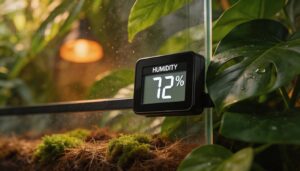
Where you place your humidity gauge matters just as much as which one you buy.
For accurate readings, follow these probe placement strategies:
- Temperature Gradient Alignment – Mount the gauge on the cool side, about 2 inches above the substrate, away from heat sources.
- Ventilation Slot Placement – Keep it clear of mesh tops where airflow creates false‑low readings.
- Substrate Moisture Zones – Avoid water bowls and misting targets; those spike humidity artificially.
Accessible mounting height at eye level makes routine checks easy.
Monitoring Multiple Microclimates
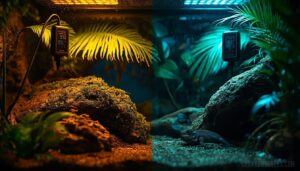
single humidity gauge won’t cut it if your enclosure has distinct warm and cool zones. Use a Staggered Sensor Layout with multiple probes to capture your temperature and humidity gradient across every corner.
Microclimate Data Sync and Zone-specific Alerts let you catch Cross-zone Condensation Monitoring issues quickly. Multi-zone Trend Analysis through microclimate monitoring gives you the full picture at a glance.
Tips for Regular Humidity Checks
Consistency is everything for humidity monitoring. Build a simple Morning/Evening Routine — check readings twice daily and log them for Trend Logging purposes so you spot patterns before problems develop.
- Spot Check Locations near hides and basking areas each session.
- Calibrate monthly using a salt test (target 75% RH) to maintain Calibration Frequency.
- Swap batteries on schedule for reliable Battery Maintenance.
- Reposition probes if readings seem off — Probe placement strategies for accurate humidity readings matter more than most beginners expect.
Top 6 Reptile Humidity Gauges for Beginners
Now that you know what to look for, it’s time to find the right gauge for your setup. These six options cover a range of budgets, mounting styles, and features — all tested with beginners in mind.
Here’s what made the cut.
1. REPTI ZOO Terrarium Thermometer Hygrometer
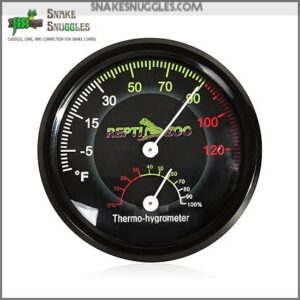
The REPTI ZOO Terrarium Thermometer Hygrometer (RHT01) is a solid starting point if you want simple, no-fuss monitoring. Dual analog gauges display temperature and humidity at a glance, with color-coded segments that make reading conditions quick and easy to grasp.
At $11.99, it’s budget-friendly and requires zero batteries. Just peel the adhesive backing and stick it to the glass.
Keep in mind that analog accuracy can drift, so it works best for hardy species rather than humidity-sensitive ones.
| Best For | Beginner reptile owners who want a simple, affordable way to monitor their terrarium without dealing with batteries or complicated setups. |
|---|---|
| Display Type | Analog dial |
| Measures Humidity | Yes |
| Measures Temperature | Yes |
| Mounting Method | Adhesive backing |
| Power Source | Battery-free |
| Housing Material | Plastic (ABS/PP) |
| Additional Features |
|
- No batteries needed — fully mechanical, so it just works around the clock
- Dead simple to install; peel the backing and stick it to the glass
- At $11.99, it’s one of the cheapest monitoring options out there
- Analog accuracy isn’t always reliable, especially for humidity-sensitive species
- The adhesive can lose grip in high-humidity tanks or if active animals bump into it
- No alerts, data logging, or app connectivity — what you see is what you get
2. JEDEW Digital Hygrometer Thermometer
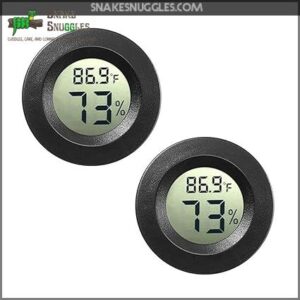
If you need more precision than an analog gauge can offer, the JEDEW Digital Hygrometer Thermometer is worth a close look. Sold as a 2-pack, each compact unit measures humidity from 10%–99% RH at ±3% accuracy and temperature from 32°F–158°F at ±1°F.
Readings refresh every 10 seconds, so you’re never guessing what’s happening inside the enclosure.
Battery life runs about 10 months per LR44 cell, and a backup cell is included — a small but thoughtful touch.
| Best For | Anyone who wants accurate, no-fuss humidity and temperature tracking in small spaces like terrariums, humidors, or filament storage bins. |
|---|---|
| Display Type | LCD digital |
| Measures Humidity | Yes |
| Measures Temperature | Yes |
| Mounting Method | Adhesive backing |
| Power Source | LR44 button cell |
| Housing Material | Plastic |
| Additional Features |
|
- Comes as a 2-pack, so you can monitor two spots without buying twice
- Updates every 10 seconds, giving you a near-real-time look at conditions
- Tiny footprint fits just about anywhere, and a backup battery is included right out of the box
- No wireless connectivity — you have to physically check the display
- Some units ship with dead batteries, so don’t be surprised if you need to swap one in immediately
- The buttons are easy to accidentally bump, which can switch units or shut the device off
3. PAIZOO LED Digital Reptile Thermometer Hygrometer
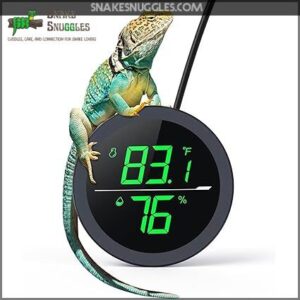
If battery life is a pain point for you, the PAIZOO LED Digital Reptile Thermometer Hygrometer sidesteps the problem entirely — it runs on USB power, so there’s no scrambling for replacement cells.
The 3-inch backlit LED display is bright enough to read at a glance, day or night, without disturbing your reptile.
It tracks temperature and humidity simultaneously, updating every 10 seconds, with accuracy within ±1°F and ±5% RH.
Dual vents help the sensor breathe, keeping readings honest.
| Best For | Reptile owners who want a no-fuss, always-on monitor without ever touching a battery. |
|---|---|
| Display Type | LED backlit digital |
| Measures Humidity | Yes |
| Measures Temperature | Yes |
| Mounting Method | Adhesive backing |
| Power Source | USB cable |
| Housing Material | Acrylic |
| Additional Features |
|
- USB-powered means it’s always running — no dead batteries at the worst time
- Big 3-inch backlit display makes it easy to check conditions at a glance, day or night
- Mounts cleanly to tank walls with adhesive, no drilling or tools needed
- Needs to stay plugged in, so you’ll need a USB port nearby at all times
- Humidity readings can drift low above 80% RH, which matters for tropical species
- A few users have reported the display cutting out over time
4. Serundo Digital Terrarium Thermometer Humidity Gauge
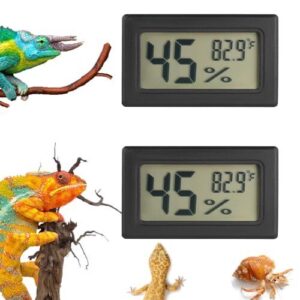
At just $5.90 for two units, the Serundo Digital Terrarium Thermometer Humidity Gauge is hard to argue with — especially when you’re starting out and not sure how many sensors you’ll need.
Each compact unit reads both temperature and humidity simultaneously, with accuracy of ±1°F and ±5% RH, updating every 10 seconds.
The adhesive mounting keeps your tank looking clean.
Heads up though: battery life runs about four months, so keep the included spares handy.
| Best For | Budget-conscious reptile owners who want a simple, no-fuss way to monitor temperature and humidity across multiple enclosures without spending a lot. |
|---|---|
| Display Type | LCD digital |
| Measures Humidity | Yes |
| Measures Temperature | Yes |
| Mounting Method | Adhesive backing |
| Power Source | AA batteries |
| Housing Material | ABS plastic |
| Additional Features |
|
- Two units for under six bucks — hard to beat for the price
- Reads both temperature and humidity at once, updating every 10 seconds
- Adhesive mount makes setup quick and keeps things looking tidy
- Battery life is only around four months, so replacements are a regular thing
- The small LCD can be tough to read in darker corners of the tank
- Adhesive may not hold up well in high-moisture setups that get misted often
5. QZQ Reptile Thermometer Humidity Gauge
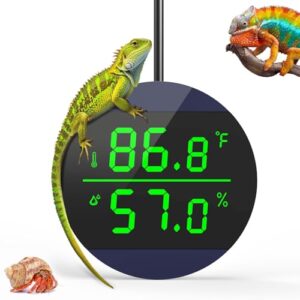
The QZQ Reptile Thermometer Humidity Gauge keeps things simple without cutting corners. It runs on USB power, so you won’t fumble with batteries at 11 PM when your snake is mid-shed.
The blue LED display shows both temperature and humidity at a glance — readable even in low light — and it covers a humidity range of 5%–99% RH with ±5% accuracy.
Adhesive mounting makes installation quick, and the compact design won’t crowd your tank.
| Best For | Reptile and amphibian owners who want a no-fuss, always-on way to monitor their enclosure’s temperature and humidity without messing with batteries. |
|---|---|
| Display Type | LED digital |
| Measures Humidity | Yes |
| Measures Temperature | Yes |
| Mounting Method | Adhesive backing |
| Power Source | USB cable |
| Housing Material | Plastic |
| Additional Features |
|
- USB-powered means it runs continuously — no dead batteries, no gaps in monitoring
- Large LED display makes it easy to check conditions at a glance, even at night
- Simple adhesive mounting gets it on your tank wall in seconds, no tools needed
- The whole unit has to sit inside the enclosure, which can be awkward in smaller setups
- Bright tank lighting can wash out the LED display, making it harder to read
- Adhesive can leave residue behind if you ever need to reposition or remove it
6. Flukers Digital Thermometer Hygrometer
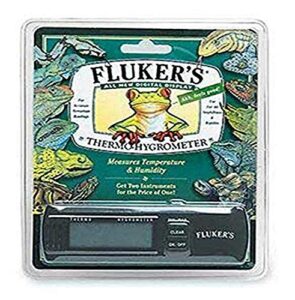
Fluker’s wraps up this list with a solid, no-fuss option that does exactly what beginners need. The digital LCD display shows real-time temperature and humidity at a glance, with MAX/MIN memory to track daily fluctuations — genuinely useful when you’re still learning your enclosure’s rhythm.
It covers 32–122°F and 0–100% RH, and the adhesive backing mounts cleanly on tank glass.
Just keep it away from heat sources, and plan for periodic battery swaps to maintain accurate readings.
| Best For | Beginner reptile and amphibian owners who want a simple, affordable way to monitor both temperature and humidity in one device. |
|---|---|
| Display Type | LCD digital |
| Measures Humidity | Yes |
| Measures Temperature | Yes |
| Mounting Method | Adhesive or Velcro |
| Power Source | Replaceable batteries |
| Housing Material | Plastic |
| Additional Features |
|
- Combines temperature and humidity into one compact unit, so you’re not juggling multiple gadgets
- Easy-to-read LCD display makes quick checks effortless, no setup or extra tools needed
- Adhesive backing mounts right to tank glass and can be repositioned as your setup changes
- Accuracy can waver — humidity may be off by ±5–10% and temperature by ±3°F, which matters for sensitive species
- The adhesive can grip too hard, and if the unit falls, it could injure small pets
- Some users reported humidity readings failing after just a month of use
Common Beginner Mistakes With Humidity Gauges
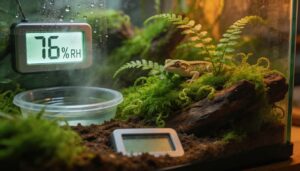
Even the right gauge won’t help much if you’re using it the wrong way. Most beginners make the same handful of mistakes without realizing it, and they’re all easy to fix once you know what to look for.
Here are the most common ones to watch out for.
Misplacing The Gauge in The Enclosure
Where you place your gauge changes everything. Substrate Proximity pulls moisture readings sky‑high, while Heat Source Interference pushes them artificially low. Ventilation Obstruction behind decor creates dead‑air pockets that skew data completely.
| Placement Error | Why It Misleads | Better Approach |
|---|---|---|
| Near substrate | Reads evaporation, not air | Mount 2" above soil |
| Behind décor | Traps stale air | Keep gauge visible, open |
| Under heat lamp | Inflates temperature drift | Use cool-side Microclimate Zoning |
Mounting Height Errors matter too — position your sensor at your reptile’s chest level for honest readings.
Using Inaccurate or Outdated Devices
An old, cheap hygrometer can quietly sabotage your reptile’s health. Common issues with reptile hygrometer readings stem from five factors affecting accuracy:
- Calibration Drift — readings shift 5–15% seasonally without annual recalibration
- Sensor Degradation — coatings wear out after 6–12 months of high humidity exposure
- Battery Power Issues — low batteries skew readings by up to 8%
- Data Logging Gaps — outdated devices miss critical humidity spikes
- Firmware Incompatibility — unsupported software misreads rapid humidity changes
Learn how to calibrate a reptile hygrometer using a salt test to verify accuracy regularly.
Ignoring Environmental and Seasonal Changes
Your enclosure doesn’t exist in a vacuum — seasonal shifts outside affect conditions inside more than most beginners realize. Seasonal Humidity Drift, Regional Climate Mismatch, and Temperature Humidity Bias can quietly push readings off target.
Here’s what to watch across seasons:
| Season | Common Risk | Action |
|---|---|---|
| Winter | Sensor Degradation Seasonal from cold | Recalibrate monthly |
| Summer | Microclimate Gradient Overlook from heat | Check multiple zones |
| Spring | Humidity fluctuations from weather shifts | Adjust misting schedule |
Frequently Asked Questions (FAQs)
Are inexpensive hygrometers accurate?
Inexpensive hygrometers can work, but accuracy of hygrometer readings generally falls within ±3–5%.
Sensor drift, battery impact, and poor temperature compensation all cause inaccurate readings over time — so periodic calibration methods matter more than the price tag.
What humidity level do reptiles need?
It depends on the species. Desert species humidity sits around 30–40%, while tropical species humidity needs can reach 70–100%. Shedding humidity spikes matter too — most reptiles need a temporary boost during molts.
How to measure humidity in a reptile enclosure?
Clip a digital hygrometer inside your terrarium, position the humidity sensor probe at mid-height, and read the percentage shown. That single number tells you exactly where your reptile’s environment stands.
What is the best hygrometer for reptiles?
The best digital hygrometer balances accuracy, battery life, and water resistance. For most keepers, the Fluker’s Thermo-Hygrometer wins overall — reliable readings, solid build, and no complicated calibration methods needed.
Are cheap digital hygrometers accurate?
Cheap digital hygrometers usually land within 3–7% RH — decent for spotting trends, but sensor drift, battery influence, and temperature cross-interference mean periodic calibration methods and comparative testing keep readings trustworthy.
How often should I calibrate my humidity gauge?
Calibrate at least once a year for standard use.
Bump that to every six months if humidity swings are frequent, and always recalibrate after moving the gauge or replacing the battery.
Can I use household hygrometers for reptile enclosures?
Yes, you can — but with caveats. Household digital hygrometers often lack sensor accuracy, skip data logging, and may show sensor lag.
For sensitive species, a reptile-specific humidity gauge gives you much better reliability.
What humidity level is best for shedding reptiles?
Ever wonder why your reptile’s shed comes off in patches? For most species, keeping humidity around 50–60% — with a short spike to 70% during shedding — makes all the difference.
Do humidity gauges need battery replacement or maintenance?
Most digital gauges do need battery replacement every 6 to 24 months. Watch for dimming displays or drifting readings — those are your Battery Life Indicators.
Calibration After Replacement keeps your humidity sensor calibration accurate.
How do I increase humidity without a misting system?
No misting system? No problem.
Place shallow water dishes in your enclosure for water surface evaporation, add live plants for transpiration, use moisture-retaining substrate, and manage your lid opening for ventilation control.
Conclusion
Like a gardener nurturing a delicate bloom, you’re cultivating life in your reptile’s enclosure. The right tools make all the difference.
By choosing one of these top-rated reptile humidity gauges for beginners, you’re taking a key step toward creating a thriving environment. Accurate readings empower you to make informed decisions, ensuring your pet’s health and happiness.
With this foundation, you’ll be well on your way to becoming a confident, capable reptile keeper, and that’s a growth worth measuring.