
This site is supported by our readers. We may earn a commission, at no cost to you, if you purchase through links.

One wrong tube of silicone can poison your snake’s home. Mold-inhibitor sealants, even ones labeled "food safe," pack biocides that don’t belong near a ball python.
Your enclosure’s seams take the heat, the humidity, and the constant slither of a curious animal. That’s why the best silicone for ball python enclosure builds comes down to purity, bond strength, and patience. Pure silicone grips glass with Si–O–Si chemistry. Cheap fillers fail fast. Even safe picks stay toxic until fully cured, and thick beads sometimes never finish.
Here are five sealants worth your money, plus the tests and techniques that keep your build leak-proof and your snake safe.
Table Of Contents
- Key Takeaways
- 5 Best Silicone Sealants for Ball Python Enclosures
- How to Check Silicone for Reptile Safety
- Silicone Compatibility With PVC and Glass
- Where to Seal a Ball Python Enclosure
- How to Apply Thin, Even Silicone Beads
- Silicone Cure Times Before Your Snake Returns
- Frequently Asked Questions (FAQs)
- Conclusion
Key Takeaways
- Check the label before you buy, because any sealant with mold or mildew inhibitors is unsafe for your ball python, even if the tube says "food safe."
- Choose pure aquarium or vivarium silicone, and read the safety data sheet on general-purpose caulk like GE before it goes near your snake’s home.
- Give every bead a full cure, since surface-dry isn’t cured: wait at least 24 hours for function, about a week for full strength, and until the vinegar smell is gone before your snake moves back in.
- Seal thin, even beads only where moisture travels, such as bottom edges, corners, and ringed vents, and stick to glass, since silicone bonds weakly to PVC and won’t grip wood.
5 Best Silicone Sealants for Ball Python Enclosures
You want a seal that holds tight and keeps your snake safe, and these five sealants deliver. Each pick below earned its spot through a clean cure and dependable grip on enclosure seams. Check the label on every tube, because "100% silicone" alone doesn’t guarantee safety.
If you’re building your own hide, this DIY snake hide box guide shows where a safe, fully cured sealant fits into the build.
1. Aquarium Safe Silicone Sealant Kit

A clear, acid-cured silicone like this one earns its spot on your shelf. It’s non-toxic and solvent-free, and the 10 fl oz pack covers a lot of seams. Surface dry hits in 30 minutes, but don’t let that fool you. Full solidification takes up to 48 hours, sometimes 3 days.
It stays elastic, so no shrinking, no cracking. Glass seams, terrarium builds, paludarium joints, all fair game.
Work between 5 °C and 40 °C, ventilate well, and expect a strong smell. Cold rooms and fat beads slow the cure.
| Best For | Hobbyists and DIYers who need a clear, flexible sealant for building or repairing freshwater aquariums, terrariums, and paludariums, or for sealing windows, door frames, and kitchen sinks. |
|---|---|
| Silicone Type | 100% silicone |
| Volume | 10 fl oz |
| Application Temp | 5°C to 40°C |
| Cured Temp Range | N/A |
| Odor | Strong odor |
| Cure Time | Up to 48 hours |
| Additional Features |
|
- Non-toxic, solvent-free silicone that is safe for freshwater aquarium use
- Dries on the surface in 30 minutes and stays elastic without shrinking or cracking
- Versatile enough for glass seams, terrariums, paludariums, windows, door frames, and sinks
- Gives off a strong odor during application, so good ventilation is a must
- Takes up to 48 hours, sometimes 3 days, to fully solidify
- Cures more slowly in cold temperatures and with large beads of sealant
2. ASI Black Aquarium Silicone Sealant

Want seams that disappear against a dark background? Black does that. This one’s a high modulus RTV that bonds to glass without primers, and its non-slump consistency stays put on vertical joints. No sagging, no drips.
Keep beads under 1/8 inch. Thicker ones may never fully cure. Clean the glass with hot water or a nonoily solvent first, since soap residue kills adhesion. Ventilate well, because the smell is strong. Once fully cured, it’s non-toxic and tolerates continuous water exposure.
| Best For | Hobbyists and builders constructing or repairing freshwater or saltwater aquariums and vivariums who want a primer-free, non-sagging black sealant for clean-looking glass seams. |
|---|---|
| Silicone Type | 100% silicone |
| Volume | 10.2 fl oz |
| Application Temp | -18°C to +50°C |
| Cured Temp Range | -57°C to +233°C |
| Odor | Strong odor |
| Cure Time | N/A |
| Additional Features |
|
- Bonds strongly to glass without primers, and the non-slump consistency stays put on vertical joints without sagging or dripping.
- Withstands continuous water immersion and is non-toxic to fish and aquatic life once fully cured.
- Resists ozone, UV radiation, and airborne chemicals, with a cured operating range of -57°C to 233°C (-70°F to 450°F).
- Beads thicker than 1/8 inch may never fully cure, so it must be applied thinly for best strength.
- Glass must be cleaned with hot water or a nonoily solvent first, because soap residue causes adhesion failure.
- The strong odor during application means you need a well-ventilated area until it is fully cured.
3. American Sealants Vivarium Safe Silicone
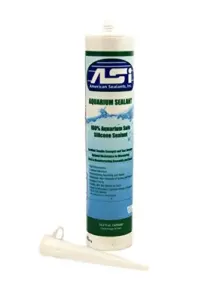
Here’s another black option built with snakes in mind. This 10.2 oz tube of liquid silicone skips arsenic, bioseal, and other commonly added toxic chemicals. It’s VOC compliant, so outgassing stays minimal after curing.
Use it for glass enclosures, vivariums, and foam backgrounds. The bond is strong enough to hold a 75-gallon tank, and it cures solid black for clean, visible seams.
Expect a sharp, lingering vinegar smell. Work in small sections, and give it several days to fade completely.
| Best For | Reptile and amphibian keepers who are building or repairing glass vivariums and want a black, arsenic-free silicone that holds up under the weight of a large tank. |
|---|---|
| Silicone Type | Liquid silicone |
| Volume | 10.2 oz |
| Application Temp | N/A |
| Cured Temp Range | N/A |
| Odor | Vinegar-like odor |
| Cure Time | Several days for smell |
| Additional Features |
|
- Made without arsenic, bioseal, or other commonly added toxic chemicals
- VOC compliant, with minimal outgassing once cured
- Bonds strongly enough to hold a 75-gallon tank and cures to a clean black finish
- Gives off a sharp vinegar-like odor while you apply it
- Takes several days for the strong smell to fade completely
- Works best when applied in small sections, which slows the job down
4. Clear Aquarium Silicone Sealant Cartridge

Prefer to see what you’re sealing? This clear 10.2 fl oz (302 ml) cartridge bonds to glass without primers, and the non-slump formula stays put on vertical seams.
It’s an acetic cure silicone, so expect that vinegar smell while you work. Once cured, it forms a tough waterproof seal that won’t crack or shrink, and it holds up under constant water immersion.
Be patient. It needs 7 to 14 days to cure fully, depending on bead size. Keep your snake out until then.
| Best For | Hobbyists and aquarium builders who want a clear, primer-free sealant for glass tanks, fresh or salt water, and can wait out the cure time. |
|---|---|
| Silicone Type | 100% silicone |
| Volume | 3 x 10.2 fl oz |
| Application Temp | -18°C to +50°C |
| Cured Temp Range | -57°C to +233°C |
| Odor | N/A |
| Cure Time | N/A |
| Additional Features |
|
- Bonds to glass without primers, and the non-slump formula stays put on vertical seams.
- Cures into a tough waterproof seal that resists cracking and shrinking.
- Stays intact under continuous water immersion and is safe for fresh and salt-water aquariums once fully cured.
- Needs 7 to 14 days to fully cure, depending on bead size.
- Toxic to fish until it has fully cured, so tanks can’t be stocked early.
- Gives off a strong vinegar-like odor while you apply it.
5. GE 100% Silicone Clear Caulk

Cartridges come in a pack of two, 10 oz each, and this clear, ASTM C-920 Class 25 silicone grips glass, metal, wood, tile, and stone without shrinking or cracking.
Here’s the catch: it’s a general-purpose formula, and "100% silicone" only means no fillers. Check the SDS for mildew biocides and D4 content before it goes anywhere near your snake’s home.
Wear latex gloves, since residue clings to skin. Keep beads thin and give them a week to cure before move-in.
| Best For | Homeowners and DIYers who need a durable, clear, waterproof seal for windows, doors, siding, trim, and molding on interior and exterior repairs. |
|---|---|
| Silicone Type | Acetic cure silicone |
| Volume | 10.2 fl oz (302 ml) |
| Application Temp | -18°C to +50°C |
| Cured Temp Range | -57°C to +233°C |
| Odor | Vinegar-like odor |
| Cure Time | 7 to 14 days |
| Additional Features |
|
- Waterproof and weatherproof silicone that can be rain-ready in as little as 12 hours
- Resists shrinking, cracking, freezing, and sunlight, and meets ASTM C-920 Class 25
- Sticks to metal, wood, glass, tile, and stone, and comes as two 10 oz clear cartridges
- Silicone residue is hard to remove from skin
- Latex gloves are needed when smoothing the bead
- Customers disagree on how strong the odor is
How to Check Silicone for Reptile Safety

How can you tell a safe tube from a risky one before it touches your snake? Start with the label, then trust your senses.
Skip anything listing mold and mildew inhibitors. Those biocides disqualify a sealant for ball python enclosures, no matter how "food safe" the front of the tube brags. Aquarium or vivarium labels are your closest proxy. It also helps to know the food-safe versus food-compliant distinction, since only food-safe sealants are certified for direct food contact, while food-compliant ones are designed for indirect contact.
Then run three quick checks:
- Stretch test: Cured silicone that pulls blue and transparent is clean; white and milky means fillers.
- Smell test: Fully cured acetic silicone shouldn’t smell like vinegar. Ask someone else to sniff, since your nose tires fast.
- Time test: Surface-dry isn’t cured. Give it at least 24 hours at 20°C.
That real-world testing keeps you in control.
Silicone Compatibility With PVC and Glass

Imagine this: you lay a perfect silicone bead along a PVC seam, then find it peeling away from the plastic a month later while the glass joint next to it holds firm. That’s no fluke.
Glass gives silicone something to grab. Its surface silanol groups form covalent Si–O–Si bonds as the sealant cures. PVC offers an inert surface, and flexible grades leach plasticizer that slowly wrecks the bond.
| Surface | Silicone bond | Your move |
|---|---|---|
| Glass | Strong, chemical | Clean, dry, degrease |
| Rigid or flexible PVC | Weak, fades over time | Use solvent cement or Lexel |
| Cured silicone | Nearly none | Scrape it off fully |
Treat silicone as a sealant on PVC, never structural glue. Keep glass tanks and PVC construction separate in your thinking.
Where to Seal a Ball Python Enclosure
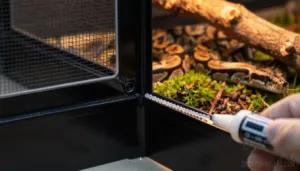
Picture a leaky Saturday: you mist your new setup, and by morning a dark puddle creeps out from under the base. The seams gave out first.
Put silicone where moisture actually travels. You don’t need to caulk every inch of a ball python enclosure, just the zones that matter.
- Bottom edges: seal all four to stop wicking.
- Vertical corners: run the bead about 6 inches up each joint.
- Vents: press in insect screen, then ring it with thin silicone. Never seal them shut.
- Penetrations: ring every grommet, fogger port, and drain bulkhead on the interior face.
- Door seams and front frame: seal these last, after hardscape and wiring are done.
Silicone won’t grip wood, so stick with PVC or glass.
How to Apply Thin, Even Silicone Beads
A fat, lumpy bead looks like confidence. It’s actually a future leak. Thin and even wins every time, and you can get there with a few habits.
Piling on sealant may feel like skill, but a sloppy, bulging seam is a slow leak, while a slim, even line holds
- Cut the nozzle at 45 degrees, small.
- Puncture the inner foil seal, or the trigger pushes only air.
- Tape both sides of the seam on your PVC panels, leaving a slim gap.
- Lay one continuous pass, matching trigger pressure to hand speed.
- Smooth immediately with a soapy fingertip, re-wetting between passes, then pull tape at an obtuse angle.
Aim for a bead slightly smaller than a pea. Work one joint at a time so nothing skins early. Neat seams support escape prevention and pet safety standards. Tidy PVC construction, tidy reptile enclosure maintenance.
Silicone Cure Times Before Your Snake Returns

Skin-dry isn’t cured. That’s the trap. Your bead feels firm after 10 to 30 minutes, but it’s only a surface skin.
Plan on 24 hours minimum for a functional cure, and 7 days for full bond strength. At 24 hours you’re sitting near 80%. Don’t move the enclosure, add water, or load substrate early. You’ll trap air bubbles and deform the bead.
Joints sandwiched between panels cure slower, since moisture can’t reach them. Cold, dry air slows things further.
Then comes the vinegar smell. That’s acetic acid leaving the silicone. Ventilate well and wait until the odor fades, usually 5 to 7 days. Rush it, and you risk your snake’s comfort and your seal’s integrity. Patience is cheap insurance here.
Frequently Asked Questions (FAQs)
How often should enclosure seams be resealed?
Forget a calendar, because a good seam can outlast your snake’s patience. Properly installed enclosures need no scheduled reseal. Check your seams once or twice a year, and reseal only after disassembly or visible damage.
How do I remove old silicone from glass?
Dry scraping smears silicone over 60% more often, so keep the blade wet and flat. Score both bead edges, warm it, then peel. Wipe leftovers with isopropyl alcohol for a clean reseal in reptile enclosures.
Does silicone smell harm snakes after curing?
Think a lingering smell means danger? Not once cured. Fully cured silicone is inert and gives off nothing harmful. The odor is only curing byproduct. Wait until no detectable odor remains, then add buffer days.
Is black silicone safer than clear silicone?
No. Color doesn’t decide safety. Black and clear aquarium silicone share the same 100% silicone base, and carbon black is just inert pigment. What matters is the label: skip mold inhibitors like chlorothalonil.
Can I use silicone on a hatchlings enclosure?
A 10-quart hatchling tub holds roughly 8 gallons of air, so fumes concentrate fast. Yes, you can use silicone, but only fully cured silicone. Wait 5 to 7 full days, until no vinegar smell remains.
Conclusion
Pick pure silicone. Check the label. Cure it fully. Those three habits separate a snug, secure home from a slow poison leak.
The best silicone for ball python enclosure projects is the one you apply thin, seal cleanly, and then leave alone. Give every bead a full cure before your snake moves back in. Skip shortcuts, and respect the cure.
Build it right once. Then watch your snake settle into a home you made safe.