
This site is supported by our readers. We may earn a commission, at no cost to you, if you purchase through links.

A single cubic foot of sand weighs about 100 lbs. Stack three tanks on a flimsy frame, add substrate, and you’ve built a collapse waiting to happen.
Stackable snake enclosures save floor space and give you control over each animal’s habitat. But a 6-foot boa needs 6′ x 3′ x 3′, and every tier needs its own thermostat to stop heat bleed. Cut corners on panels, braces, or sizing, and you risk stress, escapes, and a failed build.
Here are five top-rated units, the sizing rules that fit your snake, and the real cost of heat, light, and power. Pick the right setup the first time.
Table Of Contents
Key Takeaways
- Size every enclosure for your snake’s adult length, not its current size, since a 6-foot boa needs 6′ x 3′ x 3′ and floor space matters more than height.
- Treat weight as a hard limit, because substrate alone can overload a tier, so choose 10–12 mm PVC panels, supports rated for the load, and no more than three tiers.
- Give every tier its own heat source and thermostat, since heat rises and a shared thermostat can’t stop the top enclosure from running too hot.
- Budget beyond the sticker price for heat, light, power, safety hardware, and locks on every door, and size for adult length from the start so you won’t pay $300 to $1,200 to replace each outgrown enclosure.
5 Stackable Snake Enclosure and Stand Options
Stacking snake enclosures saves floor space, but only the right setup keeps your animals safe and stable. The five options below cover stands, tiers, and full towers so you can match one to your space and your snake. Check each one against your animal’s adult size before you buy.
If you’d rather start with a single enclosure before building up, this guide to the best 40-gallon ball python tanks shows which sizes suit an adult’s needs.
1. ToxiRium 3-Tier PVC Reptile Enclosure
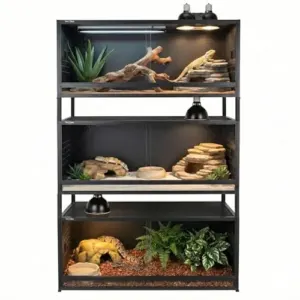
Three habitats, one footprint. This stackable PVC unit measures 40" x 16" x 16" and holds 44 gallons per tier, so you can house multiple snakes or lizards without giving up floor space.
Lockable sliding glass doors give you front access for feeding and cleaning. Steel-reinforced top and bottom frames keep the stack stable, and rear clips tidy your cables.
Expect a tricky build. Some owners report cross-threading on the internal rods, and the paper instructions contain errors. Watch a video tutorial first.
| Best For | Reptile keepers with limited floor space who want to house several snakes or lizards in separate habitats and are willing to put in some effort during assembly. |
|---|---|
| Dimensions | 40″ x 16″ x 16″ |
| Volume | 44 gallons |
| Main Materials | PVC, steel-reinforced frames |
| Door Type | Lockable sliding glass |
| Stack Configuration | Three stacked habitats |
| Suitable Animals | Snakes, lizards |
| Additional Features |
|
- The stackable design creates three independent habitats in a single footprint.
- Lightweight PVC insulates well for temperature and humidity control and is easier to move than a heavy glass terrarium.
- Lockable sliding glass doors give easy front access for feeding and cleaning, and steel-reinforced frames add stability.
- Assembly can be difficult, with reported cross-threading on the internal rods.
- The locks attach to glass without pre-drilled holes, which may reduce security.
- The paper instructions contain errors, so you will likely need a video tutorial to build it correctly.
2. Herture Double 120-Gallon Reptile Stand
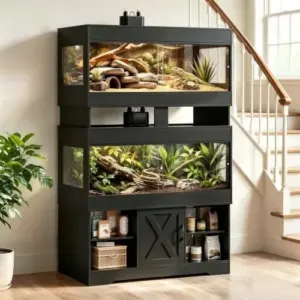
Need more room per snake? This model gives you two 120-gallon tanks, one above the other, in a 48 by 24 inch footprint that stands 75.6 inches tall.
Front sliding acrylic doors let you feed and clean without startling your animals. Four built-in AC outlets handle your heating and lighting, and the base cabinets keep supplies out of sight.
Plan your build. Assembly takes two to four hours and needs two people. Check every part and door lock on arrival.
| Best For | Reptile keepers with limited floor space who want to house two animals, such as bearded dragons or geckos, in a vertical setup with built-in storage. |
|---|---|
| Dimensions | 48 x 24 x 75.6 inches |
| Volume | 240 gallons (two 120-gallon tanks) |
| Main Materials | MDF, acrylic glass, metal |
| Door Type | Sliding acrylic |
| Stack Configuration | Two stacked tanks |
| Suitable Animals | Bearded dragons, geckos |
| Additional Features |
|
- Two stacked 120-gallon tanks fit into a 48 by 24 inch footprint, saving floor space.
- Front sliding acrylic doors allow low-stress feeding and cleaning without startling your animals.
- Four built-in AC outlets handle heating and lighting, and the base cabinets keep supplies organized and out of sight.
- Assembly takes two to four hours and requires two people.
- It is not suitable for holding water and has no lip to contain liquid spills.
- Some units arrive with misaligned holes, missing parts, or weak door locks, so check everything on arrival.
3. 3 Tier PVC Reptile Enclosure
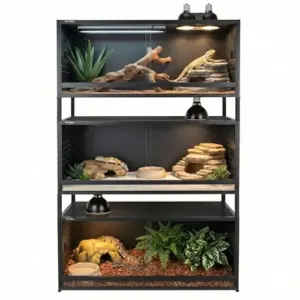
Want three separate habitats in one footprint? This stackable setup gives you exactly that. Each level is its own independent home, so you can house three snakes without taking over the room.
Corner units and slimline frames are especially handy in tight spaces, and these snake enclosures for apartments show how stable, interlocking designs keep every level secure.
The 48 by 24 by 24 inch frame holds 120 gallons total across all three tiers. PVC panels with aluminum components keep it lightweight and insulated. Front sliding glass doors lock, and pre-cut covers fit your heat lamps.
Expect a tougher build. Cross-threaded rods and misaligned holes can slow assembly. Check every part early.
| Best For | Reptile keepers and breeders who want to house several snakes, lizards, or geckos in a compact space without giving up much floor room. |
|---|---|
| Dimensions | 48″ x 24″ x 24″ |
| Volume | 120 gallons |
| Main Materials | PVC, aluminum, steel frames |
| Door Type | Sliding glass with locks |
| Stack Configuration | Three-tier stack |
| Suitable Animals | Snakes, lizards, geckos |
| Additional Features |
|
- Three independent habitats fit in one 48 by 24 by 24 inch footprint, with 120 gallons of total space.
- Lightweight PVC and aluminum construction offers easy handling and good thermal insulation.
- Front sliding glass doors with built-in locks make feeding, cleaning, and interaction simple, and pre-cut covers fit heat lamps.
- Assembly can be complex because of cross-threaded rods and misaligned pre-drilled holes.
- Locks attach to the glass with a squeeze-fit instead of drilled holes, so they may shift.
- Clear protective plastic on the internal steel frames is difficult to remove completely.
4. REPTI ZOO Double Stacked Glass Terrarium
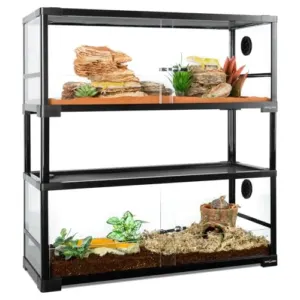
Prefer glass over PVC? Try this two-unit stack. Each 20-gallon enclosure measures 30 by 12 by 32 inches, with tempered glass walls and an aluminum alloy frame. The stack reaches 43.7 inches tall.
Once your glass enclosures are set up, outfit each level with snake housing accessories like untreated cork hides and other chemical-free decor.
Front sliding doors lock, and the mesh top lets UVB and infrared light through. Fogger holes and cable pass-throughs keep gear and wiring tidy.
Know the tradeoffs. Assembly means many small parts, and the door locks feel flimsy. Stability isn’t rock-solid, so add support near kids or pets.
| Best For | Reptile keepers with limited floor space who want to house bearded dragons, lizards, snakes, or geckos in a stackable glass setup. |
|---|---|
| Dimensions | 30″ x 12″ x 32″ per unit |
| Volume | 40 gallons (two 20-gallon units) |
| Main Materials | Tempered glass, aluminum alloy |
| Door Type | Sliding doors with locks |
| Stack Configuration | Two stacked enclosures |
| Suitable Animals | Bearded dragons, lizards, snakes, geckos |
| Additional Features |
|
- Two stackable 20-gallon enclosures save floor space by building vertically.
- Tempered glass walls, an aluminum alloy frame, and a mesh top that lets UVB and infrared light through.
- Front sliding doors with locks make feeding and cleaning easy, and fogger holes and cable pass-throughs keep gear tidy.
- Assembly involves many small parts, and gloves may be needed to avoid fingerprints.
- Users report the door locks feel flimsy and poorly designed.
- The stack isn’t rock-solid, so it may need extra support near kids or pets.
5. ToxiRium 700 Gallon PVC Reptile Enclosure
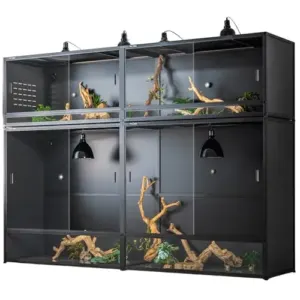
Height defines this unit. It stands 70 inches tall, 96 inches long and 24 inches deep, with 700 gallons of space split between a 460-gallon lower section and a 240-gallon upper section.
Two connected 48"x24"x46" lower habitats sit beneath two 48"x24"x24" upper enclosures. Sliding tempered glass doors lock, so you keep secure, visible access.
PVC side and rear panels hold heat and humidity better than glass tanks. At $1799.99, it’s a serious investment. Confirm your floor can carry the load.
| Best For | Experienced keepers and professional breeders who house large, active reptiles like iguanas, monitors, and tegus and have the budget and floor space for a big display enclosure. |
|---|---|
| Dimensions | 96″ x 24″ x 70″ |
| Volume | 700 gallons |
| Main Materials | PVC, tempered glass, aluminum alloy |
| Door Type | Sliding tempered glass with locks |
| Stack Configuration | Dual-level modular stack |
| Suitable Animals | Iguanas, monitors, tegus |
| Additional Features |
|
- Offers 700 gallons of space with plenty of vertical room for climbing.
- PVC side and rear panels hold heat and humidity better than glass tanks.
- Lockable sliding glass doors give secure, visible access, and the modular design allows expansion.
- At $1799.99, the price is steep for budget-conscious hobbyists.
- Its size (96" long, 70" tall) demands a lot of floor space and a floor that can carry the load.
- It is built for large reptiles and may not suit smaller species.
Snake Enclosure Sizing by Species and Growth
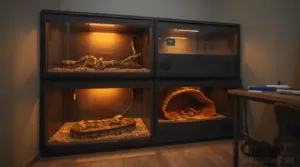
The right enclosure size starts with your snake’s adult length, not its current one. Use a simple formula: length equals the snake, width and height equal half of it. That gives you about 1 square foot of floor per foot of snake.
Match it to the species. Ball pythons and corn snakes need 48″ × 24″ × 24″ as an adult minimum. Boas at 6 to 8 feet need 6′ × 3′ × 3′, and anything over 8 feet needs 8′ × 4′ × 4′. Floor space beats height, so choose length first. Length also matters because snakes need room to create a functional thermal gradient, usually 90–95°F at the warm end and 70–75°F at the cool end.
Hatchlings are different. Young snakes avoid open ground and refuse food when exposed. Start corn snake hatchlings in a 10-gallon reptile habitat, step up as they grow.
Safe Stacking: Materials, Supports, and Load Limits
A single cubic foot of sand weighs about 100 lbs. Fill a 4x2x2 with a few inches of substrate and you’ve already passed most stacking ratings.
Before you stack a single cage, remember that ordinary substrate is surprisingly heavy and can overload a tier before your snake moves in
That’s why stackable snake cages live or die by their materials and bracing. Check four things before you stack:
- Panel thickness. Choose 10–12 mm PVC. Thin 6 mm panels flex.
- Support bars. Look for bars rated 100 lbs per unit.
- Structural locking. Stainless dowels keep tiers aligned.
- Stack height. Stay at three units, no higher.
Treat weight capacity as a hard limit. Add up substrate and water first. Never stack two 8x4x4 habitats directly. Use a stand.
Base wheels help you move an empty rack, never a loaded one. Level floors protect enclosure stability.
Heating and Ventilation Across Stacked Enclosures
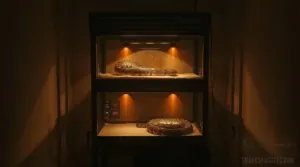
Picture a three-tier rack in a spare room. The bottom boa sits at 85°F, but the top enclosure creeps past 92°F because heat rises.
Solve it with independent reptile climate control. Give every tier its own heat source and thermostat, because a shared thermostat can’t offset heat bleed.
| Enclosure | Heat setup |
|---|---|
| PVC | Overhead heat, about 50% less wattage |
| Glass | Heat tape or mat at 85°F |
| Any tier | Its own thermostat |
Good reptile heat management also needs proper ventilation. Place vents high on the warm side and low on the cool side. Never tape vents shut. A closed airflow gap traps moisture and harms respiratory health. For thermoregulation that works, run a 51 CFM fan in sealed PVC builds.
Total Cost of a Stackable Snake Setup

Sticker price is only the start. Stackable snake cages reward planning and punish guesswork.
Budget for these four upfront items:
- Enclosures: PVC runs $300 to $1,500+, glass $150 to $800.
- Stand or shelving: $200 to $600, or $100 to $300 for 500-pound metal units.
- Heat and light: Heaters, thermostats and UVB add roughly $95 to $330 per enclosure.
- Safety hardware: Brackets and anti-tip kits cost $20 to $50.
Plan for running costs. Electricity adds $15 to $50 monthly per stack. Heating elements last 3 to 5 years, UVB bulbs just 1 to 2.
Growth matters most. Juvenile enclosures need replacing as snakes mature, at $300 to $1,200 each. Size your housing capacity for adult length, and you’ll skip that bill.
Frequently Asked Questions (FAQs)
Do stackable enclosures need locks for escape-proofing?
A door is only a promise until it’s locked. Yes, stackable enclosures need locks. Snakes push through any gap their head fits, so a resting lid fails. Add a pin lock to every door.
What humidity levels work best in stacked PVC enclosures?
Aim for 50–60% humidity in most setups, and 65–70% when a ball python’s eyes turn milky blue. Upper tiers dry fastest, so check them first. Use 4 inches of damp substrate, and keep vents open.
How often should stacked enclosures be cleaned?
Spot clean stacked enclosures daily, removing waste and 8–10 inches of soiled substrate. Do a full deep clean monthly. Bioactive setups need it only once or twice a year. Never over-clean; it stresses your snake.
Can stackable enclosures hold different snake species together?
Is a stackable setup a shortcut to mixed housing? No. Stackable reptile enclosures give each tier its own heat, humidity, and airflow. Keep boas and pythons separate. Mixing invites parasite spread, aggression, and mismatched climates.
Can beginners safely start with a stackable snake setup?
A stack is a tower: one shaky floor and everything above it feels it. Beginners can start safely if each level has its own thermostat, secure lock, and proper size. Skip tiny juvenile-only units for adults.
Conclusion
Picture a keeper who stacks a 4-foot ball python tank above a juvenile corn snake, skips the second thermostat, and finds the top tier running 8 degrees hot by morning. One missing part, one stressed animal.
Good stackable snake enclosures start with three checks: correct sizing, a frame rated for substrate weight, and independent heat control for every tier. Build around those, and the rest follows.
Choose your unit, measure twice, set it up right.