This site is supported by our readers. We may earn a commission, at no cost to you, if you purchase through links.
Your ball python’s UVB bulb can keep glowing for a year after it stops doing anything useful. The output fades first, usually within six months, and nothing about the light tells you so.
That’s the catch with reptile lighting. A heat lamp that runs 10 degrees too hot, a red bulb that ruins nighttime darkness, or a fixture sitting too close can quietly cause real trouble. Picking the best light for ball python setups means matching wattage to tank size, guarding it with a thermostat, and replacing bulbs on schedule.
Here are ten fixtures and bulbs worth your money, plus how to place them safely.
Table Of Contents
- Key Takeaways
- 10 Best Lights for Ball Python Enclosures
- 1. Exo Terra Repti-Glo 26W Lamp
- 2. REPTI HOME 100W Reptile Heat Lamp Bulbs
- 3. TFNN Reptile Heat Lamp with Timer
- 4. Flukers 100-Watt Reptile Basking Spotlight Bulb
- 5. Pawfly 6W Terrarium LED Light
- 6. Adjustable UVB Reptile Light Fixture
- 7. Hygger Zoo 13W 5.0 UVB Reptile Bulb
- 8. T5 HO Reptile Light Fixture
- 9. DXOPHIEX 15 Inch Dual Reptile Light Fixture
- 10. REPTI ZOO 100W Reptile Heat Lamp
- Why Lighting Matters for Ball Pythons
- Do Ball Pythons Need UVB Light?
- Choosing The Right Heat Lamp and Wattage
- Setting a Safe Day-Night Light Cycle
- How to Set Up and Place Lights
- Frequently Asked Questions (FAQs)
- Conclusion
Key Takeaways
- Your UVB bulb keeps glowing long after it stops working, usually losing useful output within six months, so replace it on a calendar schedule rather than waiting for it to go dark.
- Match your heat lamp’s wattage to your enclosure size (50 to 75W for juvenile tanks, up to 150W for tanks over 40 gallons), and always run it through a thermostat with a bulb cage to prevent overheating and burns.
- Aim for a basking spot of 88 to 92°F with a cooler end of 76 to 80°F, and give your snake a steady 12 hours of light and 12 hours of true darkness using a timer.
- Skip red or blue night lights because your snake can see them; use a ceramic heat emitter for nighttime warmth, and remember that ball pythons don’t strictly need UVB but benefit from a low-output 5.0 bulb.
10 Best Lights for Ball Python Enclosures
Picking lights for your ball python can feel like a maze, since you’re juggling UVB output, heat, and a safe day-night cycle all at once. The ten picks below cover bulbs, fixtures, and a few handy extras, so you can match them to your setup. Let’s start with the first one.
Once your lighting is sorted, a full ball python terrarium setup guide can help you pair those bulbs with the right enclosure, substrate, and décor.
1. Exo Terra Repti-Glo 26W Lamp
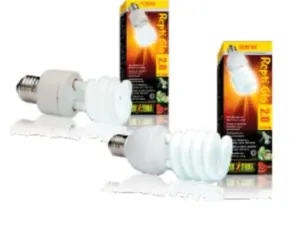
A daylight bulb can make a ball python setup feel less like a cave and more like a living space. This 26-watt CFL runs at 6700 K with a CRI of 98, so your snake’s colors look true. It gives off UVA, which helps with appetite, activity, and breeding behavior, while staying low on heat. Since UVA alone can’t trigger vitamin D3 synthesis, it helps to read up on how UV light affects reptile vitamin D3 and health before deciding whether your snake also needs UVB.
It’s best for planted or bioactive enclosures. Expect a 2 to 5 minute warm-up, and know that humidity can shorten its 4 to 12 month lifespan.
| Best For | Keepers of snakes, amphibians, or nocturnal animals who want a low-heat daylight bulb for planted or bioactive terrariums. |
|---|---|
| Light Type | Full-spectrum CFL |
| Power Rating | 26W |
| UVB Output | N/A |
| Heat Output | Low heat |
| Compatible Species | Snakes, amphibians, nocturnal animals |
| Reported Lifespan | 4 to 12 months |
| Additional Features |
|
- Its 6700 K daylight output and CRI of 98 show your animal’s true colors
- It gives off UVA, which supports plant growth, appetite, activity, and breeding behavior
- It stays low on heat, so it suits both bioactive and dry setups
- The bulb lasts only 4 to 12 months, depending on usage
- High humidity can shorten its lifespan or cause it to fail early
- It needs 2 to 5 minutes of warm-up time to reach full brightness
2. REPTI HOME 100W Reptile Heat Lamp Bulbs
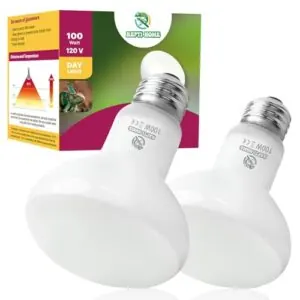
Once the lighting is sorted, you’ll still need a warm spot, and this two-pack covers it. Each 100-watt bulb has a focused shape that pushes heat downward, so less energy escapes sideways. It warms up within minutes, and the second bulb is a ready spare.
Keep it at least 30 cm from your snake, and keep it dry. Never run it through a dimmer, thermostat, or rheostat. Replace it every three months, though it’s rated for 2,000 to 3,000 hours.
| Best For | Reptile and amphibian keepers who need a rapid-heating basking spot for animals like bearded dragons, turtles, snakes, lizards, frogs, or tortoises, and who want a spare bulb on hand. |
|---|---|
| Light Type | Halogen basking bulb |
| Power Rating | 100W (x2) |
| UVB Output | N/A |
| Heat Output | Rapid basking heat |
| Compatible Species | Bearded dragons, turtles, snakes, frogs |
| Reported Lifespan | 2,000-3,000 hours |
| Additional Features |
|
- Heats quickly, reaching the temperatures amphibians need within a few minutes of activation.
- Focused bulb shape pushes heat downward, which reduces wasted energy.
- Comes as a two-pack, so the second bulb is a ready replacement.
- Cannot be used with dimmers, thermostats, or rheostats, which limits how you can control tank temperature.
- Must stay at least 30 cm from the animal and be kept dry.
- Needs replacing every three months, even though it is rated for 2,000 to 3,000 hours.
3. TFNN Reptile Heat Lamp with Timer
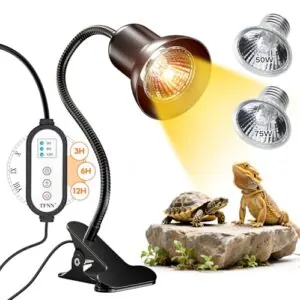
Want a lamp that runs your day-night schedule for you? This clamp-on fixture has a timer with 3H, 6H, and 12H modes, plus three brightness levels.
It comes with two bulbs, 50W and 75W. The 15.8-inch swan neck rotates 360 degrees, and a clamp attaches it to the tank.
Ball pythons can be shy, so watch how yours reacts, since the heat can overwhelm sensitive animals. Cord length gets mixed reviews, and some owners report it quitting within a month.
| Best For | Reptile keepers who want a clamp-on heat lamp with a built-in timer to run a steady day-night schedule for animals like bearded dragons, turtles, and lizards that tolerate strong heat. |
|---|---|
| Light Type | Heat lamps with UVA/B |
| Power Rating | 50W and 75W |
| UVB Output | UVA/B range widened |
| Heat Output | Strong heat |
| Compatible Species | Turtles, bearded dragons, lizards, amphibians |
| Reported Lifespan | N/A |
| Additional Features |
|
- Timer with 3H, 6H, and 12H modes plus three brightness levels automates the daily light cycle.
- Comes with two bulbs (50W and 75W) and a 15.8-inch swan neck that rotates 360 degrees for easy aiming.
- Clamp attaches directly to the tank, and the adjustable angle and distance can cover more than one habitat.
- Heat output may be too strong for light-sensitive or shy animals such as ball pythons.
- Cord length gets mixed reviews, and some owners find it too short.
- A few users report the unit stopped working within a month.
4. Flukers 100-Watt Reptile Basking Spotlight Bulb
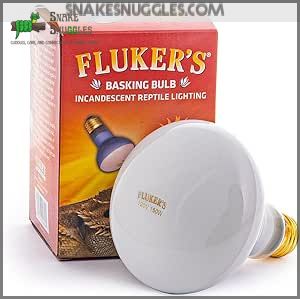
Prefer a simple bulb over a built-in gadget? This 100-watt incandescent spot delivers infrared radiant heat and aims it at one basking area, which helps you hit that 90°F hot spot. It fits standard reptile hood fixtures, and it’s made in the United States. Ball pythons handle it well.
Wattage and mounting height both affect that basking spot, so this guide to the best heat lamp for ball pythons helps you compare bulb options.
Plug it into a dimming thermostat, though. Owners report short lifespans, sometimes just a few months, plus occasional shattering or loose internals, so keep a spare handy and check it often.
| Best For | Reptile keepers who want a simple, no-frills incandescent spot bulb to create a warm basking area for species like bearded dragons, tegus, and ball pythons. |
|---|---|
| Light Type | Infrared incandescent bulb |
| Power Rating | 100W |
| UVB Output | N/A |
| Heat Output | Infrared radiant heat |
| Compatible Species | Bearded dragons, tegus, ball pythons |
| Reported Lifespan | Few months |
| Additional Features |
|
- Delivers infrared radiant heat aimed at one basking spot, helping you reach about 90°F.
- Fits standard reptile hood fixtures and lamps.
- Made in the United States.
- Short lifespan, with some bulbs failing within a few months.
- Some reports of shattering or loose internal parts.
- Each species needs its own temperature research, so you have to work out the right setup yourself.
5. Pawfly 6W Terrarium LED Light
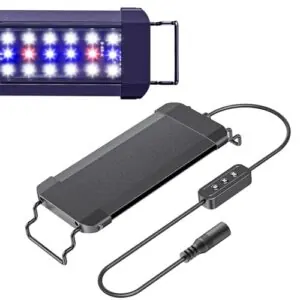
A compact LED like the Pawfly 6W earns its spot as an accent light, not a heat source. It packs 6500 K white, 450 nm blue, and 660 nm red LEDs into a solid aluminum housing that weighs 15.2 ounces. You get six intensity levels for blue and white, plus separate day and night buttons, so your snake’s sleep cycle stays natural.
Output hits 2000 lux, 40 PAR, and CRI 90. Watch the bumper setting; the bracket may slide out.
| Best For | Owners of small terrariums (6 to 10 inches long) housing tarantulas, lizards, or ball pythons who want a compact, damp-proof accent light with day and night modes. |
|---|---|
| Light Type | LED (white, blue, red) |
| Power Rating | N/A |
| UVB Output | N/A |
| Heat Output | N/A |
| Compatible Species | Tarantulas, lizards, ball pythons |
| Reported Lifespan | N/A |
| Additional Features |
|
- Combines 6500 K white, 450 nm blue, and 660 nm red LEDs, with six independent intensity levels for the blue and white light.
- Has dedicated day and night buttons that simulate natural light cycles and support healthy animal sleep patterns.
- Delivers 2000 lux, 40 PAR, and a CRI of 90 in a solid aluminum housing with strict silicone sealing for damp-proof use.
- Is not bright enough to work as a primary grow light for plants.
- Has an extendable bracket that may slide out if the bumper setting is not adjusted enough.
- Works as an accent light rather than a heat source, and its promotional video contains flashing lights.
6. Adjustable UVB Reptile Light Fixture
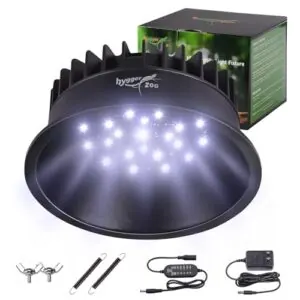
A compact aluminum fixture, about 5 x 5 x 4 inches, this one packs two purple UVB LEDs at 302 nm behind a curved reflector that concentrates output downward. It offers a nearly natural UVA/UVB ratio, plus a dimmer and an inline timer with auto-shutoff.
Here’s the catch. Some owners report the timer failing to restart, and the switch can emit a high-pitch buzz. A few units have also faded within six months, so check output with a UVB meter.
| Best For | Reptile owners with bearded dragons, geckos, turtles, chameleons, or snakes who want a compact, dimmable UVB light to support vitamin D3 synthesis and calcium absorption and who are willing to monitor its output. |
|---|---|
| Light Type | UVB LED |
| Power Rating | N/A |
| UVB Output | 302 nm UVB LEDs |
| Heat Output | N/A |
| Compatible Species | Bearded dragons, geckos, turtles, snakes |
| Reported Lifespan | Failures within 6 months |
| Additional Features |
|
- Curved reflector concentrates UVB output downward, with a nearly natural UVA/UVB ratio.
- Dimmer switch lets you adjust brightness, and the inline timer has auto-shutoff.
- Compact aluminum housing of about 5 x 5 x 4 inches suits a range of terrariums.
- Timer can be unreliable, with reports of it failing to restart.
- Control switch can emit an audible high-pitch buzz.
- Some units have failed or faded within six months, so a UVB meter is worth using.
7. Hygger Zoo 13W 5.0 UVB Reptile Bulb
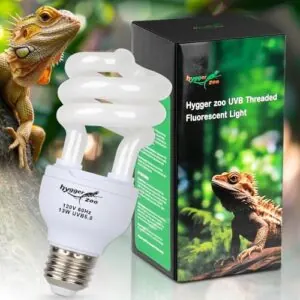
Picture a keeper with a cozy 36-inch juvenile setup, a halogen basking lamp doing its job, and a nagging worry that the snake isn’t getting any UVB. This bulb is a tidy fix for that.
It’s a 13W 5.0 model with 5% UVB and 30% UVA, built with quartz glass for steady output. At 2.3 inches wide, it squeezes into shallow domes using a standard E26 base.
Know the catch: it gives off very little heat, so you’ll still need a separate warming source. A few buyers also report short lifespans, so keep a spare handy.
| Best For | Reptile and amphibian keepers with small or shallow-domed enclosures who already have a separate heat source and want to add UVB for animals like snakes, frogs, chameleons, turtles, or iguanas. |
|---|---|
| Light Type | UVA/UVB quartz glass bulb |
| Power Rating | 13W |
| UVB Output | 5% UVB |
| Heat Output | No significant heat |
| Compatible Species | Turtles, frogs, snakes, chameleons |
| Reported Lifespan | 1 to 3 months for some |
| Additional Features |
|
- Slim 2.3-inch diameter fits shallow light domes with a standard E26 screw base.
- Quartz glass construction keeps UVA and UVB output stable, with 5% UVB and 30% UVA.
- Supports vitamin D3 synthesis and calcium absorption by mimicking natural sunlight.
- Lifespan is inconsistent, and some units reportedly fail within one to three months.
- Gives off very little heat, so a separate basking lamp is still required.
- One user reported the bulb smoking and failing to turn on at first use.
8. T5 HO Reptile Light Fixture
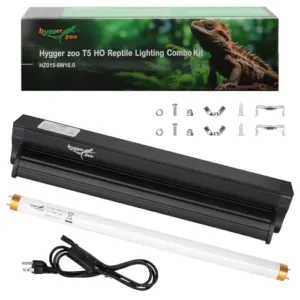
Imagine this: you’ve got a 36" x 18" juvenile enclosure and a hatchling that’s been a little wobbly around the jaw. A compact UVB fixture can help, and this is the Hygger Zoo T5 HO.
It’s a 12-inch fixture with an 8W UVB 10.0 bulb included, in a ventilated aluminum housing with a polished reflector. Mount it on mesh or inside the vivarium. Remove the blue film first.
Reviews report early bulb failures, and there’s no refund option, so test your output with a UVB meter.
| Best For | Reptile owners with a small to mid-sized enclosure, such as a 36" x 18" juvenile setup, who want a compact, affordable UVB fixture that can mount on mesh or sit inside the vivarium. |
|---|---|
| Light Type | T5 HO UVB fluorescent |
| Power Rating | 8W |
| UVB Output | UVB 10.0 |
| Heat Output | N/A |
| Compatible Species | Bearded dragons, turtles, chameleons, snakes |
| Reported Lifespan | Days to 7 months |
| Additional Features |
|
- Comes with an 8W UVB 10.0 T5 HO bulb included, so it’s ready to use out of the box.
- Polished, curved reflector directs light where it’s needed, and the aluminum housing helps dissipate heat.
- Flexible mounting: it can sit on a mesh cover or be installed inside the vivarium, and it works for bearded dragons, turtles, chameleons, and snakes.
- Some customers report bulbs failing within days, while others report failure after about 7 months.
- There is no official refund, return, or replacement option for defective units.
- The blue plastic film must be removed before use to prevent debris, and the output should be checked with a UVB meter.
9. DXOPHIEX 15 Inch Dual Reptile Light Fixture
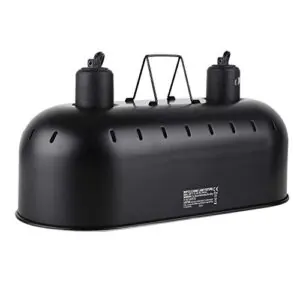
Ever tried squeezing a UVB tube and a basking lamp into one tight spot? This dual fixture gives you room to breathe. At 15 inches wide, it spaces bulbs farther apart than 11-inch versions, and two independent switches let you control each socket separately, handy for a day-night routine.
The polished aluminum shade reflects light downward, and each socket takes up to 150 watts. Two high-wattage bulbs can melt nearby plastic dividers, and some owners report switches failing within months.
| Best For | Reptile owners with bearded dragons, lizards, turtles, snakes, or frogs who want a wide dual-lamp fixture that lets them run a UVB bulb and a basking lamp side by side on separate switches. |
|---|---|
| Light Type | Dual-socket lamp fixture |
| Power Rating | 150W max per socket |
| UVB Output | N/A |
| Heat Output | High with dual lamps |
| Compatible Species | Bearded dragons, turtles, snakes, frogs |
| Reported Lifespan | Failures within months |
| Additional Features |
|
- Two independent switches let you control each socket separately, which suits a day-night routine.
- The 15-inch width spaces the bulbs farther apart than 11-inch dual fixtures, and each socket handles up to 150 watts.
- It sits on terrarium screens or hangs from the included hook, and the polished aluminum shade reflects light downward.
- Some owners report that one side stops working or a switch breaks within months.
- Running two high-wattage bulbs at once can create enough heat to melt nearby plastic dividers.
- Wires can touch the enclosure hood if they aren’t managed carefully, which creates a potential hazard.
10. REPTI ZOO 100W Reptile Heat Lamp
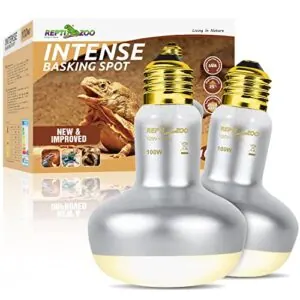
Want a no-fuss basking bulb that won’t break the bank? This one’s worth a look.
It’s a 2-pack of white 100-watt bulbs with a standard E26 base, so it fits most dome fixtures. The vacuum aluminizing boosts efficiency by 35%, and the flat-bottom shape focuses light into a tighter beam, which helps you build a clear basking hot spot.
Buyers do report bulbs failing early, and a few mention glass separating from wires. Always run it through a dimming thermostat and check it often.
| Best For | Reptile and amphibian keepers or chicken brooders who want an affordable, quiet basking heat source and are willing to monitor it closely. |
|---|---|
| Light Type | UVA heat lamp |
| Power Rating | 100W |
| UVB Output | N/A |
| Heat Output | Soft basking heat |
| Compatible Species | Reptiles and amphibians |
| Reported Lifespan | 2,000-3,000 hours advertised |
| Additional Features |
|
- Emits UVA radiation and soft heat to simulate natural sunlight
- Flat-bottom shape focuses light into a tighter beam for a clear basking spot
- Operates quietly without buzzing or light flickering
- Some users report bulbs failing early, with temperatures spiking before expiration
- Some customers report glass separating from the electrified wires, which is a safety hazard
- Reviews are mixed on whether the actual lifespan matches the advertised 2,000 hours
Why Lighting Matters for Ball Pythons
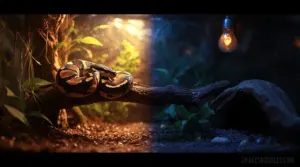
Once the bulbs are picked, it helps to know what they’re actually doing for your snake. Light isn’t just décor. Ball pythons can see ultraviolet, and their bodies use light to set their circadian rhythm, so a steady 12-hour on, 12-hour off schedule keeps them calm and predictable. For nighttime warmth, use zero-visible-light sources such as ceramic heat emitters so the dark cycle stays truly dark and their sleep isn’t disrupted.
Heat matters just as much. A warm basking spot lets your snake move between temperatures, which drives digestion and thermoregulation. Get that wrong, and you’ll often see a python refuse meals.
Do Ball Pythons Need UVB Light?
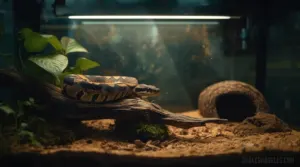
Not strictly. Ball pythons eat whole prey, so they get vitamin D3 and calcium from their meals. Still, a low-output bulb gives you more reliable calcium metabolism, and here’s what keepers notice:
- Steadier circadian rhythm
- Stronger immune function
- Healthier skin
- More natural, active behavior
- Better eyesight thanks to UVA
In the wild, they catch only faint sunlight, so skip high-output bulbs. Choose a linear 5.0 UVB tube and replace it every six months; it stops working before it stops glowing.
Choosing The Right Heat Lamp and Wattage
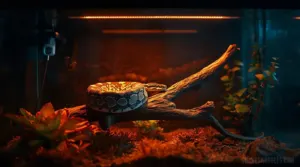
Once your UVB tube is sorted, heat comes next, and wattage is where most keepers stumble. Your room matters more than the bulb’s label, so start here: If your room runs cold, a ceramic heat emitter for reptiles adds steady warmth after dark without light disturbing your pet’s sleep.
- Juvenile tank, 10 to 20 gallons: 50 to 75W.
- Adult glass tank, 20 to 40 gallons: 75 to 100W.
- Enclosures over 40 gallons: 100 to 150W.
- Cold room? Add 25 to 50W.
Aim for a basking spot of 88 to 92°F with a thermostat guarding your heat lamp, and leave a cooler end
Setting a Safe Day-Night Light Cycle
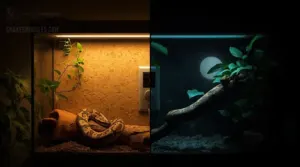
Heat is sorted, so now let’s talk about when it runs. Ball pythons come from near the equator, so a steady 12 hours on and 12 hours off suits them well. You can nudge it to 12.5 hours in summer and 11.75 in winter if you like.
Put everything on a dedicated reptile timer so the schedule never slips. Your snake wants real darkness at night, and nighttime temperatures of 70 to 78°F are perfectly fine. Skip red or blue bulbs, since snakes see them.
A timer keeps your ball python’s days and nights on schedule, because real darkness after sunset matters more than any colored bulb
How to Set Up and Place Lights
Mount your heat lamp above a screen-top enclosure whenever you can, since the mesh keeps your snake away from the bulb. Inside the tank, a bulb cage is mandatory.
Here’s the setup in four steps:
- Put the heat source at one far end, leaving the other end unheated.
- Place a flat flagstone under the lamp, with a hide beneath it.
- Put a matching hide on the cool side.
- Lay digital probes at substrate level on both sides.
Aim for 88–92°F warm, 76–80°F cool.
Frequently Asked Questions (FAQs)
How often should I replace UVB bulbs?
Most UVB bulbs need replacing every 6 to 12 months, since UVB output decay starts the day you install them. T5 HO tubes last about a year; T8 and coil bulbs, six months. Mark dates.
Do LED lights bother ball pythons?
Sometimes, yes. Daytime LED reptile lighting is fine if it’s dimmable and angled away from their eyes.
At night, though, any glow disrupts sleep, so choose heat over light with a ceramic heat emitter instead.
How can I watch my snake at night?
Skip red and colored lights, and any night vision camera with IR, because your snake can see them. Keep the enclosure dark and peek through the glass. A dimmer switch helps with nocturnal animal care.
Do bioactive enclosures need extra lighting for plants?
A reptile UVB bulb on a planted tank is like asking a candle to run a greenhouse. Yes, your bioactive terrarium needs a separate full spectrum LED, around 5200K to 7000K, because UVB alone starves live plants.
Can ball pythons see red or blue light?
Ball python eyes work like a dimmer switch. Snakes’ visual acuity is modest, red light bulbs barely register in the visible light spectrum, blue looks faint. Ambient room light and visual observation of snakes matter.
Conclusion
Does a glowing bulb mean a working bulb? Not even close. Your UVB output fades long before the light does, and that’s the quiet trap in reptile lighting.
The best light for ball python care isn’t one fancy fixture. It’s a matched, guarded setup: right wattage for your tank, a thermostat on every heat source, and a calendar reminder to swap bulbs.
Do that, and your snake gets warmth and honest darkness. You sleep easy.