This site is supported by our readers. We may earn a commission, at no cost to you, if you purchase through links.
Ball pythons don’t need much. They need it exactly right. A 36x18x12 inch tank with a warm end at 30 to 32°C and a cool end at 26 to 28°C can hold a healthy snake for decades. Get one number wrong, and you’ll meet mold, stuck shed, or an empty enclosure and a snake behind your couch.
Most keepers blow it on small details: a lid that doesn’t lock, a heat source with no thermostat, a water dish in the wrong zone. The best terrarium setup for ball pythons fixes all of that.
Here are the seven products worth your money.
Table Of Contents
- Key Takeaways
- Best Ball Python Terrarium Size and Enclosure Type
- Ball Python Heating, Temperature Gradient, and Lighting Setup
- Ball Python Humidity, Substrate, and Cleaning Setup
- Where to Place Hides, Water, and Climbing Enrichment
- Top 7 Products for a Ball Python Terrarium Setup
- 1. Zoo Med T8 ReptiSun 50 UVB Fluorescent Bulb
- 2. Exo Terra Repti Glo 20 Compact Fluorescent Terrarium Lamp
- 3. Compressed Coconut Husk Reptile Bedding Substrate
- 4. Zoo Med Aspen Snake Bedding 8 Qt
- 5. Galapagos Terrarium Green Sphagnum Moss 4 Quart
- 6. Zoo Med Forest Floor Cypress Mulch Bedding
- 7. Flukers Repta Vines Pothos Reptile Terrarium Decor
- Frequently Asked Questions (FAQs)
- What type of terrarium is best for a ball python?
- What is the best enclosure setup for a ball python?
- What size terrarium is best for a ball python?
- What are the best enclosures for ball pythons?
- How Often Should I Clean My Ball Python’s Enclosure?
- What is the Best Way to Feed My Ball Python?
- How Often Should I Handle My Ball Python?
- What Plants Are Safe to Have in a Ball Python Enclosure?
- Are Ball Pythons Vocal?
- What is the best tank setup for a ball python?
- Conclusion
Key Takeaways
- Give your adult ball python a secure, locking 40-gallon breeder (36x18x12 inches) or larger, because a cramped tank or a loose lid is the fastest route to a stressed snake or an escape.
- Offer a temperature gradient with a 30 to 32°C warm end and a 26 to 28°C cool end, run every heat source through a thermostat, and never let any spot pass 32°C.
- Keep humidity at 50 to 60% (60 to 70% during shed, never long-term above 80%), use a moisture-holding substrate like coconut husk, and trust hygrometer readings at both ends over your gut.
- Place a snug hide on each end, set the water dish in the cool or middle zone, and add climbing enrichment, then check your numbers weekly and spot-clean daily so the setup stays stable for decades.
Best Ball Python Terrarium Size and Enclosure Type
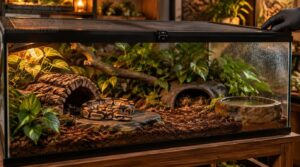
A cramped tank is the fastest way to a stressed snake. Enclosure size matters more than any fancy accessory you’ll buy later. For an adult, start with a 40-gallon breeder, which runs 36x18x12 inches. Bigger is better. Aim for a length about 1.5 times your snake’s stretched-out body.
Once the enclosure is ready, a corn snake color morph guide can help you choose a morph that suits your setup.
A cramped tank is the fastest way to a stressed snake, so give your ball python room to stretch
Glass enclosures are the easy pick. They hold humidity well and look great. PVC enclosures cost more, but they resist warping and hold moisture even better. Skip unsealed particle board. It swells and rots.
Whatever you choose, you need secure lids. Ball pythons are escape artists. Sliding screen tops with locks work, and they give you solid ventilation too. Is your lid truly snake-proof? Test it. Push on every corner before move-in.
Ball Python Heating, Temperature Gradient, and Lighting Setup
Your enclosure’s size is settled. Now give it a climate. Ball pythons regulate their own body heat, so you need to offer a gradient and let them choose.
Set a basking spot at 30 to 32°C on one end, with the cool side at 26 to 28°C. Put a thermostat on every heat source. No exceptions.
- Probe the thermostat near the warm zone.
- Check temperature at both ends with digital probes.
- Verify weekly with an infrared gun.
- Track daily highs and lows for two weeks.
A heat mat works, but heat lamps give better ambient warmth. Never let any hot spot pass 32°C. UVB rays aren’t required, but a low-output fixture on a 12-hour timer is a fine optional addition.
Ball Python Humidity, Substrate, and Cleaning Setup
Heat is only half the climate. Next comes moisture.
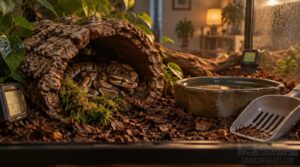
Aim for 50 to 60% humidity overall, and let it climb to 60 to 70% when your snake goes into shed. Keep it under 80% for long stretches, or you’ll grow mold. Put a hygrometer at each end of the terrarium and trust the readings, not your gut.
Pick a substrate that holds moisture without turning soggy. Compressed coconut husk does this well. Cypress mulch adds airflow. Add a handful of green sphagnum moss in one hide for a local boost. Skip fine sawdust. It irritates eyes and lungs.
Cleaning is simple. Spot-clean daily. Do a full strip every 2 to 4 weeks, rinse, and air-dry. That’s the whole maintenance routine.
Where to Place Hides, Water, and Climbing Enrichment
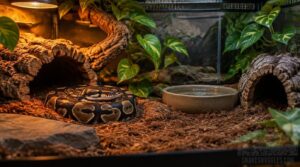
Moisture sorted, now furnish it. A bare box stresses a snake out.
Once humidity is dialed in, add a hide and a few cork flats over a deep layer of coconut husk, since ball python substrate options differ in how well they hold moisture and cushion burrowing.
Put one hide on the warm end and one on the cool end. Your ball python should have to choose, not settle. Make sure each hide fits snug and the entrance stays clear.
Set the water dish in the cool or middle zone, a few centimeters off the substrate, at least 4 to 6 cm deep. Keep it near a hide, not against it. Soggy corners breed mold, and good ventilation keeps air moving.
Here’s what happens when you skip the extras:
- Your snake hides all day.
- It never explores.
- It gets bored and stressed.
- You miss the best behavior.
Add a cork branch near the warm end.
Top 7 Products for a Ball Python Terrarium Setup
You’ve sorted out the size, the heat, the humidity, and where everything goes inside the tank. Now it’s time to fill it with gear that actually earns its spot. These seven picks cover lighting, substrate, and décor, so you can build a setup your ball python will thrive in.
1. Zoo Med T8 ReptiSun 50 UVB Fluorescent Bulb

Want a simple way to support your snake’s health? Start overhead. The Zoo Med T8 ReptiSun 50 puts out 5% UVB, so your reptile can make its own vitamin D3 and you can’t overdose it. That helps protect against bone problems.
It’s a 25W FS36 tube, 36.2 inches long. Keep your animal within 12 inches for effective output. Reviews on lifespan are mixed, so note the install date and replace it on schedule. Skip it for iguanas.
| Best For | Owners of lizards (other than iguanas), turtles, and tortoises who want a straightforward overhead UVB tube that lets their animals make their own vitamin D3. |
|---|---|
| Product Type | UVB tube |
| Length | 36.2 inches |
| Power | 25W |
| Suitable Animals | Lizards, turtles, tortoises |
| Lifespan Concerns | Mixed reviews |
| Main Limitation | Must be within 12 inches |
| Additional Features |
|
- Its 5% UVB output lets reptiles regulate their own vitamin D3, so there is no overdose risk.
- It helps prevent bone problems in lizards and supports stronger shell growth in turtles and tortoises.
- It can boost appetite and activity and encourage natural reproductive behaviors.
- Reviews on lifespan are mixed, with some owners saying it doesn’t last as long as expected.
- It isn’t recommended for iguanas.
- It must be within 12 inches of the animal to work well, and nothing is provided about its spectrum beyond the 5% UVB.
2. Exo Terra Repti Glo 20 Compact Fluorescent Terrarium Lamp
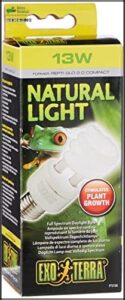
The Exo Terra Repti Glo 20 is a 13 watt compact fluorescent that gives you a bright, natural-looking day cycle. It’s a 6700K, 98 CRI bulb, so your enclosure looks true to life and live plants like it. Ball pythons are nocturnal, so this works well.
But it’s not your UVB source. Output is low, so pair it with a proper UVB tube. Also, fluorescents lose about 50% of their light within a year. Budget for replacements.
| Best For | Keepers of planted terrariums or nocturnal and low-UVB animals like snakes and amphibians who want a bright, natural-looking daylight bulb to use alongside a separate UVB source. |
|---|---|
| Product Type | Compact fluorescent bulb |
| Length | N/A |
| Power | 13W |
| Suitable Animals | Snakes, amphibians, nocturnal animals |
| Lifespan Concerns | Mixed reviews, some under six months |
| Main Limitation | Low UVB output |
| Additional Features |
|
- Full spectrum 6700K light with 98 CRI makes the enclosure look true to life.
- Supports live plant growth in planted terrariums.
- Complements UVB bulbs to create more natural lighting conditions.
- Low UVB output, so it can’t be your only light for reptiles that need UVB.
- Loses about 50% of its light output and UV within a year, so plan on replacing it.
- Customer reports on lifespan are mixed, and some units failed in under six months.
3. Compressed Coconut Husk Reptile Bedding Substrate
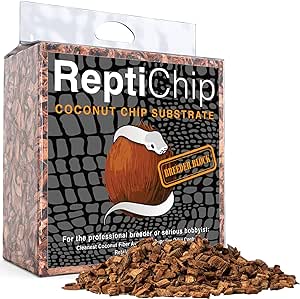
Worried it’s too damp or messy? It isn’t, if you do it right. Compressed Coconut Husk Reptile Bedding Substrate expands when you add water, so wring it out until it’s barely moist.
For humidity management, it’s hard to beat. Its moisture regulation keeps levels steady and helps with shedding. Substrate maintenance is simple: spot clean daily, replace the top inch weekly, and let wet patches dry.
| Product Type | Artificial vine |
|---|---|
| Length | 6 feet |
| Power | N/A |
| Suitable Animals | Chameleons, geckos, ball pythons, corn snakes |
| Lifespan Concerns | Leaves may fall off |
| Main Limitation | Ineffective suction cups |
| Additional Features |
|
4. Zoo Med Aspen Snake Bedding 8 Qt
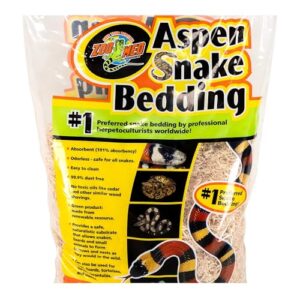
Isn’t aspen too dry for ball pythons? Fair question. Substrate selection matters, and Zoo Med Aspen Snake Bedding 8 Qt works if you add a humid hide.
These low-resin Aspen shavings are dust-free and wick moisture well. Keep 2 to 3 inches down for adults.
Substrate maintenance is easy. Scoop waste weekly, and replace any moldy patch immediately. Pothos is also a safe plant species for enclosures.
5. Galapagos Terrarium Green Sphagnum Moss 4 Quart
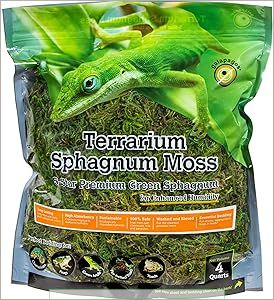
Think moss is a stand-alone substrate? No. Just, no.
Galapagos Terrarium Green Sphagnum Moss 4 Quart works best as a humidity booster, not a base. Tuck it into a damp moss pocket inside the hide for shedding assistance.
- Pair it with a drainage-capable base.
- Keep it away from heat sources.
- Smart enclosure design leaves airflow, preventing mold.
- Replace it every two to four weeks.
- Toss it if it smells sour.
Used right, it holds humidity for days. Used wrong, it grows mold fast. Check it often.
6. Zoo Med Forest Floor Cypress Mulch Bedding
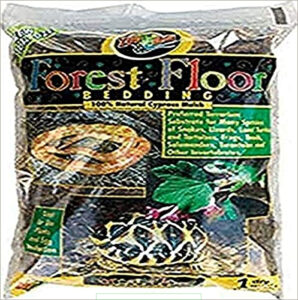
Want a substrate that behaves like a forest floor? Zoo Med Forest Floor Cypress Mulch Bedding comes close.
Good substrate selection starts with moisture control. This cypress mulch holds humidity, resists mold when kept right, and lets your ball python dig. Spread 1 to 2 inches deep. It also suits a bioactive setup.
| Task | Frequency | Why |
|---|---|---|
| Spot-clean | Daily | Prevents mold |
| Mist | As needed | Keeps humidity |
| Check moisture | Weekly | Stops stuck shed |
| Replace | Every 1-3 months | Resets substrate |
Skip substrate maintenance? No.
7. Flukers Repta Vines Pothos Reptile Terrarium Decor
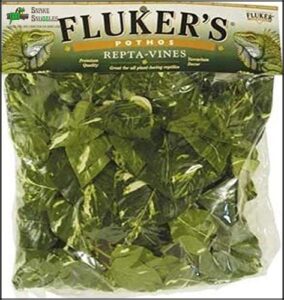
Your ball python needs something to climb, and bare glass won’t cut it. Fluker’s Repta Vines give you 6 feet of non-toxic polyethylene you can cut to fit your enclosure.
Here’s the catch. The suction cups are mediocre at best, so don’t trust them with the whole run. Anchor the vines to branches or walls instead. Also, inspect the internal wire every week. Any exposed metal means replace it. Leaves can drop off under UVB, too.
Rinse with water. Keep them clear of heat.
| Best For | Keepers of chameleons, crested geckos, ball pythons, or corn snakes who want a cut-to-fit climbing vine and will check it regularly for wear. |
|---|
- Comes in a 6-foot length of non-toxic polyethylene that can be cut to fit your enclosure
- Easy to clean with a simple water rinse
- Suits a range of reptiles, including chameleons, crested geckos, ball pythons, and corn snakes
- The suction cups are often reported as mediocre or ineffective, so the vine needs other anchoring
- Leaves may fall off over time, especially with UVB exposure
- Contains an internal metal wire that needs regular inspection to keep your reptile safe
Frequently Asked Questions (FAQs)
What type of terrarium is best for a ball python?
Your snake will escape through a pencil-wide gap, so buy a secure enclosure.
A ventilated 4x2x2 enclosure works best, with a clear temperature gradient, hides on both warm and cool sides, and regular substrate maintenance.
What is the best enclosure setup for a ball python?
Your enclosure is a tiny rainforest postcard, not a shoebox.
Give adults a 40-gallon breeder, a secure lid, and a 78–92°F temperature gradient. Keep humidity near 55%, use aspen substrate, and add two snug hideouts.
What size terrarium is best for a ball python?
Go bigger than you think. Adults need 40 to 55 gallons, ideally four feet long.
That enclosure size gives you room for a proper temperature gradient, snug hideouts, steady humidity levels, and smart substrate selection.
What are the best enclosures for ball pythons?
Your adult needs a minimum enclosure size of 40 gallons. Glass enclosures work well here. Keep a tight, secure enclosure lid, a proper temperature gradient, and humidity between 55-65 percent.
Anything smaller? No. Just, no.
How Often Should I Clean My Ball Python’s Enclosure?
Spot cleaning daily is your baseline. Follow waste removal protocols: scoop feces, urates, and uneaten prey fast. Deep cleaning monthly resets everything. Keep disinfectant use in reptile enclosures safe and rinsed, within one sanitation protocol.
What is the Best Way to Feed My Ball Python?
Picture a 300-gram juvenile eyeing a mouse.
Offer prekilled rodents once weekly, matching the prey size ratio to its girth. Keep feeding frequency steady, skip handling through the digestion period, and follow handling frequency guidelines.
How Often Should I Handle My Ball Python?
Your ball python doesn’t think you’re a friend, just a very large predator. So keep handling frequency guidelines simple: once or twice weekly, ten minutes max. Skip meal days, and feeding schedule alignment matters most.
What Plants Are Safe to Have in a Ball Python Enclosure?
Plantsafe terrarium flora builds a natural environment. Stick with spider plants, Boston ferns, and peperomia. They’re enrichment items that boost humidity, but need enclosure ventilation and substrate maintenance. Skip pollen-heavy bloomers. Philodendrons? No. Just, no.
Are Ball Pythons Vocal?
Hoping for a chatty roommate? Sorry. Vocalization absence in ball pythons is normal. A stressed ball python might hiss or sigh briefly when handled. Dial in your terrarium setup, temperature gradient, and humidity between 55-65%.
What is the best tank setup for a ball python?
What does a ball python need? A tank of at least 40 gallons, a temperature gradient from 78 to 92°F, humidity between 55-65%, hides on both warm and cool sides, plus a thermometer and hygrometer.
Conclusion
A ball python can live 30 years, so your enclosure is a long commitment, not a weekend project. The best terrarium setup for ball pythons isn’t fancy. It’s stable.
Lock the lid, run a thermostat, keep the water dish on the cool side, and check your numbers weekly.
Do that, and the daily work shrinks to a glance and a quick top-up. Your snake settles in, eats well, and sheds clean. Build it right once.