This site is supported by our readers. We may earn a commission, at no cost to you, if you purchase through links.

Your corn snake used to strike at the feeder mouse the moment it dropped in. Now she hesitates, tires halfway up the branch, and drags her belly along the substrate. That slow slide from enthusiastic to listless is often how calcium deficiency announces itself.
The early signs of calcium deficiency in corn snakes are easy to dismiss as a bad week. They’re also easy to miss until a jaw softens or a spine kinks, and damage to bone doesn’t fully reverse.
Here are five signs worth knowing, when they demand a vet today, and how to prevent the problem.
Table Of Contents
- Key Takeaways
- 5 Possible Calcium Deficiency Signs in Corn Snakes
- When Suspected Calcium Deficiency Needs Urgent Care
- How Vets Diagnose Corn Snake Calcium Deficiency
- Why Corn Snakes Develop Calcium Deficiency
- Preventing Deficiency: Whole Prey, UVB, and Supplements
- Frequently Asked Questions (FAQs)
- What are the early warning signs of calcium deficiency?
- Do corn snakes need calcium powder?
- What are the common causes of death in corn snakes?
- What are the symptoms of calcium deficiency in reptiles?
- What are the symptoms of calcium deficiency in snakes?
- What are the symptoms of calcium deficiency in corn?
- Does my corn snake need calcium?
- What are the early signs of MBD?
- Can snakes regrow bones after calcium deficiency?
- How often should I dust prey with calcium?
- Conclusion
Key Takeaways
- Watch for lethargy, tremors, appetite and weight loss, a soft jaw, and spinal kinks, since these signs often overlap and none confirms calcium deficiency on its own.
- Call a reptile vet the same day if your snake shows paralysis, seizures, a swollen jaw that makes eating hard, or weeks of lethargy with weight loss, and don’t dose calcium yourself.
- Bone damage from calcium deficiency generally can’t be reversed, so catching it early is what protects your snake’s jaw and spine.
- You can prevent most cases by feeding healthy whole prey, providing working UVB lighting, keeping temperatures correct, and dusting with calcium only lightly and occasionally.
5 Possible Calcium Deficiency Signs in Corn Snakes
Calcium deficiency in corn snakes often starts quietly, so you’ll want to know what to look for.
Since diet is the most common cause, a corn snake feeding guide can help you spot gaps in prey size, frequency, and supplementation early.
The five signs below are the ones most commonly linked to metabolic bone disease, a condition where weak bones and poor muscle control develop from low calcium. Keep in mind that these signs often overlap, and none of them confirms a diagnosis on its own.
Muscle Weakness and Unusual Lethargy
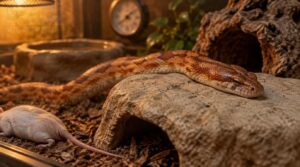
You might first notice muscular weakness as a corn snake that stops hunting, climbing, or exploring. Calcium deficiency disrupts muscle contraction, so your snake tires quickly and may drag its body instead of moving smoothly.
Lethargy outside brumation, despite correct temperatures, is usually a warning sign of metabolic bone disease. Weight loss makes that more likely.
Tremors and Muscle Twitching

Weakness often comes with muscle tremors in corn snakes. Calcium deficiency makes nerves fire too easily, so you may see fine twitching, especially during handling.
Watch for:
- Twitching along the flanks
- Trembling while climbing
- Stiff, spasming muscles
- Tremors despite correct temperatures
- Jerky movements after handling
Review your calcium supplementation and vitamin D3 exposure, then see your reptile vet right away.
Pregnant snakes have higher calcium and nutrient demands, so this guide to caring for pregnant snakes properly can help you adjust her diet, enclosure, and weekly checks.
Reduced Appetite and Weight Loss

Tremors often pair with a quieter problem: your corn snake stops eating. Calcium deficiency weakens the muscles used for feeding and swallowing, so weight drops over two to four weeks.
Watch for a visible spine, regurgitated meals, or refusal that continues beyond shedding or brumation. Check temperatures and UVB first, since poor husbandry mimics these calcium deficiency symptoms. A loss above 5% of body mass per month needs a vet.
Soft or Misshapen Jaw
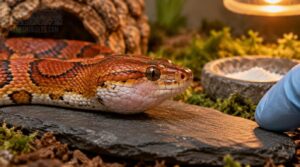
A weak appetite can also show up in your snake’s face. Calcium deficiency in snakes can soften the lower jaw, and you may notice swelling, a rounded profile, or a slight bulge. A jaw that feels rubbery or bends under gentle pressure is a warning.
These calcium deficiency symptoms usually develop over weeks, so start calcium supplementation and book a vet visit early.
Spinal Deformities and Fragile Bones
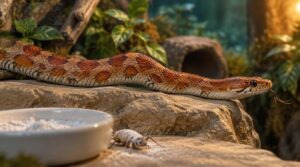
Kinks along your corn snake’s spine are among the most serious signs of calcium deficiency. When calcium stays low, the body pulls it from the vertebrae, and Metabolic Bone Disease (MBD) weakens them.
Because even nutritious prey can leave gaps in your snake’s diet, it helps to compare healthy snake food options and pick feeders that keep calcium levels steady.
You’ll usually notice spinal deformities like sideways curves or humps, plus bones that break easily during handling. Without calcium supplementation and proper UVB lighting, the damage is generally permanent.
When Suspected Calcium Deficiency Needs Urgent Care
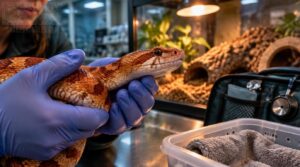
Symptoms of calcium deficiency in snakes often build slowly, but some can’t wait for a routine appointment. Call a reptile veterinarian the same day if you see any of these:
- Sudden paralysis or inability to move, which signals a hypocalcemia crisis.
- Seizures, active bleeding, vent prolapse, burns, or severe breathing distress.
- Straining or egg binding in a gravid female beyond 24 to 48 hours.
- Weeks of lethargy, refusal to eat, and visible weight loss.
- A swollen, misshapen jaw with trouble eating or drinking.
These signs usually point to serious Metabolic Bone Disease, where long-term calcium shortfalls leave bones weak. Delay generally worsens outcomes. A deformed jaw may become permanent without prompt treatment.
Don’t dose calcium yourself. Your vet stabilizes first.
How Vets Diagnose Corn Snake Calcium Deficiency

Picture a two-year-old corn snake named Biscuit whose jaw feels slightly rubbery and whose spine has a faint kink. Her owner assumes it’s an old injury, but a veterinary evaluation tells a different story.
Vets usually build the diagnosis in layers:
- Physical exam: your vet checks the jaw for softness, the spine for kinks, and muscles for tremors.
- Blood work: ionized calcium, the active form, shows true deficiency, while blood calcium levels and phosphorus ratios reveal imbalances.
- Radiographic imaging: X-rays reveal thin bone cortex, reduced density, and fractures.
- Husbandry review: expect questions about prey, supplements, gut-loading, and UVB exposure.
- Ruling out other causes: trauma, infection, genetic disorders, and kidney problems.
Follow-up diagnostic imaging also tracks bone healing once treatment begins.
Why Corn Snakes Develop Calcium Deficiency

Think of your corn snake’s skeleton as a bank account, and calcium deficiency usually starts when withdrawals keep outpacing deposits, whether from a diet with too little calcium and too much phosphorus, a shortage of vitamin D3, or poor UVB exposure. Several husbandry gaps often drive those withdrawals in captive snakes:
Your corn snake’s skeleton works like a bank account, and calcium deficiency begins when withdrawals outpace deposits
- Offering prey with a poor calcium-phosphorus ratio, like skinned or bone-free pieces.
- Skipping dietary calcium supplements when feeding frozen-thawed mice.
- Running weak or expired UVB lighting that no longer emits useful output.
- Overdosing or underdosing vitamin D3, which disrupts calcium absorption either way.
- Keeping enclosures too cool, since low temperatures slow digestion and nutrient absorption.
Many owners overlook the last item. Even a well-balanced diet can’t build bone if your snake can’t digest and absorb it properly.
Here’s the tricky part: deficiency develops slowly, often over several months, so early changes are easy to miss entirely. Breeding females face extra risk, because egg production pulls calcium straight from their skeletons.
Preventing Deficiency: Whole Prey, UVB, and Supplements

Prevention is far easier than treatment, and it starts with what you feed. Whole prey supplies bone calcium, plus vitamin A and D from the liver, in a naturally balanced calcium-phosphorus ratio. Choose healthy, well-fed rodents, and avoid skinny ones or very young pinkies, since their skeletons are poorly mineralized. Rotate frozen stock often, because vitamins degrade in storage.
UVB lighting adds a second safety net. Your snake synthesizes Vitamin D3 in its skin, and that vitamin lets it absorb and use calcium. Diet alone often works, but UVB is often more reliable when prey quality varies. Oral D3 is a weaker substitute and easier to overdo.
A calcium supplement is rarely necessary, so dust it lightly and only occasionally.
Frequently Asked Questions (FAQs)
What are the early warning signs of calcium deficiency?
One owner I saw noticed only a sluggish snake. Early calcium deficiency often starts with muscle tremors, weakness, lethargy, and a soft jaw. Left alone, it can eventually cause seizures, difficulty shedding, and skeletal deformities.
Do corn snakes need calcium powder?
Most corn snakes never need calcium powder. A whole mouse delivers bone, and bone delivers calcium. If you feed appropriately sized prey, calcium supplementation is generally unnecessary, though an occasional dusting won’t hurt.
What are the common causes of death in corn snakes?
Ironically, the quietest killers hide in your own husbandry. Respiratory infections, impaction, septicemia, and parasites lead, but calcium deficiency, Metabolic Bone Disease, and a hypocalcemia crisis can follow poor UVB lighting and missing Vitamin D
What are the symptoms of calcium deficiency in reptiles?
Reptiles with low calcium often show muscular weakness, tremors, and sometimes seizures. You’ll also notice skeletal deformities like a soft jaw or bowed limbs, poor appetite, and difficulty shedding. Call your exotic vet right away.
What are the symptoms of calcium deficiency in snakes?
Many keepers believe a soft, rubbery jaw is the first sign, but it’s usually late. Early on, you’ll usually see muscular weakness, tremors, and difficulty shedding.
Severe cases generally bring severe skeletal deformities and seizures.
What are the symptoms of calcium deficiency in corn?
A snake’s skeleton is its quiet scaffold, and when it bends, trouble is building.
Calcium deficiency usually causes lethargy, tremors, seizures, a soft jaw, skeletal deformities, and difficulty shedding. Watch for muscle twitching early on.
Does my corn snake need calcium?
Yes, but usually through diet and light, not heavy supplementation. Corn snakes fed whole prey generally get enough calcium. Light dusting with calcium supplementation and vitamin D3 helps captive setups, though over-supplementing can harm your snake, so ask your vet.
What are the early signs of MBD?
Many keepers assume Metabolic Bone Disease appears only when bones bend.
That’s not so. Early calcium deficiency brings lethargy, appetite loss, muscle tremors, and a rubbery jaw, well before skeletal deformities or calciumphosphorus ratio problems.
Can snakes regrow bones after calcium deficiency?
No, snakes generally can’t regrow bone lost to calcium deficiency. Metabolic Bone Disease damage usually stays. Calcium supplementation and bone remodeling can stabilize and strengthen what remains, but you shouldn’t expect full recovery.
How often should I dust prey with calcium?
Dust prey with calcium every other feeding for most snakes. Adults eating rats commonly need it every 14 to 21 days. Without UVB, choose calcium with vitamin D3, and avoid over-supplementation to protect calcium-phosphorus balance.
Conclusion
Picture a keeper who spots a slightly soft jaw on her corn snake and decides to wait a month. By then, the bone has already changed shape.
The signs of calcium deficiency in corn snakes start small, so call your vet early. Tremors or weakness deserve attention now, not next week.
Prevention is simpler. Feed whole prey, provide UVB, and dust supplements. Your snake can’t tell you she’s hurting, but a routine keeps her strong.