
This site is supported by our readers. We may earn a commission, at no cost to you, if you purchase through links.

Yes, a snake held by the tail can bite you. Most species can’t curl back far enough to reach your hand, but racers and water snakes twist close enough to try. Even when they can’t, your arm, shoulder, and face sit inside strike range. A snake launches the front third of its body forward, so a six-foot snake covers three feet in a fraction of a second.
Tail-holding also hurts the animal. It spikes stress hormones and can damage the spine, since the tail has no ribs to absorb the thrashing.
Here’s how bites happen, what the snake pays for your grip, and what to do if one lands.
Table Of Contents
Key Takeaways
- Yes, a snake held by the tail can still bite you, because it coils into an S-shape, braces against your grip, and strikes up to half its body length at your arm, shoulder, or face.
- You can’t predict or block a strike when you hold the tail, and flexible species like racers and water snakes can even reach the hand that’s gripping them.
- Tail-holding hurts the snake too, since it spikes stress hormones and twists a spine that the tail has no ribs to protect, sometimes causing paralysis hours later.
- Support the whole body with both hands, move slowly, and treat any suspected venomous bite as an emergency, while nonvenomous bites need gentle washing, a clean bandage, and a doctor if redness spreads or your tetanus shot is overdue.
Can a Tail-Held Snake Still Bite?
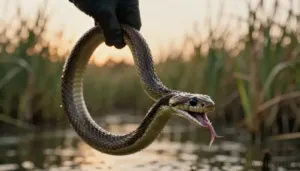
Can a snake still bite when you’re holding its tail? Yes, and you shouldn’t assume otherwise. This is one of the most common handling myths, and it gets people hurt.
Setting up an open, uncluttered habitat, like this rosy boa enclosure setup, also leaves room to use a snake hook instead of grabbing.
Most snakes can’t curl back far enough to reach the hand gripping their tail tip. Their musculature limits how far the head can rotate when the body hangs from one end. That’s the part the myth gets right.
But the real danger isn’t your hand. It’s your arm, shoulder, and face, which are all within range of a thrashing snake. Smaller, flexible species like racers and water snakes can twist closer and bite the holding hand directly.
Lifting a snake by the tail or middle can also cause vertebral displacement and spinal injury, which is why the whole body should be supported on a flat surface.
You also have no control over the head. A strike can’t be anticipated or blocked.
How Tail-Held Snakes Reach Your Hand
The previous section covered what’s at risk. Now let’s look at how a snake gets there.
A snake doesn’t need to curl back on itself to bite. It does three things in quick succession:
- It tightens its body into an S-shaped coil, which works like a compressed spring.
- It pushes against your grip, turning your hand into a fixed anchor.
- It launches the front third of its body forward.
- It closes the gap in a fraction of a second.
Reach is the problem. A snake can strike about one-third to one-half of its body length, and a tightly coiled one goes farther. A six-foot snake can cover three feet.
That range shifts with species and how much of the body is anchored, which is why how far a snake can actually jump or strike varies more than most people expect.
Speed matters too. A warm, active snake strikes faster, and even a small one can reach your hand before you react.
Tail-Holding Can Stress and Injure Snakes

Your bite risk is only half the problem. The snake pays too.
Tail-holding leaves a snake unable to orient its body, so it panics. Corticosterone spikes within minutes and stays high longer than it would with supported handling. The tail has no ribs, and thrashing sends twisting force through the spinal column.
| Harm | What happens | Warning sign |
|---|---|---|
| Stress | Hormone surge | Hissing, thrashing |
| Spinal injury | Vertebrae shift | Limp tail |
| Internal organ strain | Body hangs unsupported | Regurgitation |
| Weak immunity | Repeated stress | Infections, anorexia |
Damage can hide. A snake may look fine after being dangled, then develop paralysis hours later. Snakes can’t regrow or repair tails quickly, and healing takes months.
A snake dangled by its tail can seem unharmed, yet paralysis may strike hours afterward, and recovery takes months
Treat tail-holding as a serious snake handling risk, and don’t do it.
Safer Handling Supports Your Pet Snake’s Body

The fix is simple: support the whole body. A snake’s spine and ribs run nearly its full length, so the entire torso carries weight. Hold it at roughly the one-third and two-thirds marks, and the spine won’t bend under its own load.
Use one person per metre of snake. Anything over 8 feet needs two people.
Approach from the side or below, not from above. Overhead movement looks like a predator. Wait until the tongue-flicking slows, then use hand-over-hand movement and let the snake pick its direction. That cuts struggling and fall risk.
Skip handling during the blue phase, when the eyes turn opaque. Vision is poor and defensiveness is high.
Keep sessions to two or three a week, at a consistent time. More than that adds stress your snake can’t shake for weeks.
Snakebite First Aid and When to Seek Help
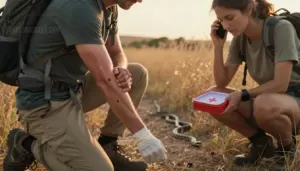
A bite can still happen, even when you do everything right. What you do in the first minutes depends on whether the snake is venomous. The two sections below cover suspected venomous bites and nonvenomous bites, so you know what to do in each case.
Suspected Venomous Bites Are Emergencies
A snake bite that looks minor can turn dangerous within hours. If you suspect venom, call emergency services now. Don’t wait for symptoms.
Watch for:
- Swelling that spreads up the limb
- Bleeding that won’t stop
- Drooping eyelids or blurred vision
- Dizziness, weakness, or trouble breathing
Keep the bitten limb still and get to a hospital fast. Antivenom works best early.
First Aid for Nonvenomous Bites
Wash the bite gently with soap and water, apply antibiotic ointment once, and cover it with a clean, dry bandage. Skip ice, cutting, sucking, and tourniquets. Avoid aspirin and ibuprofen, since they can worsen bleeding. Remove rings and watches right away, because swelling can come late.
Get medical attention if your last tetanus shot was over 10 years ago, redness spreads, pus appears, or you feel unwell.
Frequently Asked Questions (FAQs)
Can a snake bite through gloves?
Think a glove makes you bite-proof? It doesn’t. Thin leather and rubber fail often. Even snake-rated gloves are only puncture-resistant. Fangs can penetrate seams, gaps, and worn spots, so inspect gloves before every session.
Can a baby snake hurt you by biting?
You might think a baby snake is too small to matter. Usually, that’s true. A baby corn snake bites with about 2 newtons of force and teeth under 1 mm, so you’ll feel a pinch and maybe a scratch.
How can you tell if it’s a snake bite?
A snake leaves its signature in skin. Look for one or two deep puncture wounds, not rows of tiny scratches.
Swelling, bruising, and sharp pain that climbs the limb point to venom. Dry bites exist.
Is it legal to handle wild snakes?
Washington’s ban on cobras and rattlesnakes shows how much the rules vary. Whether you can handle wild snakes depends on your state and the species. Many places require permits, and threatened species are off-limits federally.
Which snake species are most likely to strike?
You might think any snake can strike equally, but it doesn’t work that way. Green mambas strike repeatedly with little provocation. Crotalus ravus struck in 71% of approach trials. Cottonmouths may lunge before any warning.
Conclusion
Can snakes bite when held by tail? Yes, and the grip rarely earns you anything but risk. Your hand, arm, and face stay inside strike range, while the snake pays with stress and possible spinal damage.
Skip the tail. Support the whole body with both hands, move slowly, and keep your face back. If a bite lands, wash it, watch it, and treat any suspected venomous bite as an emergency. Calm handling protects you both.
- https://www.quora.com/If-you-hold-a-snake-by-the-tip-of-its-tail-is-it-strong-enough-to-still-curl-up-and-bite-your-hand
- https://www.facebook.com/chawaman/videos/a-lot-of-people-ask-me-this-question-why-do-you-hold-a-snake-by-its-tail-does-it/2081933882107877
- https://peqaboo.com/knowledge/en/guides/snake-bite-and-constriction-accidents-safe-release-and-aftercare