This site is supported by our readers. We may earn a commission, at no cost to you, if you purchase through links.

Grab a snake wrong with a hook, and you won’t just spook it — you’ll trigger a strike, a wrenched spine, or a bite you didn’t see coming. A ten-foot Burmese python doesn’t forgive sloppy technique, and neither does a defensive hatchling half the size of your hand. The hook itself isn’t the hard part. Placement, pressure, and pacing decide whether your snake stays calm or coils into panic mode.
That’s where most handlers go wrong: right tool, wrong method. Get the mechanics right — where you place the hook, how you read the body’s signals, how you lift — and you’ll handle any snake with confidence, not luck.
Table Of Contents
- Key Takeaways
- Choose The Right Snake Hook
- Support The Midbody, Not Neck
- Prepare Before Hook Handling
- Read Stress Signals Carefully
- Lift and Return Safely
- Frequently Asked Questions (FAQs)
- How to properly use a snake hook?
- Can snakes hear human voice?
- Should you hold a snake by the head or tail?
- What 7 scents do snakes hate?
- How long should hooks last with proper care?
- What material is best for humid climates?
- Can beginners safely use a snake hook?
- How do I know if my snake trusts the hook?
- Whats the ideal temperature range for handling sessions?
- Conclusion
Key Takeaways
- Support your snake at the midbody with the hook curved upward, positioned one-third down from the head, since this distributes weight evenly and prevents spinal strain.
- Match your hook’s size and material to your snake’s size and species, using mini aluminum hooks for hatchlings, medium hooks for pythons, and heavy-duty steel hooks (with a second handler) for large constrictors.
- Watch for stress signals like S-coils, flattened neck posture, musking, or gaping, and end the session immediately if these signs persist or escalate.
- Move slowly and deliberately at 2-4 inches per second, tap gently before lifting, and always keep the snake’s head directed away from you to minimize strike risk.
Choose The Right Snake Hook

The right hook makes every lift safer, and the wrong one puts both you and your snake at risk. Size, weight, and species all factor into your choice, so don’t just grab whatever’s hanging on the wall. Here’s what to look for before you pick one up.
Depth matters more than you’d think—the same goes for water bowls sized right for soaking, where getting the fit wrong can stress your snake just as much as a mismatched hook.
For bigger-bodied snakes, compare snake handling hooks for large constrictors built to support their weight without flexing.
Before you buy, check out this guide on choosing the right hook length for your snake’s size so you’re not guessing at the hardware store.
Match Snake Size
One size doesn’t fit all snakes. Your snake hook must match body length and girth, or you risk instability mid-lift.
Grab the wrong tool and you’re asking for trouble:
- Weak support causes dangling
- Thin shafts bend under weight
- Poor grip triggers panic strikes
- Mismatched hooks cause spinal stress
Measuring body girth first prevents these failures entirely. It is essential to follow hook size recommendations to make sure the tool is appropriate for your specific species.
Mini-Hooks for Hatchlings
Hatchlings need mini-hooks measuring 8 to 12 inches, built from aircraft grade aluminum for a lightweight, rigid feel. Compact 0.5 to 0.75 inch heads and a 0.15 to 0.25 inch shaft keep the tool precise without added bulk.
Textured grips matter here—wet or gloved hands still need control. Always support the body, never the neck, when lifting these fragile newborns.
Medium Hooks for Pythons
Once your snake outgrows mini-hooks, step up to a medium snake handling hook built for ball pythons and similar species.
Look for anodized aluminum durability, a jaw opening of 1.5 to 2.5 inches, and contoured grip textures for sweaty hands. Shaft length runs 42 to 60 inches, giving safe python handling distance.
Smooth head design lets you support the body without snagging scales.
Heavy Hooks for Constrictors
Large constrictors demand serious gear. Reach for a heavy-duty steel hook with a 5-6-foot shaft, reinforced spine, and non-slip grip for wet conditions.
Stainless steel beats aluminum here—aluminum bends under pressure. Corrosion resistance matters in humid enclosures.
For true constrictor management, pair your hook with a second handler; two-person handling keeps snake handling safety intact when weight and strength escalate.
Smooth Rounded Hook Heads
The head shape matters as much as the shaft. A convex profile on the hook head sheds bark, grass, and rock without snagging—terrain clearance that keeps lifts smooth.
Smooth rounded heads deliver:
- Reduced scale abrasion
- Lower surface friction against scales
- Better material durability over years of use
Pair that curve with proper equipment, and your gentle lifting methods stay consistent, safe, and snag-free.
Before you handle any snake, learn to recognize defensive bluffing versus genuine strike readiness so that tucked chin and forward tilt don’t catch you off guard.
Support The Midbody, Not Neck
Once you’ve got the right hook, placement is everything. The neck might seem like the natural spot, but it’s the wrong one—support belongs at the midbody. Here’s exactly where to position that hook and why it matters.
One-Third Body Placement
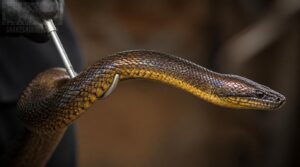
Position your snake handling hook one-third of the way down the body, measured back from the head. This spot gives you midline weight distribution without touching the neck.
Support the midsection here, and you’re stabilizing body arcs naturally, reducing spinal torque while keeping ventral scale protection intact. Monitor midbody tension constantly. This single placement rule separates confident handlers from those fighting the snake every step.
Curved Hook Facing Up

Turn that snake handling hook so the curve sweeps upward, cradling the body instead of pressing against it. This orientation delivers ventral scale protection, keeps friction low, and creates real hook pivot stability.
The upward curve spreads weight evenly, giving you genuine pressure distribution benefits while you reposition. Polished shafts add friction reduction, letting you shift smoothly without alarming an already-tense snake.
Avoid Dangling Weight

A sagging body is a snake handling hook’s worst enemy. Any unsupported length creates imbalance risks, straining muscles and risking spinal strain.
Weight distribution balance matters: keep the midsection cradled, not hanging. This preserves midbody stability, curbs snake stress reduction efforts, and stops preventing body sag from becoming an afterthought—it’s the whole point of proper midsection support.
Prevent Scale Pressure

Scales aren’t armor plating—they’re vulnerable to creasing, pinching, and micro-tears under concentrated force. Choose hooks with smooth, rounded heads and pair them with soft, towel-like padding to cut friction against ventral scale contact.
Distribute weight across a broad surface, never a narrow edge. Inspect contact points afterward for lifting or damage. This pressure point avoidance is essential to real snake handling safety.
Keep Movements Slow

Speed kills trust here—rushed hook movements read as predatory to a snake’s nervous system. Move at a controlled 2-4 inches per second to avoid triggering reflexive coiling triggers or sudden escapes.
Maintaining steady pace prevents thrashing and keeps strike prevention front and center. Slow, deliberate motion respects natural snake behavior, giving the animal time to process contact instead of panicking.
Prepare Before Hook Handling

Good technique means nothing if you skip the groundwork. Before that hook ever touches your snake, a handful of prep steps set the stage for a safe session. Here’s what to lock down first.
Sanitize Hook First
Grab your hook before your hands ever touch the snake. Wipe it down with a veterinary-grade cleaner, soak it 5 minutes in a solution safe for metal, then rinse with sterile water to strip residue. Air-dry completely.
Skipping disinfectant contact time undercuts biosecurity — log the sanitation step, product, and date before storing the hook in a closed container.
Wash Hands Thoroughly
Your hook’s clean. Now your hands need the same treatment.
Wet them, lather with soap for a full 20 seconds, working suds between fingers, under nails, and across wrists. Rinse under running water until no residue remains, then dry with a clean paper towel. This isn’t optional — it’s basic biosecurity, cutting Salmonella transmission risk before contact begins.
Secure The Room
Clean hands mean nothing if the room’s still a hazard zone.
Close every door, clear bystanders, and confirm your exit path stays open. Bite prevention starts with controlling the space, not just the snake. If your facility runs biometric access control or surveillance monitoring, make sure those systems log the session — solid emergency response readiness depends on knowing exactly who’s in the room.
Prepare Holding Container
Have a secure holding container staged before you lift the snake off the substrate. Container sizing matters: allow 1.5 body lengths of vertical space for airflow and comfortable coiling.
- Rigid, nonporous walls
- Breathable, locking lid
- Paper towel substrate
- Species and date label
- Ground-level placement
Check humidity monitoring stays within 40-60%. Skip loose substrate—impaction risk isn’t worth it.
Avoid Post-Feeding Handling
Rushing to lift a snake right after a meal invites trouble. Wait 24-72 hours before handling—this digestion window matters.
| Timeframe | Risk Factor | Action |
|---|---|---|
| 0-24 hrs | Regurgitation | No handling |
| 24-48 hrs | Aggression | Observe only |
| 48-72 hrs | Stress | Light checks |
| 72+ hrs | Minimal | Resume normal |
Watch for gaping or coiling—these signal feeding distress requiring immediate session end.
Read Stress Signals Carefully

Your hook keeps you at a distance, but it won’t do the reading for you. Every snake tells you exactly how it’s feeling, through its body, its breath, and its behavior. Here’s what to watch for before things escalate.
S-Coils and Striking
That tight S-shape isn’t posturing for show — it’s a loaded spring. Rapid strike velocity follows once the coil releases, faster than you can react.
An S-coil isn’t posturing, it’s a loaded spring that strikes faster than you can react
Watch for the pulled-back head and tensed neck muscles; that’s your signal to back off, slow your hand speed, and reposition the hook lower on the body.
Ignore it, and you’re gambling with snake handling safety.
Flattened Neck Posture
Watch the neck flatten and press forward — that’s a defensive neck posture, not relaxation. The curve straightens, loading the cervical spine unnaturally.
This signals rising tension, often paired with:
- Stiffened shoulders
- Shortened strikes-ready stance
- Reduced head mobility
Left unchecked, this posture stresses muscles and nerve pathways. Reposition your hook lower, slow down, and give the snake room to settle before continuing.
Musking or Defecating
That foul, musky smell is a stress response trigger, not an accident. Musking or defecating mid-handling means the snake feels cornered and wants you gone.
Keep gloves on for post-defecation cleanup, and check stool consistency while you’re at it — runny or bloody output signals abnormal stool worth monitoring. Handling musk odors takes soap, warm water, and patience. Set the snake down, let it calm, then resume.
Gaping or Heavy Breathing
An open mouth held wide, showing jaw interior, paired with forceful breathing — that’s your snake telling you it’s struggling, not resting. This is a respiratory panic sign, not casual behavior.
Look for jaw tension, fixed head posture, and rhythmic throat movement matching each breath. These distress breathing cues often follow hook contact directly — a clear handling pressure response demanding immediate reduction in contact.
End Sessions Early
Know when to quit. If S-coils hold 20 seconds, strikes double within a minute, or the snake musks and defecates, end the session immediately.
Document the exact moment stress appeared, coil depth, and room temperature — this termination criteria documentation shapes safer future sessions.
Return the snake head-first, then allow 10 minutes of calm-down before any follow-up contact.
Lift and Return Safely

Once you’ve read the snake’s signals and you’re clear to proceed, the lift itself demands its own precision. Every motion from here forward, from first contact to the final release, follows a specific order for a reason. Here’s exactly how to carry that process through safely, start to finish.
Tap Gently Before Lifting
Slow down before that hook makes contact. A single, light tap at the midbody warns the snake and reduces startle responses.
Match tap pressure calibration to body size:
- Use fingertip-level force only
- Center taps on midbody
- Observe reaction cues immediately
- Stop if coiling increases
- Document responses for tailoring future handling
Use Two-Point Support
Once the tap settles, move to two-point support: one contact under the midsection, one slightly behind it, spaced evenly for weight distribution balance.
| Contact Point | Placement | Purpose |
|---|---|---|
| Point 1 | Midsection | Primary spine stress prevention |
| Point 2 | Behind midbody | Contact point alignment |
| Both | Equidistant | Muscular tension control |
Keep hook heads flat, pressure steady, and movements slow for reptile handling stability.
Support Large Snakes Together
Large constrictors demand a team, not a solo effort. One handler can’t manage a supporting weight arc across a heavy body alone.
Assign roles clearly: keeper controls the head end, spotter watches for defensive coiling, extra hands cradle the midsection. Shared verbal cues before each lift keep timing synced.
This two-hand technique, scaled to multiple handlers, prevents twisting, sudden drops, or spinal strain during coordinated movement.
Keep Head Directed Away
Orient the head away from you at every stage of the lift, coordinated or solo. This single habit drives bite risk reduction more than any other technique.
Position yourself at the shoulder line, guiding midbody with steady, controlled hook movements. Avoid sudden jerks — they invite thrashing. Maintain safe distance so a strike can’t reach you, even mid-repositioning.
Return Head-First Safely
Guide the snake into its container gently, head first, over several smooth seconds — no abrupt shifts in momentum. Dim the room lights beforehand to ease stress. Keep two-point contact under the midbody until it’s fully inside, then withdraw the hook.
Monitor breathing rates as you finish. Once calm, log session details: duration, mood, any stress signs worth noting next time.
Frequently Asked Questions (FAQs)
How to properly use a snake hook?
Picture a four-foot ball python, hook slid under its midbody, curved head up. You support one-third of its weight, move at 2-4 inches per second, and keep grip steady—no sudden jerks, no dangling, just controlled, slow manual manipulation.
Can snakes hear human voice?
Not the way you’d expect. Without external ears, snakes rely on jaw-bone conduction, picking up vibrations and low-frequency sound below 500 Hz. Loud voices near the head can trigger sound-induced stress behavior—so keep handling sessions calm and quiet.
Should you hold a snake by the head or tail?
Neither. Grabbing the head risks jaw joint injury and triggers defensive strikes; the tail invites thrashing and spinal harm. Support the mid body instead—it’s your snake’s true center of gravity, and the key to safe handling.
What 7 scents do snakes hate?
Cinnamon, clove, eucalyptus, peppermint, citrus, garlic, and ammonia top the list.
Each disrupts a snake’s chemical-sensing system, triggering avoidance rather than aggression—useful for yard barriers, though skip harsh oils near captive enclosures to protect scent-sensitive pet snakes.
How long should hooks last with proper care?
A quality heavyduty steel hook can last years past a mid-grade one—2 to 3 times longer. Weekly inspection, thorough drying, and dry sheath storage methods prevent corrosion. Coated finishes add 20–50% more service life under proper maintenance protocols.
What material is best for humid climates?
Salt air rusts cheap gear fast — myth or fact? True.
Corrosion-resistant metals like stainless steel and heavy-duty steel win here. Skip moisture-absorbing materials; composite material durability keeps your snake hooks solid, mold-free, and safely maintained for years.
Can beginners safely use a snake hook?
Yes, with the right setup.
Choose lightweight aluminum hooks, wear protective gloves, and start with calm, smaller snakes.
Proper safety gear, slow movements, and basic handling knowledge build confidence fast, turning early nerves into steady, capable control.
How do I know if my snake trusts the hook?
Trust isn’t quite the word—snakes don’t bond with tools. Instead, watch for relaxed muscle tone, smooth gliding instead of stiff freezing, and no musking or striking. A calm, steady posture on the hook signals comfort, not fear.
Whats the ideal temperature range for handling sessions?
Room temperature between 68 and 75°F keeps stress low. Never exceed 85°F—heat stress risk climbs fast.
Use infrared monitoring for ambient room stability, watch snake behavior closely, and maintain temperature consistency protocols to prevent metabolic strain during your session.
Conclusion
A hook works like a bridge, not a leash — it carries weight, it doesn’t control it. Master how to properly support a snake with a hook, and every lift becomes routine instead of risky.
Watch the coils. Read the posture. Move slow.
The snake doesn’t need to trust the tool — it needs to trust the hands behind it. Get the mechanics right, and calm follows every time.