This site is supported by our readers. We may earn a commission, at no cost to you, if you purchase through links.

A snake hook looks like a simple tool—until you watch someone use the wrong size on a defensive ball python. Grab too short a hook, and you’re within strike range before you know it. Grab the right one, and you control the entire interaction from a safe distance.
That’s the real value of learning how to use a snake handling hook safely: it turns a moment of risk into a routine procedure. The right hook, placed correctly and read against the snake’s body language, does most of the work for you.
Below, you’ll find the exact sizing, prep steps, and lifting mechanics that separate confident handlers from lucky ones.
Table Of Contents
Key Takeaways
- Match your hook’s length and shaft diameter to the snake’s size and weight—from 12-14" mini-hooks for hatchlings up to 48-72" heavy-duty models for large constrictors—since undersized tools mean poor control and scale stress.
- Prepare thoroughly before handling by washing your hands, sanitizing tools, wearing puncture-resistant gear, securing the area, and having a proper holding container ready.
- Read your snake’s body language—defensive S-coils, flattened necks, heavy breathing, or retreating postures—to know when to proceed, back off, or stop handling entirely.
- Lift correctly by placing the hook one-third back from the head, moving at 2-4 inches per second, supporting the body fully, and keeping the head angled away from you to prevent strikes.
Choose The Right Snake Hook

Your hook is the single biggest factor in whether a handling session goes smoothly or turns risky. The right length, material, and head shape depend entirely on what’s in front of you—size, weight, and temperament all matter. Here’s how to match your equipment to the snake you’re actually working with.
For a deeper breakdown of shaft length, hook curve, and grip options suited to bigger or more defensive snakes, this guide to snake handling hooks for experienced keepers walks through what actually matters when you’re choosing gear.
Match Hook to Snake Size
One wrong-sized hook can turn a routine lift into a strike. Precision length matching keeps your grip out of range while giving you control over the snake’s midsection.
- Hatchlings: 12-14" mini-hooks
- Small snakes: 24-36"
- Medium (ball pythons): 36-48"
- Large constrictors: 48-72"
- Telescoping models for on-the-fly adjustment
Match shaft diameter to body weight, too—thinner aluminum for light species, thicker steel for heavy-bodied ones, preventing scale stress. It is also essential to use snake handling hooks correctly to maintain clear behavioral cues.
Mini-Hooks for Hatchlings
Hatchlings demand a different touch entirely. A 6 to 10 inch tip reach, tapered shaft, keeps your control precise without pinching fragile scales.
Stainless steel resists corrosion in humid enclosures, and rounded, curved tips prevent snagging delicate skin. Pair your mini-hook with matching pinners—a proper kit, built specifically for hatchling scale protection, beats improvising with oversized gear every time.
Hooks for Small Snakes
Once your snake outgrows the mini-hook, step up to a 24–36 inch hook for juveniles or a 36–47 inch model for small-to-mid-sized species.
Aluminum keeps things light for quick moves; steel adds durability in damp setups. Collapsible designs save space and adjust on the fly. Smooth, rounded heads and ergonomic grips prevent scale abrasion and keep your control steady.
Hooks for Large Snakes
Big constrictors demand serious hardware. Reach for 48–72 inch heavy-duty steel or fiberglass hooks with reinforced shafts resisting flex under 15-60 pound bodies.
Look for:
- Tempered steel or fiberglass construction
- Thick shaft walls preventing bending moments
- Load testing exceeding 100 pounds static weight
- Ergonomic grips reducing fatigue
Telescoping models add reach flexibility. Match hook width to girth—undersized tools mean poor control and scale stress.
Smooth Rounded Hook Heads
Run your thumb along the head before you buy it—if you feel a seam or edge, keep looking. A scale-friendly hook tip should glide like a river stone.
Rounded geometry distributes pressure evenly, cutting scale friction and preventing tissue damage. Polished or coated surfaces add slip, so your snake hooks engage smoothly, not roughly, protecting skin during every lift and reposition.
Prepare Before Using The Hook

Grabbing the hook is the easy part—getting ready is where most handlers cut corners. Before you ever reach for a snake, your hands, tools, gear, and space all need attention. Here’s what you need to check off first.
For a full rundown of the essentials, check out this guide on safe snake removal methods before you gear up.
Wash Hands First
Before your hook ever touches a snake, your hands need attention. Wet your hands with clean, running water, then lather soap well—friction lifts germs effectively. Scrub for 20 seconds, covering palms, backs, between fingers, and under nails. Rinse, dry with a clean towel.
This prevents Salmonella transfer and keeps handling snakes safely from the start.
Sanitize Handling Tools
Grab a soft cloth and wipe organic debris off the hook before disinfecting—dried scale oil and grime shield bacteria from sanitizers.
Use isopropyl alcohol (70%) or quaternary ammonium cleaners; both fight cross-contamination risks without corroding aluminum or steel. Rinse thoroughly to eliminate sanitizer residue, then air-dry on a clean rack.
Log the cleaning date and method for sanitation log accuracy.
Wear Protective Gear
Your body’s the last line of defense if the hook slips. Wear puncture-resistant gloves (Kevlar or UHMWPE) and Cordura gaiters on ankles and knees—strikes happen fast.
Add wraparound polycarbonate lenses for eye protection against sudden strikes, and confirm any respirator fits properly if you’re working dusty enclosures. Footwear with solid impact ratings rounds out your gear before touching any hook.
Secure The Area
A loose snake turns a routine job into a chase. Before the hook ever touches scales, lock down the space—close doors, block gaps, and clear people out.
For field safety, treat it like a controlled perimeter: limited entry points, clear sightlines, no bystanders wandering into strike range. This margin of control is what separates confident wildlife removal from a scramble.
Prepare a Holding Container
Where does the snake go once it’s off the hook? Have that answer ready before you start. A proper holding container runs 20 to 27 liters for small snakes, 40 to 60 liters for larger ones, with 8-12 vents for airflow.
Line it with reptile carpet, skip loose substrate, and keep a secure, easy-latch lid on hand—no scrambling once you’re holding a defensive snake.
Read Your Snake’s Body Language

Before that hook ever touches your snake, you need to read what it’s telling you. Snakes communicate stress through clear physical signals, not guesswork. Here’s what to watch for before you make your move.
Once you can reliably read those signals, the full picture of safe and confident snake handling techniques starts to click into place naturally.
Defensive S-Coil Posture
Watch for a tight loop with the head tucked behind the body—that’s your defensive S-coil, and it’s telling you something specific.
Spine muscles hold tension without cutting off breathing, ready for strike readiness if you push closer. The tail anchors as a counterweight.
Recognizing this posture during snake hook training keeps your hands out of the strike zone.
Flattened Head or Neck
A puffed-out neck or flattened head means the snake’s escalating past that S-coil. This is a defensive neck posture, often paired with a triangular head profile that mimics viper identification markers—even in non-venomous species bluffing hard.
Don’t mistake shape for species. Confirm with pupil shape and heat-pit presence before assuming risk level, and keep your hook ready for a possible strike.
Heavy Breathing or Gaping
Rapid breaths, audible huffs, or an open mouth signal respiratory distress indicators, not casual exertion. This isn’t about oxygen consumption from movement—it’s a stress signal tied to panic response cycles.
Gaping paired with tremors means you’re near defensive strike triggers. Back your hook off, give distance, and let respiratory rate settle before resuming handling.
Hiding and Retreating
A tucked head and tight coil near cover mean it’s done posturing—it’s leaving. Tail flicking drops off here, unlike earlier warning signs.
Watch for these retreating posture cues:
- Head pulled low, tucked against the body
- Movement toward leaf litter or brush for concealment through terrain
- Slow, deliberate withdrawal—no sudden bolts
- Heading toward burrows offering microhabitat thermal stability
Let it go. Forcing contact now pushes it toward the strike zone.
When Not to Handle
Some situations call for putting the hook down entirely. Visible health concerns—swelling, discharge, lethargy—mean deferral until a vet clears the animal. Post-medical handling should wait until full recovery.
| Trigger | Risk | Action |
|---|---|---|
| Poor lighting | Missed strikes | Improve visibility first |
| Wrong hook size | Scale stress | Match hook to girth |
| Recent shed | Skin injury | Postpone handling |
When in doubt, wait.
Signal Handling, Not Feeding

Your snake can’t tell the difference between a hook and a meal by sight alone—it relies on context clues you control. Get the approach wrong, and you risk a defensive strike instead of calm cooperation. Here’s how to send the right signal every time.
Approach From The Side
Your line of approach matters as much as the hook itself. Coming in from the side keeps the snake’s head oriented away from you, cutting your exposure to defensive strikes.
This side entry also minimizes shoulder movements that startle snakes into escape mode. Keep the hook parallel to the snake’s length, never bent or angled, so you maintain a stable platform and avoid sudden contact that reads as a threat.
Use Gentle Hook Taps
Tap the mid-body once, firmly enough to register, then wait. This isn’t feeding time, so your tap pressure calibration should stay light—just enough contact to signal intent without pinching scales.
Use perpendicular, directional taps, then watch closely. Forward movement means compliance; coiling away signals stress. This kind of observing post-tap responses habit builds trust between you and the snake over repeated sessions.
Avoid Sudden Movements
Your body speaks before your hands do. A jerky reach reads as an attack, and defensive strikes often follow that exact trigger.
Keep your breathing rhythm steady, your posture calm, and your approach slow. Fix your visual focus on the mid-body, not the head, and move the hook with even, unhurried tempo—no darting, no hesitation.
Keep Food Scents Away
Your snake can’t tell the difference between your hand and dinner if it smells like a rat. Prey scent lingering on skin triggers feeding response, not calm handling.
Wash up, and treat your kitchen habits like your feeding room habits—airtight food storage, sealed rodent management, no stray aromas. Skip the hook session if you’ve handled feeder rodents recently.
Wait After Feeding
A full belly buys you nothing if you rush it—wait 24 to 48 hours before any handling session.
That window lets digestion settle, calms feeding response, and cuts regurgitation risk. Maintain proper basking temps and stable humidity to support metabolic efficiency.
- Watch for digestion stress indicators
- Respect species-specific wait times
- Skip handling after large meals
Hooks stay put; patience does the rest.
Let the hook stay still and let patience do the work of calming your snake
Lift and Support Safely
Once your snake’s calm and you’ve made your intentions clear, the actual lift is where technique matters most. Bad positioning here causes more injuries than any other step in the process. Here’s exactly where to place the hook and how to carry the weight from there.
Place Hook One-Third Back

One number matters most here: one-third back from the head. That’s where ventral scale contact stays even, spreading weight without pinching soft tissue.
This spot balances control with comfort—close enough to the head for stability, far enough back to avoid spinal strain. Keep depth consistent across every lift. Your snake hooks work best when placement becomes muscle memory, not guesswork.
Lift Slowly and Briefly

Getting position right means nothing if your tempo’s off. Lift at 2 to 4 inches per second—fast enough for control, slow enough to reduce momentum force.
Pause briefly mid-lift. Check your balance, your snake’s response, before continuing. Keep your back neutral, knees bent—that’s spinal load management, not just for the snake but for you too.
Never Let Snakes Dangle
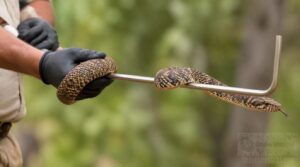
A dangling snake is a snake fighting gravity with nothing but its own spine. That’s a recipe for spinal strain, especially in longer-bodied animals.
Your hook gives lift, but it’s not a sling. Always keep at least one-third of the body weight supported, distributing load rather than letting it hang loose and unsupported below the hook point.
Support Larger Bodies

Big-bodied snakes need more than one hook can give. Use two-point contact: hook for the front, free hand cradling the midsection. This prevents spinal strain and stabilizes bulky weight properly.
Slide your palm under the thickest part of the body. Distribute weight evenly—don’t let any single section bear the load alone.
Keep Head Pointed Away

Direction matters as much as grip. Angle the head away from your body and bystanders throughout the lift—this is essential strike prevention, not just courtesy.
An away-facing head limits gaze tracking toward your hands, aiding gaze control and cutting defensive strikes. It also improves control optimization during controlled relocation, keeping safety margins intact while you guide the body forward.
Finish With Safe Aftercare

Handling doesn’t end when the snake goes back in its enclosure. What you do in the next few minutes matters just as much as the lift itself. Here’s how to close things out the right way.
Return Snake Calmly
The final moments matter as much as the lift itself. Guide the snake with smooth, steady motions, never abrupt jerks that spark a strike. Stay low, avoid towering over the enclosure, and let it exit the hook calmly.
Watch for a few seconds after release—confirm it moves away, not coiling defensively near the opening. Minimizing reentry anxiety starts with your composure.
Clean and Disinfect Hooks
Grab a microfiber cloth and warm, soapy water to wipe down the hook before anything else. Rinse thoroughly, then apply an EPA-registered disinfectant, respecting labeled contact times.
Stainless steel resists staining; check coated finishes for wear. Dry completely to prevent corrosion, then log the cleaning date—your inventory record proves the tool’s ready for next time, free of cross-contamination.
Check for Stress Signs
Did that session leave your snake calmer, or more wound up? Watch for breathing pattern shifts—rapid gaping signals lingering stress, not recovery.
Check muscle tension: rigid coiling or reluctance to move suggests agitation still hasn’t settled. Note any withdrawal behavior, appetite changes, or irritability toward normal handling cues.
These signs guide your next session’s timing—rushing a stressed snake back into handling only compounds the risk.
Store Equipment Safely
A cluttered shelf is where bad habits start. Store each snake handling hook on its own labeled shelf, separated by size and material to avoid mixups.
Keep aisles clear, cabinets locked, and use color-coded labeling systems for quick identification. Wipe down hooks after every use, and run a monthly inventory audit alongside routine corrosion prevention checks to keep gear ready and compliant.
Review Emergency Plans
A hook only controls the animal—it won’t manage a snakebite emergency. That’s why your emergency plan needs quarterly review: check evacuation maps, confirm incident command roles, and verify first aid kits and antivenom contacts are current.
Run communication drills so nobody hesitates during real emergency response. Every post-incident review should feed back into training, tightening snakebite prevention long before the next hook leaves the shelf.
Frequently Asked Questions (FAQs)
What are the risks of using snake hooks?
Mismatched hooks risk spinal injury and scale abrasion; rough handling triggers stress hormone spikes and defensive strikes. Damaged tools can fail mid-lift, causing snakebite hazards. Proper technique and protective gear keep both you and the snake safe.
How do you identify a venomous snake before handling?
Triangular heads, heat sensing pits, and elliptical pupils signal danger—but defensive posturing and bold body patterns matter too. Combine these venomous snake identification cues with cautious body language reading before ever reaching for your handling tools.
What pupil shape indicates a pit viper species?
Vertical, catlike pupils signal a likely pit viper—paired with heat-sensing pits and a triangular head. They constrict in bright light, dilate at night, aiding ambush vision. Pupil shape varies by species, so confirm with other traits before handling.
Since most bites happen when people poke, pin, or try to move a snake, it helps to learn the snake species found in Texas and admire them from a safe distance.
Juvenile pit vipers add another clue with their bright yellow-tipped tails used to lure prey, a trait detailed in this guide on identifying baby copperhead snakes.
Can you use a hook on aquatic snake species?
Yes, but expect a fight against murky water, not the snake. Submerged visibility challenges and rapid strikes demand specialized aquatic hooks—curved, rubber-tipped, wide-headed—to handle buoyancy shifts and warmer water’s heightened activity safely.
How often should snake hooks be replaced entirely?
Plan on replacing aluminum hooks every 5 years, stainless steel every 7- Watch for tip rounding, weld cracks, or rust pockets—these mean immediate replacement, regardless of age or material.
Whats the difference between aluminum and steel hook durability?
Steel wins on tensile strength and surface wear resistance; aluminum trades some durability for lighter handling. Hardening keeps steel edges sharp longer, while anodizing boosts aluminum’s corrosion protection.
Under repeated fatigue cycles, steel outlasts aluminum in demanding, high-load handling situations.
Conclusion
A thousand snake encounters could go sideways in a single heartbeat, yet a hook, sized right and read correctly, stops nearly every one of them cold. That’s the entire lesson behind how to use a snake handling hook safely: distance beats luck, every time.
Your hands stay clean, your snake stays calm, and the room stays controlled. Master the coil. Master the tap. Master the lift. Skip a step, and you’re gambling with fangs—follow the process, and you’re just doing your job.