This site is supported by our readers. We may earn a commission, at no cost to you, if you purchase through links.
Step outside on a summer night and the ground still radiates heat long after the sun disappears—warmth a snake’s belly scales can read like a map.
That single detail explains a lot about why snakes hunt at night: cooler air protects them from lethal overheating, while rodents, amphibians, and insects grow bold once darkness settles in. Heat-sensing pits, forked tongues, and low-light vision turn this nightly shift into a finely tuned survival strategy, not random wandering. What looks like stealth is really biology working exactly as it should.
Table Of Contents
- Key Takeaways
- Snakes Hunt Nightly to Survive
- Night Hunting Helps Thermoregulation
- Darkness Matches Snake Prey Habits
- Nocturnal Senses Guide Snake Hunting
- Night Encounters and Pet Snake Insights
- Frequently Asked Questions (FAQs)
- Why do snakes hunt at night?
- Do nocturnal snakes hunt at night?
- Why are snakes more active at night?
- Do rattlesnakes hunt at night?
- What smell do snakes hate the most?
- What is a snakes worst enemy?
- What month do snakes go away?
- What is the best time of day to avoid snakes?
- Do all snake species hunt exclusively at night?
- How does light pollution affect snake hunting behavior?
- Conclusion
Key Takeaways
- Nighttime temperatures between 60–85°F let snakes hunt efficiently while avoiding the lethal overheating and dehydration risks of daytime heat.
- Prey like rodents, amphibians, and insects become far more active after dark, giving snakes greater access to food while facing less competition from daytime predators.
- Specialized senses—heat-sensing pits, low-light vision, forked-tongue scent tracking, and ground vibration detection—allow snakes to locate and ambush prey effectively in darkness.
- Snake activity patterns vary by species and season, with factors like temperature, humidity, and prey migration shaping whether a snake is nocturnal, crepuscular, or diurnal.
Snakes Hunt Nightly to Survive
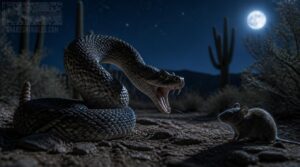
When the sun goes down, snakes don’t just disappear into the dark—they get to work. Every choice they make after dusk, from where they move to what they chase, ties back to one goal: staying alive. Here’s what’s really driving them out at night.
As temperatures fall, many species seek out warm, sheltered spots, following patterns similar to when snakes hibernate to conserve energy through the coldest months.
Cooler Hunting Temperatures
When the sun dips, cooler hunting temperatures let ectothermic snakes regulate their bodies without risk of overheating. Between 60 and 85 degrees Fahrenheit, they’re able to hunt efficiently, conserve moisture, and reduce metabolic stress.
Post-sunset thermal gradients across rocks and ground offer microhabitat refuges, supporting safe digestion and sustained activity, while preventing nighttime dehydration and boosting survival. Similar to snakes, certain sharks use a hunting behavioral strategy that aligns activity with temperature shifts.
Active Nighttime Prey
As temperatures drop, rodents emerge from burrows, and amphibians cluster near water after rainfall. Crickets and beetles swarm around midnight, amplifying prey density for snakes. Nocturnal hunting patterns line up with these prey peaks, letting snakes exploit:
- Rodent midnight foraging
- Amphibian vocalization surges
- Insect swarm concentrations
- Moisture-driven prey movement
Better Predator Avoidance
While prey density rises after dusk, predation risk drops sharply. Nocturnal snakes melt into shadowy substrates, using background matching and irregular body patterns to stay hidden from hawks or foxes.
Their heat-sensing pits and low-light vision detect approaching threats, prompting rapid evasion maneuvers—short bursts, coiled postures, and escapes into dense cover. These behaviors are woven into their nightly survival strategies.
Reduced Daytime Competition
Nocturnal snakes sidestep interspecific competition by occupying night hunting niches where diurnal rivals—birds, mammals, and larger predators—are absent. This opens exclusive foraging windows and reduces overlap for prime ambush spots. Resource partitioning lets you access prey with less interference, leading to:
- Higher hunting success rates
- Fewer territorial disputes
- Expanded feeding opportunities
- Enhanced natural environment interactions
Safer Moisture Levels
When you hunt at night, higher humidity protects your skin from dehydration and keeps body functions stable. Moist air prevents respiratory stress and helps maintain structural integrity—for both your shelter and wild habitat—by reducing mold and rot.
Choosing humid, low-light hides for nocturnal reptiles also dampens sound, easing stress during those crucial nighttime hunts.
Monitoring moisture with a humidity sensor ensures safe levels. These environmental factors shape your activity, letting you thrive when daytime dryness threatens health and nature’s stability.
Night Hunting Helps Thermoregulation
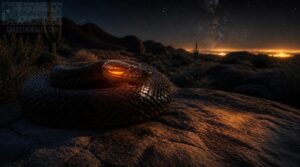
When snakes hunt at night, they’re carefully regulating their body temperature to stay healthy and active. This behavior relies on several key strategies that support their unique physiology. Let’s look at how they achieve effective thermoregulation through different nighttime adaptations.
Ectothermic Body Control
A snake can’t shiver its way warm; as an ectotherm, its body temperature rises and falls with the surroundings, not a built-in furnace.
Thermoregulation happens through vascular heat regulation—blood vessels dilating or narrowing—paired with subtle metabolic activity shifts and careful microhabitat selection. Even solar absorption techniques and occasional respiratory cooling play supporting roles, making animal thermoregulation a full-body balancing act rather than one single trick.
Avoiding Dangerous Heat
Rarely does a snake risk exposure during midday heat. Microhabitat thermal refuges—burrows, shaded rocks, leaf litter—offer shelter when ambient temperatures soar past their temperature tolerance limits. Extreme heat accelerates metabolic dehydration risks and evaporative water loss, stressing nutrient assimilation. Nocturnal activity helps avoid these hazards. Here are five ways snakes sidestep dangerous heat:
- Seek shaded refuges
- Pause movement
- Use moist microhabitats
- Limit daytime exposure
- Shift hunting to night
Warm Ground After Sunset
As night falls, heat stored in soil and rocks radiates upward, creating subtle warm ground patches that snakes exploit for thermoregulation. This thermal mass effect persists longer in urban areas, where concrete and asphalt act as reservoirs.
Beneath leaf litter or mulch, soil moisture insulation slows cooling, offering stable microclimates—essential for nocturnal snakes needing safe, energy-efficient body temperature control.
Seasonal Activity Shifts
You might notice that reptilian activity cycles shift with the seasons—when spring rains trigger amphibian migrations, snakes adjust their nocturnal behavior to follow prey abundance. During summer, temperature-driven metabolic shifts push snakes to hunt after sunset, conserving energy. As humidity rises in autumn, humidity-linked movement opens new corridors, shaping seasonal hunting windows and climatic activity variations that guide snake survival.
- Seasonal prey migrations
- Temperature-driven metabolic shifts
- Humidity-linked movement
Darkness Matches Snake Prey Habits
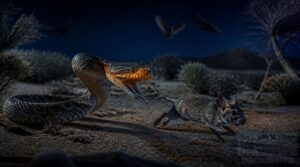
Many of the animals snakes rely on for food are most active after dark, shaping when and how snakes hunt. The cover of night creates unique opportunities for tracking, stalking, and ambushing prey. Here’s how different nighttime prey habits influence a snake’s approach to hunting.
Rodents Moving at Night
You’ll find that nocturnal foraging routes let rodents exploit darkness to move undetected along baseboards and inside walls. Their tactile navigation methods, using whiskers and body positioning, help them travel in near total darkness.
For snakes, this means scent trail detection and heightened sensitivity to nighttime auditory cues reveal prey availability, aligning perfectly with nocturnal snake behavior and their specialized sensory adaptations.
Amphibians After Rainfall
After rain, amphibians surge across moist ground, heading for newly formed pools to breed. These temporary ponds boost tadpole survival, as low fish presence reduces predation.
High humidity keeps skin hydrated, letting frogs and salamanders forage actively. Moisture-driven movement concentrates them in leaf litter and damp corridors, making them prime nocturnal targets for snakes equipped to detect scent and ground vibrations.
Ambush Hunting Advantages
With amphibians clustered in damp corridors, snakes exploit ambush hunting advantages. Remaining motionless in camouflage, they conserve energy and avoid detection. Strategic positioning near prey travel lanes and bottlenecks lets them strike efficiently.
Nocturnal behavior maximizes their stamina—waiting in cover, using infrared heat sensing to pinpoint prey movement, and reducing exposure to harsh conditions or competition from other predators.
Scent Trails After Dark
Cool night air slows odor dispersion, letting scent linger where prey once passed. Moist ground after rain holds trails longer, while lower wind concentrates plumes near their source.
- Fresh footprints versus stale ones
- Damp earth mingling with prey scent
- Still air forming detectable columns
Enhanced olfaction via forked-tongue sampling lets nocturnal serpents distinguish thermal scent contrast, guiding precise, silent pursuit through darkness.
Nocturnal Senses Guide Snake Hunting
Darkness only works as a hunting strategy if you can actually sense what’s moving through it.
Darkness only becomes a hunting strategy once a predator can sense what’s moving within it
Snakes carry a toolkit of specialized senses built for exactly this job, each one picking up what human eyes would miss entirely. Here’s a look at the five senses that turn a moonless night into a snake’s hunting ground.
Heat-sensing Pits
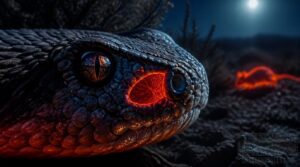
Picture seeing in heat instead of light. Heat-sensing pits on a pit viper’s face hold a membrane just 0.01mm thick, detecting infrared radiation down to thousandths of a degree.
The trigeminal nerve carries this data straight to the brain, where TRPA1 proteins help build a genuine thermal image—letting you understand how a snake strikes accurately at warm prey it can’t even see.
Low-light Vision
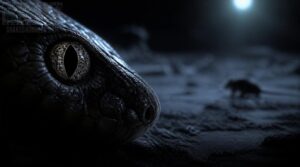
Once thermal imaging fades, vision takes over through a retina packed with high rod photoreceptor density, letting snakes navigate in near darkness where cones simply can’t function.
Vertical pupils widen dramatically, gathering scarce light while dark adaptation kicks in over several minutes. Even in mesopic conditions, contrast sensitivity trumps sharpness—so a rustling silhouette against pale ground stands out more than fine detail ever could.
Forked Tongue Scenting
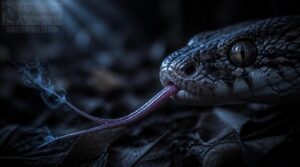
Flick, flick—that quick tongue motion is doing far more than tasting the air. Each fork tip samples a separate point in space, feeding its own Jacobson’s organ and enabling stereo smell triangulation.
Your snake’s brain compares both signals, building directional scent cues into a spatial map for tracking prey trails and chemical plumes through darkness.
Ground Vibration Detection
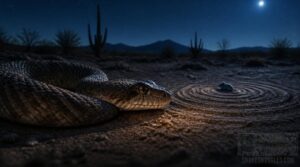
Rarely does a hunt begin with sight—it begins underfoot. Specialized scales and inner-ear structures give your snake seismic sensitivity, letting it detect a scurrying rodent through ground motion alone.
This works much like triangulation localization: comparing vibration timing across its body pinpoints direction. Signal strength fades with distance, so closer prey registers loudest, sharpening its strike before amphibians even rustle.
Silent Stalking Behavior
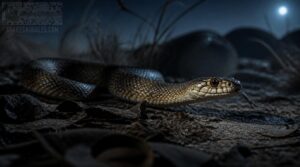
Ever wonder how something without limbs can move like a shadow? Your snake relies on stealthy movement patterns, keeping a low profile posture while distributing weight evenly to achieve vibration minimization.
Rather than one long glide, it advances in measured burst advances, pausing between each. This patience allows precise strike timing, ensuring lowlight navigation and predator avoidance work together for a silent, successful ambush.
Night Encounters and Pet Snake Insights
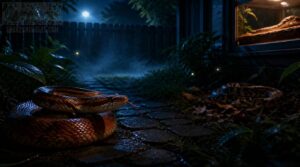
If you keep pet snakes or share a yard with wild ones, understanding their nighttime habits pays off in real, practical ways. Species like boas, pythons, ball pythons, and corn snakes each bring their own routines and quirks worth knowing. Here’s what you should keep in mind, both indoors and out.
Boas and Pythons
Boas and pythons share a hunting toolkit built around labial pits that sense infrared warmth, both relying on constriction tactics after dark.
Their reproduction diverges sharply: boas are viviparous, birthing live young, while pythons lay eggs and coil around them in maternal incubation, with temperature-dependent sex determination shaping hatchlings.
Regional distribution splits them too, boas favoring the Americas, pythons spanning Africa, Asia, and Australia.
Ball Python Activity
Ball pythons follow a crepuscular rhythm, waking around dusk to explore, tongue-flick, and test their enclosure’s temperature gradient before hunting.
Watch for stress cues: excessive nighttime pacing often signals inadequate hides, while shedding cycles can suppress appetite temporarily.
Feeding cues intensify in evening hours, with keepers noting slowed, deliberate movement right before prey capture—a hallmark of this species’ patient biological rhythm.
Corn Snake Routines
Corn snakes swap ball pythons’ patient dusk rhythm for a more flexible schedule, shifting between crepuscular and nocturnal activity as temperatures climb. You’ll notice hatchlings feeding every 5-7 days, adults every 10-14, always paired with fresh water access.
Keep humidity near 40-50%, maintain a proper temperature gradient, and rotate substrate regularly—these routine checks keep foraging behavior and biological rhythms steady year-round.
Safe Outdoor Precautions
Whether you’re tending a corn snake’s enclosure or hiking at dusk, outdoor readiness matters. Wear closed-toe boots and tucked pants against ticks and venomous snakes underfoot.
- Apply DEET-based repellent liberally
- Carry 2+ liters of water
- Pack bandages and antiseptic wipes
- Bring a whistle or satellite messenger
If bitten, keep the limb still, below heart level, and seek help immediately—never use tourniquets or ice.
Respecting Wild Snakes
Preparedness aside, a wild snake still deserves safe observation distances—two body lengths, minimum. Resist handling or cornering it; this isn’t your ball python. Let it retreat naturally, respecting its role in rodent control.
For structures or high-traffic encounters, follow proper wildlife removal protocols through local authorities. Habitat preservation ethics matter too: leave brush piles undisturbed, since they sustain the prey base every nocturnal hunter depends on.
Frequently Asked Questions (FAQs)
Why do snakes hunt at night?
Imagine hunting under a blazing desert sun that could cook you alive in minutes.
Snakes avoid that fate entirely: nocturnal behavior offers cooler temperatures, synchronized prey activity, stealth advantages, and better hydration, aligning perfectly with animal circadian rhythms and metabolic efficiency.
Do nocturnal snakes hunt at night?
Yes. Nocturnal behavior aligns with midnight foraging peaks, when prey cycle synchronization and temperature stress reduction favor active hunting, using heatsensing pit organs and prey availability to guide efficient, post-sunset ambush strikes across most nights.
Why are snakes more active at night?
What draws snakes out after dark? Cooler temperatures, less vigilant prey, and reduced competition from daytime predators all play a role. Darkness also offers cover from nocturnal predators, while higher humidity helps with hydration, making nighttime hunting far more efficient for most species.
Do rattlesnakes hunt at night?
Rattlesnakes, classified among pit vipers, hunt after dusk once temperatures hold near 65–70°F.
Their heat-sensing pits and vibration sensitivity guide ambush strikes on nocturnal rodents, while cooling ground temperatures extend safe thermal hunting windows through spring and summer nights.
What smell do snakes hate the most?
Where a garden thrives, a snake retreats: ammonia nasal irritation overwhelms their sensory perception most severely.
Naphthalene repellent use, garlic scent deterrence, and citrus olfactory repulsion also disrupt chemoreception, triggering predator avoidance instincts rooted in reptile biology and natural surroundings shaping snake behavior.
What is a snakes worst enemy?
No single enemy dominates. Honey badgers shrug off venom, mongooses rely on speed and agility, and hawks strike from above. Kingsnakes even eat other snakes. Still, human retaliation from fear or misidentification remains the deadliest, most persistent threat overall.
What month do snakes go away?
Funny how the calendar and the thermometer conspire together — most temperate-region snakes vanish by November, once nocturnal and crepuscular habits give way to temperature-triggered dormancy, though southern populations linger later depending on regional timing and post-frost activity drops.
What is the best time of day to avoid snakes?
Early morning offers the best visibility and cooler temps, limiting activity from crepuscular and nocturnal species alike. Midday heat and evening shadows raise risk—so dawn hikes reduce snake bite chances while supporting overall wildlife safety.
Do all snake species hunt exclusively at night?
Not every species sticks to darkness. Coachwhips hunt by day, copperheads shift crepuscular at dusk, and pythons turn diurnal in cooler seasons.
Climate, prey availability, and species-specific schedules—not a fixed rule—determine each snake’s nocturnal, diurnal, or crepuscular activity pattern.
How does light pollution affect snake hunting behavior?
Artificial lighting reshapes nocturnal hunting through altered prey density, disrupted camouflage effectiveness, and sensory overload risks from heat and vision cues.
Urban movement corridors along lit paths and shifting artificial thermal gradients further complicate how snakes track prey across increasingly human-altered landscapes.
Conclusion
Daylight hides danger; darkness reveals real opportunity, and that contrast is the true answer to why snakes hunt at night: heat, prey, and safety all align once the sun finally goes down.
Your backyard transforms after dusk into a quiet arena of scent trails, warm ground, and silent strikes. A snake doesn’t chase chaos; it reads the night like a language it was born to understand. What seems mysterious to you is simply survival, perfected.