This site is supported by our readers. We may earn a commission, at no cost to you, if you purchase through links.

A snake without a hide isn’t just uncomfortable—it’s living in a state of constant threat. In the wild, snakes spend most of their time tucked beneath bark, rocks, or leaf litter. Strip that away in captivity, and you’ve removed something their nervous system genuinely depends on.
The trouble is, stress in snakes doesn’t announce itself loudly. No whimpering, no obvious limping. What you get instead are subtle shifts—behavioral changes, posture cues, and feeding disruptions that are easy to misread or miss entirely.
Knowing how to tell if your snake is stressed without a hide could be the difference between catching a problem early and dealing with a sick animal. These signs are worth learning.
Table Of Contents
- Key Takeaways
- Stress Shows Through Behavior Changes
- Defensive Signs Mean Your Snake Feels Exposed
- Feeding Problems Can Signal Stress
- Physical Symptoms Need Close Attention
- Missing Hides Create Habitat Stress
- Help Your Snake Feel Secure
- Frequently Asked Questions (FAQs)
- Is a snake hiding on enclosure rocks a sign of stress?
- How do you know if a snake is stressed?
- How do you know if a snake is uncomfortable?
- How do you know if a snake is relaxing?
- What Are the Long-term Effects of Stress on a Snake?
- How Can the Environment of a Snake’s Habitat Be Changed to Reduce Stress?
- What Are the Best Ways to Handle a Snake to Prevent Stress?
- Is It Safe to House Multiple Snakes Together?
- Does a Snake Need a Companion to Reduce Stress?
- How do snakes show distress?
- Conclusion
Key Takeaways
- A snake without a hide stays in a constant state of alert, showing stress through behaviors like glass surfing, constant pacing, and defensive striking — all signs it can’t find a safe place to rest.
- Feeding problems such as meal refusal, hesitant strikes, and regurgitation are often the earliest and most overlooked signals that your snake’s environment is causing it harm.
- Physical warning signs like labored breathing, poor shedding, retained eye caps, and sudden lethargy mean the stress has moved beyond behavior and into the body — and some need a vet right away.
- The fix is simpler than you’d think: add two properly sized hides (one warm side, one cool), dial in your heat gradient and humidity, cover exposed enclosure walls, and reduce handling until your snake settles.
Stress Shows Through Behavior Changes
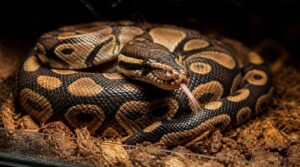
A snake without a hide rarely suffers in silence — its body tells you exactly what’s wrong. Most stress signals show up as movement patterns that just don’t look right. Watch for these key behaviors that signal your snake isn’t feeling secure.
Recognizing these patterns early gives you a real edge — a closer look at healthy snake behaviors and stress indicators can help you tell normal movement from a warning sign.
Glass Surfing
Watch your snake — glass surfing is one clear stress signal you’ll spot early.
- Repeated nose-pressing against enclosure walls
- Following seams and corners along the boundary
- Cycling the same path without settling
- Orienting toward glass even when pausing
- Increasing restlessness near the front viewing side
Barrier-focused restlessness means your snake can’t find a secure zone.
Constant Pacing
Glass surfing often blurs into something more persistent — constant pacing.
Your snake isn’t just restless. It’s looping the same narrow path repeatedly, rarely stopping long enough to rest or regulate its temperature. That repetitive, goal-less movement signals it can’t find anywhere to feel hidden. This behavior often acts as a coping mechanism to manage internal stress.
Without a hide, there’s no cue to stop. So it just keeps moving.
Excessive Climbing
Pacing often goes vertical when there’s nowhere to hide.
Your snake may repeatedly climb the walls, pressing toward the top like it’s searching for a way out. This escape-like climbing isn’t curiosity — it’s desperation.
Watch for these patterns:
- Climbing toward heat sources without settling
- Pausing briefly, then resuming instead of resting
- Persistent wall-pressing near gaps or seams
Without a hide, up feels safer than exposed floor.
Perimeter Edging
Think of it like a snake tracing its own invisible fence line — running the perimeter repeatedly, nose to glass, never stopping.
This isn’t exploration. It’s edging behavior: a continuous loop around the enclosure walls, driven by the need to find cover that isn’t there.
No anchor point, no rest. Just circuits.
Restless Wandering
Some snakes never truly stop moving — not because they’re curious, but because environmental insecurity won’t let them settle.
Restless wandering looks like this:
- Constant motion with no clear destination
- Repeated enclosure escape attempts at corners and lids
- Seeking hidden crevices that simply don’t exist
That’s constant motion fatigue — and it’s your snake telling you something’s wrong.
Defensive Signs Mean Your Snake Feels Exposed
When a snake feels exposed, it doesn’t just get nervous — it switches into self-defense mode. Without a hide to retreat to, that defensive behavior can show up fast and in ways that might catch you off guard. Here are the most common signs your snake is telling you it feels vulnerable.
Shedding problems like retained eye caps can also signal that your snake’s environment lacks proper humidity — check out this guide on snake moisture and species-specific humidity needs to make sure their setup is dialed in.
Tight Coiling
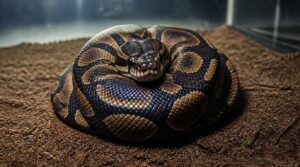
A tightly wound coil isn’t rest — it’s armor. When your snake pulls into a compact shape, it’s signaling exposure with nowhere safe to retreat.
| Coil Behavior | What It Signals | What To Watch |
|---|---|---|
| Compact "C" or round coil | Defensive constriction response | Gaps between turns closing |
| Head elevated, angled outward | Threat monitoring posture | Head tracking your movement |
| Rigid, tense body | High defensive body tension | Snake feels hard to touch |
| Minimal movement | Reduced locomotion patterns | Avoiding open enclosure space |
| Repeated coiling all day | Persistent coiling frequency | No alternating rest or explore |
This persistent coiling — returning tight repeatedly — tells you the enclosure lacks security.
Hissing
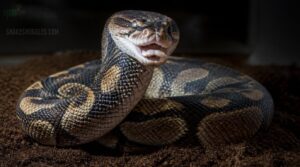
That sharp sound is no accident. Hissing is a warning — air forced through your snake’s airway creates an urgent signal when it feels cornered.
Watch for these defensive warning signals:
- Rapid, sustained hissing without retreating
- Tense body posture alongside the hiss
- Head raised, tracking your movement
- Louder hiss as you move closer
- No calming until the threat leaves
Striking

A strike isn’t aggression — it’s a last resort. When defensive striking happens, your snake has already run out of other options.
| Trigger | What You’ll See | What It Means |
|---|---|---|
| Sudden movement | Fast lunge toward threat | Acute vulnerability response |
| Close approach | Coiled, tensed muscles | Agitation warning activated |
| No retreat path | Repeated defensive strikes | Threat mimicry, feels trapped |
Muscle tension cues usually come first — watch the body go rigid before the strike lands.
Tail Flicking
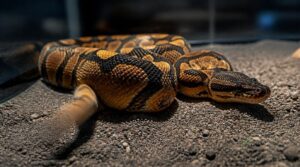
Tail flicking is easy to dismiss — until you notice the pattern. A stressed snake flicks in quick, abrupt bursts, especially when it can’t find cover. The movements are sharp, not slow and exploratory.
Watch for tension in the body too: the tail flicks while the muscles stay rigid. Once it’s settled in a hide, those flicks usually stop.
Pulled-Back Head
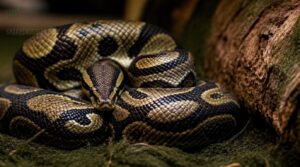
When a snake pulls its head back, it’s shrinking its exposure — tucking the chin low, pressing toward surfaces instead of traveling out in the open.
- Head drops toward the body, chin visibly tucked
- Avoids elevating the head during movement
- Presses closer to ground, branches, or décor
- Persists even without a clear retreat route
- Continues through slow movement or cautious pauses
That defensive posture tells you one thing: your snake feels seen, and unsafe.
Feeding Problems Can Signal Stress
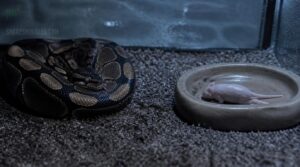
A stressed snake often stops eating long before it shows any other obvious signs. Without a hide, the constant exposure takes a real toll on its appetite and digestion. Here are the feeding problems worth watching for.
Refusing Meals
When a snake skips a meal, it’s easy to assume something’s medically wrong — but missing hides stress is often the real culprit.
A snake that can’t retreat won’t feel secure enough to eat. Prey temperature, seasonal metabolic shifts, and routine disruption all factor in. Consistent refusal across multiple meals signals more than pickiness — it’s your snake telling you something in its environment isn’t right.
Hesitant Strikes
Meal refusal isn’t always the full picture. Sometimes a snake does approach food — it just can’t fully commit.
A hesitant strike looks like a short lunge followed by immediate withdrawal. The snake reassesses, repositions, then tries again without following through. That stop-start pattern signals uncertainty, not hunger. Missing hide stress leaves snakes too exposed to feel confident even when food is right there.
Regurgitation
Even when a snake succeeds in eating, stress doesn’t stop there. If digestion gets disrupted — by temperature drops, handling too soon after feeding, or a hide-less enclosure — regurgitation can follow. The returned prey may look nearly intact.
After it happens, hold off on the next meal and check your setup first. Watch breathing closely; regurgitation raises respiratory risk.
Weight Loss
Regurgitation takes a toll, but the slower damage is harder to spot. A snake refusing meals week after week burns through fat reserves and muscle mass — the midbody starts to narrow, and bones become more visible along the spine.
Weigh juveniles weekly. They deplete reserves fast. Consistent downward readings mean the problem runs deeper than a skipped meal.
Irregular Feeding Response
What’s harder to spot than a full refusal? Inconsistent appetite. Your snake eats one week, skips the next, shows mild interest after that — no pattern, no clear cause.
Watch for:
- Eating one meal, skipping the next
- Investigating prey without striking
- Only feeding in familiar, quiet conditions
- Reacting to movement near the enclosure
- Appetite shifting week to week
Physical Symptoms Need Close Attention
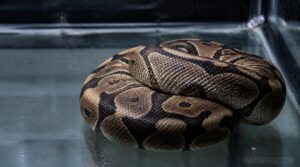
Stress doesn’t always announce itself through behavior — sometimes it shows up in your snake’s body. When a hide is missing, the physical toll can quietly build before you even notice something’s wrong. Watch for these signs that your snake’s body is sending you a message.
Labored Breathing
Watch your snake’s sides carefully — accessory muscle use during breathing, where the neck or chest wall works visibly harder than usual, is a red flag. Rapid breathing at rest or chest retractions that repeat across multiple breaths suggest respiratory distress.
If labored breathing persists after fixing the enclosure, that’s not stress anymore — that’s a vet call.
Open-Mouth Gaping
Gaping — holding the mouth wide open — isn’t normal resting behavior. When a snake does this repeatedly, especially near the glass or enclosure front, it signals acute stress or respiratory distress.
The tongue may stay visible between cycles rather than flicking normally. If it’s paired with stiff body tension or restlessness, your snake isn’t just uncomfortable — it’s struggling.
Poor Shedding
A stressed snake without a hide often sheds poorly. Low humidity and dehydration make shed skin dry and patchy, tearing instead of sliding off in one piece. Rough or dusty substrate adds friction, snagging old skin further.
Temperature instability slows the whole process. Younger snakes are especially prone to incomplete sheds when these conditions don’t align.
Retained Eye Caps
One shed that goes wrong can leave eye caps stuck in place. These transparent scales normally lift off cleanly, but without proper humidity, they cling.
Your snake’s eyes may stay cloudy or milky long after the rest of the shed drops. That retained spectacle can blur vision and raise infection risk. Check the shed skin — missing eye holes means the cap is still on.
Sudden Lethargy
A snake that suddenly stops moving is telling you something is wrong. Sudden lethargy can stem from temperature mismatch, dehydration, or internal illness — and it moves fast.
Watch for:
- No response to gentle warming
- Sunken skin from dehydration indicators
- Dim demeanor with reduced tongue flicking
Don’t wait. Emergency veterinary assessment is necessary if it doesn’t resolve quickly.
Missing Hides Create Habitat Stress
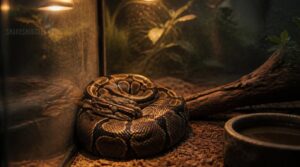
Behavior and physical symptoms are only part of the picture — the enclosure itself might be working against your snake. Without a hide, several habitat factors can quietly pile on the stress. Here’s what to check inside the setup:
Lack of Security
What does a hide do for your snake? It lowers perceived threat levels by offering true retreat availability.
| Behavior | Cause | Sign |
|---|---|---|
| Boundary reliance | No hide | Perimeter pacing |
| Rest disruption | Exposure | Broken sleep |
| Escape behavior | Open spaces | Wall pressing |
Your enclosure setup with inadequate hiding spots keeps environmental scanning constant. Boundary reliance and escape behavior take over, making rest disruption routine.
Poor Temperature Gradient
Without a hide anchoring one end, thermal zoning accuracy breaks down. Your snake can’t choose warm or cool — it just wanders endlessly.
Signs of thermoregulation choice failure:
- Constant position switching
- Lingering too close to the heat source
- Restlessness after meals
- Refusing to settle anywhere
- Delayed or failed digestion
Poor temperature gradient leaves no real microclimate control — just one uncomfortable zone.
Wrong Humidity Levels
Temperature isn’t the only thing a hide helps regulate. Hides trap localized moisture, giving your snake a humidity microclimate it can seek out or avoid.
Without one, humidity swings unchecked. Levels above 60% invite mold and dust mites. Too low, and dry air causes incomplete shedding — skin that won’t release cleanly, sometimes leaving retained patches behind.
Oversized Open Spaces
Bigger isn’t always better. An oversized enclosure with no hide forces your snake to cross open ground just to reach cover — and that travel distance alone raises stress.
Without line-of-sight breaks, there’s nowhere to disappear. Your snake keeps moving, repositioning, unable to settle. That restlessness isn’t curiosity. It’s a snake that can’t feel safe long enough to stop.
Without line-of-sight breaks, a snake never stops moving — it can’t feel safe long enough to rest
Excessive Visibility
Snakes read their world through sight — and a fully exposed enclosure gives them nowhere to disappear.
High-contrast lighting makes your snake’s silhouette stand out against the substrate, triggering constant alertness. Reflective glass adds fake movement cues, keeping the snake scanning rather than resting.
When every corner is bright and visible, there’s no low-visibility retreat. Your snake stays on edge — indefinitely.
Help Your Snake Feel Secure
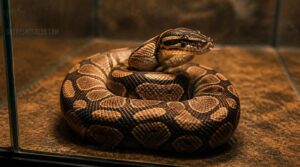
The good news is that most of these stress signs are fixable with a few straightforward changes. Once you know what your snake needs, creating a calmer environment isn’t complicated. Here’s where to start.
Add Proper Hides
A hide is the simplest fix you can make. Place one on the warm side and one on the cool side — that’s dual zone placement — so your snake stays secure no matter where it needs to thermoregulate.
Size matters too. The hide should fit your snake’s full body without extra space. Too roomy, and it won’t feel sheltered at all.
Reduce Handling
When your snake is already stressed from missing hides, less handling is better. Aim for once every few days — not daily. Keep sessions short, and always support the full body. Grabbing only the head or neck triggers defensive reactions fast.
Stick to a consistent routine. Predictable timing and calm movements reduce startle responses. Handle only for necessary tasks, then return your snake promptly.
Cover Enclosure Sides
Covering the enclosure sides can make a real difference. Opaque panels block direct sightlines from people and pets moving nearby, reducing constant visual stimulation. Dark, non-reflective materials work best — glossy covers bounce light back in, which ruins the purpose.
Just don’t seal the vents. Airflow gaps keep humidity and heat stable while still giving your snake that much-needed sense of shelter.
Check Heat and Humidity
Wrong readings can fool you. Sensor placement accuracy matters — put thermometers where your snake actually rests, not just on the floor.
Check both sides daily:
- Hot side reaches the correct basking range
- Cool side stays measurably lower
- Thermal gradient runs cleanly end to end
- Humidity holds steady, not just right after misting
- Digital meters get checked for humidity sensor drift
Call a Reptile Vet
When behavior and environment fixes aren’t enough, call a reptile vet. Not just any clinic — confirm they treat snakes specifically, not just "exotics."
When you call, describe the species, symptoms, and how long you’ve noticed changes. Bring feeding records and a short video of the stressed behaviors. For breathing trouble or gaping, don’t wait — seek urgent care.
Frequently Asked Questions (FAQs)
Is a snake hiding on enclosure rocks a sign of stress?
Yes — it can be. When rocks are the only shelter option, a snake may rely on them even if they don’t offer full protection. That’s a setup worth fixing.
How do you know if a snake is stressed?
Stress shows up in behavioral changes, defensive postures, and physical warning signs. Watch for refusing food, restless movement, hissing, or lethargy. These daily habits reveal how secure your snake feels.
How do you know if a snake is uncomfortable?
Your snake can’t speak, but its body does. Tight coiling, hissing, or restless pacing are clear signals. Watch for refused meals, labored breathing, or poor shedding — each one tells you something is wrong.
How do you know if a snake is relaxing?
A relaxed snake settles quietly, holds a soft, loose coil, and breathes without effort. Movement is slow and unhurried. It chooses a sheltered spot, stays there, and doesn’t react to every small disturbance.
What Are the Long-term Effects of Stress on a Snake?
Chronic stress quietly erodes your snake’s health over time. Immune suppression, metabolic decline, and persistent behavioral changes compound into serious damage — including reproductive failure, significant weight loss, and a measurably reduced lifespan.
How Can the Environment of a Snake’s Habitat Be Changed to Reduce Stress?
Small changes matter most. Start with proper hides on both sides, then check your heat gradient and humidity. Cover exposed enclosure walls. Keep the layout consistent. Your snake needs predictability to feel safe.
What Are the Best Ways to Handle a Snake to Prevent Stress?
Move slowly when picking up your snake and support its full body weight. Keep sessions brief, avoid handling after feeding, and stay consistent. Sudden grabs and vibrations trigger defensive responses fast.
Is It Safe to House Multiple Snakes Together?
Think of cohousing snakes like forced roommates — proximity alone doesn’t mean peace. Species compatibility, size, and territorial needs matter. Most snakes are solitary, and shared spaces spark competition, stress, and disease transmission risks fast.
Does a Snake Need a Companion to Reduce Stress?
Not necessarily. Research on Southern Pacific rattlesnakes found that social buffering — a companion’s calming effect on heart rate — exists. But most pet snakes manage stress better through proper hides than through cohousing.
How do snakes show distress?
A snake goes quiet before it signals panic. Watch for tight coiling, glass surfing, meal refusal, labored breathing, or hissing — these are distress signals your snake can’t hide.
Conclusion
A snake without a hide is like a soldier without shelter—exposed, alert, and burning energy just surviving. That constant tension leaves marks.
Once you know how to tell if your snake is stressed without a hide, the signs stop blending into the background. Glass surfing, refused meals, defensive strikes—none of it’s random. Your snake is talking.
Add a hide, dial in the humidity, and give it somewhere safe to simply exist.
- https://faunalytics.org/always-on-display-what-does-snake-stress-actually-look-like
- https://thetyedyediguana.com/blog/the-72hour-survival-protocol-of-newly-translocated-reptiles
- https://www.behavioreducation.org/post/minimizing-transition-stress-for-snakes-a-guide-to-low-stress-home-and-habitat-changes