This site is supported by our readers. We may earn a commission, at no cost to you, if you purchase through links.
A boa constrictor can’t shiver, sweat, or put on a jacket. Every degree in that tank comes from the equipment you install, and a single malfunctioning thermostat can turn a basking spot into a burn hazard within hours. Reptile hotlines field calls every week about thermal burns that started with a stuck relay or a probe taped in the wrong spot.
Getting thermostat setup for boa constrictor tank right isn’t guesswork, it’s calibration, placement, and testing done in a specific order. Skip a step and you’re rolling dice with your snake’s safety.
The good news: once you understand how heat sources, probes, and controllers work together, building a reliable gradient becomes second nature.
Table Of Contents
Key Takeaways
- Pick a thermostat that matches your heat source’s wattage and control style, and make sure it has safety cutoffs plus an alarm set 5-10°F above basking range.
- Keep probes at least three feet from heat lamps, off heat mats entirely, and securely mounted so they read the true surface temperature instead of a false high.
- Before your boa ever moves in, test the shutoff by cutting power and confirming the heater deactivates within 1-2 seconds without re-firing when power returns.
- Check basking and cool zone temperatures daily, clean probes weekly, and track humidity separately since your thermostat only controls heat, not moisture.
Choose The Right Boa Thermostat
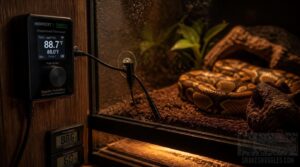
Your boa’s safety depends on picking a thermostat built for the job, not just any model off the shelf. The right choice comes down to how it controls your heat source, how many zones it grips, and what happens if something goes wrong. Here’s what to look for before you buy one.
Pairing your thermostat with a properly rated heating pad designed for boa constrictor habitats ensures the two work together instead of fighting each other.
Match Controls to Heat Sources
Not every thermostat suits every heater. Wattage matching keeps things safe: hot rocks and ceramic heat emitters demand high-wattage support with precise ambient limits, while radiant heat mats need surface sensor compatibility for smooth, hot-spot-free control. Ceramic emitters require stable basking temps through intermittent cycles.
Getting heater type compatibility right isn’t optional, it’s what prevents overheating disasters in your boa’s tank.
Dimming Versus Pulse Control
Beyond wattage matching, look at how your thermostat actually controls power. PWM dimming cycles current rapidly for finer low-level control, while analog dimming adjusts voltage continuously for smoother output. Proportional thermostats using PWM improve temperature stability and power efficiency versus basic on/off pulsing, which can stress heat lamps and wiring over time. Check digital probe compatibility either way.
Single-Zone Versus Multi-Zone
Once your control method is settled, decide how many zones you actually need. A single-zone thermostat runs one probe and one heat source, keeping cost and setup complexity low, but it can’t fine-tune a separate basking spot.
Multi-zone setups improve temperature stability and heat distribution across the gradient, though they draw more power and demand pricier hardware.
Prioritize Fail-Safe Features
Zone count matters less than what happens when things go wrong. Choose a thermostat with safety cutoffs and a built-in temperature alarm set 5-10°F above basking range.
Test backup power and fail-safe switches during setup, not during an outage. GFCI protection is non-negotiable given enclosure humidity.
Run a probe calibration routine quarterly and simulate contingency mode before your boa ever moves in.
Position Heating Equipment Correctly
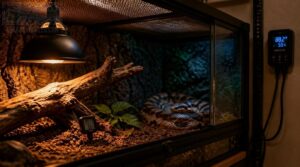
Your thermostat is only as good as the setup surrounding it, and placement makes all the difference. Where you mount your heat source, how you ventilate the tank, and how you protect your wiring all affect whether your boa thermoregulates safely. Here’s what you need to get right before flipping the switch.
Start with the basics—like confirming your ideal heat lamp distance from the tank—since even a few inches off can throw your entire temperature gradient out of balance.
Heat One Enclosure End
Your boa’s enclosure needs one clear hot end, not scattered warm patches, so the animal can actually thermoregulate. Place your heat source at one terminus, letting it cover roughly a third to half the enclosure length.
If you need a target range, this corn snake temperature control guide helps you fine-tune the warm-to-cool gradient.
This creates a true temperature gradient, with the basking zone holding 85-90°F and ambient areas settling near 78-82°F toward the cool end.
Mount Lamps Outside Safely
When lamps sit outdoors near the enclosure, height and hardware matter as much as wattage. Mount fixtures at least 18 inches above the tank on non-conductive bases, using a weatherproof fixture rating of IP65 or higher.
Shield wiring runs with silicone sealant, and always plug into a GFCI outlet rated for outdoor use. These steps protect your boa’s basking spot and gradient from electrical hazards.
Maintain Adequate Ventilation
Since heat lamps raise tank temperature fast, your enclosure needs matching airflow management to stay safe. Aim for screened openings on opposite ends for crossventilation, covering roughly 5-15% of surface area.
Keep Vent Placement away from heat sources to avoid disrupting the temperature gradient. Weekly Vent Maintenance and Safety Checks for dust or webbing preserve steady Humidity Control and Ventilation.
Protect Electrical Connections
Water and electricity make a dangerous pair, so treat every cord like a safety hazard waiting to happen. Use cable strain relief at entry points, waterproof sealing on outdoor adapters, and IP44-rated plugs. Wipe prongs dry before connecting. Check monthly for corrosion, and never daisy-chain power strips, since your thermostat’s power regulation depends on clean, single-outlet connections near the enclosure.
It’s also wise to follow general electrical equipment safety guidelines, such as keeping hands dry and avoiding contact with equipment near moisture.
Install and Secure Thermostat Probes
Probe placement makes or breaks your thermostat’s accuracy, so precision matters here. A misplaced probe can send false readings straight to your controller, putting your boa at risk. Here’s exactly how to get it right, step by step.
Getting the temperature right also sets the stage for feeding success, and this baby ball python feeding guide explains how proper heat zones support healthy appetites.
Locate The Hottest Surface
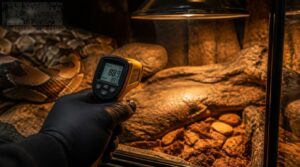
Where’s the hottest surface in your boa’s tank? Run Surface Temperature Mapping with an infrared thermometer before placing any probe. Check the basking spot directly under your heat source, that’s your hot side.
Confirm it falls within your snake’s safe range through Basking Spot Verification. Proper Heat Source Positioning and Thermal Gradient Analysis help your temperature gradient stay consistent, guiding accurate infrared surface reading results.
Avoid Direct Heater Contact
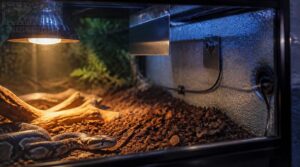
A probe touching your heater reads false highs, not tank reality. Keep it three feet from lamps, use heater shield placement and a physical barrier blocking radiant heat.
Route cords away from the basking spot:
- Keep probes off heat mats entirely
- Add insulation beneath mats
- Block direct radiant contact
- Route cords outside the enclosure
- Recheck gradient after adjustments
Secure Probes Against Movement
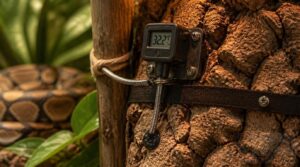
Once positioned correctly, that probe needs to stay put. Clip it to a fixed mounting bracket, then back it up with a braided stainless steel cable tying the body to a rigid support.
For extra vibration resistance, apply heat resistant adhesive to a non expanding surface, and add a safety strap so shifting decor won’t tug it loose.
Add Independent Thermometers
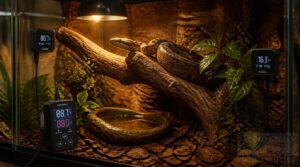
Don’t rely on the thermostat alone to tell the full story. Add independent thermometers to verify ambient temperature and monitor basking surface readings separately.
- Compare thermostat readings against digital probes weekly
- Identify drift zones before they harm your boa
- Confirm sensor accuracy through regular calibration checks
This layered approach catches probe accuracy issues fast.
Program and Test Temperature Settings
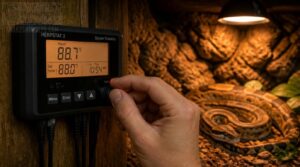
With your probes secured in place, it’s time to put numbers into the thermostat itself. This is where precision really counts, since your boa’s health depends on getting each setting right. Here’s what you need to configure, step by step.
Set Safe Basking Temperatures
Dial in your basking spot range before anything else. Hatchlings need 88-92°F, adults 90-95°F, never sustained above 95°F.
Program your thermostat to these exact numbers using accurate temperature measurement at head height with an infrared thermometer. This precision protects your boa’s thermal regulation and prevents metabolic stress from overheating during basking sessions.
Establish Warm and Cool Zones
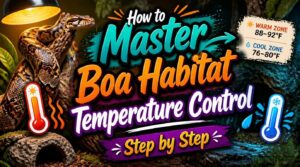
Once basking numbers are set, build the rest of the gradient around them. Keep the warm side at 88-92°F and the cool side between 75-82°F, spanning at least half the enclosure.
If you notice your snake’s appetite dip as temperatures drop seasonally, this ball python brumation guide explains how to tell normal slowdown from actual illness.
Concentrate your heat source at one end for a clear thermal outlet, with hides on the cool side so your boa can thermoregulate freely across a visually accessible gradient.
Configure Nighttime Temperature Drops
Nighttime doesn’t mean "lights off, heat off." Program your programmable thermostat for a gradual cooling protocol: drop 5-8°F over 60-90 minutes, landing basking surfaces near 85-90°F and the cool zone at 72-78°F. For night zone safety:
- Use dimmable heat mats or ceramic emitters
- Avoid lamp pulses
- Route cords away from moisture
- Test power outage recovery
Test Shutoff Before Use
Never trust a new thermostat blindly, test it first. Run a Shutoff Test Procedure: cut power and confirm the heater deactivates within 1-2 seconds. Check Power Loss Response, verify no re-firing on restoration, and complete a Sensor Accuracy Check alongside Fail Safe Validation. Finish with Post Test Verification, confirming your programmable thermostat restores stable temperature monitoring within five minutes.
Confirm Readings With Infrared Thermometer
Once your thermostat passes shutoff testing, verify readings with an infrared thermometer for true accuracy. Adjust emissivity settings to 0.92-0.96 for boa scales, hold the device 6-8 inches from the basking surface, and avoid glossy glass reflections.
- Confidence in true temperatures
- Relief from guesswork
- Trust in your setup
- Safety for your boa
- Peace of mind daily
Cross-check against your probe reading for temperature stability.
Monitor and Maintain The Setup
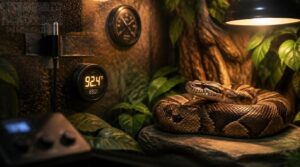
Getting your thermostat programmed and tested is only half the job done. Boa enclosures shift with the seasons, with equipment wear, and with your snake’s changing needs, so ongoing attention keeps everything running the way it should. Here’s what your regular maintenance routine needs to cover.
Check Temperatures Every Day
A thermostat only works if you verify it. Check your basking spot and cool zone at the same times daily, logging highs and lows to catch drift. Keep probe placement consistent, watch for temperature gradient shifts, and respond to alerts within 15 minutes.
Daily temperature logging reveals trends calibration alone won’t catch.
Track Humidity Separately
Your thermostat controls temperature, not moisture, so you’ll need a dedicated hygrometer for humidity levels. Mount it at mid-enclosure height, away from heat sources that cause false readings.
Log humidity alongside your daily temperature monitoring. Calibrate sensors per manufacturer instructions, and remember: proper humidity placement matters just as much as your temperature gradient setup for accurate, trustworthy readings.
Clean Probes and Sensors
A dusty probe lies to you, quietly skewing readings until your boa’s basking spot runs colder or hotter than the display shows.
A dusty probe lies quietly, skewing readings until your boa’s basking spot no longer matches the display
Wipe probes weekly with a damp cloth, skip harsh cleaners, and check cable connections for corrosion. Replace protective sleeves monthly, then calibrate hygrometers alongside your digital probes so every temperature monitoring reading stays trustworthy for reptile thermoregulation.
Recheck Settings After Changes
Clean sensors stay accurate only if you recheck settings whenever you adjust equipment. Verify Thermostat Power, Confirm Target Basking, and Align Display Readings against independent thermometers.
- Check active schedules haven’t reset
- Record recheck time and date
- Watch for temperature fluctuations after calibration
Sensor calibration means little without this final verification step.
Troubleshoot Temperature Fluctuations
Even with careful recheck habits, temperature fluctuations can still creep in. Start with the basics: check probe placement, verify thermostat calibration, and inspect the heating element for wear. Monitor ambient room temp, since drafts skew readings. Test enclosure insulation for gaps. A shifting temperature gradient often traces back to one overlooked spot, not equipment failure.
Frequently Asked Questions (FAQs)
How often should I replace my thermostat?
Picture a heart monitor drifting out of sync, that’s an aging unit. Most units run 10 to 15 years, but slow response, power surge damage, or drifting calibration and sensor accuracy are your cues to replace it now.
Can I use one thermostat for multiple enclosures?
Only if enclosures share identical heat loads and heat sources. You’ll still need multi-zone compatibility with independent probes per zone, careful probe placement strategy, and fail-safe redundancy to catch drift before one tank overheats while another cools.
What humidity level is best for boa constrictors?
Getting humidity right shapes everything else in your setup. Keep humidity levels between 55 and 75 percent normally, using a reliable hygrometer, then allow a shedding humidity spike to 75-85 percent with a humid hide for smoother sheds.
Do boas need different temperatures as they age?
Not drastically. Your boa’s basking zone should stay 90-92°F lifelong, though older snakes tolerate cooler nights. Slowing metabolic rate still needs consistent gradients, since gaps below 70°F risk digestion problems, poor shedding, and respiratory illness.
How much does a quality reptile thermostat cost?
A cheap $20 dial thermostat feels safe until it fails silently; a quality digital thermostat at $30-$60 actually protects your boa. Smart WiFi models run $70-$150, with probes and accessories adding another $5-$
Conclusion
Precision protects your snake. A proper thermostat setup for boa constrictor tank doesn’t happen by accident, it happens through careful calibration, correct probe placement, and daily verification. Your boa can’t tell you when something’s wrong, so the equipment has to get it right every single time. Test the shutoff. Check the readings. Trust the numbers, not assumptions. Get this foundation solid, and everything else, feeding, shedding, thermoregulating, falls into place safely, reliably, and predictably, always.