This site is supported by our readers. We may earn a commission, at no cost to you, if you purchase through links.

A snake sitting on a cold floor can’t digest its last meal. That’s not a metaphor—it’s physiology.
Reptiles depend entirely on external heat sources to drive their metabolism, and the wrong setup means food rotting in the gut instead of fueling growth.
Most keepers know they need heat, but the under tank heater vs overhead heat debate trips up beginners and experienced hobbyists alike.
Get it wrong and you’re either burning your snake’s belly or leaving the ambient air too cold to matter.
The heating choice you make shapes everything—digestion, shedding, activity, and long-term health.
Table Of Contents
- Key Takeaways
- Under-Tank Heaters Explained
- Overhead Heat Sources Explained
- Which Snakes Prefer Belly Heat?
- When Overhead Heat Works Better
- Temperature Gradient Setup Basics
- Thermostat Safety and Control
- Burn, Fire, and Escape Risks
- Humidity Effects on Heating Choice
- Enclosure Size and Climate Factors
- Choosing The Right Snake Heater
- Frequently Asked Questions (FAQs)
- Are under tank heaters good for snakes?
- What is the best heating system for a snake enclosure?
- Is 70 degrees too cold for a Ball Python at night?
- What is the safest way to heat a reptile tank?
- Can heating methods affect a snakes shedding cycle?
- Do heating choices influence snake feeding response?
- How does lighting schedule interact with heat timing?
- Does substrate depth change how heat performs?
- Conclusion
Key Takeaways
- Belly heat from under-tank mats drives digestion directly by warming the gut from below, making it non-negotiable for ground-dwellers like ball pythons and corn snakes.
- Overhead heat sources — especially ceramic heat emitters and radiant panels — are a better fit for tall enclosures, climbing species, and any setup where ambient air temperature needs to stay stable around the clock.
- Every heat source, whether a mat or a lamp, must be paired with a thermostat, because unregulated heaters can hit dangerous surface temperatures that burn your snake or crack the tank before you notice anything is wrong.
- Your heating choice quietly controls humidity too — heat mats slow substrate evaporation and help retain moisture, while overhead lamps dry out the upper air fast, so matching the heat method to your species’ humidity needs is just as important as hitting the right temperature.
Under-Tank Heaters Explained
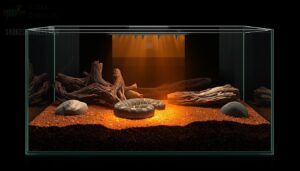
Under-tank heaters are one of the most common heating options for snake keepers, and for good reason. They work in a specific way that not every setup can replicate.
They heat from below, mimicking ground warmth—exactly how under-tank heaters work for corn snakes and why so many keepers swear by them.
Here’s what you need to know before choosing one.
How Heat Mats Warm The Enclosure Floor
Heat mats work through simple conduction — the heating element warms the glass floor, which transfers that warmth upward through whatever substrate sits on top.
Floor warmth mapping shows heat concentrates directly under the mat, then fades outward.
Conductive substrate thickness matters here: thin layers boost heat transfer efficiency, while thick bedding acts like thermal insulation, blocking warmth before it reaches your snake.
Best Setups for Glass Tanks and Tubs
Glass tanks and plastic tubs handle undertank heaters differently. Glass conducts warmth upward well, but always raise the tank slightly — edge bracing or rubber feet let air circulate underneath, protecting both the glass and your heat source placement.
For tubs, substrate layering becomes your buffer. Without it, direct belly contact gets dangerously hot. Proper ventilation placement also prevents moisture from warping plastic over time.
Floor-space Coverage and Heat Placement
Coverage matters more than most keepers realize. Your undertank heater should cover 60–75% of the tank floor — enough to support a true thermal gradient without eliminating the cool zone entirely.
- Position heat mats on the warm side only
- Prioritize substrate conductivity by keeping bedding under 2 inches
- Avoid zone overlap with water dish areas
- Check edge heat distribution at tank corners
- Verify uniform floor gradient across all three zones
When Belly Heat Supports Digestion
Belly heat does more than warm the floor — it directly aids digestion. After feeding, snakes rely on substrate warmth to trigger enzyme activation and keep gastric motility moving smoothly.
Belly heat isn’t just comfort — it triggers the enzyme activation that keeps your snake’s digestion moving after every meal
Without that consistent belly contact, digestive timing slows. Under-tank heaters provide the abdominal circulation your snake needs for post-meal comfort, making heat source selection genuinely matter when your animal is processing a meal.
Overhead Heat Sources Explained

Overhead heat works differently than belly heat — it warms the air, creates basking zones, and can run around the clock without disturbing your snake’s sleep cycle. Not all overhead sources do the same job, though, and picking the wrong one can leave your enclosure too bright, too dry, or unevenly heated.
Here’s a breakdown of the main options worth knowing.
Ceramic Heat Emitters Vs Halogens
Both tools get the job done, but they serve different purposes. Ceramic heat emitters win on lifespan — often 50,000+ hours — and energy efficiency, since there’s zero wasted light output. Halogen basking bulbs heat quickly and add visible spectrum light, but burn out sooner.
Pick based on your goal:
- Night heating — ceramic only
- Daytime basking — halogen wins
- 24/7 ambient warmth — ceramic, hands down
Radiant Heat Panels for Ambient Warmth
Mounting a radiant heat panel on the ceiling transforms how your enclosure holds warmth.
Instead of heating air, Infrared Energy Distribution warms surfaces and your snake directly — steady, quiet, no flickering.
| Feature | Benefit |
|---|---|
| Ceiling Mounting Benefits | Even top-down heat distribution |
| Panel Wattage Selection | Match enclosure size precisely |
| Quiet Operation Advantages | Zero noise, no disturbance |
| Thermal Efficiency Insulation | Retains ambient temperature longer |
| Energy Efficiency | Lower running costs overall |
Deep Heat Projectors and Infrared Output
Deep heat projectors take infrared heat to another level entirely. Unlike standard heat lamps or undertank heaters, they emit Infrared A penetration waves that reach deep into tissue, plus Infrared B surface warmth for balanced heating.
parabolic reflector design focuses output evenly across your thermal gradient.
wattage selection guide recommendations to enclosure size — usually 50–80W — and enjoy long-term durability rated for thousands of hours.
Night-safe Options Without Visible Light
Nighttime heating without visible light is easier than you’d think. Ceramic heat emitters are your go-to — no glow, just steady infrared heat around the clock.
Pair them with dimmable night heaters or pulse-mode IR sources for precise control.
Infrared LED illumination lets you use infrared camera monitoring to watch your snake without disturbing it, while hidden cable warmth and heat mats keep the floor comfortable all night.
Together, these setups make it easy to maintain those ideal corn snake temperature gradients — cool side around 24–28°C, warm side hitting 32–34°C — without constant manual adjustments.
Which Snakes Prefer Belly Heat?
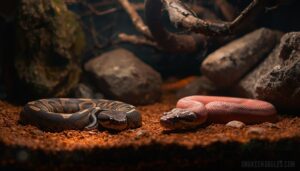
Not every snake needs heat raining down from above — some just want warmth coming up through the floor. Ground-dwellers, especially, depend on belly heat to digest food and regulate their body temperature properly.
Here’s a look at which species lean heavily on that contact warmth and when it’s actually enough.
Ground-dwelling Species and Substrate Contact
Ground-dwelling snakes live life low — every move, every meal happens belly-down on the substrate.
That’s why substrate texture effects matter so much: particle size friction shapes how smoothly your snake moves, while moisture retention balance directly affects shed quality.
Burrowing depth preference also plays into this, since looser, deeper substrates let heat from under tank heaters reach your snake naturally through consistent belly contact.
Ball Pythons and Corn Snake Needs
Ball pythons and corn snakes are built for belly heat — their digestion, shedding cycle, and overall growth rate depend on consistent substrate warmth.
Seasonal snake metabolism differences also explain why corn snakes often need winter cooling, unlike tropical ball pythons.
Here’s what heat mats directly support for both species:
- Feeding Frequency – Warm bellies speed up digestion, so snakes eat more reliably.
- Shedding Cycle – A stable temperature gradient reduces incomplete sheds.
- Stress Reduction – Secure, warm hides prevent anxious glass-surfing.
- Habitat Enrichment – Consistent floor warmth lets your ball python or corn snake explore confidently.
When Under-tank Heat is Enough
For many common species, heat mats alone get the job done. If your snake is ground‑dwelling and lives in a small tank — think a 20‑gallon corn snake setup — under tank heating covers digestive efficiency without extra cost.
Room temps between 72–78°F handle the cool side naturally, giving you thermal gradient stability with minimal gradient design. One mat, one thermostat, lower energy cost reduction built right in.
Species That Still Need Ambient Heat
Not every snake thrives on belly heat alone. Tropical colubrid activity drops fast when ambient temperature falls below the range — ball pythons and boa constrictors both need overhead warmth to stay active.
Juvenile metabolic support depends on consistent air warmth for healthy feeding.
Desert night cooling and mating season thermoregulation also demand ambient stress relief.
Your heat source choice and heat source placement guidelines should reflect that.
When Overhead Heat Works Better

Belly heat has its place, but it can’t do everything on its own. Some setups genuinely need warmth coming from above to work properly.
Here’s when overhead heat stops being optional and starts being the right call.
Tall Enclosures and Climbing Species
If your snake spends most of its time six feet off the ground, heat mats simply can’t follow it up there.
Vertical space utilization in tall enclosures demands height-adjusted lighting and ceramic heat emitters positioned near the top.
Climbing perch placement and branch anchor design must account for variable load safety, ensuring heat source placement guidelines keep the thermal gradient accessible at every level your snake actually uses.
Heating Upper Air Zones Evenly
Tall enclosures trap heat unevenly — warm air stagnates near the ceiling while lower zones stay cool. Fix that with multi-level emitters and radiant heat panels spaced along the perimeter. vertical air circulation prevents stratification.
Insulate the lid for ceiling insulation benefits, and calibrate your height sensor for accurate readings. That way, your temperature gradient stays consistent from branch to floor.
Daytime Basking for Active Snakes
Active snakes don’t just warm up — they time it deliberately. Basking Timing peaks in the morning, when Behavioral Heat Seeking drives them toward overhead sources like heat lamps, ceramic heat emitters, and radiant heat panels.
Sunlight Simulation triggers feeding readiness and boosts Metabolic Rate Impact noticeably.
Watch for these basking behaviors to confirm your setup works:
- Sustained contact with the basking spot
- Dorsal flattening to increase heat absorption
- Morning activity spikes after lights activate
- Thermal Preference Variation between warm and cool zones
- Reduced hiding during peak basking temperatures
Combining Ambient and Basking Warmth
Layered Heat Zones work best when each source manages a specific job — ambient temperature stays consistent through a ceramic heat emitter, while a dedicated basking spot delivers surface intensity. That’s Heat Source Synergy in practice.
Adaptive Temperature Scheduling and Zone Overlap Management keep the thermal gradient clean, preventing heat distribution gaps that confuse thermoregulation.
| Heat Role | Recommended Source |
|---|---|
| Ambient Bask Balance | Ceramic heat emitter |
| Basking spot warmth | Halogen flood lamp |
| Under tank heaters | On/off thermostat |
| Nighttime ambient | Radiant heat panel |
| Gradient foundation | Cool-side hide placement |
Temperature Gradient Setup Basics
Getting the temperature gradient right is what ties your whole heating setup together. Whether you’re using a heat mat, an overhead source, or both, the same core rules apply.
Here’s what you need to know to build a gradient that actually works for your snake.
Warm-side and Cool-side Target Ranges

Getting your temperature targets right is the foundation of everything else. The warm side should sit between 28°C and 32°C, while the cool side stays between 22°C and 26°C. That gradient differential gives your snake real choices.
- Species-specific ranges vary — corn snakes run cooler than ball pythons
- Thermostat setpoints lock each heat source to its zone
- Nighttime drop of 2°C–4°C helps natural cycles
- Probe accuracy at snake level keeps readings honest
Creating a Usable Heat Gradient

A usable thermal gradient isn’t just warm on one end and cool on the other — it’s a smooth, continuous slide between zones. Place your heat mats or ceramic heat emitters on one side only.
Map at least three points using Gradient Visualization Tools or basic digital probes.
Substrate Conductivity Choice, Air Circulation Patterns, and Temperature Differential Calibration all shape how cleanly that basking spot transitions across the floor.
Nighttime Temperature Drops
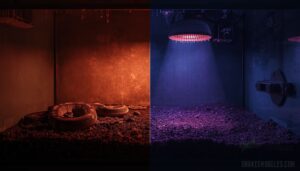
Nighttime temperature drops are sneakier than most keepers expect.
Radiative Cooling pulls heat from enclosure surfaces fast, while Ambient Air Lag means the air stays warmer longer than your substrate does.
A heat mat helps through Substrate Heat Storage, and a ceramic heat emitter regulates upper air.
Humidity Dampening and solid Insulation Efficiency slow that drop — keeping your nighttime heating stable without dramatic swings.
Avoiding Hot Spots and Cold Zones

Hot spots can form within just a few inches of your heat source — sometimes running 4–8°F above your target.
Combat this through Gradient Microzone Mapping: check temperatures at multiple snake-level points using a calibrated probe (monthly Probe Calibration Frequency keeps readings honest).
Substrate Thermal Mass smooths spikes, Reflective Panel Placement diffuses radiant energy, and Heat Diffusion Barriers prevent thermal bridge mitigation failures that create dangerous cold zones.
Thermostat Safety and Control
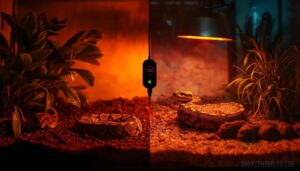
Getting the temperature right is only half the job — keeping it stable and safe is the other half. A thermostat is what stands between your snake and a dangerously overheated enclosure.
Here’s what you need to know about the different types, how to position the probe correctly, and how to match each thermostat to the right heat source.
On/off, Dimming, and Pulse Thermostats
Three thermostat types handle most snake setups.
An on/off thermostat is cheap and simple but creates wider temperature swings — and frequent power cycling shortens cycle life on heat mats. A digital thermostat with dimming control smooths those swings, cutting power consumption along the way. A pulse proportional thermostat hits ±0.5°F accuracy, ideal for ceramic heat emitters.
Check your compatibility matrix before buying.
Probe Placement at Snake Level
Your thermostat is only as accurate as where its probe sits.
For heat mats, a Belly Contact Probe placed directly on the warm-side floor gives real contact readings. Arboreal setups need a Perch Surface Sensor clipped to the actual branch. Always practice Hidden Pocket Avoidance — decorations create false cold spots.
- Adjust for Substrate Depth Alignment after bedding changes
- Use Multiple Spot Calibration with digital probe thermometers across the basking spot
- Secure probes with heat-resistant tape to prevent drift along your temperature gradient
Preventing Overheating With Regulation
Knowing where your probe sits is half the battle — the other half is what your thermostat does with that reading.
Thermal Hysteresis Tuning keeps your temperature setpoint stable without wild swings.
Auto Shutoff Integration and Safety Cutoff Calibration prevent dangerous spikes.
Build in Regulated Night Drops for recovery.
Good thermostat safety and control mean Temperature Spike Prevention and overheating risk stay firmly under your control.
Matching Thermostats to Heat Sources
Not every thermostat works with every heater — and that mismatch is where things go wrong. Wattage Compatibility and Voltage Matching matter more than most keepers realize.
Heat mats need pulse or dimming thermostats for smooth control. Ceramic emitters need slower Response Time Sync to avoid overshoot.
Always run Load Calculations before combining sources, and confirm Safety Cutoff Settings match each heat source’s output range.
Burn, Fire, and Escape Risks
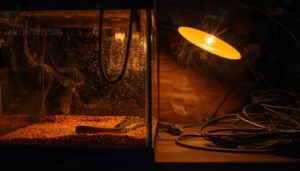
Getting the temperature right is only half the job — keeping your snake safe from the heat itself is the other half. Unregulated mats, unsecured lamps, and overloaded outlets can turn a simple heating setup into a serious hazard fast.
Here’s what you need to watch for.
Unsafe Temperatures From Unregulated Mats
A heat mat without a thermostat is basically a runaway heater. Mat overheating risks are real — uncontrolled surface temps can exceed 120°F before you notice anything wrong.
Sensor drift issues, moisture condensation effects, and substrate insulation impact all quietly push temperatures higher. Watch for:
- Probes measuring air, not belly-contact surface
- Damp substrate skewing heat transfer
- Thick bedding trapping dangerous warmth
- Gradual calibration drift raising temps undetected
Glass Cracking and Surface Burns
Unregulated heat mats don’t just threaten your snake — they threaten the tank itself. Thermal shock cracking starts at edge stress concentration points, where surface flaw initiation turns microscopic scratches into spreading fractures.
That heat conduction gradient through glass also creates real contact skin burns. Heat burn risk from heat mats and heat lamps is a genuine heat source safety concern you can’t ignore.
Lamp Guards and Secure Mounting
Securing your overhead lamp isn’t optional — it’s a core part of heat source safety. Use stainless steel mesh material choice guards rated for your bulb’s wattage, with corrosion-resistant fasteners that won’t loosen over time.
Adjustable arm design lets you fine-tune positioning while respecting clearance guidelines (keep 2–4 cm between bulb and guard).
Quick release mechanisms make bulb swaps fast without sacrificing safety guard’s integrity.
Reducing Cord and Outlet Hazards
Cords and outlets are easy to overlook — until something fails. Route cables using Cord Management Systems along tank walls, away from heat sources.
Use Surge Protection Strips with built-in breakers, and never overload your Power Strip Load by daisy-chaining. Install Tamper-Resistant Outlets and Outlet Safety Covers on unused ports. Form wiring drip loops to keep moisture away from connections.
Humidity Effects on Heating Choice

Heat and humidity are more connected than most keepers realize. The heating method you choose can quietly raise or tank your enclosure’s moisture levels before you even notice.
each approach affects humidity — and what you can do to stay in control.
How Overhead Heat Changes Humidity
Overhead heat lamps pull moisture straight out of the upper air — that’s upper air drying in action. Warmer air holds more vapor, but your humidity readings still drop because evaporation acceleration pulls moisture from water dishes and substrate faster. This creates a vertical humidity gradient: drier near the top, more humid near the floor.
For solid humidity and temperature balance, watch your hygrometer closely at snake level.
Heat Mats and Moisture Retention
Heat mats actually help with humidity management by warming the substrate from below — slowing evaporation rather than accelerating it. That gentle belly heat facilitates Substrate Moisture Management, keeping coconut fiber or biopactive mixes moist longer.
Water-Resistant Mat Design protects internal wiring in damp setups. Wicking Substrate Layers draw warmth upward, enabling Moisture Gradient Control without Mat-Induced Condensation.
Smart substrate selection and thermal insulation together improve heat retention throughout the enclosure floor.
Species-specific Humidity Balancing
Every snake has its own humidity sweet spot. Corn Snake Humidity sits at 40–60%, while Ball Python Moisture needs 50–70%. Rat Snake RH mirrors corn snakes closely. Gopher Snake Humidity runs drier at 30–50%, and King Snake Moisture stays around 45–60%.
Getting humidity right matters even more when temperatures dip, since snake regurgitation caused by temperature and humidity stress can become a real risk if both factors fall out of balance simultaneously.
Your heating choice directly shapes those numbers:
- Undertank heaters preserve substrate insulation and moisture balance beneath the snake.
- Radiant heat panels gradually pull ambient humidity downward.
- Humidity management suffers most when heat sources go misaligned to species needs.
Adding Water or Substrate Support
Once you’ve matched your heat source to your species’ humidity needs, substrate selection becomes your next lever. Coconut coir or cypress mulch offers real Water Retention Substrates that maintain Substrate Moisture Balance without going soggy.
A loose Dimpled Texture Benefits airflow and even heat transfer — your thermal mass stays stable. For Shedding Hydration Support, spot clean using Spot Cleaning Practices to avoid humidity swings.
Enclosure Size and Climate Factors

Your enclosure size and the climate in your home both shape how well any heating setup actually performs. A tiny plastic tub and a six-foot glass terrarium don’t play by the same rules.
Here’s what you need to know about the setups that matter most.
Small Tubs Versus Large Terrariums
Because enclosure size shapes every heating decision you’ll make, matching your heat distribution methods to the right setup matters more than most keepers realize. A small tub demands an under tank heater for concentrated belly warmth, while a large terrarium needs a heat lamp or radiant panel to push warmth across wider air zones.
- Space Utilization shrinks in tubs, limiting gradient range
- Heat Distribution gaps appear faster in tall terrariums
- Power Efficiency improves in compact tubs with less air volume
- Airflow Management becomes critical in larger enclosures to prevent cold pockets
- Maintenance Frequency rises when multiple heat sources run simultaneously
Thermostat selection and placement stay equally critical in both — but the thermal gradient you’re building looks very different depending on the square footage you’re working with.
Room Temperature and Seasonal Changes
Your room’s ambient temperature quietly shapes the thermal gradient inside the enclosure more than most keepers expect.
| Season | Room Temp Range |
|---|---|
| Winter | 61–68 °F |
| Summer | 68–77 °F |
| Spring/Fall | 64–72 °F |
| With HVAC | 64–75 °F |
Seasonal Setpoint Shifts force real thermostat selection and placement adjustments — winter rooms demand more wattage, while summer Window Solar Gain near enclosures can spike warm-side readings unexpectedly. Draft Mitigation Strategies near vents reduce erratic fluctuations, and understanding Thermal Mass Effects helps predict how quickly your setup reacts to seasonal variation.
Insulation for Heat Retention
Insulating your enclosure is one of the most thermal insulation techniques in snake keeping. Rigid foam board R-value improves dramatically with thickness, while reflective barrier benefits kick in by bouncing radiant heat back toward your snake. Moisture-resistant foam manages humid setups without degrading. Smooth edge sealing and thermal bridge mitigation strategies close the gaps where heat silently escapes.
- Phase change materials buffer overnight temperature swings
- Thermal mass stabilizes gradients during seasonal room shifts
- Heat loss prevention reduces heater strain and energy costs
When One Heater is Not Enough
One heater rarely cuts it in large enclosures — Temperature Gradient Gaps appear quickly when a single source tries to warm four feet of floor space. Multi-Zone Heating with Hybrid Heat Systems fills those voids properly.
Use Redundant Thermostats for each zone, practice smart Power Load Management to avoid tripped breakers, and always verify heat source compatibility before combining sources.
Temperature monitoring confirms your thermal gradient holds end to end.
Choosing The Right Snake Heater

By now, you’ve got a solid grasp of what each heating option actually does. The real question is which one fits your snake, your setup, and your budget.
Here’s how to match everything together.
Best Use Cases for Each Option
Each heater has a job it does best. Under‑tank heaters and heat mats shine for ground‑dwelling snakes needing belly warmth, while overhead heat sources such as ceramic heat emitters excel where Desert Basking Needs, Tropical Humidity Balance, Large Terrarium Uniformity, or Nighttime Heat Safety matter most:
- Ground dwellers: heat mats for direct ventral contact
- Tall enclosures: overhead heat sources for upper-zone temperature gradient coverage
- Nocturnal species: ceramic heat emitters for disturbance‑free warmth
- Energy Consumption Comparison: heat mats usually draw less wattage overall
Pros and Cons Side by Side
Both options have real trade-offs worth knowing before you commit.
| Feature | Heat Mats | Overhead Heat Sources |
|---|---|---|
| Heat Distribution | Floor-level only | Full ambient coverage |
| Installation Complexity | Simple, adhesive mount | Requires mounting hardware |
| Heat Source Safety | Burn risk without thermostat | Drying risk overhead |
Heat mats win on energy efficiency for small setups. Overhead heat sources build a better temperature gradient in tall enclosures.
Budget, Energy Use, and Upkeep
Heat mats are the budget-friendly starting point — most draw just 5–20 watts. A ceramic heat emitter runs 60–100 watts, so monthly power audit habits matter.
Smart plug savings add up fast when you automate runtime.
Factor in component replacement costs yearly (roughly 5–15% of setup cost).
An insulation upgrade ROI pays off in 1–3 years through better energy efficiency across all overhead heat sources and under tank heating.
Final Selection by Species and Setup
Your snake’s biology makes the decision for you. Ground-dwelling selection points to belly heat first — corn snake heating requirements and temperature gradient sit between 29–32°C warm side with a cool zone around 23°C.
Comparative heating needs of corn snakes vs ball pythons differ mainly in ambient warmth.
Arboreal heating plan and tall terrarium strategy demand overhead radiant heat, while species humidity integration and nocturnal temperature drop guide every final call.
Frequently Asked Questions (FAQs)
Are under tank heaters good for snakes?
Yes — heat mats genuinely work well for ground-dwelling snakes. They support thermal regulation, aid digestion, and offer solid substrate compatibility.
Paired with a thermostat, they’re a safe, energy-efficient belly-heat solution for species-suitable setups.
What is the best heating system for a snake enclosure?
The best heating system combines under tank heating with overhead heat sources, using thermostats for temperature regulation and safety redundancy.
Match the setup to your species, enclosure size, and temperature monitoring routine.
Is 70 degrees too cold for a Ball Python at night?
70°F is cutting it close. For a ball python, night temperature should stay between 75–80°F. Dropping to 70°F risks gradient metabolic slowdown, immune response risk, and disrupted thermoregulation behavior.
What is the safest way to heat a reptile tank?
Always pair every heat source with a thermostat — that’s your first line of defense. Keep cords clear, outlets unloaded, and log temperatures daily. Control plus monitoring equals safety.
Can heating methods affect a snakes shedding cycle?
Absolutely. Heating methods directly shape shedding timing and ecdysis frequency.
Poor temperature gradient design creates thermal stress that delays or disrupts sheds, while consistent, well-monitored warmth keeps your snake’s cycle smooth and predictable.
Do heating choices influence snake feeding response?
Heating choices shape meal acceptance directly. Belly warmth from heat mats boosts digestive efficiency, while radiant heat panels support appetite modulation.
Thermal cue sensitivity, metabolic rate, and temperature gradient all drive feeding frequency and digestion efficiency.
How does lighting schedule interact with heat timing?
Your lighting schedule and heat timing work as one system.
Photoperiod Heat Sync ensures a Daylight Driven Gradient rises with lights‑on, and Nighttime Heat Dimming follows lights‑off, keeping your snake’s day/night cycle intact.
Does substrate depth change how heat performs?
Yes — substrate depth directly affects thermal inertia, heat transfer lag, and depth-dependent warmth.
Thicker beds slow surface temperature lag, alter heat distribution uniformity, and can weaken the temperature gradient your snake depends on.
Conclusion
Heat mats warm the belly; overhead sources warm the world your snake actually lives in. Neither wins outright—your species, enclosure, and setup decide. The real debate around under tank heater vs overhead heat for snakes isn’t about picking a side; it’s about understanding what your animal needs physiologically and building around that.
Get the gradient right, run everything through a thermostat, and your snake won’t just survive the setup—it’ll thrive inside it.