This site is supported by our readers. We may earn a commission, at no cost to you, if you purchase through links.
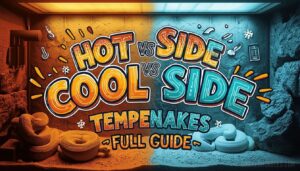
A snake refusing to eat is rarely about food. Nine times out of ten, it’s a temperature problem—specifically, a failed thermal gradient.
Snakes can’t generate their own body heat, so they depend entirely on moving between zones you create. Get the hot side vs cool side temperature for snakes wrong, and you’ve built a box that slowly breaks them down: poor digestion, chronic stress, suppressed immunity, botched sheds. The gap between a thriving snake and a struggling one often measures less than 10°F—and it lives between your warm hide and your cool side.
Table Of Contents
- Key Takeaways
- Hot Side Vs Cool Side Basics
- Ideal Snake Temperature Ranges
- How to Build a Thermal Gradient
- Heating Tools and Temperature Control
- Common Snake Heating Mistakes
- Frequently Asked Questions (FAQs)
- What temperature should a snake cool down?
- Do corn snakes need a thermostat?
- How hot should a snake enclosure be?
- Can snakes thermoregulate?
- Can substrate type affect enclosure temperature consistency?
- How does humidity interact with thermal gradient maintenance?
- Do snakes need temperature changes during breeding season?
- How often should thermometers be replaced or recalibrated?
- Can enclosure size impact how well gradients form?
- Conclusion
Key Takeaways
- A snake refusing to eat is almost always a temperature problem—specifically, a broken thermal gradient, not a picky appetite.
- Your hot side needs to hit 88–92°F and your cool side 75–80°F; miss that 8–12°F spread, and digestion, shedding, and immunity all quietly fall apart.
- Heat rocks, missing thermostats, and evenly heated enclosures aren’t just bad practice—they’re the fastest way to stress a snake you’ll never catch in the act.
- Night temps dropping below 72°F aren’t a minor inconvenience; they stall digestion, suppress the immune system, and compound into chronic health decline over time.
Hot Side Vs Cool Side Basics

Your snake isn’t just sitting there looking cool — it’s constantly reading its environment and making calculated moves. Two distinct temperature zones give it the tools to regulate everything from digestion to immune function.
By shuttling between warm and cool zones, your snake self-regulates more precisely than most people realize — proper habitat design makes all the difference.
Here’s what each side of the enclosure actually does, and why both matter.
What Each Temperature Zone Does
Each zone in your enclosure pulls a specific biological lever. The hot side drives digestion acceleration and activity pattern influence—your snake simply can’t process prey without it. The cool side manages metabolic rate control and stress hormone management.
| Zone | Primary Function | Key Benefit |
|---|---|---|
| Hot Side / Basking Zone | Digestion & activity | Enzyme activation |
| Cool Side | Metabolic regulation | Stress reduction |
| Thermal Gradient Middle | Change buffer | Shedding facilitation |
Why Snakes Need Both Zones
One zone isn’t enough. Your snake needs the hot side for digestive speed and the cool side for energy budgeting—skip either, and you’re forcing a biological compromise.
Stress reduction, hormonal balance, and immune efficiency all depend on that dual-zone setup.
Maintaining a proper temperature gradient importance is essential for metabolic health in snakes.
| Need | Zone That Solves It |
|---|---|
| Faster digestion | Hot side |
| Stress reduction | Cool side |
| Hormonal balance | Cool side |
| Immune efficiency | Full thermal gradient |
| Energy budgeting | Cool side |
How Thermal Zoning Supports Ectothermy
Ectotherms don’t generate body heat—they borrow it from their environment. That’s the whole game.
Your temperature gradient isn’t decoration; it’s the control panel for Metabolic Rate Modulation, Shedding Efficiency, and Growth Rate Optimization. Behavioral Thermoregulation keeps Stress Hormone Balance in check by giving snakes real choices—hot side, cool side, anywhere between.
| Function | Hot Side | Cool Side |
|---|---|---|
| Digestion speed | Accelerated | Slowed |
| Stress hormones | Neutral | Reduced |
| Shedding efficiency | Supported | Compromised |
How Snakes Move Between Warm and Cool Areas
After feeding, your snake isn’t lounging—it’s working. Digestive Heat Seeking kicks in immediately, pulling it toward the basking zone to accelerate gut motility.
Basking Duration Patterns shift based on meal size, hunger cycles, and Circadian Shift Timing.
Cool-side Retreat Triggers—like overheating or post-digestion recovery—send it back across the gradient.
Hydration Influence matters; thirsty snakes favor cooler, damper microzones.
| Trigger | Zone Preference | Snake Behavior |
|---|---|---|
| Post-feeding digestion | Basking zone | Extended warm-side stay |
| Overheating risk | Cool hide | Tight coiling, minimal movement |
| Nighttime rest cycle | Cool side | Reduced thermoregulation activity |
| Pre-shed hydration need | Cool-damp zone | Moisture-seeking behavior |
| Hunger/hunting mode | Middle gradient | Active shuttling, exploration |
Ideal Snake Temperature Ranges

Getting the temperature right isn’t guesswork—it’s a matter of hitting specific numbers for your species. Every snake has a range where it thrives, and straying outside it causes real problems.
A quick look at species-specific snake temperature and habitat guides makes it easy to dial in the exact numbers your snake actually needs.
Here’s what those ranges actually look like.
General Warm-side Temperature Targets
The warm side isn’t a suggestion—it’s the engine. Your target range sits between 88–92°F for most species, with a dedicated basking spot temperature hitting 90–95°F. Temperature stability here directly drives digestion, immune function, and shedding success.
- Ball pythons need 90–92°F on the hot side
- Corn snakes thrive at 85–88°F
- Boas require 88–92°F warm side
- Hatchlings need 2–4°F higher than adults
- Thermostat calibration keeps your thermal gradient design locked in
General Cool-side Temperature Targets
The cool side does the quiet work. Your target range sits at 75–80°F for most species—cool enough to slow metabolism when needed, not so cold it triggers stress.
cool side stability matters as much as the warm end.
Poor cool zone airflow or ambient cool influence from drafty rooms can push readings below the minimum cool threshold.
Don’t ignore it.
Recommended Nighttime Temperature Range
Once the lights go out, your gradient still matters. Nighttime temperature drop should be gradual—not a free fall.
Most species tolerate a night drop to 75–80°F on the warm side and 70–75°F on the cool side.
Nighttime gradient stability prevents stress and shed issues.
Use nighttime heat sources with thermostats, and invest in nighttime temperature monitoring to catch seasonal nighttime adjustments before they become problems.
Species-specific Ranges for Ball Pythons, Corn Snakes, and Boas
One size never fits all. Ball Python Limits sit at 88–92°F warm, 78–82°F cool. Corn Snake Limits run cooler—82–88°F warm, 72–78°F cool. Boa Constrictor Limits land in between: 84–90°F warm, 75–80°F cool.
Species-specific temperature ranges for snakes aren’t suggestions—they’re biological requirements. Honor each species’ thermal gradient, and your snake’s metabolism, digestion, and Growth Temperature Needs stay on track.
Hatchling Temperatures Versus Adult Snakes
Hatchlings aren’t just small adults—their Metabolic Rate Differences demand tighter thermal control. Growth Rate Impact, Feeding Readiness, and Shedding Frequency all spike when temperatures stay precise.
Keep their temperature gradient 2–4°F warmer than adults, with a 6–8°F spread between zones.
- Hatchling warm side: 2–4°F above adult targets
- Tighter gradient window—around 6–8°F total
- Stress Hormone Levels rise fast with temperature swings
- Species-specific temperature requirements for snakes apply from day one
How to Build a Thermal Gradient
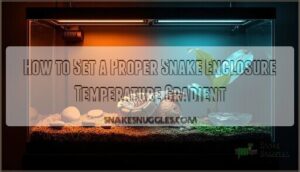
Building a thermal gradient isn’t complicated, but the details matter. Where you place heat sources, hides, and probes determines whether your snake actually uses the gradient—or just sits in one spot.
Here’s how to set it up right.
Enclosure Placement of Heat Sources
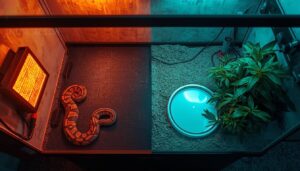
Position heat mats under one-third of the floor on the hot side only—never centered. Side wall mounting works for radiant panels; ceiling heat placement suits overhead emitters, using natural convection to push warmth downward.
Keep cables routed cleanly along enclosure edges for safe cable management.
Mount your thermostat where you can reach it fast.
Heat shield orientation matters: direct heat inward, not outward.
Where to Position Warm and Cool Hides

Your warm side hide goes directly over the heat source—that’s your Heat Proximity Hide in action. Tuck the cool hide into the opposite corner using Corner Hide Placement, away from any draft-free position concerns.
Keep substrate height even, so neither hide tilts. Leave a Clear Path Access between both ends, letting your snake navigate the full thermal gradient and basking zone without detours.
Best Temperature Difference Between Zones

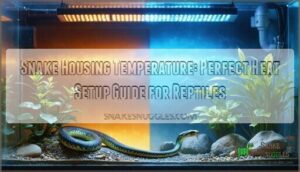
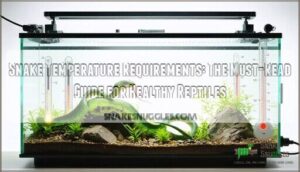
Now that your hides are locked in place, the spread between zones is where your thermal gradient design either works or fails. Target an 8–12°F differential—anything tighter collapses Zone Balance Effects.
- Hot side: 88–92°F
- Cool side: 76–82°F
- Middle zone: 80–85°F
- Nighttime floor: 72°F minimum
- Gradient Drift Prevention: ±2°F tolerance max
A dual thermostat manages Differential Adjustment Techniques automatically.
How to Create a Smooth Middle Zone

The middle zone isn’t filler—it’s your thermal gradient design doing its real work. Gradual Temperature Change depends on smart heat source placement, not luck.
Lay substrate deep enough for Substrate Heat Distribution to even out hot spots naturally. Thermal Buffer Materials like cork bark to slow airflow.
Middle zone Airflow Management and Middle Zone Insulation keep temperatures hovering smoothly between 80–85°F—no jarring jumps.
Step-by-step Setup for a Stable Gradient

Now that your middle zone is dialed in, lock the whole system down with a repeatable setup sequence.
- Set your heat source on the hot side, targeting 90–92°F with a thermostat
- Verify cool side hits 75–80°F using a second probe—that’s your Gradient Validation Procedure
- Deep substrate manages Substrate Heat Retention and Humidity Control simultaneously
- Run a Thermometer Calibration Routine weekly; add a Redundant Power Supply for overnight protection
Temperature logging catches drift before your snake does.
Heating Tools and Temperature Control

Getting the temperature right comes down to the tools you use and how well you control them. The wrong setup—or a missing thermostat—can erase your gradient entirely.
Here’s what actually works.
Heat Mats Versus Heat Lamps
Both tools work—they do different jobs.
heat mat excels in substrate compatibility, spreading diffuse belly heat across the floor at low wattage; solid energy efficiency over time.
heat lamp delivers spotlight coverage from above, mimicking solar radiance.
Always pair either with a thermostat. Safety shields on lamps prevent burns.
Cost comparison favors mats long-term.
When to Use Radiant Heat Panels
Radiant heat panels earn their place in serious reptile husbandry—especially large enclosures where maintaining a clean temperature gradient is otherwise a juggling act. Here’s when they genuinely make sense:
- Quiet Zone Heating – Silent operation; no fan noise stressing your snake
- Infrared Energy Efficiency – Direct object warming, not wasted air heating
- Wall-Mounted Installations – Ceiling-mounted panels preserve floor space for substrate depth
- Rapid Warm-Up – Target hot side temps within 15–30 minutes
- Low Maintenance Design – No bulbs to swap, no moving parts to fail
Why Thermostats Are Essential
Skip the thermostat and your heat mat becomes a liability—not a tool.
A quality thermostat delivers precise zoning, holding your warm side within a degree or two of target without manual babysitting. That consistency protects system longevity, prevents burnout, and maintains the temperature gradient your snake’s biology depends on.
Safety alerts flag dangerous spikes before burns happen. Energy savings follow automatically.
Probe Placement for Accurate Readings
Your thermostat probe is only as reliable as where you put it. Place your Warm Hide Probe inside the hide at chest height—not touching the heat mat.
For guidance on pairing your probe setup with the right controller, how thermostats protect reptiles from dangerous temperature spikes breaks down which unit works best with your specific heat source.
Keep your Cool Zone Probe at the opposite end. Maintain Substrate Tip Height at 1–2 cm above bedding.
Avoid Direct Heat contact. Cross-check your digital probe thermometer against an infrared gun weekly, and log every reading in a Calibration Log to catch drift early.
Using Dual Thermostats for Extra Safety
One thermostat failure shouldn’t mean a dead snake. Dual relay failover setups pair two independent units—each with redundant sensor placement across warm and cool zones—for real cross verification.
Fault detection alarms trigger automatically when readings diverge beyond tolerance, and resettable safety thresholds cut power before temperatures spike. That 15–25% reduction in overshoot isn’t a marketing claim. It’s measurable protection that your temperature gradient actually depends on.
Common Snake Heating Mistakes

Even experienced keepers make heating mistakes that quietly stress their snakes for months. Most of these errors come down to a few predictable patterns—and they’re easier to fix than you’d think.
Here’s what to watch for.
Heating The Whole Enclosure Evenly
Uniform heat everywhere sounds logical—until your snake stops eating and sits in one corner for three weeks.
Without no gradient, there’s nowhere for it to cool down.
Distributed heat sources, power balancing, and smart heat source placement guidelines all exist for one reason: choice.
Signs your heat distribution is wrong:
- Snake always occupies one end
- Uniform Heat Spread erases behavioral thermoregulation
- Substrate Heat Retention collapses without zone separation
- Even Radiant Coverage from radiant panels and heat mats becomes a trap
- No cool retreat means chronic stress
Skipping Thermostats and Temperature Checks
Fixing the gradient means nothing if your thermostat is missing.
Without one, Overheating Risk becomes real fast — heat sources run unchecked, hot zones spike, and Safety Cutoff Bypass means no automatic shutoff when temps climb.
Sensor Drift from uncalibrated digital thermometers quietly skews your readings over weeks.
Manual Override Danger creeps in when you assume it’s "close enough."
Data Log Neglect makes it worse.
| Risk | Consequence |
|---|---|
| No thermostat | Uncontrolled heat spikes |
| Skipped checks | Undetected sensor drift |
Using Heat Rocks Safely, or Not at All
Heat rocks are a classic rookie trap. They concentrate heat in one tiny spot — surface temps can hit 50–60°C — while your enclosure reads fine.
Snakes don’t detect dangerous contact heat fast enough to move away, so Heat Rock Burns happen quietly.
Skip them entirely. For Alternative Belly Heat, use a thermostat-controlled heat mat instead. Secure Rock Placement and Rock Temperature Monitoring can’t fully offset the risk.
Problems Caused by Low Nighttime Temperatures
Night temps below 72°F don’t just make your snake uncomfortable—they trigger a cascade of problems.
Metabolic Slowdown hits first, stalling digestion and causing regurgitation by morning. Then Immune Suppression follows, leaving your snake vulnerable to temperature‑related illness. Cold stress compounds Shedding Complications, Dehydration Risks, and Growth Stunting over time.
Cold nights below 72°F stall digestion, suppress immunity, and silently compound into chronic health decline
Watch for these nighttime temperature drop warning signs:
- Regurgitation after morning warmup
- Retained shed or patchy skin
- Reduced appetite for multiple feeding cycles
- Visible lethargy on the cold side
- Thermal shock symptoms after rapid temperature swings
Signs The Gradient Needs Adjustment
Your snake’s behavior tells you before the thermometer does. Stress behavior signs—repeated boundary crossing, feeding refusal, restless nights outside hides—point directly to middle zone instability or temperature gradient collapse.
Watch for probe variance between zones narrowing over consecutive days.
Uneven heat spread, nighttime cooling dips, and shedding problems confirm it.
Cold stress and signs of overheating demand immediate temperature monitoring and recalibration.
Frequently Asked Questions (FAQs)
What temperature should a snake cool down?
Your cool side should sit between 75–80 °F—the Cool Zone Minimum for most species.
That temperature drop signals the body to slow digestion, reduce metabolic output, and recover properly using Thermal Gradient Recovery overnight.
Do corn snakes need a thermostat?
Yes, corn snakes need a thermostat. Without one, your heat source runs unchecked—burn risk, gradient collapse, stressed snake. Non-negotiable for safe keeping.
How hot should a snake enclosure be?
Your enclosure needs a warm side of 80–92 °F and a cool side of 75–80 °F. That temperature gradient lets your snake self-regulate—moving between zones as digestion and activity demand.
Can snakes thermoregulate?
Absolutely.
Snakes are ectothermic masters of behavioral basking, using infrared detection via pit organ sensing and vasomotor control to regulate metabolic rate, immune response, and digestion across a temperature gradient — no internal furnace required.
Can substrate type affect enclosure temperature consistency?
Substrate is the hidden variable most keepers overlook. Thermal conductivity, moisture retention, substrate depth, and material heat capacity all shape thermal variance — directly affecting how stable your temperature gradient stays.
How does humidity interact with thermal gradient maintenance?
Humidity quietly undermines your thermal gradient.
Moisture-laden substrates slow heat transfer—moisture thermal lag—while vapor pressure effects reduce radiant efficiency. Condensation microclimates and humidity-driven gradient shifts compress zone separation before you notice.
Do snakes need temperature changes during breeding season?
Yes.
Seasonal temperature cycles trigger hormonal shifts that cue mating behavior, support embryo development heat needs, and guide gestation temperature needs—mimicking natural breeding temperature cycles, your snake’s biology still expects.
How often should thermometers be replaced or recalibrated?
Recalibrate your thermometer at least once a year. Replace it immediately if you notice drift, physical damage, or inconsistent readings. When in doubt, trust the manufacturer’s guidelines over guesswork.
Can enclosure size impact how well gradients form?
Enclosure volume effects are real—think of a small tank as a skillet and a large one as an oven.
Size shapes thermal mass impact, gradient zone spacing, and microhabitat diversity directly.
Conclusion
Your enclosure isn’t just a box—it’s a climate you engineer.
Nail the hot side vs cool side temperature for snakes, and you’ve quietly removed the most common source of slow, invisible decline in captive reptiles.
A functioning gradient means your snake digests, sheds, and regulates without compensating for your setup’s failures.
Temperature isn’t one of several factors to keep in mind. It’s the factor everything else runs on. Get it right, and your snake will show you.
- https://www.coalitionbrewing.com/how-often-should-a-thermometer-be-checked-for-accuracy/
- https://www.pattontheedge.ca/thermometer-calibration-frequency-optimal-measurements/
- https://www.fluke.com/en-in/learn/blog/temperature-calibration/accurate-fever-scanning-infrared-forehead-thermometers-issues-solutions-how-calibrate