This site is supported by our readers. We may earn a commission, at no cost to you, if you purchase through links.

A snake needs about four seconds to find the one weak spot in your enclosure. Then it’s gone, tucked behind a couch or sliding under a dresser.
Escape is only the loudest failure. Quiet ones do more damage: a cool side that runs too cold, humidity that sags overnight, a hide that tips and traps your animal. Good snake habitat design tips fix all of it at once, because a secure setup is also a healthy one.
Your snake can’t tell you what’s wrong. The enclosure has to say it for them, so build one that speaks clearly, starting with size and materials.
Table Of Contents
- Key Takeaways
- Choose The Right Snake Enclosure Size and Materials
- Create Species-Appropriate Temperature and Humidity Gradients
- Select Safe Substrates, Hides, and Enrichment
- Plan Snake Habitat Lighting, Ventilation, and Water
- Keep Your Snake Habitat Clean and Escape-Proof
- Frequently Asked Questions (FAQs)
- What is the best habitat for a snake?
- What material can snakes not bite through?
- What habitat do snakes prefer?
- What wood to avoid for snakes?
- How often should I handle my snake?
- Can multiple snakes share one enclosure safely?
- What signs indicate my snake is stressed?
- How do I transition my snake between enclosures?
- Should I use live or artificial plants?
- How often should I feed my snake?
- Conclusion
Key Takeaways
- Size your enclosure to your snake’s length, with width at least half of it, and pick sealed, non-toxic materials like PVC or sealed wood, since the box itself sets your heat, humidity, and security.
- Build a real temperature gradient with at least a 10°F spread and digital thermometers on both sides, so your snake can choose its own comfort zone.
- Give your snake 3 to 4 inches of burrowable substrate (more for big burrowers), a warm hide and a cool hide anchored in place, and a heavy water bowl on the cool side.
- Treat escape prevention as a habit: check latches, seams, and mesh after every feeding and cleaning, and lock the lid so no small gap goes unnoticed.
Choose The Right Snake Enclosure Size and Materials
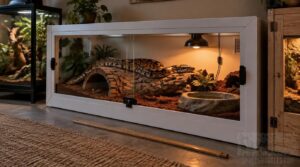
A snake doesn’t care about your décor. It cares about space, security, and heat that stays where you put it. These Snake Habitat Design Tips start with the box itself.
Once the enclosure is sized and secured, these snake habitat decoration tips show how to add hides and climbing branches without blocking heat or airflow.
Measure your snake nose to tail. Your Enclosure Dimensions should match that length at minimum, with width at least half of it. Terrestrial snakes need height of one to one and a half times body length, mostly for substrate depth. Arboreal species need taller builds, so skip standard racks once they outgrow juvenile size. Speciesspecific Design beats guesswork every time.
For rack setups, a tub size calculator applies the perimeter rule and life-stage adjustments to suggest practical footprint dimensions.
Weigh your Reptile Enclosure Materials. Glass shows your snake but leaks heat. PVC insulates, holds humidity, and wipes clean. Wood works only when sealed with non-toxic, waterproof Escape-Proof DIY Finishes.
Create Species-Appropriate Temperature and Humidity Gradients
Heat is a tool, so build it like one. A temperature gradient lets your snake choose, and choice keeps it healthy. Without one, you’re guessing.
Put your heat source at one end. Your enclosure dimensions decide whether the gradient works, because a short box bleeds warmth everywhere. Aim for at least a 10°F difference between thermal zones. Smaller than that, and the gradient has failed.
For a ball python, hold the basking surface at 88 to 92°F, the warm side at 80 to 85°F, and the cool side at 75 to 80°F. Use digital thermometers on both sides. Skip analog ones.
Species-appropriate humidity follows the heat. Keep ball pythons at 70 to 85% on the cool side, 60% or higher on the warm.
Select Safe Substrates, Hides, and Enrichment
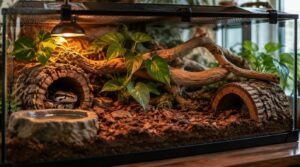
Your snake lives on this floor, hides in these shelters, and climbs these branches. Get them wrong and safety goes out the window, along with your snake’s good health. Here are three choices that shape everything inside the glass.
If your snake has already slipped out, knowing how long a snake can survive lost in a house can help you judge how urgently to search.
Substrate Choices and Burrowing Depth
Watch a hognose plow through loose soil, nose first, and vanish like a coin down a drain. That’s the effect you want from burrowingfriendly substrate.
Give most snakes 3 to 4 inches of substrate depth, and big burrowers 4 to 6. Fossorial substrate depth under 3 inches leaves them exposed and pacing.
Escapeproof DIY finishes boost reptile enclosure security, too.
Secure Hides and Climbing Structures
Burrowing is one way to feel safe. Hiding spots are the other. Give your snake two hides, one warm and one cool, so it never has to pick between security and temperature.
Anchor everything. Screw hides to the wall, fasteners tucked out of reach. Zip-tie grapevine or cork branches so they can’t shift. Check each entrance: your snake should turn around easily.
Bioactive Plants and Cleanup Crews
Nature does the cleaning when living plants and cleanup crews share one bioactive terrarium.
Here’s what you gain:
- Your snake explores a lush, living world.
- Waste vanishes before it smells.
- Roots grip soft, bioactive substrate.
- Nontoxic plants mean zero panic.
- Maintenance finally feels calm.
Choose reptilesafe plants, feed your crew, and stop scrubbing. Balance beats sterility, and your snake benefits.
Plan Snake Habitat Lighting, Ventilation, and Water
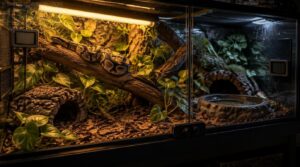
Light, air, and water decide whether your snake thrives or merely survives. You’ll set up each one in turn, starting with light cycles and UVB zones. Get all three right, and the rest of your habitat works harder for you.
Light Cycles and UVB Ferguson Zones
Bright isn’t better. Your snake needs the right light, not the most light.
Sort your species into Ferguson zones first. Ball pythons sit in Zone 1, corn snakes and boas in Zone 2. Aim for a basking UVI of 0.4–0.6 or 0.7–1.0, verified by a UV index meter. Run UVB lighting for reptiles on strictly timed 10–12 hour lighting cycles.
Balance Airflow With Humidity Retention
Think of your enclosure as a lung, not a sealed jar. It needs to breathe in and out, or it rots.
Place intake vents low and exhaust vents high. Adjustable ventilation systems let you tune humidity control by season. Material matters too. Sealed PVC holds moisture; glass and mesh leak it. Choose front-opening doors with tight locking mechanisms, then check seams monthly.
Water Bowl Placement and Hygiene
A fouled water dish turns your enclosure into a swamp.
- Cool side, beside a hide entrance.
- Heavy porcelain, never painted.
- Fresh water every 1-2 days.
- Weekly scrub with F10SC diluted 1250.
- Slimy film means scrub sooner.
Smart enclosure material choices make habitat maintenance easier. Rinse thoroughly with plain water, and use any reptile-safe cleaning solution sparingly. Your snake notices purity.
Keep Your Snake Habitat Clean and Escape-Proof
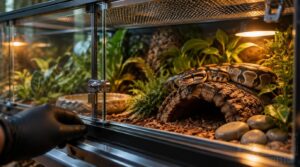
A snake doesn’t escape through a dramatic breakout. It escapes through a gap you didn’t notice.
Snakes rarely stage dramatic breakouts; they simply slip away through the one small gap you never noticed
Good reptile escape prevention is a habit, not a purchase. After every feeding and cleaning, check each latch, seam, and hinge. Press on the lid. Run a finger along the door tracks. Bent mesh corners and warped lids get fixed today, not next week. If you run a fogger for humidity, remember that its ventilation and reservoir upkeep matter too, so this guide to fogger safety and humidity control is worth a read.
Tight lid seals matter most. Clip them, lock them, and never trust a lid that merely rests in place. Cover ventilation panels with fine mesh, and swap wire grommets for solid ones.
Your enclosure material choices count too. Front-opening glass, wood, or PVC gives you sturdier doors and better cage security. Snakes test weaknesses, so you should find them first.
Frequently Asked Questions (FAQs)
What is the best habitat for a snake?
Why do so many escapes happen overnight? Because the best habitat is species-specific design with tight lid seals. Size the enclosure to your snake’s length, add ventilation panels, offer two hides, and hold the gradient steady.
What material can snakes not bite through?
Tempered glass, rigid steel mesh, and solid plastic panels like polycarbonate stop fangs cold. Choose mesh openings of 1/4 inch or smaller, and build with sealed exterior plywood. Front-opening doors need secure locks.
What habitat do snakes prefer?
Do snakes all love heat and dryness? No. Reptile habitat planning starts with origin: hognoses want dry, burrowable sand, corn snakes want cooler edges, tropical species want species-appropriate humidity. Always copy nature, not your assumptions.
What wood to avoid for snakes?
Would you sleep in a perfume factory? Your snake won’t. Skip pine and cedar, plus plywood or MDF that releases off-gas compounds. Choose kiln-dried hardwood, nontoxic finishes, and safe enclosure materials, then hold species-appropriate humidity.
How often should I handle my snake?
Keep your handling routine short: five to ten minutes, two or three times weekly. Use front-opening doors gently. Watch stress responses like hissing, then return your snake calmly to proper enclosure dimensions and species-appropriate humidity.
Can multiple snakes share one enclosure safely?
Most snakes shouldn’t share a home. They’re solitary, so company brings stress, competition, disease, and cannibalism, not comfort.
Even with visual barriers and generous space, cohabitation often ends badly. Keep one snake per enclosure.
What signs indicate my snake is stressed?
Your corn snake skips two meals, then spends every night pressed against the glass. That’s not mood. Those are stress responses.
Watch for hiding that never ends, striking, or lethargy. Check temperatures, humidity, and hiding spots first.
How do I transition my snake between enclosures?
Moving is a marathon, not a sprint. Carry your snake in a secure container. Match species-appropriate humidity, enclosure dimensions, and 3-4 inches of substrate. Choose front-opening doors, add behavioral enrichment activities, then wait 48-72 hours.
Should I use live or artificial plants?
Live or artificial plants both work. Artificial plants demand zero care and survive any conditions, if reptile-safe.
Live, snake-friendly plants add humidity and a naturalistic environment. Either way, cover brings habitat enrichment and stress reduction.
How often should I feed my snake?
Think a snake eats on your schedule? Think again. Feed hatchlings every 5-7 days, juveniles every 7-10, adults every 10- Boas and pythons often wait longer.
Keep a proper temperature gradient, and expect feeding refusals.
Conclusion
Picture a ball python named Juniper, calm in her 4-foot tub, heat gradient steady at 78 to 88 degrees, lid latched. Nothing dramatic happens. That’s the point.
Every one of these snake habitat design tips does the same goal: remove surprises. Size the enclosure right, build the gradients, secure the hides, and lock the lid.
Your snake can’t thank you. But a boring, uneventful enclosure is the highest praise it can give. Build one tonight.