This site is supported by our readers. We may earn a commission, at no cost to you, if you purchase through links.
A snake in shed looks like it’s wrapped in wax paper—dull, milky eyes, grayish skin that no longer catches the light. That transformation is your signal to act, not watch.
What happens over the next several days depends largely on one variable you control entirely: moisture. Too little humidity, and the old skin dries before it separates cleanly, leaving patches stuck to digits and eye caps that can cut off circulation or impair vision. Getting your misting schedule for shedding right isn’t complicated, but it does require a deliberate approach timed to your snake’s biology.
Table Of Contents
- Key Takeaways
- Why Misting Helps Shedding
- Set Your Species Humidity Target
- Build a Misting Schedule
- Monitor Humidity and Shed Progress
- Fix Common Shedding Problems
- Frequently Asked Questions (FAQs)
- How often should you mist your home?
- How often should you mist a plant?
- Do Plants need misting?
- When is the best time to mist a plant?
- Do snakes like to be misted?
- Does water quality affect misting and shed outcomes?
- Can misting stress snakes during active shedding?
- How long does a typical shedding cycle last?
- Should misting stop after a successful full shed?
- Do hatchlings need different misting schedules than adults?
- Conclusion
Key Takeaways
- Humidity is the single variable you control that determines whether your snake sheds cleanly or struggles with stuck skin, restricted digits, and damaged eye caps.
- Each species has a distinct target humidity range — ball pythons need 70–80%, boas 75–85%, and corn snakes around 60% — and guessing wrong during a shed causes real, preventable harm.
- Morning misting beats evening misting because evaporation works in your favor, giving surfaces time to dry before cooler nighttime air turns lingering moisture into a mold problem.
- A humid hide is a targeted tool, not a permanent fixture — add it the moment pre‑shed cues appear, keep it damp but not soaked, and remove it once the shed is complete.
Why Misting Helps Shedding

Shedding is one of those moments where your care routine really shows its worth. Moisture is the key factor that determines whether your snake sheds cleanly in one piece or struggles through a patchy, incomplete process.
Getting the humidity levels just right makes all the difference, as outlined in this guide to ideal moisture conditions for snake shedding.
Here’s what you need to know about how misting helps a healthy shed — and what to watch for when it isn’t working.
How Moisture Supports a Clean Shed
When your snake enters the shedding process, moisture does the heavy lifting. Proper humidity levels soften the keratin layer, making skin separation smoother and reducing the risk of cracking.
Eye cap hydration is especially critical — without it, the eye cap won’t lift cleanly.
well-maintained humidity gradient aids moisture retention across the full shed, helping the skin release in one clean piece. Ensuring preventing condensation in sheds helps maintain ideal humidity for a smooth shed.
What Happens When Humidity is Too Low
Drop humidity below your snake’s target range, and the shed film dries out before it can lift cleanly — that’s when cracked shed film, digit skin retention, and eye cap dryness become real problems.
Low humidity dries the shed film before it lifts, leaving cracked skin, trapped digits, and stuck eye caps
Here’s what low humidity does:
- Skin brittleness causes the shed to crack and fragment
- Digit skin retention tightens around toes, restricting circulation
- Eye cap dryness delays full release
- Extended shed duration increases stress and incomplete shedding
Signs Your Snake is Entering Shed
Before you adjust your misting frequency, you need to know when to act. Watch for dull coloration and cloudy eyes — both signal that ecdysis is starting.
Increased soaking and rubbing behavior follow closely behind, and reduced feeding often confirms it.
| Sign | What It Means |
|---|---|
| Cloudy eyes | Pre-shed phase beginning |
| Increased soaking | Skin needs more moisture |
| Rubbing behavior | Old skin loosening |
Set Your Species Humidity Target

Not every reptile plays by the same humidity rules, and getting it wrong during a shed can cause real problems.
Even when you think you’ve nailed the setup, persistent shedding issues in reptiles often point to species-specific needs that general humidity guidelines simply don’t cover.
Before you touch your misting schedule, you need to know the target range for your specific species.
Here’s what ball pythons, boa constrictors, and corn snakes each need — and how your enclosure size fits into the picture.
Ball Python Humidity Needs
Ball pythons do best with an ideal RH range of 55–70% during normal conditions, bumping up to 70–80% when shedding aids are most needed.
Your misting schedule should respond to what your humidity monitoring actually shows — not a fixed clock.
Factor in seasonal humidity adjustments, balance ventilation humidity carefully, and choose substrate moisture retention materials like coconut fiber to hold moisture between sessions.
Boa Constrictor Humidity Needs
Boa constrictors are a step up from ball pythons regarding moisture needs. Keep RH between 55–75% normally, then ramp toward 75–85% as the pre-shed humidity ramp begins.
Humidity sensor placement matters — position it where your boa actually rests. Water bowl evaporation near a heat source passively helps your misting schedule, while substrate moisture retention and ventilation balance prevent stagnant dampness.
Corn Snake Humidity Needs
Corn snakes are more forgiving than their tropical cousins, but they still need precision.
Keep relative humidity between 40–60% for everyday care, then push toward 60% as shedding approaches.
Bedding Material Choice drives a lot of this — coconut fiber and cypress mulch excel at Substrate Moisture Retention, keeping levels steady. Pair that with Water Bowl Soaking to support Microclimate Creation and improve shedding quality.
How Enclosure Size Affects Moisture
Enclosure size quietly controls everything.
A small tank reaches target Volume Humidity fast — sometimes too fast — while a larger one distributes moisture slowly, creating uneven Microclimate Zones.
Surface Condensation builds differently too, especially near glass walls.
That’s why Misting Distribution and Ventilation Scaling matter: bigger enclosures need multiple spray points, and ventilation design should balance airflow with substrate moisture to prevent humidity fluctuations without over-drying.
Build a Misting Schedule
Now that you know your snake’s humidity target, the next step is turning that number into a real, repeatable routine. A good misting schedule isn’t complicated, but the timing and frequency do matter — especially when your snake is getting ready to shed.
Here’s how to build one that actually works.
Daily Misting for Shed Support
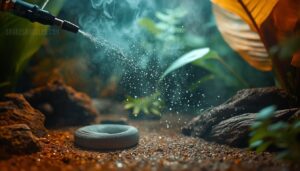
Daily misting isn’t about keeping the enclosure wet — it’s a targeted humidity tool. once per day is usually enough outside the shed, but your daily misting schedule should shift when pre-shed begins.
Focus on misting duration over volume: shorter, consistent bursts raise humidity without soaking the substrate. Use clean water and quality nozzle selection to avoid mineral buildup that clogs your system and skews your ability to monitor humidity levels accurately.
Morning Versus Evening Misting

Morning mist wins for one simple reason: evaporation rate works in your favor. Misting after lights-on gives surfaces hours to dry before nighttime condensation risk climbs.
Evening mist lingers longer on hides and glass, and without careful ventilation timing, overnight dampness builds fast. For misting cycle optimization, let temperature humidity interaction guide you — cooler nights mean slower drying, so front-load your moisture earlier in the day.
Adjusting Frequency During Pre-shed and Active Shed

Pre-shed timing calls for a gentle humidity lift — not a flood. When your snake’s skin starts dulling, increase misting frequency gradually to avoid surface wetness control issues that invite mold or bacterial growth.
- Pre-shed: Add one extra daily mist, targeting morning sessions.
- Active shed misting: Maintain steady humidity; coordinate with airflow so humidity sensor triggers fire consistently.
- Surface wetness: Let substrate partially dry between sessions to prevent stuck shed.
When to Mist More Often or Less Often

Once pre-shed humidity is dialed in, fine-tuning becomes about reading your environment.
High airflow pulls moisture out fast, so increase frequency.
Sealed tanks hold it longer — back off.
Seasonal temperature shifts matter too: dry winter heating drops ambient humidity, demanding more misting.
Watch your hygrometer placement and droplet size — coarse spray wets surfaces without raising air humidity for long.
Monitor Humidity and Shed Progress
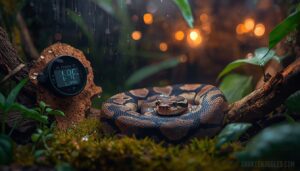
Building a misting schedule is only half the job — the other half is knowing whether it’s actually working. That means keeping an eye on your readings, your snake, and a few key warning signs along the way.
Here’s what to track.
Using a Digital Hygrometer Correctly
A digital hygrometer is only as useful as the accuracy behind it — so calibration isn’t optional. Run a salt test before trusting any new device: seal it in a bag with a damp salt mixture and confirm it reads around 75% RH.
From there, build log consistency into your routine:
- Confirm placement accuracy away from heat sources and drafts
- Follow the calibration procedure after every battery change
- Practice reading interpretation by comparing morning and evening data
- Track your misting schedule alongside humidity readings daily
This turns raw numbers into real patterns you can actually act on.
Checking Humidity at Snake Level
Where you place your sensor matters just as much as having one. A microclimate gradient naturally forms in every enclosure — warmer, drier air rises while cooler, more humid air settles near the substrate.
Mounting a reliable terrarium thermometer for small apartments halfway up the enclosure gives you readings from that middle zone where your reptile actually spends its day.
For compact setups, humidity gauges for small spaces help you monitor both warm and cool zones accurately.
For a ball python, probe placement strategies at substrate level reveal the humidity levels your snake actually experiences.
A dual sensor setup, one low and one mid-tank, gives you complete substrate air readings without guesswork.
Watching for Stuck Shed and Dry Patches
Even with sensors in place, your eyes are still your best humidity monitoring tool. Watch for shed color shift — dull, grayish patches instead of a clean, papery pull, means moisture didn’t reach evenly.
Tail tip dryness and digit swelling are early warnings. During pre-shed behavior changes, check those tight spots daily.
Patch hydration timing matters: stuck shed hardens fast.
Logging Mist Times and Readings
Keeping a simple log turns guesswork into a system. Record your Pre‑Mist Baseline reading each morning before the first cycle, then note the Post‑Mist Spike a few minutes after.
Use Timestamp Consistency — same times daily — so your data stays comparable. Your Sensor Placement Protocol should stay fixed too.
Log Anomaly Notes for anything unusual, like an early mist end, so outliers don’t mislead you later.
Fix Common Shedding Problems

Even with a solid misting routine, shedding problems still happen — and that’s okay. Most issues come down to a few fixable factors inside the enclosure.
Here’s what to check and how to correct it.
Reducing Excess Moisture and Condensation
Too much moisture creates its own problems — condensation on glass, soggy substrate, and mold creeping in before you notice. Smart Surface Temperature Management starts with using room-temperature water, which reduces the sharp cooling that triggers droplets on tank walls.
Keep these Condensation Prevention Tips in mind:
- Spot-mist inside the humid hide only for Hide Moisture Regulation
- Spread misting into shorter cycles to avoid humidity spikes
- Practice Substrate Dryness Control by removing wet bedding after heavy misting
- Apply Bowl Placement Optimization by moving the water bowl away from the coldest wall
- Wipe drips from glass immediately to stop repeated wetting cycles
Improving Ventilation Without Drying The Tank
Ventilation doesn’t have to mean drying your tank out. Controlled Air Exchange — using small, paired intake and exhaust openings — lets stale air out without gutting your humidity.
Indirect Airflow Design and Vent Placement Optimization keep circulation moving across the substrate, not directly at your snake.
Add Low-Speed Fan Settings outside the enclosure and rely on Moisture Buffer Integration through damp substrate to handle humidity retention naturally, preventing shedding problems and mold prevention issues.
When to Add a Humid Hide
A humid hide isn’t a permanent fixture — it’s a targeted tool. Add it the moment you notice pre-shed cues like dull skin or cloudy eyes, not after shedding begins.
- Place it on the warm side for stronger humidity
- Keep hide moisture level damp, not soaking
- Follow a re-damp schedule based on species hide timing
- Remove it once skin shedding completes
Signs You Need Veterinary Help
Most shedding problems resolve with better humidity and a humid hide — but some don’t.
If your snake shows labored breathing, persistent vomiting, or sudden collapse, contact a vet immediately. Uncontrolled bleeding from torn skin, signs of toxic exposure, or failed sheds causing repeated stuck shed on digits or eyes also need professional attention.
Respiratory infections, skin issues, and fungal infections won’t fix themselves.
Frequently Asked Questions (FAQs)
How often should you mist your home?
Misting your home follows no universal rule — it depends on your climate, season, and humidity goals.
Smart controller integration and sensor placement tips help dial in mist frequency guidelines without guesswork.
How often should you mist a plant?
Most plants do well with misting two to three times per week, though ferns may need daily moisture and succulents need none.
Adjust based on seasonal dryness and your plant’s leaf moisture signs.
Do Plants need misting?
Some tropical plants do benefit from misting, but it depends on the species. Moisture-loving plants like ferns and calatheas appreciate it, while succulents don’t.
Consistent humidity methods matter more than misting alone.
When is the best time to mist a plant?
Your best windows are the morning dew window (7–9 a.m.) and the evening humidity boost (after 5 p.m.).
Stomata openness periods peak, then — avoid midday evaporation when heat pulls moisture away before leaves absorb it.
Do snakes like to be misted?
Snakes don’t enjoy misting the way a dog enjoys a walk — but they do respond to it.
Watch for Snake Comfort Signals like skin-licking or calm repositioning near moist areas.
Those are your green lights.
Does water quality affect misting and shed outcomes?
Yes, water quality matters. Hard water residues leave mineral deposits on surfaces, and high TDS impacts nozzle performance over time.
Microbial contamination, pH scale formation, and chemical odor effects are real concerns.
Use distilled water or reverse osmosis water instead of tap water.
Tap minerals can clog nozzles over time, so pairing purified water with one of the best reptile misting systems for terrariums helps keep everything running smoothly.
Can misting stress snakes during active shedding?
Misting during active shedding can stress your snake if done carelessly.
Rapid humidity swings, handling during mist, or slippery surface risks can trigger a stress hormone spike — watch for behavioral stress signs like defensive posturing or refusal to move.
How long does a typical shedding cycle last?
A typical shedding cycle runs 7 to 14 days. The early stage duration covers cloudy eye period of 3 to 5 days, followed by a full shed window of 1 to 3 days.
Should misting stop after a successful full shed?
Like flipping off a light once the work is done, you can dial back misting after a full shed.
Post-shed humidity returns to your normal baseline — no need to keep the enclosure soaked.
Do hatchlings need different misting schedules than adults?
Hatchlings are more sensitive to humidity swings due to their smaller body mass, so they need tighter control.
Adults tolerate a wider range, but both still require the same species-specific misting schedule during shedding.
Conclusion
The less you intervene, the more control you actually have—that’s the quiet truth behind a solid misting schedule for shedding. Build the right humidity, time your misting to your snake’s biology, and the shed takes care of itself. Miss the window, and you’re pulling stuck skin off digits with damp towels.
Your snake can’t ask for what it needs, but its enclosure tells you everything. Read those signals, act on them, and clean sheds become the rule—not the exception.