This site is supported by our readers. We may earn a commission, at no cost to you, if you purchase through links.
Most snake owners obsess over feeding schedules and hide placement, then hang a single incandescent bulb and call the lighting done. That single oversight quietly drives more vet visits than bad prey size or rough handling ever will—because light isn’t decoration inside a snake enclosure, it’s physiology.
It controls hormone cycles, calcium metabolism, skin health, and your snake’s ability to thermoregulate the way evolution designed it to. Getting it right means understanding which fixtures do what, where each one goes, and how to wire them all into a rhythm your snake’s body actually recognizes.
Table Of Contents
- Key Takeaways
- Choose Your Snake’s Lighting Goals
- Pick The Right Light Fixtures
- Plan a Safe Thermal Gradient
- Install UVB Correctly
- Set Up Day-Night Cycles
- Match Lighting to Snake Species
- Protect Your Snake From Burns
- Monitor Lighting and Heat
- Avoid Common Lighting Mistakes
- Frequently Asked Questions (FAQs)
- Conclusion
Key Takeaways
- Snake lighting isn’t just about visibility — it directly controls hormone cycles, calcium metabolism, and digestion, making it one of the most critical elements of your enclosure setup.
- Without proper UVB exposure at the right distance and intensity, your snake can’t synthesize vitamin D₃, which leads to calcium deficiency and metabolic bone disease over time.
- A strict 12-hour light/dark cycle, run by a digital timer with complete darkness at night, keeps your snake’s internal clock accurate and supports healthy feeding, shedding, and behavior.
- Every heat source needs a thermostat and a physical guard — skipping either puts your snake at real risk of burns, overheating, and a thermal gradient that breaks down thermoregulation entirely.
For tips on choosing the right timer and bulb setup, check out this ball python habitat lighting guide, which walks through building a schedule your snake can rely on.
Choose Your Snake’s Lighting Goals
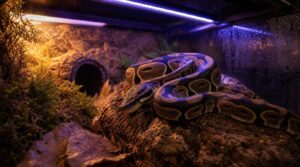
Before you buy a single bulb, it helps to get clear on what you actually need lighting to do in your snake’s enclosure. Different goals call for different gear, and mixing them up leads to gaps — or worse, health problems down the line.
Understanding how UVA and UVB affect snakes differently is a solid first step before you start comparing bulbs.
Here are the five core lighting goals to think through first.
Daylight Visibility
Good daylight visibility lets you spot health issues before emergencies. Natural light offers better color rendering, revealing skin lesions, parasites, or shedding changes that artificial setups miss.
To enhance visibility:
- Reduce glare by angling the enclosure away from direct sun
- Use shadow detail from morning light to read coil posture
- Match brightness levels to your viewing position for accurate color assessment
Safe Basking Heat
Beyond just seeing your snake clearly, you need to get the heat right. A proper basking spot sits between 88–92°F — warm enough for digestion, not enough to burn.
Use thermostat calibration to lock that target, and always follow heat source safety protocols: guarded fixture setup, no heat rock, and careful heat distribution across thermal gradient zones. Practical overheat prevention ensures consistent safety.
Basking zone monitoring keeps conditions stable. Consider using overhead radiant heat panels for even warmth.
UVB Support
Heat manages digestion — UVB manages bone health. Without full-spectrum UVB lighting, your snake can’t complete vitamin D₃ synthesis, which means calcium isn’t absorbed properly and metabolic bone disease follows.
The UVB spectrum’s benefits only work when intensity hits the right range and bulb lifespan stays in check — UVB degradation timeline is 6–12 months.
Keep fixtures dust-free; UVB shadow prevention and UVB fixture cleaning directly affect output consistency.
Natural Day-night Rhythm
Your snake’s body relies on a 24-hour internal clock, and light is essential to maintaining its accuracy. Circadian entrainment hinges on abrupt light transitions rather than gradual fading. Ensuring complete darkness at night eliminates the "day" signal entirely, preventing rhythm drift and mitigating long-term failures.
To stabilize your snake’s circadian rhythm, maintain these four critical elements:
- A natural day-night cycle of 12 hours on, 12 hours off.
- A fixed lighting schedule via a digital timer.
- Complete darkness during the night phase.
- A regular feeding schedule that reinforces your photoperiod.
Species-specific Needs
Not every snake needs the same setup. Diurnal snakes require strong UVB lighting and exposure to bright daylight, while nocturnal snakes are sensitive to intense light and need minimal UVB.
Getting that balance right matters—a natural vs. artificial lighting comparison for snakes can help you build a gradient setup that lets your snake self-regulate just like it would in the wild.
Species-specific lighting directly influences Vitamin D requirements, temperature gradient design, and crepuscular activity patterns.
| Species | Temperature Range Tolerance | Species UVB Sensitivity |
|---|---|---|
| Ball Python | 80–92°F | Low |
| Corn Snake | 70–90°F | Moderate |
| Desert Species | 90–110°F | High |
Pick The Right Light Fixtures
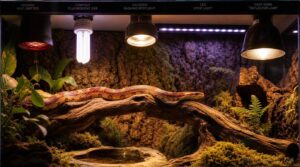
Not all light fixtures pull equal weight in a snake enclosure — each one does a specific job, and mixing the wrong ones together causes real problems.
Before you buy anything, it helps to know what your options actually are and what each one brings to the table. Here are the five fixtures worth considering.
Halogen Basking Bulbs
Halogen bulbs are the trusted choice for basking lights — and for good reason. Their infrared output penetrates reptile skin efficiently, achieving surface temperatures of 88–92°F with precision.
Wattage selection matters: choose 50W for smaller enclosures, while 100–150W suits larger setups. This ensures optimal heat distribution tailored to space requirements.
The bulbs emit a color temperature of 2900–3200K, producing a warm, natural glow that mimics sunlight.
Always pair with a reflector and thermostat to maintain a safe, reliable heat source. This combination prevents overheating and ensures consistent thermal regulation.
T5 HO UVB Tubes
T5 HO fluorescent tubes are the go-to choice for UVB lighting in snake enclosures. Their phosphor coating delivers precise spectrum peaks in the 290–320 nm range — exactly what drives vitamin D₃ synthesis.
Remember the Inverse Square Law: double the distance, quarter the UVB intensity.
Ensure ballast compatibility carefully, use a specular reflector, and replace bulbs annually since UVB dosage drops long before a bulb visibly dims.
LED Daylight Bars
LED daylight bars won’t heat your enclosure — that’s actually the point. These energy-efficient lighting bars handle ambient visibility while your dedicated heat sources manage thermal work, keeping heat management clean and intentional.
- Bar Length Options (300–900 mm) let you match coverage to enclosure size precisely.
- Dimmable Controls support photoperiod transitions at dawn and dusk.
- IP Rating Selection (IP44–IP65) matters if humidity is a factor.
Confirm power supply compatibility — most run 12V or 24V DC — before buying.
Ceramic Heat Emitters
Ceramic heat emitters are your best after-dark heat source — they radiate deep into the infrared spectrum without a single photon of visible light, so your snake’s circadian rhythm stays intact.
| Feature | Detail |
|---|---|
| PTC Self-Regulation | Prevents dangerous overheating automatically |
| Mounting Brackets | Secure positioning for consistent temperature gradient |
| Maintenance Routine | Wipe monthly; inspect guards each check |
| Energy Efficiency | Long lifespan, minimal replacement costs |
Always pair one with a thermostat for precise thermal regulation.
Mercury Vapor Bulbs
Mercury vapor bulbs pull double duty — delivering full-spectrum UVB radiation and serious basking heat from one fixture. The arc tube warmup takes a few minutes before you get full output, so factor that into your timer settings.
Ballast selection matters; a mismatched unit risks flicker or failure. Heat distribution is directional and intense, so mount these high.
Watch for spectrum aging — UVB output degrades over time. Handle spent bulbs with care: mercury safety means proper hazardous disposal, no exceptions.
Plan a Safe Thermal Gradient
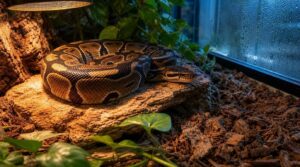
Getting the temperature right inside your snake’s enclosure isn’t guesswork — it’s about giving your snake real control over its own body heat. A proper thermal gradient means your snake can warm up, cool down, and regulate its metabolism on its own terms.
Here’s what you need to set one up safely.
Warm-side Placement
Think of the warm side as your snake’s personal sun—and placement is everything. Angle the lamp to focus heat directly onto the basking perch, keeping the heat source 15–30 cm above it for precise distance calibration. Substrate heat shielding matters too, so mount fixtures clear of the floor.
- Use angled lamp placement to concentrate perch heat focus
- Make sure warm-side airflow isn’t blocked by décor
- Confirm that lamp placement above mesh creates a defined basking spot
This builds a stable temperature gradient without hot zones your snake can’t escape.
Cool-side Temperatures
Once the warm side is locked in, the cool zone almost maintains itself—but don’t ignore it. Target 75–80 °F, knowing ambient room drift directly influences this side since there’s no active cooling.
The thermostat’s impact is indirect here: it prevents radiant spillover from creeping upward.
Watch substrate conductivity and hide temperature too—a cool-side hide can run noticeably lower than ambient air temperature, giving your snake genuine temperature regulation options.
Basking Spot Targets
Precision really pays off when setting up the basking spot. Your heat source should maintain a target temperature between 88–92 °F, with beam focal adjustment ensuring a concentrated, rather than diffuse, heat footprint.
The spot surface material is equally critical: slate or reptile-safe rock excels at retaining and radiating heat evenly, optimizing thermal consistency.
A simple target cleaning routine is essential to prevent debris buildup, which can insulate the surface and reduce basking temperatures over time.
Multiple Thermometer Locations
One thermometer won’t cut it. Accurate gradient mapping means placing temperature monitoring devices at multiple points — and spacing them at least 12 inches apart prevents overlapping data.
- Warm-side center, within 2–3 inches of the hotspot
- Mid-enclosure sensor for gradient transitions
- Cool-side ambient sensor at mid-height
- Substrate-level probe on the cool side
A centralized data logging setup with alert thresholds and a quarterly calibration schedule keeps your sensor placement honest and your thermostat control responsive.
Avoid Heat Rocks
Heat rocks seem convenient — they’re not. The real danger is uneven heating: one spot hits 100°F while an inch away is 75°F. Snakes can’t detect that difference until burns appear.
Heat rocks look harmless until your snake burns on a 100°F hotspot it never saw coming
For a safe basking surface, use a thermostatically controlled heat mat under flat slate instead. Pair it with temperature logging on both zones, and your thermal gradient stays predictable and your snake stays safe.
Install UVB Correctly
Getting UVB right isn’t just about screwing in a bulb and calling it done — placement, distance, and materials between the light and your snake all change how much UV actually reaches them. These factors collectively determine the effectiveness of the setup.
A few specific details make the difference between effective UVB exposure and a configuration that appears correct but falls short. Understanding these nuances is critical before finalizing your snake’s habitat.
Proper UVB Distance
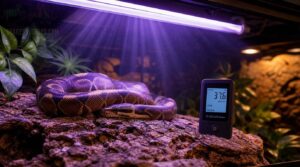
Distance isn’t guesswork — it’s the foundation of proper UV Index Calibration. UVB intensity drops rapidly with distance from the tube, making Tube Strength Distance critical. For example, a 6% T5 HO requires placement 11–13 inches above the basking spot, while a 12% tube needs 16–20 inches. Always use Spot Specific Metering with a Solarmeter to confirm Basking Height Measurement, ensuring UVB exposure achieves a UV Index of 2–6.
- Measure from the lamp to your snake’s actual resting surface, not the substrate
- Use a UV meter — don’t guess based on bulb distance alone
- Higher-percentage tubes need more distance to avoid excessive UVB penetration
- Apply an Obstruction Adjustment Factor if anything sits between the bulb and snake
- Recheck UVB lighting placement whenever you change basking furniture or platforms
Mesh Lid Reduction
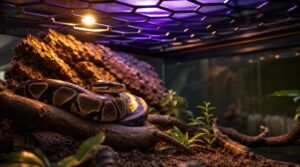
Mesh density quietly sabotages your reptile lighting setup. Standard lids block 30–40% of UVB before it even reaches your snake. Reducing that mesh footprint improves Shadow Minimization, Heat Transfer Efficiency, and Mounting Clearance for fixtures.
Fewer openings also support Airflow Optimization and a more Cost-effective Design long-term. These adjustments enhance both functionality and sustainability without compromising performance.
Just don’t sacrifice escape-proof lids — ventilation and security aren’t negotiable. Prioritize designs that balance openness with safety to maintain a healthy environment.
No Glass Barriers
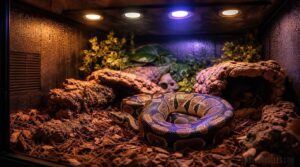
Glass blocks UVB radiation completely — even a thin pane filters out the wavelengths your snake actually needs. Proper enclosure design ensures species-specific lighting accuracy, as glass barriers between the bulb and your snake should be avoided entirely.
Frameless Installation with Impact-Resistant Glass panels enables Unobstructed Sightlines and allows full-spectrum UVB to pass freely into the enclosure. This design eliminates barriers that block essential radiation while maintaining structural integrity.
Proper enclosure design also simplifies Effortless Cleaning and enables Condensation Control, ensuring a healthy environment without compromising lighting precision.
Tube Length Coverage
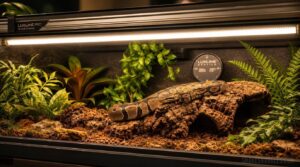
Your tube’s ideal span should match your enclosure’s length — not just cover part of it. For a 4×2 ft setup, a 22-inch T5 HO tube leaves dark zones; go longer than that. Use adjustable rails to fine-tune mounting height and overlap placement at the ends.
Light diffusion helps even out full-spectrum UVB, ensuring consistent UVB lighting across every inch of the space your snake actually uses.
Reliable UVB Brands
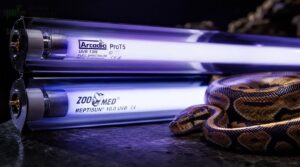
Not all UVB lighting is created equal. For spectrum accuracy and brands’ lifespan, Arcadia and ZooMed Reptisun are the go-to choices.
Arcadia’s full-spectrum UVB tubes pair well with their reflector fixtures for even coverage. ZooMed Reptisun offers solid price-performance and wide fixture compatibility.
Both brands provide reliable customer support — and that matters when your snake’s health depends on consistent UVB bulb lifespan.
Set Up Day-Night Cycles
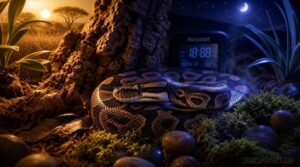
Snakes don’t have an internal clock — they rely entirely on light cues to know when to eat, resting, and shed. Getting the day-night cycle right is one of the simplest things you can do for your snake’s long-term health.
Here’s what you need to set it up properly.
Twelve-hour Baseline Cycle
Start with a simple photoperiod: 12 hours on, 12 hours off. This baseline cycle locks in circadian stability and keeps feeding, shedding, and behavior on track.
Use timers for lighting control and enable light shift smoothing where possible — abrupt switches stress snakes.
- Set Timer Calibration to the same clock time daily
- Log cycle temperature alignment each week for baseline logging
- Confirm your day-night cycle holds steady before adjusting anything
Seasonal Light Adjustments
Once your baseline is locked in, you can start mimicking what happens outside. In nature, photoperiod shifts with the seasons — and your snake notices.
During Winter Light Reduction, dial back to 11 hours. Then, ease forward through the Spring Photoperiod Shift toward 13 hours in summer. Autumn Dusk Extension creeps in gradually too.
Use timers for lighting control so every adjustment is smooth, never sudden.
Digital Timers
A reliable digital timer takes the guesswork out of photoperiod management. Set it once — 12 hours on, 12 hours off — and your day-night cycle runs itself. Look for these features when choosing one:
- Timer Display — Clear LCD readout showing current time and programmed events
- Programming Features — Minute-level precision with multiple daily schedules
- Safety Mechanisms — Surge protection and child-lock controls
Wi-Fi or Bluetooth connectivity options let you adjust the light cycle timing remotely.
No Colored Night Bulbs
Once your timer locks in a 12-hour on/off photoperiod, don’t undermine it with colored night bulbs. Red, blue, and green light — even at low intensity — disrupts your snake’s circadian rhythm. Skip them entirely.
For nighttime observation, use infrared night viewing equipment or a night camera monitoring setup.
Infrared heat lamps provide heat-only night zone warmth with no colored illumination, no visible light, no confusion.
Darkness for Rest
Complete darkness isn’t optional — it’s the other half of your photoperiod.
A strict 12 hours on/12 hours off cycle drives melatonin boost, cortisol reduction, and circadian stability in your snake’s body.
- Lower ambient temperature slightly at night
- Cut all visible light completely
- Let sleep efficiency build through undisturbed darkness
- Use timers to automate the day-night cycle without fail
Match Lighting to Snake Species
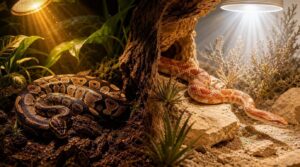
Not every snake needs the same lighting setup — what works for a ball python won’t necessarily work for a corn snake or a desert boa. Species differences in behavior, origin, and metabolism all affect how much light, heat, and UVB your snake actually needs.
Here’s how to match your lighting to your specific snake.
Ball Python Lighting
Ball pythons are naturally crepuscular — they’re most active at dawn and dusk, which shapes every lighting decision you make.
Pair a low-wattage heat lamp with an LED daylight bar for efficient power consumption and solid LED color rendering without frying the enclosure. A 12-hour photoperiod keeps feeding and shedding on track.
Maintain your temperature gradient at 88–92°F warm, 75–80°F cool.
Match your bulb lifespan to your enclosure’s size impact.
Corn Snake Lighting
Corn snakes are crepuscular and forgiving — but that doesn’t mean lighting is an afterthought. A linear LED daylight bar with a 6000–6500K color temperature manages your reptile lighting setup efficiently, with low heat and solid bulb lifespan. Add a reflector to boost output and optional low-level UVB lighting to support calcium metabolism.
Maintain a temperature gradient of 88–92°F on the warm side and 78–82°F on the cool side. Budget options work fine here.
Getting these zones right pays dividends long-term, as outlined in this complete snake habitat setup guide covering how thermal gradients directly influence your snake’s lifespan.
Boa Constrictor Lighting
Boas are tropical animals, so your reptile lighting setup needs to reflect that. Pair energy-efficient LED lights with a 5.0 UVB tube — your UVB spectrum choice matters here — mounted at the correct fixture height (12–18 inches).
Map your thermal gradient carefully: maintain a 90–95°F basking area and a 75–80°F cool side.
Stick to a 12-hour photoperiod, monitor power consumption, and skip any visible nighttime light.
Diurnal Snake Needs
Diurnal snakes run on sunlight — their calcium metabolism, vitamin D synthesis, and thermoregulatory behavior all depend on getting light right. Morning activity peaks mean your UVB lighting and basking spot need to be ready at dawn.
Nail the light spectral balance and photoperiod, and you’ll support a stable circadian rhythm that keeps feeding, shedding, and digestion on track.
Desert Versus Tropical Species
Desert and tropical species aren’t interchangeable — their needs sit at opposite ends of the spectrum.
Desert snakes have higher keratin density for heat resistance and rely on burrowing shade plus intense temperature spikes during brief basking.
Tropical species need tighter temperature gradients, consistent humidity regulation, and stable photoperiods.
Match your UVB lighting, humidity control, and species-specific lighting setup to where your snake actually evolved.
Protect Your Snake From Burns
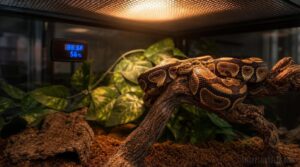
Burns are one of the most preventable injuries in snake keeping — and also one of the most common.
Simple safeguards between your snake and its heat sources make all the difference.
Here’s what you need in place before you ever turn a bulb on.
Thermostat-controlled Heat
Without a thermostat, your heat lamp becomes a liability. Temperature control isn’t optional — it’s the difference between a healthy snake and a burned one. Match your thermostat’s power load to your heater’s wattage, and perfect your sensor placement strategies by positioning probes near (not under) the basking zone.
- Run daily heating cycle optimization checks
- Confirm calibration frequency every 12–24 months
- Use fail-safe alerts on digital units
- Never stack heat mat and under tank heating on one channel
Wire Bulb Guards
Even with a thermostat doing its job, your snake can still press against a hot bulb and get burned. That’s where wire bulb guards come in.
These metal cages — available in stainless or zinc-plated steel — slip over heat lamps and UVB bulbs, blocking direct contact without sacrificing heat dissipation. Match the guard size to your bulb diameter, and you’ve got simple, effective lighting safety.
Secure Cable Routing
Bulb guards stop burns at the source — but loose cables are their own hazard. To mitigate risks, implement these critical measures:
- Run cables inside concealed conduit along the enclosure’s back wall
- Use a surge-protected strip with built-in GFCI for all lighting circuits
- Apply color-coded labeling to identify each cable quickly during maintenance
- Maintain heat-safe spacing of 12+ inches between wiring and any heat source
For enhanced safety, consider installing a redundant power path for critical lighting systems.
Escape-proof Lid Checks
Your cables are locked down — now check the lid. A snake doesn’t need much of a gap to squeeze through.
Run a quick latch integrity check weekly: test magnet hold strength, confirm bolt alignment sits flush, compress the gasket evenly around the rim, and cycle through the tamper ring’s two-step release.
Escape-proof lids make solid enclosure design complete.
Safe Fixture Mounting
Fixtures that wobble or tilt can burn your snakes or start a fire. Mount every heat source the right way:
- Use a Ceiling Box Rating that holds your fixture’s full weight on a joist
- Verify Level Mount Verification within 1/8 inch for even heat spread
- Apply a Heat‑Spread Mount plate to distribute load safely
- Install Cable Strain Relief at every junction point
- Maintain proper Guard Clearance Distance above the enclosure
Monitor Lighting and Heat
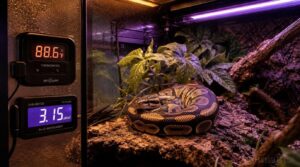
Setting up the right lighting is only half the job — keeping it working properly is the other half.
Your snake’s health depends on consistent temperatures and UVB levels, not just the gear you install on day one. Check regularly to stay on top of it all.
Daily Temperature Checks
Think of your thermometer as a daily health check for the whole enclosure. Consistent probe placement prevents misleading readings near hot bulbs.
Use an infrared probe thermometer to verify your temperature gradient—warm side, cool side, basking spot—every morning. Ambient room influence can shift numbers overnight, making temperature drift detection and data logging essential practices for catching thermostat issues before your snake is affected.
UVB Meter Readings
Your UV meter tells you what your eyes can’t — whether your UVB lighting is delivering safe, effective output. Use a UV index meter at the exact basking spot, ensuring sensor placement remains consistent for every reading.
Reflection from nearby surfaces can skew measurements, so log your data during each session to track accuracy.
Most UVB bulbs require replacement every 6–12 months; maintaining a UVI of 2–3 confirms optimal intensity.
Bulb Replacement Schedule
Every bulb has an expiration date your senses detect before you notice it. UVB bulbs should be changed every 6–12 months — even when they still glow. Keep a maintenance log with install dates and rated hours. Watch for dimming cues like yellowing light or reduced brightness.
Halogen bulbs require replacement every 1–2 years, while LEDs last 3–5 years.
Follow local disposal protocols, especially for mercury-containing UVB lighting.
Humidity Interaction
Humidity doesn’t just affect shedding — it shapes your entire thermal setup. High moisture slows heat transfer and throws off sensors, causing drift in thermometers, which leads to false readings. Poor enclosure ventilation exacerbates this, enabling rapid mold growth in hides and substrates.
Watch for these warning signs:
- Moisture buildup near the basking zone during shedding
- Substrate remaining soggy after misting-system cycles
- Condensation creating microclimates in enclosures, skewing temperature data
Addressing these issues requires proactive humidity management and improved airflow to protect both equipment accuracy and habitat health.
Behavior Warning Signs
Your snake’s behavior is the most honest feedback you’ll get on your lighting setup.
| Warning Sign | Likely Lighting Cause |
|---|---|
| Basking Refusal | Heat or UVB intensity mismatch |
| Feeding Hesitation | Disrupted photoperiod cycle |
| Abnormal Hiding | Excessive brightness or glare |
| Increased Aggression / Daytime Lethargy | Sudden light changes or overnight visible lighting |
Snake behavior monitoring catches lighting mistakes before they become health crises — fix the environment, and proper lighting manages stress reduction naturally.
Avoid Common Lighting Mistakes
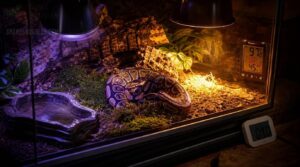
Even with the right bulbs and a solid setup, a few small missteps can quietly undermine your snake’s health.
Most of these mistakes are easy to fix once you know what to look for.
Here are the most common lighting errors to avoid.
Too Much Bright Light
Bright light stresses snakes more than most keepers realize. If your snake squints, avoids the basking zone, or seems restless, check your bulb height first — raising the fixture is the fastest form of glare mitigation.
Reflective surfaces inside the tank intensify the problem. Wattage reduction helps too, and addressing these factors ensures a more comfortable environment for your snake.
Don’t overlook overnight light leaks; even dim visible light disrupts rest and compounds UVB exposure issues.
Missing Thermostat Controls
Skipping a thermostat is just as risky as leaving heat sources unattended overnight. Without one, heat source selection becomes a guessing game. Fixed-output lamps cause dangerous fluctuations with no safety cutoff or fallback mechanism.
Manual heat management risks escalate rapidly: no temperature alarms, no absence warnings, and unresolved calibration challenges. These failures disrupt automatic adjustments, leaving systems vulnerable.
This instability directly harms your snake’s thermoregulation, creating an unstable temperature gradient. Always use a thermostat to prevent these critical failures.
Incorrect UVB Placement
Angle misalignment means rays hit the basking spot at the wrong trajectory, creating shadowed basking zones your snake can’t benefit from. Excessive mount height drops UVB intensity dramatically. Obstructed rays from hides or decor cause uneven UVB distribution across the enclosure.
Position UVB lighting directly above the basking platform — no barriers, no guesswork.
Overnight Visible Lighting
Leaving any visible light on overnight is a mistake that quietly wrecks your snake’s photoperiod replication. Nocturnal snakes are especially sensitive — even low lux levels from blue LED lights or white bulbs disrupt their rest cycle.
Stick to motion-activated illumination for nighttime checks, and opt for red LED lights paired with flicker-free fixtures to minimize disturbance. Crucially, keep heat-light separation intact — ensure your heating setup operates independently from lighting systems.
One-temperature Enclosures
A single-zone enclosure sounds simple, but it leaves your snake with nowhere to self-regulate. Without a true thermal gradient, thermoregulation breaks down — and that affects digestion, immunity, and shedding. Even smart insulation strategies and careful airflow management can’t compensate for missing heat distribution.
- Thermal mass in substrate slows temperature recovery
- Single-zone design limits natural behavioral thermoregulation
- LED lighting and UVB lighting need gradient placement
- Temperature consistency requires warm and cool zones, not one
Frequently Asked Questions (FAQs)
Can lighting affect a snakes shedding cycle?
Yes — lighting directly affects shedding cycles. Hormonal lighting cues, photoperiodism, and sleep phase darkness all regulate skin turnover.
Disrupting the light intensity cycles, your snake’s shed schedule pays the price.
How do I light a bioactive snake enclosure?
Bioactive terrarium lighting balances plant and snake needs. Use full spectrum LED lighting for plants, and a separate UVB source for your snake.
Monitor UVB degradation regularly to maintain safe spectral output.
What wattage bulb suits my enclosure size?
Wattage scales with space. Small enclosures need 2–6 watts, medium setups around 6–15 watts, and large enclosures often require 25–60 watts. Always verify with a thermometer — wattage alone won’t tell the whole story.
Does enclosure color affect heat and light absorption?
Enclosure color does matter. Dark surfaces absorb more heat, while lighter ones reflect it.
In addition to surface finish, glossy vs matte coatings and thermal mass interaction can noticeably shift the internal temperature gradient.
How should lighting change during snake brumation?
During brumation, shift to shortened daylength, dim basking light, and low UVB output. Gradually taper to a 10–12 hour light-dark cycle.
Maintain full night darkness, and let the temperature gradient drop naturally.
Conclusion
Light isn’t an accessory you add after everything else is in place—it’s the foundation your snake’s entire biology runs on.
When you know how to set up lighting correctly, you stop guessing and start giving your animal exactly what its body expects. Nail the gradient, run the UVB, protect the darkness.
Do that consistently, and you won’t just keep a snake alive—you’ll keep one that genuinely thrives.
- https://www.zenhabitats.com/blogs/reptile-care-sheets-resources/corn-snake-complete-lighting-and-heating-guide?srsltid=AfmBOoq--msOUgp2G0ZkGV7JD1xAlaTrpCAGzgM1hSLB9oxqiTuYv7gG
- https://showmereptileshow.com/resources/creating-a-natural-environment-for-snakes-the-importance-of-uvb-lighting
- https://vcahospitals.com/know-your-pet/reptiles---proper-lighting