This site is supported by our readers. We may earn a commission, at no cost to you, if you purchase through links.

You’ll see it in exam rooms every week: a snake with bones so soft they bend like rubber. Metabolic bone disease doesn’t happen overnight. It builds slowly, one missed UVB cycle at a time, until calcium reserves run dry.
Most owners focus on temperature and forget light does far more than help snakes see. It drives digestion, triggers vitamin D3 synthesis, and keeps circadian rhythms locked in place. Get snake enclosure lighting requirements wrong, and you’re not just risking a dull-looking pet. You’re risking a slow, costly decline in your snake’s health.
Get the setup right from day one, and you’ll avoid that trip to my exam table entirely.
Table Of Contents
- Key Takeaways
- What Lighting Does a Snake Enclosure Need?
- UVB Lighting Requirements for Pet Snakes
- Best Lighting Options for Snake Enclosures
- Setting a Healthy Day-Night Cycle
- Installing and Maintaining Lights Safely
- Frequently Asked Questions (FAQs)
- Do snake enclosures need lighting at night?
- What is the best light for a snake enclosure?
- Can you put LED lights in a snake enclosure?
- Is 90 degrees too hot for a snake?
- How do you light a snake enclosure?
- Do snakes need a lot of light?
- Why is lighting a snake enclosure important?
- How do I choose a lighting setup for a snake?
- How big should a snake enclosure be?
- What kind of enclosure does a snake need?
- Conclusion
Key Takeaways
- Your snake needs three separate lighting jobs covered—light, heat, and UVB—since skipping any one can silently damage its health over time.
- Without proper UVB exposure, your snake’s calcium absorption can drop from 30-40% down to just 10-15%, setting the stage for metabolic bone disease.
- Your snake needs true darkness at night, with zero light leaks, timers, or indicator LEDs, to protect its circadian rhythm and support natural rest.
- Bulbs lose UVB strength long before they look dim, so you should replace them every 6-12 months and verify output with a meter rather than trusting appearances. For a complete breakdown of testing schedules and species-specific UVB requirements, ball python morph lighting needs and UVB guidelines walk you through exactly what levels to target and when to replace your bulbs.
What Lighting Does a Snake Enclosure Need?
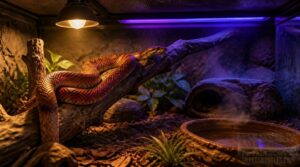
Your snake’s enclosure needs more than a single bulb to stay healthy. Light, heat, and UVB each play a different role, and getting them right depends on your species, setup, and screen type. Here’s what to think about before you buy your first fixture.
This step-by-step snake lighting setup guide breaks down which bulbs pair well together so you’re not guessing at your first setup.
Light, Heat, and UVB Roles
Because snakes can’t produce vitamin D3 without help, your lighting setup needs three distinct jobs covered: light, heat, and UVB. Light drives daytime activity. Heat transfer mechanisms fuel digestion at the basking spot. UVB wavelength spectrum exposure triggers light-induced vitamin synthesis, supporting calcium absorption.
Skip any piece, and thermal regulation balance suffers, often silently, until it’s costly.
Species-Specific Lighting Needs
Not every species reads light the same way. Desert species lighting needs stronger UVB and harsher basking gradients, while tropical species UVB requirements stay moderate but constant.
Nocturnal species darkness must stay uninterrupted after dusk, since dark-phase light exposure can disrupt melatonin production and circadian rhythms even in reptiles.
Crepuscular species thrive on dim light.
Temperate seasonal adjustments shift photoperiod effects, guiding behavioral thermoregulation and shaping how your snake naturally thermoregulates throughout the year.
Enclosure Size and Screen Type
Your snake’s photoperiod means little if the enclosure itself works against you. Enclosure footprint should give at least 1.5 times body length in floor space, with height matching that ratio too.
Screen tops need fine mesh for screen ventilation, 4-6 air exchanges hourly. Stainless steel resists corrosion better than aluminum, a detail that affects your entire lighting setup and fixture placement.
Daytime Light Versus Nighttime Heat
Screen quality matters little if your light-heat balance is off. Daytime hours call for bright basking spots reaching species-specific ranges, driving thermoregulation and normal activity.
Nighttime flips the script. Swap bulbs for ceramic heat emitters, non-light heat sources preserving nocturnal activity and darkness your snake needs to rest undisturbed.
UVB Lighting Requirements for Pet Snakes
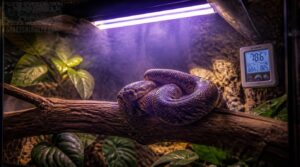
UVB isn’t optional. Get it wrong, and your snake pays the price with weak bones and lasting damage. Here’s what you need to know to get it right.
Understanding your setup matters too—the best affordable snake terrariums are designed with proper UVB positioning in mind, making it easier to get lighting right from the start.
Replicating those conditions at home means thinking beyond the basking spot — understanding how many hiding places your snake actually needs is part of building an enclosure that supports natural behavior and healthy UVB exposure.
Vitamin D3 and Calcium Absorption
UVB exposure fuels vitamin D3 synthesis in your snake’s skin, starting a two-step conversion in the liver and kidneys.
That active hormone drives calcium absorption through:
- TRPV6 channels pulling calcium into cells
- Calbindin-D9k binding it safely
- PMCA1b pumps exporting it to blood
- Tight junction proteins opening passive pathways
Without proper UVB lighting, absorption drops sharply, from 30-40% to just 10-15%.
Pairing your UVB setup with a reliable heat gradient, guided by this snake temperature control guide, helps ensure your snake absorbs and processes calcium as it should.
Preventing Metabolic Bone Disease
Skip too many UVB sessions and calcium metabolism starts to fall apart fast.
Metabolic bone disease develops when mineral balance breaks down, weakening bones and joints. Watch for reduced appetite, lethargy, or trouble climbing, early detection catches problems before deformities set in.
Prevention means pairing consistent UVB lighting with solid feeding practices and stable temperature gradients. UVB deficiency alone can undo months of good husbandry.
Choosing The Right UVB Strength
How strong should your bulb really be? Match UVB percentage to species: desert snakes need higher output, forest and nocturnal species need less. Most snakes thrive on 5-7%. Juveniles need more than adults for proper development.
Check spectrum too, aim for 290-320 nm, avoiding UVC leakage. Bulbs degrade over time, so replace every 6-12 months.
Safe UVB Distance and Placement
A couple inches can turn safe UVB into a burn risk. Mount T5 HO tubes 12-24 inches from your basking spot, T8 tubes 8-12 inches.
Mesh screens block up to 50% of UVB, so subtract that before trusting the chart.
Always add a reflector behind bulbs, and verify placement with a Solarmeter, not guesswork.
UVB Exposure by Activity Pattern
Not all UVB exposure looks the same, because your snake’s behavior drives it. Basking duration matters more than fixture strength alone. Active foragers need frequent access, while shelter seekers get little unless basking spots sit near hides. Crepuscular species peak at dawn and dusk. Match your lighting schedule to natural activity for real circadian rhythm support, not just photoperiodism on paper.
Best Lighting Options for Snake Enclosures
Not all lights are created equal, and picking the wrong one can cost your snake’s health. You’ll find several solid options out there, each with its own strengths and quirks. Here’s a breakdown of five choices worth knowing before you buy.
T5 HO UVB Tubes
Think of T5 HO tubes as miniature suns for your enclosure. They pack strong UVB output into a slim quartz design, with lengths from 22 to 60 inches.
Match tube length to enclosure size, mount 6-12 inches above basking spots, and verify ballast compatibility. Reflectors boost coverage, but UVB output degrades over time, replace every 6-12 months.
Incandescent Basking Bulbs
UVB tubes handle vitamin D3, but your snake still needs steady warmth. Incandescent basking bulbs deliver that heat, using a tungsten filament reaching 250-300°C, lasting 1,000-2,000 hours.
- Watching your snake finally bask contentedly, soaking up real warmth
- Avoiding costly vet bills from botched thermal gradients
- Preventing devastating burns with proper guards
- Feeling confident your setup mimics nature
- Knowing shedding and digestion run smoothly
Mercury Vapor Bulbs
One bulb, two jobs. Mercury vapor bulbs combine heat output and UVB emission through a quartz arc tube, cutting your lighting setup down to a single fixture.
They run hot, so heat output efficiency matters. Confirm ballast compatibility before buying since these bulbs won’t work on standard sockets.
Lifespan degradation is real. Expect roughly 24,000 hours, but output drops well before failure, so track performance rather than trusting it blindly.
- UV shielding requirements built into the outer envelope, never bypass this
- Proper mounting distance of 12-18 inches above your basking spot
- Bluish-white light output, less warm-toned than incandescent bulbs
- Establishes a strong temperature gradient in larger enclosures
- Mercury content demands careful disposal at recycling facilities
LED Daylight Fixtures
LED daylight fixtures skip the mercury entirely. You’ll get energy efficiency savings with lifespans of 25,000-50,000 hours, plus 5000-6500K color temperature that mimics daylight beautifully. Beige housing reduces glare too.
Remember, though: LEDs don’t produce UVB lighting on their own. Pair them with a dedicated UVB source, or your snake’s calcium absorption suffers.
Heat-Only Ceramic Emitters
Your snake needs warmth without light interrupting sleep. Ceramic heat emitters solve this, radiating infrared basking heat while staying dark. Pick wattage (25-150W) based on enclosure size. Mount securely, maintain your thermal gradient, and pair with a thermostat.
- Check surface temps with an infrared thermometer
- Shield wiring from moisture
- Inspect for cracks regularly
- Replace on schedule
- Avoid overheating risks
Setting a Healthy Day-Night Cycle
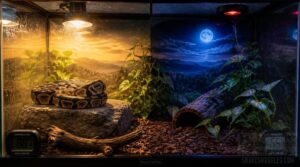
Your snake’s body clock runs on light, not habit. Get the timing wrong, and you risk stress, poor appetite, or worse down the road. Here’s what a healthy day-night cycle actually looks like.
Standard Twelve-Hour Light Cycle
Think of your snake’s light switch like a sunrise you control. Run lights 7 AM to 7 PM, dark the other 12 hours. This 12L:12D pattern stabilizes circadian rhythms and thermal regulation year-round.
| Time | Condition |
|---|---|
| 7 AM–7 PM | Lights on |
| 7 PM–7 AM | Total darkness |
| Daily | Consistency required |
Species-Specific Photoperiods
Not every snake thrives on that same 12:12 pattern. Corn snakes, being crepuscular, adapt well to it, but desert species often need 10-14 hours based on native habitat conditions.
Photoperiod thresholds vary by species. Get your snake’s origin wrong, and you’ll disrupt feeding, molting, and breeding cues your snake depends on for healthy circadian rhythms.
Seasonal Lighting Adjustments
Seasons matter to your snake’s biology, not just the calendar. You’ll shift photoperiod by 2 to 4 hours, lengthen winter days to 12-14 hours, shorten summer to 10-12. Adjust gradually over 1-2 weeks.
Reduce winter UVB intensity by 10-20%, shift color temperature toward warmer tones, and watch feeding response. It guides your timing.
Timers and Dawn-Dusk Dimming
Manual switches invite mistakes. Programmable timers remove guesswork, running consistent lighting cycles that mirror photoperiodism in the wild.
Photocell activation triggers dawn-dusk dimming automatically, ramping intensity over 20-60 minutes. Zone-based scheduling separates UVB lighting from basking heat.
Quality units include:
- Surge protection timers
- Adjustable ramp timing
- Photocell sensors
- Multiple outlet zones
- Weather-resistant housing
Complete Darkness at Night
Darkness isn’t optional, it’s medicine. Your snake needs zero lux after lights out, no exceptions.
Darkness isn’t optional for your snake, it’s medicine, so keep the enclosure at zero lux after lights out
Block external light leaks with a solid cover. Kill every indicator LED on timers or thermostats. Skip reflective surfaces, they scatter stray glow.
Verify with a light meter. That devastating flicker disrupts circadian rhythm and melatonin production, wrecking your snake’s natural day-night cycle.
Installing and Maintaining Lights Safely
Good lighting only helps your snake if it’s installed correctly. Small mistakes, like placing a bulb too close, can lead to burns or overheating fast. Here’s what you need to know to set up and maintain your lights safely.
Create a Temperature Gradient
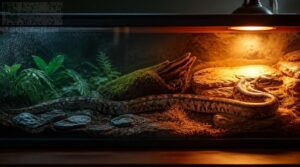
Think of your enclosure as having climate zones, not one setting. Your snake needs a 10 to 15°C spread between basking and cool ends.
- Heat zone: 28-32°C
- Mid zone: 24-28°C
- Cool zone: 20-24°C
Place basking lamps overhead; add under-tank heaters for the cool side. Use a barrier so temperatures shift gradually, not abruptly.
Measure Heat and UVB
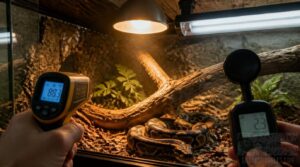
Setting a gradient means nothing without proof it works. Grab a thermometer and UVB meter, then check readings at snake height, not tank glass.
| Zone | Target Reading |
|---|---|
| Basking spot | 28-36°C |
| Cool end | 20-24°C |
| UVB at snake | Per bulb spec |
| UVB at basking | Highest zone |
| Distance check | 20-30cm |
Recheck weekly. Bulbs fade fast.
Prevent Burns and Overheating
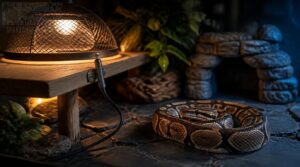
Numbers only prove safety if burns don’t happen anyway. Basking guards or domed covers stop direct bulb contact while heat still reaches your snake.
Pair every heat source with a thermostat. Runaway heat is costly and devastating for snake skin.
Use heat-resistant substrate. Skip flammable bedding near bulbs, and keep basking platforms roomy enough for quick retreat.
Secure Fixtures and Wiring
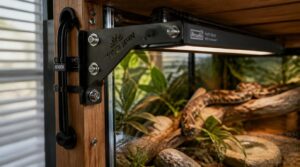
Burns aren’t the only risk. Loose fixtures can fall, and frayed wires can shock or spark near humid enclosures.
Secure mounting with brackets rated for 5 kg keeps UVB fixtures level and stable. Use stainless screws, route cords through grommets, and separate heat lines from sensor wiring.
Inspect monthly. Damaged cords get replaced immediately, not "eventually.
Replace Bulbs on Schedule
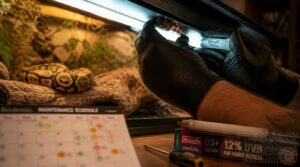
A secure fixture means nothing if the bulb inside is dying quietly. UVB output degrades long before light disappears, so replace UVB bulbs every 6-12 months regardless of appearance.
A proper ball python terrarium setup covers every layer of care, from bulb schedules to heat gradients that keep your snake thriving year-round.
Schedules vary by species, so check the UVB lighting guide for desert species to match replacement cycles with your animal’s Ferguson Zone needs.
Pair fresh lighting with natural snake terrarium enrichment ideas to keep the enclosure secure, stimulating, and species-appropriate.
Track lifespan with a maintenance log or color-coded calendar. Set reminders one month early, match wattage and base type exactly, and always unplug and glove up before handling.
Frequently Asked Questions (FAQs)
Do snake enclosures need lighting at night?
Even nature switches off the sun. Your snake needs that same true darkness at night, no UVB or bright bulbs, to protect its circadian rhythm, support restful shedding, and prevent stress from light pollution.
What is the best light for a snake enclosure?
Your best setup pairs a T5 HO UVB tube for calcium metabolism with a basking bulb for heat, creating a proper temperature gradient. Add LED daylight fixtures for natural brightness, and ceramic heat emitters for safe, light-free nighttime warmth.
Can you put LED lights in a snake enclosure?
Think of LEDs as string lights on a porch, pretty but useless for warmth. Yes, LED lights work great for visual illumination. Choose low-heat models, place them away from enclosure walls, and skip UVB claims entirely.
Is 90 degrees too hot for a snake?
Not usually. For most species, 90°F sits within a healthy basking zone, especially ball pythons and king cobras. But pair it with proper thermal gradient balance and a cooler retreat side, so your snake can regulate freely without heat stress.
How do you light a snake enclosure?
Picture the sun’s arc across a desert sky: that’s your blueprint. Position UVB fixtures and basking lamps to build a true temperature gradient, then set timers for consistent photoperiod scheduling and safe, secure wiring throughout the enclosure.
Do snakes need a lot of light?
Your snake doesn’t need blazing brightness. Light necessity depends on species: diurnal snakes need 10-12 hours daily, nocturnal ones need far less. UVB still matters for circadian rhythm, so match duration and intensity to natural day-night cycles, not intensity alone.
Why is lighting a snake enclosure important?
Your lights do more than brighten the tank. They drive UVB lighting for vitamin D3 synthesis and calcium metabolism, shape a temperature gradient for thermoregulation, and support circadian rhythm, cutting stress while sparking natural feeding response.
How do I choose a lighting setup for a snake?
Match bulbs to your snake’s activity pattern. Diurnal species need UVB lighting for vitamin D3 synthesis.
Nocturnal snakes do fine under ceramic heat emitters.
Pair heat sources with lighting cycles that mimic natural temperature gradient shifts for a balanced setup.
How big should a snake enclosure be?
Your enclosure should let your snake stretch fully, with minimum enclosure dimensions matching its length. Juveniles need growth space. Include a temperature gradient, vertical climbing area, hiding places, and escape-proof ventilation for safe thermal regulation.
What kind of enclosure does a snake need?
Home sweet coil: your snake’s tank needs escape-proof lids, mesh ventilation, secure hides on both ends, safe substrate, a water dish, and reliable heating and lighting to control temperature, humidity, and stress.
Conclusion
The dimmest bulb can cause the brightest emergency. That’s the paradox of reptile care: light seems simple, yet it silently shapes calcium levels, digestion, and sleep.
Getting snake enclosure lighting requirements right isn’t about buying expensive gear. It’s about matching UVB strength, photoperiod, and placement to your species’ natural rhythm.
Set timers, measure output, replace bulbs on schedule. Do that, and you’ll give your snake something better than a cure. You’ll give it a life that never needs one.