This site is supported by our readers. We may earn a commission, at no cost to you, if you purchase through links.
Most reptile owners obsess over temperature gradients and feeding schedules, yet the single variable most responsible for skeletal collapse in captive lizards costs less than a decent thermometer to fix.
Metabolic bone disease—the soft limbs, jaw deformities, and eventual fractures that haunt under-lit enclosures—develops not from poor diet alone, but from the absence of the right wavelength of light.
Your bearded dragon’s skin can synthesize vitamin D₃ from UVB radiation the same way yours does from a afternoon outdoors, and without that process, calcium metabolism simply stalls.
Understanding the full benefits of UV lamps for reptiles means going well beyond "buy a bulb and point it at the basking spot"—species, lamp type, distance, and monthly verification all determine whether your setup actually works.
Table Of Contents
Key Takeaways
- Without UVB light, your reptile’s body can’t produce vitamin D3, which means calcium absorption stalls and metabolic bone disease quietly takes hold—no matter how good the diet is.
- Mesh screens can cut UVB output by half, and standard glass blocks over 95%, so what reaches your reptile depends heavily on what’s between the bulb and the basking spot.
- UV needs vary significantly by species—desert lizards need a UVI of 6–10, forest dwellers thrive at 3–5, and corn snakes only need 1–2, so matching your setup to the animal’s natural habitat is non‑negotiable.
- UVB bulbs lose effective output long before they burn out, making monthly meter checks and annual T5 replacements (or every 6–8 months for T8s) essential to keeping your reptile’s lighting actually functional.
What UV Lamps Do for Reptiles
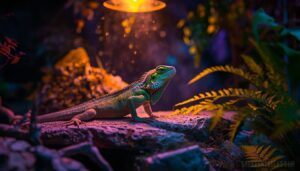
UV UV lamps aren’t just accessories — for most reptiles, they’re closer to a basic necessity. Understanding what different light types actually do helps you make smarter choices for your animal’s setup.
If you’re just getting started, this beginner’s guide to reptile UVB lighting breaks down exactly what to look for without the overwhelm.
Here’s what you need to know before picking a lamp.
UVB Vs. UVA Vs. Visible Light
Not all light is created equal—and for your reptile, that distinction is life-changing. Three bands have completely different jobs:
- UVB (280–320 nm): Drives vitamin D3 synthesis; deficiency causes metabolic bone disease
- UVA (320–400 nm): Influences behavior, mood, and feeding response
- Visible light (400–740 nm): Regulates circadian rhythms and activity
- Heat output: Aids thermoregulation independently of UV wavelength ranges
How Artificial UV Mimics Natural Sunlight
Think of a good reptile UVB lamp as a scaled-down sun: it uses Spectral Matching to reproduce the same 280–320 nm UVB band that drives UVB and vitamin D3 synthesis in reptiles outdoors.
Beam Shaping and reflectors recreate an Intensity Gradient from basking hotspot to cooler retreat, while Cycle Simulation and Heat Integration mimic the sun’s daily arc—giving your animal meaningful behavioral and physiological cues.
Natural equatorial UV‑B levels reach about 250 µW/cm², far exceeding typical lamp output.
Why Indoor Reptiles Often Need UV Lighting
Your reptile’s enclosure, no matter how carefully designed, blocks the very wavelengths that drive vitamin D3 synthesis—standard glass filters out over 95% of UVB before it reaches your animal. Without deliberate UVB lamp replacement interval planning and UVB meter calibration, metabolic bone disease builds silently.
Indoor setups also strip away Seasonal Lighting Cycles, disrupting Heat-UV Balance and triggering measurable Stress Reduction failures that compound over time.
Full-Spectrum Lighting and Overall Welfare
Full-spectrum lighting does more than replace sunlight—it rebuilds the entire sensory environment your reptile expects.
Visual cue integration helps them locate basking zones confidently, while photoperiod stability and circadian rhythm regulation through light exposure keep behavior predictable.
You’ll notice reduced pacing, better feeding response, and genuine behavioral enrichment.
Combined with vitamin D3 synthesis and UVB safety guidelines, its enclosure aesthetics and stress mitigation working as one system.
Stronger Bones and Calcium Absorption
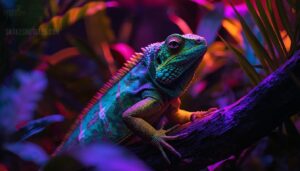
UVB lighting does more than just brighten your reptile’s enclosure—it drives a chain of biological processes that determine whether your animal’s bones stay strong or slowly fall apart. At the center of that chain is vitamin D3 synthesis, calcium regulation, and everything downstream that depends on both.
Here’s what’s actually happening under the surface, and why each piece matters.
UVB and Vitamin D3 Synthesis
When UVB wavelengths between 280–315 nm strike your reptile’s skin, photolysis mechanism converts 7-dehydrocholesterol into previtamin D3 directly in the epidermis.
From there, temperature-dependent conversion completes previtamin D3 isomerization into vitamin D3, which the liver processes into serum 25(OH)D3 levels that your vet can measure.
Because UVB intensity diminishes with distance and UVB lamp decay is real, following UVB exposure guidelines and monitoring UVB dose-response ensures vitamin D3 synthesis stays sufficient to prevent metabolic bone disease.
Calcium Metabolism and Bone Mineralization
Once vitamin D3 synthesis activates calcium absorption in the gut, your reptile’s skeleton depends on three tightly linked processes:
Getting the UVB bulb distance right is just as critical, since it directly influences how efficiently your reptile synthesizes D3—check out this king snake UVB and basking setup guide to dial in the right positioning for consistent calcium metabolism.
- Osteoblast Activity lays down new bone matrix and drives bone mineralization.
- Calcium Reservoir Release via Parathyroid Hormone Regulation restores serum calcium when levels dip.
- Phosphate Homeostasis ensures mineral crystals form correctly during bone remodeling balance.
UVB intensity directly sustains this cascade — UVB lamp decay quietly disrupts it.
Preventing Metabolic Bone Disease
Metabolic bone disease is one of the most preventable yet frequently diagnosed conditions in captive reptiles — and proper vitamin D3 synthesis sits at the center of that prevention. Without adequate UVB dosage, calcium-phosphorus balance collapses, bones demineralize, and deformities follow.
| Prevention Factor | Target Standard | Risk If Neglected |
|---|---|---|
| UVB Metering Protocols | Monthly Solarmeter readings | Silent UVB lamp lifespan decline |
| Heat-UVB Synergy | Basking temp + UVB overlap | Reduced D3 conversion efficiency |
| Calcium-Phosphorus Balance | 1.5:1–2:1 dietary ratio | Bone demineralization |
| UVB Safety Thresholds | Species Ferguson Zone UVI | Overexposure skin and eye damage |
| Veterinary Bone Screening | Annual radiographic review | Late-stage skeletal disease |
Seasonal UV adjustments and consistent lamp maintenance keep this disease entirely avoidable.
Benefits for Growing Juveniles
Growing juveniles are basically building their entire skeleton from scratch — and that’s where proper UVB exposure becomes non‑negotiable.
- Accelerated growth demands increased calcium absorption, which UVB‑driven vitamin D3 synthesis directly aids
- Bone mineralization failures during organ maturation and muscle development can cause reduced deformities only if caught early
- Hormone regulation tied to consistent UVB prevents metabolic bone disease before skeletal patterns solidify
- Improved growth rates correlate directly with reliable basking access and therapeutic UV Index maintenance
- Juveniles without adequate UVB often show compounding deficits across multiple developing systems simultaneously
Why Diet Alone May Not Be Enough
Even a perfectly balanced diet can’t fully compensate for absent UVB. Without UVB-driven vitamin D3 synthesis, calcium absorption stalls — nutrients pass through the gut unused. Hormonal regulation of calcium depends on UVB-dependent enzyme activity, not diet alone.
No diet can substitute for sunlight: without UVB, calcium absorption simply stalls
Add thermal-digestion synergy and digestive efficiency into the equation, and it’s clear: nutrient bioavailability requires light.
Skipping UVB risks metabolic bone disease regardless of what’s in the food bowl.
Better Immunity, Skin, and Behavior
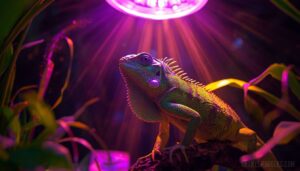
Strong bones matter, but UVB does more than keep your reptile’s skeleton solid. The right lighting also shapes how your animal fights off illness, sheds its skin, and behaves day-to-day.
Here’s what consistent UV exposure actually looks like beyond calcium.
Immune Function Support
UVB does more than build bones — it’s quietly running your reptile’s immune system in the background.
Through Vitamin D3 Modulation, UVB-driven synthesis activates Immune Cell Activation pathways that depend on Calcium Signaling to mount effective responses to pathogens.
Consistent UVB also helps maintain Stress Hormone Balance, reducing chronic physiological load that weakens Pathogen Resistance. Without adequate UVB dosage, even minor infections can overwhelm a compromised system.
Healthier Skin and Shedding
Skin health tells a similar story. Consistent UVB skin renewal promotes keratinocyte differentiation — the process governing how your reptile’s outer skin layers build up and release cleanly.
When UVB and vitamin D3 metabolism in reptiles are properly aligned, shedding cycle timing stabilizes, skin hydration improves, and stuck shed prevention becomes far less of a concern.
Poor UVB? Expect patchy, retained shed.
Natural Basking Behavior
Beyond shedding, there’s something worth watching: how your reptile actually uses the basking zone. Natural basking behavior isn’t random lounging — it’s deliberate Microclimate Selection, Posture Adjustment, and Sun Angle Timing working together.
Your reptile reads heat gradients instinctively, cycling between warmth and shelter through purposeful Shelter Shift.
Get the Heat Gradient Preference right, with proper UVB bulb placement, mesh interference minimized, and UVB intensity diminishes with distance accounted for, and that behavior normalizes beautifully.
Improved Activity and Feeding Response
That behavioral rhythm you’ve just set up pays off at feeding time, too. Solid basking behavior directly drives Appetite Stimulation, Thermoregulatory Activity, and Energy Utilization — the three pillars of a healthy feeding response:
- Reliable Foraging Activity increases after quality basking.
- Post-Meal Movement improves digestion efficiency.
- UVB influence on reptile behavior keeps feeding cycles consistent.
Weak UVB quietly undermines all three.
Circadian Rhythm Regulation
Feeding consistency doesn’t happen by accident — it’s your reptile’s circadian clock doing its job.
Light-Dark Entrainment drives that internal ~24-hour cycle, synchronizing the suprachiasmatic nucleus with your enclosure’s photoperiod.
Peripheral Clock Sync then cascades through organ systems, governing Melatonin Production, Phase Shift Timing, and Hormonal Rhythm Influence.
Without reliable UVB output monitoring and correct light intensity lux requirements, circadian clock entrainment breaks down — and so does everything else.
Breeding and Reproductive Health Benefits
Reproductive success hinges on more than pairing two healthy animals together. UVB-driven vitamin D3 metabolism facilitates calcium metabolism directly — and that calcium fuels eggshell quality, egg development, and gravid female condition throughout the laying cycle.
UVB lighting systems for breeding reptiles also help maintain seasonal photoperiod cues and support stronger hatchlings.
Without adequate UV, reproductive hormones drift out of rhythm, mating courtship becomes sporadic, and the seasonal reproductive cycle loses its anchor.
Hatchling success follows naturally when the foundation is right.
Species-Specific UV Benefits
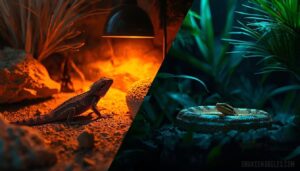
Not every reptile needs the same amount of UV light — and getting that wrong can cause real problems. A bearded dragon and a corn snake live in completely different worlds, so their lighting needs couldn’t be more different.
Here’s how UV requirements break down by species type.
Desert Reptiles and Higher UV Needs
Desert-dwelling species evolved under relentless, unfiltered sunlight — and their biology reflects that. UVB and vitamin D3 metabolism in reptiles like bearded dragons and uromastyx operates at intensities that indoor setups rarely achieve without deliberate effort.
Desert Heat Balance and Thermal UV Integration work together at the basking spot, so your lamp placement matters enormously. Target these four parameters:
- Basking UVI of 6–10
- Ambient temperatures matching the species’ thermoregulatory range
- Monthly UVI verification accounting for UVB lamp decay patterns and quality control
- UVB intensity consistent with Seasonal UV Index fluctuations
UVB Hormonal Regulation and UVB Stress Management both depend on hitting that window accurately — too low risks metabolic bone disease, too high risks tissue damage.
Forest Species and Moderate UV Exposure
Unlike their desert counterparts, forest and shade-loving species evolved under Canopy Shade Effects that filter UVB dramatically — closed canopies transmit just 1–2% of incident UVB to the understory. Sunfleck Patterns deliver brief, dappled bursts rather than sustained exposure, and Seasonal UV Variation shifts that baseline further.
Target UVI 3–5, following UVB dosage recommendations, to prevent metabolic bone disease without exceeding UVB safety thresholds.
Low-UV Species Like Corn Snakes
Corn snakes sit at the quieter end of the UV spectrum — crepuscular by nature, shaped by Microhabitat Selection toward cover rather than open basking. Their wild UVI hovers around 0.5–1.5, so low-level UVB exposure is the target, not intensity. Here’s what that looks like in practice:
- Shade Preference is hardwired — provide hides near the UVB zone so Self-Regulating Exposure remains possible.
- Target UVI 1–2 to support vitamin D₃ synthesis without UVB risk of toxicity.
- Maintain a Calcium-Phosphorus Ratio of 1.5:1–2:1 alongside UVB to prevent metabolic bone disease.
- Adjust UVB dosage seasonally to reflect natural Seasonal UV Variation.
- Even minimal UVB meaningfully improves calcium metabolism compared to none at all.
UV Lighting for Nocturnal Reptiles
Even nocturnal reptiles like leopard geckos benefit measurably from UVB — short Nighttime UV Scheduling windows delivering Low UVB Levels that support UVB and vitamin D3 metabolism in reptiles without disrupting circadian rhythm.
UVB and immune function both improve with correct exposure.
Apply UVB Metering Techniques monthly, account for UVB bulb placement and mesh interference, and integrate Heat-UV Integration thoughtfully for genuine Behavioral Enrichment.
Using Ferguson Zones Safely
Ferguson Zones aren’t just a classification system — they’re your roadmap to safe, measurable UVB dosage.
Follow Zone Mapping Guidelines by measuring UVI at the actual basking spot using a UVB meter, not at the lamp.
Barrier Transmission Checks for mesh or glass, Gradient Intensity Control across the enclosure, and a Routine Reassessment UVI Monitoring Schedule prevent UVB overexposure and metabolic bone disease before either becomes a problem.
Matching UV Index to Natural Habitat
Matching UV Index to natural sunlight means accounting for Latitude UV Shifts, Altitude UV Effects, and Seasonal UV Variation — not just species labels. Use a UVB meter to verify Habitat UV Gradient levels across the basking zone, since Microhabitat Selection determines actual UVB dosage received.
Ferguson Zones give you the target; measuring confirms you’ve actually hit it.
Safe UV Lamp Setup Tips
Getting the setup right makes all the difference between a lamp that actually works and one that just sits there looking functional. A few practical decisions—lamp type, placement, and maintenance—will determine whether your reptile gets the UVB it needs or misses the mark entirely.
Here’s what to keep in mind before you point that bulb at a basking spot.
Choosing T5, T8, Mercury Vapor, or LED UVB
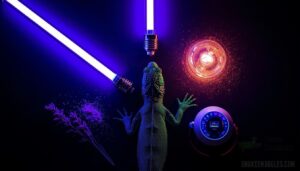
Each UVB lamp type carries real tradeoffs worth understanding before you buy.
T5 UVB tubes offer higher UVB intensity range and longer lifespan compared to T8 fluorescent tubes, which suit shallower enclosures well.
Mercury vapor UVB lamps deliver combined heat output, but demand larger setups safely.
LED UVB units run cool with excellent cost efficiency.
Reflector compatibility varies—always verify output with a Solarmeter before finalizing UVB lamp selection and placement guidelines.
Creating a Basking “Patch of Sunlight”
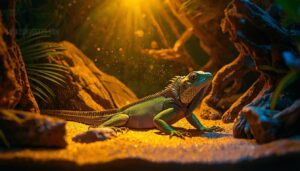
Once you’ve selected your lamp, think of the basking zone as a miniature patch of sunlight—warm and bright on one end, shaded and cool on the other.
Temperature gradient design and shade integration aren’t optional extras; they’re how your reptile self-regulates.
Surface material choice matters too: flat rocks and stable branches improve UVB gradient exposure while supporting natural posture throughout the basking period.
Proper Lamp Distance and Placement
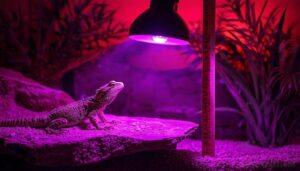
Distance calibration matters more than most keepers realize. Once your basking patch is set, measure the actual air gap from bulb surface to basking surface — not the enclosure top.
Lamp centering keeps UVB delivery even; an obstructed path from heat shields or misaligned fixtures quietly shrinks your effective UV zone.
Verify UVB placement optimization monthly using a UVB meter, following guidelines for UVB distance and enclosure height.
How Mesh and Glass Affect UVB
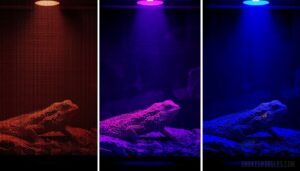
Even a perfectly placed lamp can underperform if barriers interrupt the UVB path.
Mesh hole size and material UVB attenuation both matter: fine mesh screen UV blockage commonly cuts output by half or more, while standard glass type transmission is effectively zero — blocking over 95% of UVB. UV-transmitting acrylic permits roughly 80% through.
Measure at reptile level to quantify real UVB loss from barrier placement effects.
Bulb Replacement and Maintenance Schedule
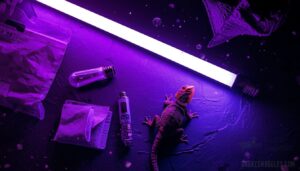
Your bulb’s UVB output declines long before it burns out — that’s the Bulb Aging Timeline trap most keepers miss. Follow a lamp replacement schedule of 12 months for quality T5/T8 tubes, 3–6 months for budget brands.
Use Replacement Calendar Alerts to stay on track.
Monthly UVB meter calibration confirms actual basking UVI. Clean fixtures regularly — Fixture Cleaning Frequency matters — and always run Post‑Swap Verification after every UVB bulb replacement.
Signs of Too Little or Too Much UVB
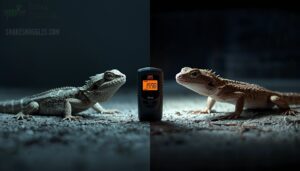
Too little UVB quietly triggers UVB deficiency and metabolic bone disease — watch for jaw deformities, soft limbs, and lethargy, loss of appetite as calcium metabolism breaks down and bone health deteriorates.
Too much flips the script: eye cloudiness, skin sunburn-like lesions, and abnormal basking avoidance signals overexposure stress.
Both extremes compromise immune function.
Your UVI meter is the only reliable referee.
Frequently Asked Questions (FAQs)
Why is UV light important for reptiles?
UV light isn’t just a luxury—it’s a biological necessity.
Ultraviolet B radiation drives vitamin D3 production, enabling calcium absorption, supporting bone health, immune function, thermoregulation support, and hormonal regulation that keeps your reptile thriving.
Can you get vitamin D from an UVB lamp?
Yes — a UVB lamp triggers vitamin D3 production through wavelength specificity and a measurable dose-response relationship, just as sunlight does.
The right UVB output promotes calcium metabolism and bone health effectively.
How often should I replace an UV bulb for a reptile?
Think of it as a "dim before done" situation—your UVB bulb replacement schedule should follow manufacturer guidance, not burnout. Replace T8s every 6–8 months, T5 HOs every 10–
Can reptiles get UVB through a window?
standard window glass blocks virtually all UVB radiation — your reptile gains nothing useful from windowsill basking.
Glass transmission limits the spectrum to UVA and visible light only, stripping out the UVB your animal actually needs.
How long should UV lamps stay on daily?
Run UV lamps 10–12 hours daily for diurnal species, dropping to 8–10 hours in winter for seasonal light adjustment. Timer calibration keeps circadian rhythm in reptiles stable and UVB exposure consistent.
Do UV lamps increase reptile lifespan?
Proper UVB and vitamin D3 exposure directly shapes long-term health and lifespan correlation in captive reptiles, supporting calcium homeostasis, immune function, and prevention and management of metabolic bone disease, and drives measurably better longevity outcomes and survival trends.
Are UV lamps safe around children and pets?
Yes — but placement matters. Keep UV lamps out of children’s reach, use Pet Barrier Design to block direct access, and apply Lamp Shielding Options.
Eye Protection Measures prevent accidental exposure for everyone nearby.
Conclusion
What happens inside that enclosure when the lamp finally delivers the right wavelength isn’t dramatic—but it’s decisive. Bones calcify properly. Behavior normalizes. Immune function holds.
The full benefits of UV lamps for reptiles only materialize when species requirements, Ferguson zones, lamp type, and replacement schedules align with precision.
Get one variable wrong, and the others can’t compensate. the animal under that light won’t just survive captivity—it’ll thrive in it.