This site is supported by our readers. We may earn a commission, at no cost to you, if you purchase through links.
A boa constrictor won’t die from a cold room overnight—but it will stop digesting, stop growing, and start declining in ways that don’t show up until real damage is done. Unlike mammals, boas can’t generate their own body heat, so every metabolic process they run depends on warmth absorbed directly through their belly.
Get that warmth right, and your boa thrives. Get it wrong, and a meal that should take three days to digest sits rotting in their gut for two weeks.
Setting up a heating pad for your boa constrictor correctly isn’t complicated, but the details matter more than most keepers realize.
Table Of Contents
- Key Takeaways
- Can You Use a Heating Pad?
- Where Should The Pad Go?
- What Temperature Should It Reach?
- How Do You Set Up The Hide?
- How Do You Monitor Safe Heat?
- Frequently Asked Questions (FAQs)
- Can I use a heat pad for my boa constrictor?
- Where do you put a heating pad in a snake tank?
- Should I leave my snakes heat mat on all night?
- What is the best heating for a boa constrictor?
- How often should heating pads be replaced?
- Can heating pads be used with other reptiles?
- What substrate works best over a heating pad?
- Do heating pads require GFCI-protected outlets?
- How large should the basking area be?
- Conclusion
Key Takeaways
- Boas can’t make their own body heat, so belly warmth from a pad placed under one side of the enclosure is what drives digestion, growth, and overall health.
- Always connect your heat pad to a thermostat and place the probe inside the warm hide — without this, temperatures can spike unpredictably and burn your snake without warning.
- A real thermal gradient means the warm side holds 86–90°F while the cool side stays at 75–80°F — a lukewarm tank gives your boa nowhere to regulate, which causes chronic stress over time.
- Keep substrate thin over the pad, align the warm hide directly above it, and check both zones daily — small drifts you miss early can quietly damage your boa’s health over weeks.
Can You Use a Heating Pad?
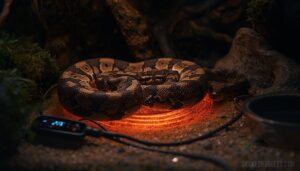
Yes, you can use a heating pad for your boa constrictor — but how you use it matters more than whether you use it. Boas are cold-blooded, so they rely entirely on their environment to regulate body temperature, and belly heat plays a bigger role in that than most keepers expect.
Getting that warm belly contact right is key, and a proper boa constrictor temperature gradient setup gives your snake the control it needs to thrive.
Here’s what you need to know before plugging anything in.
The REPTI ZOO 100W uses a standard E26 base, so check out these reptile heat lamp options for small spaces to find a compatible dome fixture you may already have.
Why Boas Need Belly Heat
Unlike warm-blooded pets, boas can’t generate their own body heat — they depend entirely on their environment. Ventral heat transfer, meaning warmth absorbed through the belly, directly drives metabolic rate and digestive efficiency.
Without thermal comfort from a heat mat set to the right temperature range, thermoregulation breaks down, digestion stalls, and long-term growth development suffers.
That’s the core reason belly heat matters so much.
Post‑feeding boas often spend extra time on the warm side to aid digestion, as described in the post‑feeding warm side.
When a Heat Pad is Useful
A heat mat works best in specific situations. If your room temperature drops or drafts near windows cause cold spots, Draft Mitigation becomes a real concern — and a thermostat-controlled heat mat stabilizes those temperature zones reliably.
It’s also ideal where Limited Overhead Space rules out a lamp, or when Thermal Hide Enhancement is your goal.
Power Failure Recovery after brief outages is another strong use case.
Heat Pad Limits for Boa Constrictors
That reliability has a ceiling, though. A pad alone can’t fill a full enclosure with warmth across wide thermal zones, and without proper Thermostat Calibration, Burn Risk Assessment becomes a real concern — especially since Substrate Thickness affects how heat travels upward.
Factor in Power Consumption, GFCI Protection, and appropriate power output, and you’ll see this tool works best within a controlled temperature range.
When to Use a Lamp Instead
Sometimes a heat lamp or ceramic heat emitter makes more sense than a pad. If your boa consistently avoids floor heat, a lamp targets the warm hide from above using Radiant Heat Benefits without disturbing substrate moisture for better Humidity Control. During Seasonal Temperature Shifts, overhead heat responds faster.
Just follow Safety Electrical Precautions — GFCI outlets, secure cords, and smart heat source placement with a thermostat keeping everything in check.
Where Should The Pad Go?
Pad placement makes or breaks your boa’s entire heating setup, so getting it right from the start saves you a lot of troubleshooting later.
There are a few key rules to follow that work together to create a safe, effective thermal gradient. Here’s what you need to know about where that pad actually belongs.
Place It Under One Side Only

Your boa’s ability to self-regulate depends entirely on having a real choice between warm and cool. Position the pad under one side of the enclosure only — this creates Heat Zone Isolation that drives natural Behavioral Heat Preference.
Track temperatures in both zones consistently, because spotting subtle heat drift early is what keeps that behavioral choice meaningful for your boa.
- Side Specific Power keeps temperature zoning intentional and measurable
- Pad Edge Clearance prevents the thermal gradient from bleeding into the cool retreat
- Heat source placement on one side provides safe, effective reptile care
Keep It Outside The Enclosure Interior
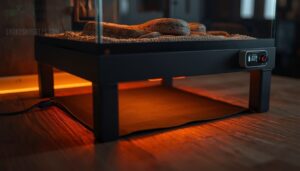
The pad belongs outside the enclosure, never inside where your boa can contact it directly.
This External Power Routing setup uses the floor as a Heat Transfer Barrier, moving warmth upward without exposing cords or the heating element. Set your enclosure on a Non-slip Stand, route cords cleanly through proper Cord Management, and always connect to a thermostat for safe, controlled heat.
Align It With The Warm Hide
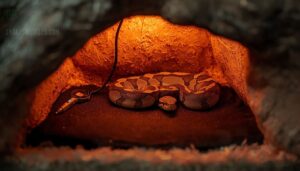
Center the pad directly under your warm hide — this pad hide alignment is what makes heat transfer actually work. If the hide sits offset, your boa’s resting zone misses the warmed section entirely.
Air gap minimization matters too; any space between the hide bottom and pad bleeds heat away.
After rearranging the enclosure, always run an alignment check routine to confirm placement hasn’t shifted.
Leave The Cool Side Unheated

The cool side does one job: staying cool. Leave it completely unheated so your boa has a genuine retreat when it’s done digesting or simply wants to slow down.
Behavioral thermoregulation only works when the temperature gradient is real — not a 3°F difference, but a meaningful drop to 24–26°C (75–79°F).
Three things protect cool zone stability:
- Keep the heat source placement strictly under the warm side only.
- Use a thermostat to prevent warm-zone heat from creeping outward.
- Rely on distance and substrate as natural heat transfer barriers and insulation strategies.
Without this, ambient temperature rises evenly, and your boa loses control of its own body temperature.
What Temperature Should It Reach?
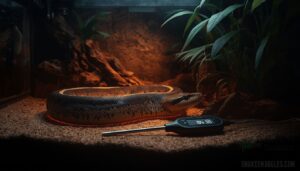
Getting the temperature right on your heating pad isn’t guesswork — there are specific numbers your boa needs to stay healthy. Those targets shift depending on whether you’re keeping an adult or a juvenile, and they change again at night.
Here’s what each zone in the enclosure should actually reach.
Adult Warm-side Target Range
For adult boa constrictors, the ideal temperature range on the warm side sits between 28–32°C (82–90°F) during the day. Your basking spot temperature should consistently hit around 32°C (90°F) — not spike and dip, but hold steady.
Thermal zone consistency is what drives healthy digestion and activity. Connect your heat source to a thermostat, and log temperatures daily to stay on target.
Juvenile Warm-side Target Range
Juveniles run a little warmer than adults — their digestion temperature needs and growth rate correlation make that difference matter.
Aim for 88–92°F (31–33°C) in the warm hide, and set your thermostat to hold that range consistently.
Behavioral heat preference tells the story: if your juvenile keeps avoiding the warm side, check probe calibration accuracy first, then re-verify your heat source surface readings.
Cool-side Temperature Range
Once your warm side is dialed in, the cool side does its half of the work. Target an ambient temperature of 75–80°F (24–27°C) — that’s the range your boa needs to genuinely lower its body temperature.
Airflow influence and heat bleed prevention both shape this zone, so monitor ambient air measurement at snake level, and verify thermostat calibration catches any temperature fluctuation early.
Nighttime Minimum Temperature
Once the cool side is steady, shift your attention to what happens after lights out. Your boa’s enclosure shouldn’t drop below 70°F (21°C) overnight — that’s your nighttime temperature floor.
Thermal inertia means heat is released slowly, so even a well-set digital thermostat can allow brief dips when room draft control is poor or heat pad aging reduces output.
Log temperatures nightly.
Creating a Proper Thermal Gradient
All those individual numbers only matter if they work together as a system. Temperature gradient means your boa gets a genuine choice — 86–90°F on the warm side, 75–79°F on the cool side — not a tank that’s uniformly lukewarm.
A boa’s health depends not on perfect numbers, but on a real thermal choice between warm and cool
Zone separation, smart heat source placement, insulation techniques under the hide, and a calibrated digital thermostat all combine to lock in gradient stability you can trust.
How Do You Set Up The Hide?
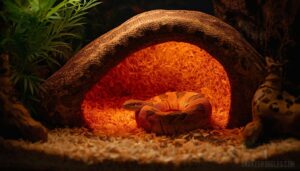
Getting the hide right is what ties the whole heating setup together. A few simple decisions about placement, size, and substrate depth make the difference between a boa that actually uses its warm hide and one that avoids it.
Here’s what to get right before your snake moves in.
Choose a Snug Warm Hide
The hide you choose is the foundation of a stable temperature gradient. Select a snug thermal hiding place made from smooth, non-porous material — surface smoothness prevents skin irritation during long rests, while seal integrity keeps warmth inside.
Hide dimensions should allow your boa to curl fully inside with just enough room to turn. Clean it regularly using a reptile-safe cleaning routine to prevent bacterial buildup.
Keep Substrate Layer Thin Over The Pad
Keeping substrate depth shallow over the heating pad directly affects how well heat reaches your boa. A thin layer improves Heat Transfer Efficiency, enhances Belly Contact Optimization, and simplifies Spot Cleaning Ease — all critical for reptile safety guidelines and heat source reliability.
- Moisture Management: Less bedding depth means less trapped moisture over the heat source, supporting Microbial Prevention.
- Belly Contact Optimization: A shallow layer keeps the hide floor close to the pad’s actual temperature.
- Heat Transfer Efficiency: Thin substrate lets warmth rise predictably into the warm hide.
- Spot Cleaning Ease: Less material means faster removal during routine maintenance.
- Temperature Monitoring: Thin layers help your thermostat track the setpoint accurately.
Add Enough Airflow Around The Hide
well-placed heat pad can create uneven warmth if airflow around the hide gets cut off. Position thermal hiding places slightly away from enclosure corners, since corners trap air and disrupt your temperature gradient.
Porous hide materials support better reptile ventilation than sealed plastic, and thoughtful airflow path design prevents moisture trap prevention issues. Clearance optimization — even just an inch of space — keeps heat distribution smooth across the warm zone.
Make Sure The Snake Can Retreat Fully
Your boa needs a clear pathway out of the warm hide—not just space to enter, but adequate clearance to back out completely. Check that the hide entrance size allows the snake’s full body thickness through without forcing a bend.
An obstacle-free layout means no cables, pad edges, or décor blocking the retreat route. That unobstructed exit is what makes your temperature gradient actually work.
Use Multiple Hides in Larger Enclosures
Larger enclosures need more than one hide—think of it as giving your boa a map of safe retreats across the full thermal gradient. Place a warm hide near the heat source, a cool hide on the opposite end, and a middle-zone option for in-between temperatures.
This hide distribution planning facilitates thermal zone accessibility, behavioral enrichment hides, and shed comfort zones, so your snake never has to cross exposed floor space just to feel secure.
How Do You Monitor Safe Heat?
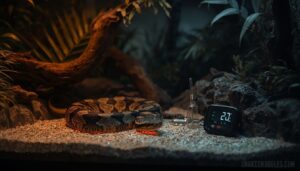
Getting the temperature right is only half the job — keeping it right is what actually protects your boa.
A few simple monitoring habits will tell you exactly what’s happening inside the enclosure before any problem gets out of hand.
Here’s what you should be doing consistently.
Connect The Pad to a Thermostat
heating pad without a thermostat is just a liability waiting to happen.
Wire the pad to the thermostat’s load terminal — never directly to mains power — and confirm the thermostat power rating matches your pad’s wattage.
Linear control mode prevents hot spots by adjusting output smoothly.
Keep connections inside a dry junction box placement, label all wiring color codes per the device manual, and use app integration for remote monitoring when available.
Here’s what controlled setup actually protects:
- Your boa from dangerous temperature cycles that spike without warning
- Consistent heat source placement and power output calculations that stay within safe limits
- Reliable thermal zoning and reptile behavioral thermoregulation across the enclosure
- Electrical safety through proper load wiring and analog thermostat backup options
- Peace of mind knowing the system cuts power automatically at the preset limit
Put The Probe Inside The Warm Hide
The probe’s location makes or breaks your thermostat’s accuracy. Set it directly on the substrate inside the warm hide, right above the heat source — this captures the temperature your boa actually experiences.
A probe mounting bracket keeps it stable, while a probe insulation sleeve prevents false readings from direct contact.
Consistent probe placement turns your analog thermostat into a reliable guardian of the thermal hiding places your snake depends on.
Check Surface Heat With a Temp Gun
Once your thermostat probe is dialed in, a temp gun gives you the full picture. Aim at the exact surface your boa touches — the hide top, the substrate — not the air above it. Laser aim technique and spot size consistency matter here.
- Hold the gun at the same distance every time
- Adjust emissivity settings for porous vs. plastic surfaces
- Scan the entire warm contact area for hot spot scanning
- Note surface material influence — wood reads differently than tile
Test Warm and Cool Zones Daily
A temp gun catches hot spots in the moment, but daily checks tell you whether your setup is actually holding over time. Log Temperature Readings from both zones each morning — warm hide surface and cool side air.
This habit helps you Verify Gradient Consistency and Inspect Thermostat Function before small drifts become real problems.
| Zone | Daily Target |
|---|---|
| Check Hide Surface | 86–90 °F |
| Monitor Cool Side | 75–80 °F |
| Nighttime floor | Above 70 °F |
| temperature gradient spread | 6–10 °F difference |
Tracking ambient temperature alongside your readings also reveals how room temperature cycles affect thermoregulation inside the enclosure.
Watch for Overheating, Burns, or Failures
Daily logs catch drift, but you also need to watch for warning signs that something is actively failing.
- Hot Spot Detection — A burning plastic smell, discoloration, or uneven heat output signals Pad Material Degradation; replace the unit immediately.
- Electrical Wiring Integrity — Check cords for pinching or damage regularly, and confirm your Thermostat Load Rating matches the pad’s power output.
- Safety Shutdown Procedures — If temperature cycles stop or the warm side overshoots without cycling off, recheck probe placement and thermostat calibration before the next use.
Frequently Asked Questions (FAQs)
Can I use a heat pad for my boa constrictor?
Yes, but here’s the paradox: a heat pad warms your boa without heating its enclosure.
It delivers belly heat your snake needs, yet can’t replace a full heat source for proper temperature range.
Where do you put a heating pad in a snake tank?
Place the pad under one side of the tank only, outside the enclosure floor. This keeps the cool side unheated, supporting a proper temperature gradient for natural thermoregulation.
Should I leave my snakes heat mat on all night?
Too much of a good thing" applies here. Leave the mat on overnight only if a thermostat keeps the warm hide at 86–90 °F while the cool side stays below 80 °F.
What is the best heating for a boa constrictor?
For boas, a combination of a heat mat and a radiant heat lamp covers both belly heat and ambient warmth, hitting the ideal temperature range of 86–90°F on the warm side efficiently.
How often should heating pads be replaced?
Plan on a replacement interval of every 3 to 5 years.
Watch for wear indicators like fraying cords, uneven warmth, or odd smells — those signal the safety lifespan is up before the schedule hits.
Can heating pads be used with other reptiles?
Yes, heating pads work well for ground-dwelling lizards, snakes, and some geckos, but arboreal reptiles need overhead heat instead.
Always match the pad to each species’ specific temperature gradient and electrical safety requirements.
What substrate works best over a heating pad?
The wrong substrate can quietly cook your boa. A thin soil layer or paper towel insulation keeps heat transfer honest.
Sand heat transfer spreads unevenly. Mulch porosity benefits airflow.
Substrate thickness impact matters most.
Do heating pads require GFCI-protected outlets?
GFCI isn’t universally required — Code Location Rules determine it. Near moisture, it’s essential. For dry indoor setups, an Electrical Inspection Guidance check confirms compliance. When in doubt, use GFCI anyway.
How large should the basking area be?
Size the basking spot to match your boa’s adult length — enough floor space ratio for full stretching platform size, but only 10–20% of total enclosure footprint.
Conclusion
A boa that’s too cold looks fine—until it doesn’t. By the time you notice something’s wrong, weeks of poor digestion or chronic stress have already taken their toll.
That’s exactly why knowing how to set up a heating pad for boa constrictor care isn’t optional—it’s the foundation everything else rests on. Nail your temperature gradient, trust your thermostat, and check your readings consistently.
Your boa can’t ask for what it needs. Your setup speaks for it.