This site is supported by our readers. We may earn a commission, at no cost to you, if you purchase through links.
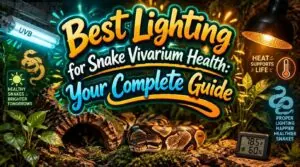
A snake sitting under the wrong bulb isn’t just uncomfortable; it’s quietly stressed, struggling to digest meals, and burning through immunity reserves it can’t afford to lose. Most keepers don’t realize a UVB tube can look perfectly bright while delivering zero usable output, because the phosphors age invisibly long before the glow fades.
Getting the lighting right matters more than most care guides admit. The type of bulb, its distance from the basking spot, and even the mesh screen between them all shape what your snake actually receives.
This guide breaks down every lighting category so you can build a vivarium that genuinely works.
Table Of Contents
- Key Takeaways
- Best Snake Vivarium Lighting Options Compared
- How UVB Lighting Supports Snake Health
- Match Vivarium Lighting to Snake Species
- Safe Lamp Placement and Thermal Gradients
- Lighting Schedules, Controls, and Bulb Maintenance
- Frequently Asked Questions (FAQs)
- What is the best light for a snake enclosure?
- What is the best type of lighting for a snake plant?
- Do I keep my snakes’ heat lamp on all night?
- How many watts should my snake light be?
- Are Snake lights necessary?
- How do I choose the Best Lighting for a snake tank?
- What is the best light for a corn snake tank?
- What is the Best Lighting for snakes?
- Do snakes need UVB light?
- Do snakes need halogen light?
- Conclusion
Key Takeaways
- UVB bulbs age invisibly, losing usable output long before they stop glowing, so replacing them every 6–12 months is essential even when they still look bright. Regular meter testing takes the guesswork out of scheduling replacements, and a solid overview of ball python morph lighting needs can help you understand exactly what output levels to aim for.
- A proper thermal gradient — created by positioning your basking lamp at one end of the enclosure — is what lets your snake self-regulate temperature, directly supporting digestion and immune function.
- Matching your lighting setup to your snake’s natural activity pattern (diurnal, nocturnal, or crepuscular) determines bulb type, UVB output level, and photoperiod length.
- Without UVB-driven vitamin D3 synthesis, snakes risk metabolic bone disease, but the actual UVB dose your snake receives depends on bulb distance, mesh screening, and how often it actually uses the basking zone.
Best Snake Vivarium Lighting Options Compared
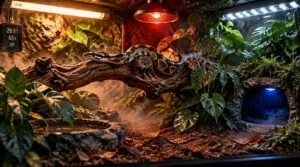
Not all snake vivarium lighting is built the same, and choosing the right type makes a real difference for your snake’s health. Each option on this list has a different purpose, so knowing what you’re working with helps you build a setup that actually functions. Here’s a breakdown of the four main lighting types worth knowing about.
For a deeper dive into how each type affects your snake’s wellbeing, best lighting for snake vivarium health walks through practical setup guidance worth bookmarking.
UVB Fluorescent Tubes
Although phosphor aging is invisible, your UVB bulbs quietly lose output over time. For most snakes, 6–8% UVB output at 12–18 inches covers UVB spectrum requirements without overexposure.
Keep these essentials in mind:
- Replace UVB bulbs every 6–12 months
- Clean fixtures monthly to protect UVB dosage
- Run UVB lighting on a 12-hour cycle
- Position tubes directly above the basking spot
Full-Spectrum LED Lights
UVB tubes are solid, but full-spectrum LED lights often upgrade your snake vivarium lighting in ways that matter most. They cover the full reptile lighting spectrum, supporting circadian rhythms, feeding cues, and visual comfort without producing unwanted heat spikes.
| Feature | Ball Python | Corn Snake |
|---|---|---|
| PPFD | 20-30 μmol | 30-50 μmol |
| CRI | ≥90 | ≥90 |
| Daily Hours | 8-10 | 10-12 |
| Fade Type | Gradual | Sunset |
Basking Heat Lamps
LEDs handle visuals beautifully. But heat lamps are what actually create your snake’s basking spots, making thermal regulation possible.
(https://snakesnuggles.com/difference-between-heating-pad-and-heat-lamp-for-snakes/) your snake needs to properly thermoregulate between warm basking spots and cooler retreat areas.
Here’s what to nail:
- Use 40–60W for small snakes, 100W for larger enclosures
- Target a basking hotspot of 90–100°F
- Position the lamp 8–16 inches above the perch
- Use a reflector dome to direct basking heat
- Add a thermostat for temperature gradients
Ceramic Heat Emitters
Basking lamps create your basking spot with visible heat. Ceramic heat emitters do the same thing without any light, making them perfect for maintaining warmth through the night.
For a full breakdown of what these heating setups actually cost to buy and run, snake housing and heating expenses are worth reviewing before you commit to a setup.
They run hot, around 100–150°C at the surface, so thermostat control is non-negotiable. Without it, you can’t sustain a safe thermal gradient or support your snake’s thermoregulation. Use 40–75W for most vivariums.
How UVB Lighting Supports Snake Health
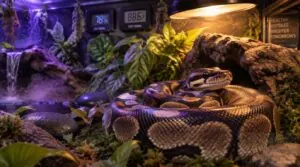
Vitamin D3 synthesis starts the moment UVB lighting reaches your snake’s skin. It’s a chain reaction: UVB converts skin precursors into vitamin D3, which drives calcium metabolism and keeps bones strong. Skip that step, and metabolic bone disease becomes a very real risk.
UVB lighting triggers vitamin D3 synthesis in snakes, and without it, metabolic bone disease follows
Here’s what directly affects how much UVB your snake actually absorbs:
- Distance from the bulb reduces UVB output fast
- Glass and acrylic covers block nearly all UVB
- Old bulbs lose output before they stop glowing
- Mesh screens can filter UVB depending on spacing
- Poor heat gradients cut basking time, reducing total exposure
Even a quality UVB fixture won’t help if your snake avoids the basking zone. Warm temperatures encourage basking, and that’s when UVB does its job.
Match Vivarium Lighting to Snake Species

Not every snake needs the same lighting setup, and getting it wrong can stress your animal or cause real health problems. Your snake’s activity pattern — whether it’s diurnal, nocturnal, or crepuscular — determines exactly what you need. Here’s how to match your vivarium lighting to three common species.
Getting the basics right starts with understanding your species’ needs, from bulb type to photoperiod — all covered in these corn snake housing requirements that apply broadly across common vivarium setups.
Corn Snake Lighting
Corn snakes are naturally forgiving, but your snake vivarium lighting still matters. Aim for 12 to 14 hours of bright light daily to keep their circadian rhythm steady.
UVB lighting isn’t mandatory, but a 5-6% tube at 25-30 cm above the basking spot helps. Pair basking lamps at 30-35°C with a thermal gradient dropping to 24-26°C on the cool end.
Ball Python Lighting
Think of a ball python’s day as a slow, warm sunrise followed by a long dim evening. These aren’t diurnal snakes, but structured snake vivarium lighting still anchors a healthy circadian rhythm.
A simple 12:12 light/dark cycle mimics nature without overexposure. Add low-output UVB lighting at 6-10% for calcium support, and keep your basking zone at 32-34°C for thermal regulation.
Crepuscular Snake Lighting
Imagine dusk settling over sun-baked ground, your snake stirring as shadows stretch. That shift is what crepuscular snake lighting mimics.
Keep your lighting cycle dim and warm, around 2700–3500 K, with a 45-minute fade at each change. Low-intensity UVB lighting at 1.0–2.0 mW/cm² helps with vitamin D without overheating. Align thermal regulation zones with that gradient for clean reptile circadian control.
Safe Lamp Placement and Thermal Gradients
Getting lamp placement right separates a thriving snake from one that can’t self-regulate.
Position your basking lamps at one end only. This creates a thermal gradient your snake moves along freely, choosing warmth or coolness as needed.
Four things to nail:
- Mount lamps at one end, never centered, so warm and cool temperature zones stay distinct.
- Use a surface probe at the basking spot, not midair, for accurate temperature readings.
- Fit a lamp guard so your snake can’t press directly against hot bulbs.
- Add a thermostat to prevent hot-side temperatures from overshooting safe limits.
Without a real gradient, your snake can’t cool down after basking. That puts stress on digestion and immunity. Get the placement right, and the rest follows.
Lighting Schedules, Controls, and Bulb Maintenance
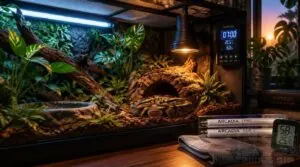
Your snake’s body clock runs on light. A consistent day/night cycle signals when to bask, digest, and rest, so your timer settings matter as much as the bulb itself.
Digital timers are an easy win. Set UVB and visible light to run 10-12 hours, then schedule heat separately to avoid overlap. Astronomical timers sync dawn and dusk to real sunrise and sunset, cutting the jarring lights-off shock your snake would otherwise feel.
Bulb replacement catches keepers off guard. UVB bulb lifespan is shorter than you’d think, so swap tubes every 6-12 months even if they’re still glowing. Full-spectrum LEDs last far longer but can drift spectrally over time. For lighting maintenance, wipe bulbs monthly with dry microfiber, no cleaning agents.
Frequently Asked Questions (FAQs)
What is the best light for a snake enclosure?
The best setup pairs full-spectrum LED lighting with a dedicated UVB tube and a basking lamp. LEDs handle visible light, UVB aids vitamin D3, and the basking lamp drives the thermal regulation your snake needs.
What is the best type of lighting for a snake plant?
A keeper once swapped to full-spectrum LED lights and watched his corn snake’s activity spike almost immediately. For most setups, LEDs paired with UVB bulbs handle day/night cycles and temperature gradients without creating excess heat.
Do I keep my snakes’ heat lamp on all night?
Worried about cold nights? Turn your heat lamps off anyway.
A 12-hour day/night cycle better aids natural thermal regulation. For nocturnal temperature dips, a thermostat-controlled ceramic emitter provides steady warmth without disrupting your light cycle.
How many watts should my snake light be?
A solid target is 3-5 watts per liter of vivarium space.
Corn snakes generally do well at 40-60W; ball pythons need 50-75W. Start at the lower end and adjust in 5-10W increments over 7-10 days.
Are Snake lights necessary?
Not always, actually. Ambient room light and a thermal gradient can meet most snakes’ basic needs. That said, UVB lighting promotes vitamin D3 and guards against metabolic bone disease, so it’s rarely a bad idea.
How do I choose the Best Lighting for a snake tank?
Match your snake enclosure lighting to the species first. You’ll want UVB lighting for daytime, well-placed temperature gradients throughout the tank, and a reliable 12-hour day/night cycle to naturally support your snake’s vitamin D3 levels.
What is the best light for a corn snake tank?
For your corn snake’s snake terrarium lighting, pair a low-output UVB bulb to support vitamin D3 synthesis with a basking lamp that creates the temperature gradients your snake needs. A 12-hour day/night cycle rounds it out.
What is the Best Lighting for snakes?
Your snake is a natural sun-chaser at heart. Pair UVB lighting and LED lights with heat lamps, run everything on a 12-hour day/night cycle, and you’ll give your snake exactly the thermal regulation it craves.
Do snakes need UVB light?
Think of UVB lighting as sunscreen in reverse for reptile health. Basking species genuinely need vitamin D3 synthesis to prevent metabolic bone disease, but nocturnal snakes simply don’t. Match UVB output carefully to your species.
Do snakes need halogen light?
Halogen light isn’t essential, but it can work as a heat lamp to support thermoregulation and warm your basking spot well. It won’t supply UVB, so pair it with a dedicated UVB source if needed.
Conclusion
One keeper switched bulbs after noticing her corn snake had refused food for three weeks straight. The culprit? A nine-month-old UVB tube still glowing brightly but outputting nothing useful.
Getting the best lighting for snake vivarium health right doesn’t require expensive or complicated gear, just informed choices. Pick the correct bulb for your species, nail the placement, and replace tubes on schedule. Your snake can’t tell you when something’s wrong, but its behavior always will.
The same attentive approach applies at feeding time — consult safe snake feeding practices and prey preparation tips to ensure thawed prey is properly warmed and offered promptly.
- https://thetyedyediguana.com/blog/the-ultimate-reptile-lighting-guide-uvb-basking-and-how-to-get-it-right
- https://flukerfarms.com/reptile-u/blog/the-difference-between-uva-and-uvb-for-reptile-lighting
- https://www.cttlight.com/post/the-science-behind-uvb-lighting-for-reptiles-what-every-keeper-should-know