This site is supported by our readers. We may earn a commission, at no cost to you, if you purchase through links.

A corn snake that stops eating is telling you something. A ball python that strikes and drops its prey is doing the same. Most keepers miss these signals because they’re focused on the wrong variables, offering prey that’s too large, too cold, or completely wrong for the species.
Feeding errors compound fast. A single oversized meal can trigger regurgitation and set your snake’s digestion back weeks. The wrong prey type, repeated over months, causes metabolic stress that’s difficult to reverse.
The best snake feeding practices aren’t complicated, but they are specific. Every detail here is practical.
Table Of Contents
- Key Takeaways
- Choose Prey That Fits Your Snake’s Diet
- Match Prey Size and Feeding Frequency
- Thaw and Offer Prey Safely
- Clean Up and Track Feeding Responses
- Top 3 Products Unsuitable for Snake Feeding
- Frequently Asked Questions (FAQs)
- What is the best way to feed a snake?
- Do snakes remember who feeds them?
- How many times a week should you feed a snake?
- What not to feed snakes?
- How long should I wait to handle after feeding?
- What if my snake refuses to eat?
- Can I feed multiple snakes in one enclosure?
- Do snakes need water bowls during feeding time?
- Should I feed my snake in a separate container?
- Should I feed my snake in a separate enclosure?
- Conclusion
Key Takeaways
- Prey size should match 20–40% of your snake’s widest girth, and two consecutive refusals signal the wrong prey type—not stubbornness.
- Frozen-thawed prey must reach 90–100°F before offering, and any thawed prey left out beyond an hour risks dangerous bacterial growth.
- Feeding juveniles every 5–7 days and adults every 7–14 days prevents the overfeeding mistakes that cause regurgitation and metabolic stress.
- Logging each meal’s date, prey type, response time, and your snake’s weight every few weeks turns feeding records into your earliest warning system for health decline.
Choose Prey That Fits Your Snake’s Diet

Three factors shape whether your snake accepts and processes prey: species lineage, prey type, and nutritional profile. A corn snake does well on rodents, while a rough green snake needs insects or small amphibians. Ignoring species-specific dietary needs creates chronic refusal, metabolic stress, and long-term health decline.
Matching prey type to your snake’s lineage is just the first step — understanding how to treat snake loss of appetite can help you catch nutritional deficiencies before they spiral into serious health problems.
Ignoring your snake’s species-specific dietary needs invites chronic refusal, metabolic stress, and long-term decline
Source prey that mirrors your snake’s wild diet. Prey type and nutrient profile both matter, and proper prey size directly affects how your snake processes each meal. Confirm your species’ exact requirements before assuming any single item covers all nutritional bases.
Use feeding tongs to present prey at the correct temperature. Two to three consecutive refusals mean you’ve chosen the wrong prey. Conduct post-feeding observation for 48 hours to catch early digestive issues.
Match Prey Size and Feeding Frequency
Once you’ve confirmed the right prey type, prey size and feeding frequency become your next calibration points. Getting either wrong leads to regurgitation, refusal cycles, or rapid weight loss that compounds quickly.
Use a body width ratio as your measure: prey should be 20-40% of your snake’s girth at its widest point. For juveniles, target age-appropriate prey at 0.5-1.0 times the head width. Only increase prey size after two consecutive successful feeds at the current size.
A weight-based approach anchors your schedule closely to actual condition: Tracking weekly weigh-ins with a reptile digital gram scale helps you catch subtle weight changes before they become serious feeding problems.
- Hatchlings feed every 5-7 days to support fast, consistent growth.
- Adults need feeding every 7-14 days to maintain steady weight.
- If digestion slows or your snake loses weight, reduce frequency before increasing prey size.
Thaw and Offer Prey Safely

Once you’ve set prey size and schedule, how you thaw matters just as much. Frozen-thawed prey is the standard for captive snakes, but safe handling is what makes it work. Stocking up on frozen feeder mice and rats in bulk makes it easier to maintain a consistent thawing routine without gaps in your feeding schedule.
Techniques like warm-water thawing and proper temperature checks—covered in detail in this frozen vs. live snake food guide—help ensure every feeding is both safe and stress-free for your snake.
Thaw overnight in the refrigerator, then move prey to room temperature for 30-60 minutes before feeding. For a faster option, submerge in warm water until fully thawed, then offer immediately. Don’t let thawed prey sit more than an hour because bacterial growth accelerates quickly.
Use a temperature gun to confirm body-warm temperature, around 90-100°F, before offering. Overheating degrades tissue and drops acceptance. A reptile infrared temperature gun gives you an instant, non-contact reading so you can nail that 90–100°F window every time without disturbing the prey.
Always use feeding tongs to present prey, not your hands. This limits your snake’s chance of a mistaken strike and keeps your hygiene standards intact between handling sessions.
Clean Up and Track Feeding Responses
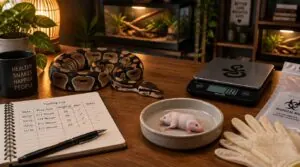
Once the meal is down, your work shifts to cleanup and documentation. Postfeeding observation starts immediately, and what you record now determines what you’ll catch later.
Remove uneaten prey within the hour. Decomposing rodents spike bacterial levels fast and create health risks inside the enclosure.
Build these habits into every session:
- Log date, time, and prey type offered
- Note your snake’s feeding response: quick strike, investigation, or refusal
- Record response latency from offering to first contact
- Track any partial feeding or regurgitation separately
- Weigh your snake every few weeks to catch slow decline
Consistent waste disposal practices prevent pathogen buildup. Over weeks, your logs become the clearest tool for snake health monitoring and sharpen your feeding confidence when something’s off.
A dedicated reptile care log book makes tracking feedings, weights, and waste removal far easier to maintain consistently over time.
Top 3 Products Unsuitable for Snake Feeding
Not every product marketed for reptile use—or even animal care broadly—belongs anywhere near your snake’s feeding routine. Some items create real risks, from thermal burns to nutritional gaps that compromise long-term health.
Here are three products to avoid when feeding your snake.
1. Deepsoon Electric Heating Pad for Pain

The Deepsoon Electric Heating Pad is built for human pain relief, not reptile husbandry. Its six adjustable heat levels and timers designed for shoulder and back discomfort create unpredictable thermal spikes your snake simply can’t escape.
Without a feedback loop calibrated to enclosure conditions, you risk focal overheating that burns tissue before you notice distress.
Users have reported E1 failures within weeks. Don’t repurpose this pad as a feeding aid; it lacks the safety controls your snake’s life depends on.
| Best For | People seeking drug-free relief from back, neck, shoulder, and other muscle or nerve pain at home or in the office. |
|---|---|
| Primary Use | Human pain therapy |
| Product Form | Electric heating pad |
| Brand | Deepsoon |
| Weight | N/A |
| Dimensions | Multiple sizes available |
| Reported Issues | E1 error, early failure |
| Additional Features |
|
- Six heat levels and four timer settings (up to 120 minutes) give you precise, flexible control over your therapy session.
- Soft flannel fabric and a 75-inch cord make it comfortable and easy to position on a bed, sofa, chair, or desk.
- Machine-washable design adds convenience, with multiple size options to target different areas of the body.
- Some users report the material feels thin and lacks the plush, padded feel you might expect from a heating pad.
- Built-in heating wires make frequent machine washing risky and can shorten the product’s lifespan.
- There are reports of units failing within weeks and displaying an E1 error, raising concerns about long-term reliability.
2. Ahab Live Prey Vinyl Record

Though the name implies otherwise, the Ahab Live Prey Vinyl Record is a 12-inch doom metal LP, not a feeder animal. It’s a live recording from Death Row Fest 2017 in Jena, Germany, weighing 1.25 pounds at 12.2 x 12.3 inches. Introducing this to your snake risks choking, impaction, or intestinal injury.
It delivers zero protein, moisture, or caloric value. Your snake needs correctly sized, nutritious prey. Don’t ever let a misleading product name put your animal’s health in danger.
| Best For | Collectors of doom and funeral doom metal who want a rare live recording of AHAB’s nautical soundscapes on vinyl. |
|---|---|
| Primary Use | Music collecting |
| Product Form | 12-inch vinyl LP |
| Brand | Ahab |
| Weight | 1.25 lbs |
| Dimensions | 12.2 x 12.3 in |
| Reported Issues | No digital download |
| Additional Features |
|
- Captures a unique live performance from Death Row Fest 2017, offering a rare listening experience not available through standard releases
- Features five tracks from The Call of the Wretched Sea, a landmark album in the funeral doom genre
- Side D includes a special etching, adding collector appeal beyond just the audio
- Limited to five tracks, so it doesn’t represent a full live set
- No digital download included, meaning no portable or streaming access comes with the purchase
- As a niche metal release, availability can be inconsistent and stock may be hard to restock once sold out
3. Gargeer Land Snail Veggie Diet

Feeding this to a snake is like prescribing eyedrops for a broken leg. The Gargeer Land Snail Veggie Diet is a plant-based powder formulated specifically for herbivorous land snails, containing Non-GMO oats, dandelion leaf, spirulina, calcium carbonate, and sweet potato.
Snakes are obligate carnivores and simply can’t metabolize plant-heavy nutrition in any meaningful way. Its 22.4% crude protein derives almost entirely from plant and insect sources, not the whole-prey animal matter your snake’s digestive system is actually built to process.
| Best For | Hobbyists and pet owners looking for a nutritionally balanced, plant-based diet powder for herbivorous land and garden snails at any life stage. |
|---|---|
| Primary Use | Snail nutrition |
| Product Form | Powder supplement |
| Brand | Gargeer |
| Weight | 2.08 oz |
| Dimensions | 6 x 4 x 0.5 in |
| Reported Issues | Snail mortality reports |
| Additional Features |
|
- Made with clean, natural ingredients including Non-GMO oats, hemp seeds, pumpkin seeds, and black soldier fly larvae, with no ethoxyquin or copper sulfate
- Delivers solid nutritional coverage with 22.4% crude protein, 14.1% crude fat, and added calcium carbonate to support shell health
- Manufactured in the USA under quality-controlled conditions, offering peace of mind about sourcing and production standards
- Some users reported snail deaths after feeding, raising questions about safety or individual sensitivity
- Can attract fruit flies if not sealed and stored carefully after opening
- A few snails refused the food initially, meaning it may take time and patience before your snail adjusts to the diet
Frequently Asked Questions (FAQs)
What is the best way to feed a snake?
Around 40% of captive snakes experience regurgitation from improper feeding. Follow Best Snake Feeding Practices: use feeding tongs, respect prey size guidelines, maintain prey temperature control, and commit to thorough postfeeding observation after every feed.
Do snakes remember who feeds them?
Snakes don’t truly recognize you as an individual, but your consistent handler presence shapes their snake feeding response through conditioning. Familiar scent and routine build feeding confidence, and any feeding schedule adjustment can reset it.
How many times a week should you feed a snake?
Most experienced keepers actually overfeed their snakes. Feed juveniles weekly and adults every one to two weeks. If you’re offering appropriately sized prey, a larger, slower-metabolizing adult can easily handle two full weeks between meals.
What not to feed snakes?
Wild-caught prey seems natural, but it’s carrying parasites, pathogens, and pesticide residue. Avoid raw fish: thiaminase destroys thiamine quickly. Never feed oversized prey, human food, fruit, or anything not properly matched to your snake’s species.
How long should I wait to handle after feeding?
Wait until swallowing fully completes and your snake settles back to its normal resting posture. Larger prey meals extend that window by a lot. Cooler temperatures slow the process, so always watch behavior, not just the clock.
What if my snake refuses to eat?
Congratulations, your snake’s officially become a food critic.
Check prey size and type first, then thaw it completely. Reduce handling stress before every offer, time feeding to active hours, and keep your feeding schedule consistent.
Can I feed multiple snakes in one enclosure?
Sharing a meal sounds neighborly, but your snakes strongly disagree. Feeding competition causes both aggression and starvation. Always separate them individually at feeding time, using a dedicated feeding container to guarantee each one eats safely.
Do snakes need water bowls during feeding time?
Does your snake really need a water bowl present during feeding? No. Snakes naturally regulate their hydration between meals, and a dish left in during feeding can trap prey fluids, directly compromising your hygiene standards.
Should I feed my snake in a separate container?
Like switching rooms before dinner, a separate feeding container limits enclosure contamination and lowers your snake’s defensive feeding response.
Keep it sufficiently warm, non-porous, and easy to clean so you can spot refusal patterns reliably.
Should I feed my snake in a separate enclosure?
Many keepers swear by it, and the reasoning really holds up. A separate feeding enclosure keeps your substrate cleaner, limits prey-fluid contamination, and lets you confirm your snake’s feeding response without disrupting its primary habitat.
Conclusion
A keeper who switched from live prey to properly thawed mice saw their reluctant ball python eat consistently within two weeks. Small adjustments, real results.
The best snake feeding practices come down to reading your animal, matching prey correctly, and staying consistent. Your snake can’t tell you what’s wrong, but its behavior will. Track every meal, respond to refusals early, and don’t guess with prey size. Get these details right, and your snake thrives.
If your snake’s droppings look off or stop altogether after meals, this guide to irregular bowel movements in snakes explains which signs call for a vet visit.