This site is supported by our readers. We may earn a commission, at no cost to you, if you purchase through links.
A crested gecko can dehydrate in 48 hours when humidity crashes below 50%, even if the enclosure looks fine on the surface. Hand-spraying twice a day works until you travel, oversleep, or simply forget. That’s where reptile misting systems for tropical species earn their keep: pumps like the Exo Terra Monsoon RS400 push 0.8 liters per minute through nozzles that produce 60–120 micron droplets, fine enough to bead on leaves instead of flooding substrate.
The catch is that a $40 timer mister and a $200 controller-driven setup behave nothing alike. The differences in pressure, droplet size, and expansion options determine whether your chameleon’s cage stays stable or swings between swamp and desert. The reviews and specs below break down exactly which system fits your enclosure, your species, and your budget.
Table Of Contents
- Key Takeaways
- Best Reptile Misting Systems of 2026
- Misting Systems Versus Ultrasonic Foggers
- Are Automatic Reptile Misters Worth It?
- What to Look for Before Buying
- Match Humidity Systems to Tropical Species
- Safe Setup, Maintenance, and Dry-Out Cycles
- Frequently Asked Questions (FAQs)
- What is the best misting system for reptiles?
- Are automatic reptile misters worth it?
- Is there a smart rainforest spray system available?
- How to make a misting system for reptiles?
- Can misting systems run on tap water safely?
- How long do misting pumps typically last?
- Do misting systems work in glass or mesh enclosures?
- Can I connect a misting system to a smart home hub?
- What water temperature is best for misting tropical reptiles?
- Conclusion
Key Takeaways
- The MistKing Starter v5 ($90–$150) is the top pick for most keepers thanks to its modular, expandable design, while the Exo Terra Monsoon RS400 suits those wanting a smart, high-pressure unit with humidity sensing for up to four enclosures.
- Pressure misting beats ultrasonic fogging for planted tropical vivariums because it wets surfaces and creates microclimates at multiple heights, whereas foggers suit only small, contained setups needing constant saturation like dart frog tanks.
- Use distilled or RO water, clean nozzles regularly, and pair your system with a setpoint-triggered humidity controller (sensor at creature level, away from mist streams) to hold stable RH without over-wetting or mineral clogs.
- Match misting schedules to species—dart frogs need 85–90% RH with frequent short mists, tree frogs 75–85%, tropical geckos 70–80% with one or two deeper mists—and budget for pump replacement every 1–3 years.
Best Reptile Misting Systems of 2026

You’ve got plenty of options this year, but only a handful of misting systems actually deliver consistent results for tropical setups. We tested the top contenders and narrowed them down to three standouts plus one smart upgrade. Here’s what made the cut for 2026.
Exo Terra Monsoon RS400
Because it pairs a 2-roller pump (0.8 L/min at 0.4–1.0 bar) with an adjustable nozzle cluster, the Exo Terra Monsoon RS400 delivers 60–120 μm droplets ideal for a tropical terrarium.
For help matching a system like this to your enclosure size and misting schedule, our ball python misting system guide breaks down the top options and setup tips.
You can schedule 2–6 daily cycles, integrate a humidity controller for automated misting, and mount it on walls or cabinets.
Clean nozzles every 2–4 weeks and use distilled water.
MistKing Starter System
Where the Monsoon RS400 uses a single all-in-one unit, the MistKing Starter Misting System v5 takes a modular approach. Its diaphragm pump runs 20–40 psi, and you can expand to 10 nozzles across enclosures.
- Use 1/4-inch tubing with quick-connect fittings.
- Tune droplets below 100 microns.
- Add humidity setpoint automation.
- Flush lines monthly.
Skip ultrasonic mist generation; pressure misting prevents substrate pooling.
Zoo Med Repti Rain
If the MistKing’s modularity feels like overkill, the Zoo Med Repti Rain keeps things simple.
Its 1.5–2 gallon reservoir and 12–24 V pump handle small tropical species enclosures under 36 inches well.
For a full walkthrough on matching pumps and nozzles to your tank size, this beginner’s guide to reptile misting systems breaks it down step by step.
You set a misting schedule with a basic timer, though an ultrasonic fogger it isn’t; pressure misting means no substrate pooling.
Flush nozzles monthly, use filtered water, and check fittings weekly.
Humidity Controller Upgrade
The Repti Rain’s timer-based scheduling gets you close, but a humidity controller upgrade closes the gap. It pairs a proportional controller with a digital sensor, holding ±5% RH via setpoint-triggered misting.
- Install a 12–24 V DC controller with common ground.
- Position probes mid-enclosure; bad probe placement causes false readings.
- Set 2–5% hysteresis plus a fail-safe dry-out cycle to prevent over-wetting.
Misting Systems Versus Ultrasonic Foggers
Two distinct technologies compete for your humidity budget, and the differences matter more than most care sheets admit. A misting system fires intermittent bursts of roughly 50micron droplet size and larger, so moisture evaporates gradually across foliage and substrate. An ultrasonic fogger produces a continuous cloud of 1 to 5 micron droplets, raising humidity steadily but unevenly in tall, open enclosures.
Choose misting when you keep tropicals in planted vivariums with climbing structures, since droplets wet surfaces and create microclimates at multiple heights. Choose a fogger for species like dart frogs that need constant saturation in contained, smaller spaces.
Practical tradeoffs: foggers need frequent descaling and run best on distilled water; misting nozzles clog with minerals but pair cleanly with a humidity controller to prevent oversaturation. Misting Systems Versus Ultrasonic Foggers isn’t either-or; many keepers run both.
Are Automatic Reptile Misters Worth It?
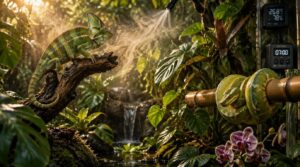
Anything that runs itself changes how you manage reptile enclosure moisture. Instead of spraying twice a day and hoping the hygrometer cooperates, a programmable timer delivers consistent humidity control whether you’re home or not. For tropical species that crash without stable moisture, that consistency alone justifies the cost.
Automated misters deliver the consistent humidity that tropical reptiles need, whether you’re home or not
Here’s what you’re actually paying for:
- Time recovery. Manual misting eats 10–15 minutes daily; automation returns roughly 90 hours a year.
- Stability. Timed wet-dry cycles synced with daytime heat prevent the swings that stress chameleons and tree pythons.
- Fewer failures. Predictable terrarium misting means less mold, less soil saturation, and fewer emergency interventions.
The tradeoffs are real: higher upfront cost, pump replacement every 1–3 years, and electricity use of 5–40 watts. If you keep even one humidity-dependent species, automatic misting systems pay for themselves within the first year.
What to Look for Before Buying
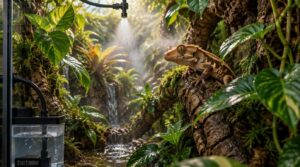
Before you spend money, you need to know what separates a reliable system from a frustrating one. The five factors below cover everything from reservoir capacity to warranty terms, and each one affects daily performance more than brand names do. Work through them in order and you’ll match a system to your setup with confidence.
Reservoir Capacity and Tank Size
Your reservoir size determines how often you’ll refill, so match it to your enclosure volume. Use 1–2% of total water volume per mist cycle as your baseline.
An 8L reservoir suits single smaller vivariums, a 10L reservoir covers most mid-size setups, and a 15L reservoir or 22L top-fill tank controls large or multiple enclosures.
Choose opaque, wide-mouth tanks with visible water lines.
Pump Pressure, Droplets, and Noise
Droplet size can vary fivefold between systems: 20–40 microns at 60 psi versus 80–150 microns at 30 psi.
- RS400: 60–90 psi, denser mist, louder
- MistKing: 30–50 psi, quieter operation
- Fluctuations over 10 psi cause uneven coverage
- Diaphragm pumps with rubber mounts dampen vibration
- Ultrasonic fogger droplets drift, reducing targeted coverage
Match pump pressure to your enclosure size and noise tolerance.
Timers and Humidity Controllers
A cheap programmable timer runs blind; a humidity controller runs smart.
Timer-based scheduling suits dart frogs on dawn and dusk cycles, but setpoint-triggered misting with a humidity sensor feedback loop holds 85–95% RH without over-wetting.
Place the sensor at crown height, away from vents, and recalibrate quarterly since capacitive sensors drift 1–3%.
Enable high-RH alarms above 98%.
Multiple-Enclosure Expansion
Planning to grow your collection? Your misting system should grow with it.
- Choose a pump rated 1–2 L/min per enclosure.
- Keep 2–3 meters between enclosures to prevent condensate drift.
- Add inline shutoff valves so one faulty loop never depressurizes everything.
- Size your external reservoir with 25–30% headroom.
Most pressurized misting systems expandable to 10 nozzles handle 6–8 enclosures per manifold. Use quick-disconnect fittings, stagger activation cycles, and recalibrate sensors after each addition for true humidity gradient replication.
Price, Warranty, and Availability
Expansion costs add up fast, so budget per enclosure. The MistKing Starter Misting System v5 runs $90–$150, while the Exo Terra Monsoon Solo II sits at $120–$180. Zoo Med’s Repti Rain stays cheapest. Expect a 1-year warranty covering pumps, not wear items.
Check availability before committing: MistKing accessories backorder often, and 220V regions face import restrictions. Extended retailer warranties are worth considering for multi-unit builds.
Match Humidity Systems to Tropical Species
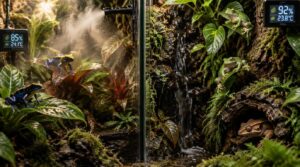
Once you’ve compared specs, the final filter is your animal. Humidity regulation isn’t one-size-fits-all, and tropical species differ sharply in what they need from terrarium moisture control.
Use this quick pairing guide:
- Poison dart frogs: 85–90% RH, short mists 6–8 times daily, a few seconds each.
- Tree frogs: 75–85% RH, spray every 1–2 hours during wake periods, targeting leaf surfaces vertically.
- Tropical geckos: 70–80% RH, one or two deeper mists daily to refresh hides and crevices.
Your misting schedule should also match microhabitats. Canopy zones want fine droplets under 50 μm for drizzle-like enclosure hydration, while ground zones need larger droplets for evaporative cooling. Keep substrate damp, never waterlogged, and place hygrometers in both hot and cool zones so your controller reads the whole enclosure, not just one corner.
Safe Setup, Maintenance, and Dry-Out Cycles
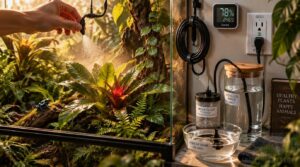
Pairing the right schedule with your species is only half the job. Safe setup and upkeep keep that schedule running for years.
Electrical safety first. Plug everything into a GFCI outlet, keep adapters 15 cm above the substrate, and add a drip loop on every cable so water can’t travel to your controller.
| Task | Frequency | Key Detail |
|---|---|---|
| Nozzle check | Weekly | Soak in white vinegar, rinse |
| Pump seals/O-rings | Every 2 weeks | Replace if worn |
| Reservoir sanitize | Monthly | 3% hydrogen peroxide, 10 min |
| Timer calibration | Weekly | After moves or seasonal shifts |
Use distilled water and a 110–200 micron mesh filter for nozzle clog prevention. Verify probe placement at creature level, out of mist streams, and route tubes with gentle bends.
Run dryout cycles by tapering misting over 6–12 hours, boosting ventilation, and logging a 20–30% RH drop before resuming baseline.
Frequently Asked Questions (FAQs)
What is the best misting system for reptiles?
The MistKing Starter Misting System v5 wins for most keepers. It offers modular nozzles, reliable pressure, and easy expansion. Pair it with an Inkbird Humidity Controller IHC200 for precise, hands-off humidity control.
Are automatic reptile misters worth it?
Rain falls on schedule in a real jungle; your terrarium should too. You’ll save 50–70% of manual misting time, gain humidity output consistency, and protect tropical species from dry-out cycles, if your reservoir and pump match demand.
Is there a smart rainforest spray system available?
Yes. The Exo Terra Monsoon RS400 works as a smart rainforest spray system, combining high-precision misting with a built-in humidity sensor for up to four enclosures. MistKing offers programmable timer alternatives.
How to make a misting system for reptiles?
Building one is straightforward. You’ll need a 5–5 L/min pump, inline solenoid valve, low-flow filter, tubing, nozzles, and a programmable timer. Use a gravity-fed reservoir, distilled water, and target 70–90% humidity.
Can misting systems run on tap water safely?
Think of your misting lines as veins: tap water is the sediment that hardens them. It’s safe short-term, but mineral deposit avoidance matters. Use distilled or RO water to protect nozzles and keep water droplet drinking safe.
How long do misting pumps typically last?
Most hobby pump misters last 1–3 years. Diaphragm pumps fail sooner, around 12–24 months, while peristaltic pumps reach 2–5 years. Filtered water, timer-based scheduling, and reasonable duty cycles extend pump longevity.
Do misting systems work in glass or mesh enclosures?
Ever wonder why your misting results vary by tank type? Both work.
Mesh top terrariums spread humidity faster but dry quicker, so mist more often.
Glass enclosure limitations cause beading and pooling; aim diffused nozzles at substrate.
Balance your terrarium ventilation balance with ambient humidity management.
Can I connect a misting system to a smart home hub?
Yes, but not natively. Most systems connect through a smart plug or relay compatible with your hub. You’ll get on/off control only, so pair it with a humidity controller or sensor for automated triggers.
What water temperature is best for misting tropical reptiles?
Aim for 68–77°F (20–25°C), close to your enclosure’s ambient temperature. Use distilled water, pre-warm reservoirs, and adjust misting schedules so cooler droplets never shock heat-sensitive tropical species.
Conclusion
Humidity is the invisible heartbeat of a tropical enclosure, steady and silent until it falters. Your gecko or chameleon can’t tell you it’s drying out, but the right reptile misting systems for tropical species speak for it. Whether you choose the Monsoon RS400, a MistKing starter, or a controller-driven upgrade, match the pump to your enclosure and species. Set it, maintain it, schedule dry-out cycles, and your animals get the one thing automation promises: consistency you can trust.