This site is supported by our readers. We may earn a commission, at no cost to you, if you purchase through links.
Fecal flotation catches nematode and cestode eggs in up to 95.65% of infected snakes, yet a clean float doesn’t mean a clean bill of health. Motile protozoans like Cryptosporidium slip past flotation entirely, and mites hiding near the eyes can multiply for weeks before you notice a single black speck. Parasites don’t announce themselves. Your snake soaks a little longer, rubs its chin against the water bowl, sheds with retained caps on its toe tips, and you chalk it up to a rough week.
Recognizing snake parasites prevention starts with knowing what these signs mean before they escalate into weight loss, anemia, or open-mouth breathing. Get the diagnostics right, and the rest, quarantine protocols, dosing schedules, follow-up testing, falls into place.
Table Of Contents
- Key Takeaways
- How to Identify Common Snake Parasites
- Warning Signs of Parasites in Snakes
- How Snake Parasites Are Diagnosed
- How to Prevent Snake Parasites
- Safe Treatment and Recurrence Prevention
- Frequently Asked Questions (FAQs)
- How to tell if your snake has parasites?
- What do you crave when you have a parasite?
- Which smell do snakes hate?
- What US state is snake free?
- Can wild-caught prey introduce parasites to snakes?
- How do stress levels affect parasite susceptibility?
- Are certain snake ages more vulnerable to parasites?
- Can parasites spread between different reptile species?
- Do UV lighting requirements influence parasite prevention?
- Can humans catch parasites from pet snakes?
- Conclusion
Key Takeaways
- Fecal flotation catches most worm and tapeworm eggs but misses motile protozoans like Cryptosporidium, so you need a direct smear too for a full picture.
- Watch for subtle warning signs—prolonged soaking, retained shed, appetite loss, or grey stool—since these often show up well before a snake looks visibly sick.
- A proper 90-day quarantine with two negative fecal exams (spaced weeks apart) is essential for catching slow-developing parasites before they spread to your collection.
- Successful treatment means dosing your snake accurately, disinfecting the enclosure at the same time, and confirming clearance with follow-up fecal tests, since skipping any step risks quick reinfection.
How to Identify Common Snake Parasites
Parasites don’t announce themselves, and by the time you spot obvious trouble, the infestation may already be well established. Knowing what you’re looking for—and where to look—puts you ahead of the problem instead of reacting to it. Here’s what to check first.
Subtle signs of dehydration or shedding issues—like how low humidity leads to incomplete sheds—are often the first clues that something’s off before a full parasite problem develops.
Before you go hunting for mites or worms, it’s worth reviewing common snake husbandry mistakes that invite parasites, since poor setup is often the root cause.
Internal Worms and Protozoan Parasites

Worms and protozoa hide where you can’t see them, inside the gut, which is why fecal flotation matters so much. It detects nematode and cestode eggs, including Ophiotaenia perspicua, in up to 95.65% of snakes tested. Direct smears catch motile protozoans like Cryptosporidium that flotation misses.
Strongylid nematodes multiply differently than protozoa, so subclinical monitoring catches infections before symptoms appear.
In humans, intestinal parasites similarly include both multicellular helminths and single-celled protozoa, with transmission often tied to contaminated water and poor sanitation.
External Mites and Ticks
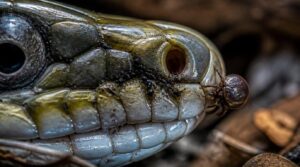
Unlike gut-dwelling parasites, mites and ticks announce themselves on the surface, if you know where to look. Ophionyssus natricis measures under 1mm, appearing as black specks near eyes and nostrils.
Ticks anchor with barbed, scissor-like mouthparts after scouting attachment sites. Both belong to Arachnida, with four leg pairs (three in larvae) enabling rapid crawling across scales, unlike three-legged insects.
Where External Parasites Commonly Hide
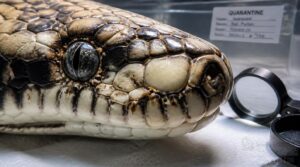
Knowing what mites look like means little if you’re checking the wrong spots. Focus your scale inspection on head and facial areas, the vent and cloacal region, and scale edges where overlapping scutes trap moisture.
During quarantine, smooth nonporous enclosures with paper substrates make substrate management easier, exposing hiding mites before infestations establish.
Don’t overlook enclosure microhabitats either.
Mite and Tick Appearance
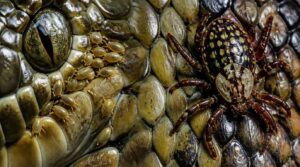
Size and color separate mites from ticks at a glance. Ophionyssus natricis measures under 1.3 mm, oval and thumbprint-shaped, while Amblyomma gervaisi stretches 3–29 mm, with yellow-spotted males and heart-shaped scutum females. Unfed mites show yellow-brown tones, darkening to black when engorged.
Both have four leg pairs, but mite legs stay uniform in length, unlike ticks’ elongated front pairs.
Parasite Differences Among Snake Species

Because parasites co-evolve with specific hosts, host specificity varies widely: some, like Sarcocystis zuoi, infect only king rat snakes, while others cross families entirely.
- Colubridae harbor diverse digeneans
- Viperidae carry heavier parasite loads
- Boidae host unique Hepatozoon species
Morphological adaptations and fecal examination findings shift by species too, so don’t assume one snake’s parasite profile applies to another.
Warning Signs of Parasites in Snakes

Your snake can’t tell you something’s wrong, but its body will—if you know where to look. Parasites announce themselves through subtle shifts in behavior and physical condition long before an infection turns severe. Here’s what should catch your attention during routine handling and observation.
Prolonged Soaking and Excessive Rubbing
A snake spending hours submerged isn’t relaxing, it’s fighting mites. Prolonged soaking drowns feeding parasites; check the water for brown-black flecks afterward. Excessive rubbing against hides or substrate mechanically dislodges mites clustered near the eyes and chin.
Regular substrate changes and enclosure disinfection go a long way toward preventing infestations, but if you’re already battling an outbreak, this guide to identifying and treating snake mites covers the full recovery process.
Together, these behavioral indicators signal parasite load, though low humidity or overheated basking spots can trigger similar soaking without any parasites present at all.
Appetite Loss and Weight Changes
Refusing prey isn’t stubbornness, it’s often parasites disrupting appetite signaling. Watch for:
- Feeding frequency decline
- Smaller meals than usual
- Calorie intake reduction
- Muscle wasting near the tail
- Dehydration risk from reduced drinking
Serial weight checks and body condition tracking catch decline before it’s dramatic. Persistent appetite loss warrants fecal examination, not a waiting game.
Abnormal Stool or Regurgitation
What comes out the back end tells you plenty. Grey, pale stool often points to bile pigment disruption from parasites like Entamoeba invadans. Watery, mucus-laden feces suggests protozoan or coccidial overgrowth. Visible worms confirm infestation outright.
Regurgitation within two hours of feeding, especially with undigested prey, signals heavy gastric burden. Any of these warrants fecal flotation or a direct smear, not guesswork.
Skin Irritation and Retained Sheds
A snake’s skin rarely lies. Retained shed clings to toe tips and eye caps when humidity falters or mites disrupt the barrier.
Catching these early warning signs matters, since incomplete sheds often precede bacterial skin infections in snakes that can escalate quickly without proper treatment.
Watch for:
- Patchy, dull post-shed skin
- Redness from excessive rubbing
- Tick bite inflammation near hides
Mite-induced irritation and dermatitis compound shedding issues fast, exposing scales to further damage.
Weakness, Anemia, and Breathing Changes
A gray, gaping mouth tells you more than any chart. Open-mouth breathing signals your snake can’t get enough oxygen through inflamed lungs.
Paired with other warning signs like lethargy or discharge, corn snake clicking and wheezing sounds during breathing can help you gauge just how serious the situation has become.
A gray, gaping mouth speaks louder than any chart—it means your snake is struggling to breathe
| Sign | What It Means |
|---|---|
| Pale gums | Hematocrit below 20% |
| Rib flaring | Compensatory respiratory effort |
| Lethargy | Present in 85% of cases |
| Wheezing | Airway inflammation, mucus buildup |
Blood parasites and mites both drain oxygen-carrying capacity, worsening weakness fast.
How Snake Parasites Are Diagnosed
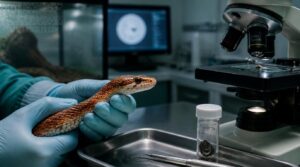
Suspecting a parasite is one thing; confirming it is another matter entirely, and that’s where diagnostics come in. You can’t treat what you haven’t identified, so accurate testing has to come before any anthelmintic touches your snake’s system. Here’s what a proper diagnostic workup actually involves.
Fecal Flotation for Parasite Eggs
Nearly every parasite eggs case starts here: fecal flotation, your frontline diagnostic accuracy tool.
- Strain fresh stool (under 24 hours old) through gauze into saline
- Mix with sugar solution at 1.27 specific gravity
- Centrifuge to concentrate eggs faster than passive methods
- Apply coverslip to the meniscus for microscopic recovery
Solution preparation and sample freshness dictate whether parasite morphology gets accurately identified.
Direct Smears for Motile Protozoa
Flotation misses one thing: motile protozoan trophozoites, which die and distort once sugar solution hits them. That’s why fresh feces (under 10 minutes old, body-temp) go straight to a saline wet mount instead.
Mix roughly 2 mg stool with 0.85% NaCl, add Lugol’s iodine only if you want stained morphology, then apply a 22x22mm coverslip.
Diagnostic accuracy hinges on catching trophozoites before cooling kills their motility.
Blood Smears for Blood Parasites
Motile trophozoites tell you what’s happening on the surface. Blood tells you what’s happening inside the bloodstream itself.
Blood smear preparation requires an EDTA-drawn sample, properly labeled with patient identifiers and draw time. Fix thin smears in methanol within four hours; thick smears go unstained.
Stain quality control matters: pH 7.2 Giemsa reveals key morphology. Scan 100x oil immersion fields with 10-20 white blood cells for parasite morphology ID, catching Hepatozoon before it triggers blood in stool.
Skin and Scale Examination
Blood work reveals internal parasites; your hands and eyes catch what’s living on the surface. Run fingers along scale rows, checking scale texture and edges for roughness or gaps. Inspect for retained shed, dullness, or crusting, classic signs of ectoparasite irritation. Watch for prolonged soaking and excessive rubbing too. These behavioral changes often precede visible lesions by days.
When Veterinary Testing is Needed
Some signs cross the line from home care into clinical territory. Unexplained weight loss calls for blood testing to check organ function. Mucus in feces, open-mouth breathing, skin tenting, or retained spectacles each demand prompt veterinary diagnosis.
Don’t wait out symptom monitoring alone; early detection through fecal exams during quarantine catches problems before they escalate.
How to Prevent Snake Parasites
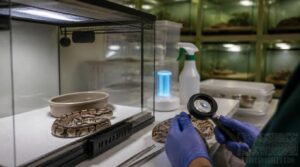
Diagnosis tells you what you’re dealing with, but prevention keeps you from needing that diagnosis in the first place. Most parasite outbreaks trace back to a handful of preventable gaps in husbandry, not bad luck. Here’s what you need to build into your routine, starting with quarantine.
Follow a 90-Day Quarantine
Ninety days isn’t arbitrary; it’s the window needed to catch slow-incubating organisms like Cryptosporidium that shorter 30-60 day stints miss entirely.
Quarantine new arrivals in a separate room using:
- Paper towel substrate
- Disposable plastic hides
- Dedicated tools
- Daily-cleaned water dishes
Count from arrival, not first negative test. Release criteria met only after 14 symptom-free days.
Complete Two Quarantine Fecal Exams
Two negative fecal exams, not one, clear a snake from quarantine. Schedule the first within 1-2 weeks of arrival, the second 2-3 weeks later, using centrifugal flotation and direct smear techniques together for over 90% detection accuracy. Collect fresh samples (1g minimum) within two hours. Document everything.
| Exam | Timing |
|---|---|
| First | 1-2 weeks post-arrival |
| Second | 2-3 weeks after first |
| Wild-caught second | 4-6 weeks |
| Recheck interval | Every 6-12 months |
Clean and Disinfect Enclosures Safely
A dirty enclosure hides parasites better than any camouflage. Scrub first, disinfect second: debris blocks contact every time.
- Clean before disinfecting, always
- Use reptile-safe disinfectants only
- Never mix chemicals
- Honor wet contact time
- Wash hands after handling
Follow label dilution, protective gear, and drying steps exactly. Sanitation habits protect your snake and your quarantine’s integrity.
Maintain Proper Temperature and Humidity
Stress weakens immunity, and unstable enclosures create stress. A proper thermal gradient, warm basking zone paired with a cooler retreat, lets your snake thermoregulate instead of enduring one static temperature.
Check surface readings, not just ambient air. Pair humidity control with condensation prevention: stable relative humidity, monitored via hygrometer, discourages mite proliferation and reduces the immune-suppressing stress that leaves snakes vulnerable to nematode and protozoan burdens.
Source Feeder Rodents Carefully
Your snake’s dinner can carry parasites too. Choose feeder suppliers with documented biosecurity standards and closed rack systems preventing escape. Insist on quarantine protocols and traceable transport records.
Frozen rodents need clear storage labeling for safe handling. Careless sourcing risks reintroducing the same parasite life cycle and zoonotic transmission you’ve worked to eliminate through diligent quarantine and fecal examination.
Safe Treatment and Recurrence Prevention
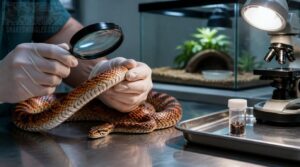
A positive fecal exam doesn’t end with a prescription—it starts a process you need to manage correctly. Success hinges on dosing accuracy, environmental control, and knowing when reinfection risk is highest. Here’s what safe, effective treatment actually looks like from diagnosis to clearance.
Veterinarian-Prescribed Dewormers and Dosages
Deworming isn’t guesswork. Your vet selects fenbendazole, levamisole, or ivermectin based on parasite type, calculates dosage by body weight, and sets treatment intervals. Consider:
- Initial dose upon diagnosis
- Repeat dose at 10-14 days
- Follow-up fecal exam at 2-4 weeks
Correct dosing prevents drug resistance and reduces the 25% failure rate tied to calculation errors.
Treating Snakes and Enclosures Together
Correct dosing means little if the enclosure keeps reinfecting your snake. Effective integrated parasite control requires simultaneous treatment protocols: dose the snake while executing a full disinfection protocol on substrate, furnishings, and surfaces.
Discard porous bedding, scrub smooth-sided enclosures, and time enclosure disinfection to match medication schedules. Skipping environmental control undermines coordinated treatment, letting eggs or mites survive to reinfect a dewormed snake within days.
Supportive Care During Recovery
Killing parasites is only half the job; your snake’s body still needs help rebuilding after the assault. Hydration therapy comes first, with warmed subcutaneous fluids at 15–25 ml/kg/day correcting dehydration left behind by nematode damage.
Recovery also depends on:
- Thermal support, keeping the warm side between 29–32 °C to aid drug metabolism and gut flora restoration
- Nutritional support, offering easily digestible prey at reduced intervals
- Minimal handling, protecting immune system recovery while you track weight and respiration
Follow-Up Fecal Testing
Recovery isn’t confirmation. You need fecal re-examination at 2–4 weeks post-treatment, since parasite shedding is often intermittent, one negative sample can mislead you.
| Sample | Timing | Purpose |
|---|---|---|
| 1st | Day 0 | Baseline |
| 2nd | 2–4 wks | Verify clearance |
| 3rd | 6 wks | Catch intermittent shedders |
Label, seal, and submit specimens promptly, degraded samples skew fecal flotation and direct smear accuracy alike.
Avoiding Reinfection and Dosing Errors
Most treatment failures trace back to two culprits: sloppy math and dirty enclosures. Weigh your snake to the nearest gram, since dosing accuracy at 25 mg/kg fenbendazole differs wildly from 100 mg/kg.
Disinfect thoroughly before reintroduction. Skip this and reinfection follows within weeks, undoing your entire deworming schedule. Store anthelmintics properly (metronidazole refrigerated, sulfas below 25°C) and never estimate doses by eye.
Frequently Asked Questions (FAQs)
How to tell if your snake has parasites?
Watch for behavioral changes like lethargy or weight loss, check stool for worms, inspect scales and mouth for parasites, and confirm findings through fecal egg detection during routine fecal exams every 6-12 months.
What do you crave when you have a parasite?
This one applies to you only indirectly, since snakes can’t verbalize cravings. But glucose competition, mineral depletion, and gut inflammation from parasites like Ascaris or Blastocystis drive sugar and carb cravings alongside appetite loss, lethargy, and diarrhea in infected snakes.
Which smell do snakes hate?
Snakes avoid pungent sulfur and ammonia odors, along with cinnamon oil, clove oil, and cedarwood compounds. Citrus oils and vinegar offer weaker, short-lived deterrence. None replace proper quarantine and enclosure hygiene for actual parasite control.
What US state is snake free?
Picture a landmass with no serpents slithering underfoot at all: that’s Alaska, kept snake-free by brutal winters. Hawaii shares that status too, its ocean isolation blocking any natural colonization, both enforcing strict import laws and quarantine to stay that way.
Can wild-caught prey introduce parasites to snakes?
Yes. Wild-caught prey often carries endoparasites and ectoparasites, transferring nematodes, protozoa, or mites during feeding. This parasite spillover potential is why commercially bred feeder rodents, paired with strict biosecurity for feeders, remain your safest choice for consistent parasite prevention.
How do stress levels affect parasite susceptibility?
Chronic stress elevates cortisol, weakening immune defenses and lowering resistance. This hormone-immune feedback loop works both ways: parasites themselves can spike stress hormones, compounding susceptibility.
Reducing handling, stabilizing husbandry, and maintaining body condition all protect your snake’s natural defenses against opportunistic infection.
Are certain snake ages more vulnerable to parasites?
Ironically, hatchlings born to survive get hit hardest: juvenile immune weakness, growth demands, and undernourishment invite infection fast.
Adults often mask chronic carrier status, quietly shedding parasites while stress-induced susceptibility and weakened immune response threaten every age nearby.
Can parasites spread between different reptile species?
Absolutely, cross-species transmission occurs routinely in mixed collections. Cryptosporidium and Ophionyssus mites spread opportunistically between snakes, lizards, and turtles sharing water, substrate, or tools, though host specificity limits some parasites.
Quarantine and environmental control remain your best defense against contamination.
Do UV lighting requirements influence parasite prevention?
Think of it as sunshine with a purpose. UVB helps vitamin D synthesis and immune strength, but germicidal UV needs precise wavelength-specific action and dose, not casual exposure, and never replaces enclosure hygiene and quarantine.
Can humans catch parasites from pet snakes?
Yes. Snakes carry genuine zoonotic risk through feces, saliva, and contaminated enclosures. You can contract Salmonella, Cryptosporidium, or Sarcocystis via poor hygiene or food contamination, with immune-compromised individuals and young children facing a much higher infection risk.
Conclusion
A parasite-free snake is a locked door, quiet until something forces it open. Recognizing snake parasites prevention means checking that lock regularly, not waiting for it to break.
Two clean fecal exams during quarantine, careful sourcing of feeder rodents, and prompt attention to subtle behavior changes keep infestations from taking hold. You won’t catch every organism through flotation alone. But consistent diagnostic habits and disciplined husbandry give your snake far better odds than luck ever will.
- https://www.wisconsinherps.org/educational-articles/acariasis-dealing-with-the-dreaded-snake-mites
- https://thetyedyediguana.com/blog/parasites-in-reptiles-the-silent-threat-every-keeper-should-screen-for
- https://www.merckvetmanual.com/exotic-and-laboratory-animals/reptiles/parasitic-diseases-of-reptiles