This site is supported by our readers. We may earn a commission, at no cost to you, if you purchase through links.

Most snake keepers obsess over hides and heating — then grab whatever bowl fits the corner. That’s a mistake.
A snake that can’t soak properly is heading toward a bad shed, retained skin, or dehydration you won’t notice until it’s a problem.
The right snake water dishes for soaking do more than hold water; they regulate humidity, support thermoregulation, and give your animal a place to decompress.
Size, material, and placement all affect whether your snake actually uses the dish — or avoids it.
These four bowls cover the range, from compact setups to enclosures housing large constrictors.
Table Of Contents
Key Takeaways
- Your snake’s water dish directly affects shedding success, humidity levels, and hydration — it’s not an afterthought.
- Non-porous materials like food-grade resin, glass, and ceramic are the only safe choices, since porous surfaces quietly harbor bacteria between cleanings.
- Size and depth matter: match bowl diameter to roughly one-third to one-half your snake’s midbody width, and choose depth based on whether your snake needs daily hydration or full soaking.
- Placement and daily water changes are just as critical as the bowl itself — warm-side positioning supports humidity, while consistent cleaning prevents biofilm before it becomes a health problem.
Top 4 Snake Water Bowls
Finding the right water dish matters more than most keepers realize. The wrong bowl tips over, holds bacteria, or stresses your snake every time it tries to soak.
A quick look at water dishes designed specifically for snake keepers can save you from a lot of avoidable headaches down the road.
Here are four solid options worth considering.
1. Exo Terra Large Reptile Water Bowl
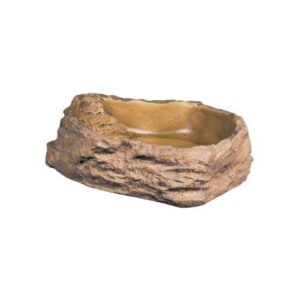
The Exo Terra Large Reptile Water Bowl is a solid pick for ball pythons and similar mid-to-large snakes. It measures 8.7 × 6.7 × 2 inches and weighs 2.2 lbs — heavy enough to stay put when your snake decides to redecorate.
The food-grade resin interior is smooth and non-porous, so bacteria don’t get a foothold. Those built-in safety steps are a genuine plus, letting smaller tank mates climb out without help. Just note the depth may be too much for tiny hatchlings.
| Best For | Medium to large reptiles and amphibians like ball pythons, tortoises, and tree frogs who need a roomy, stable water source. |
|---|---|
| Material | Food-grade resin |
| Interior Surface | Smooth, non-porous |
| Exterior Finish | Natural rock look |
| Tip Resistance | Heavy construction |
| Dimensions (LxWxH) | 8.7×6.7×2 in |
| Weight | 2.2 lb |
| Additional Features |
|
- Heavy build stays put even when your snake is doing its thing — no tipping, no spillage
- Smooth, non-porous interior wipes clean easily and doesn’t harbor bacteria
- Built-in safety steps let small critters climb out on their own
- Actual size may not match the listed dimensions, so measure your enclosure before buying
- Too deep for tiny hatchlings or very small species that can’t easily reach the surface
- Rigid plastic means it won’t fit into oddly shaped or tight enclosure spots
2. Reptizoo Large Terrarium Water Bowl
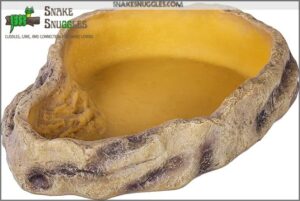
If you need something with a bit more depth, the Reptizoo Large Terrarium Water Bowl steps up. It measures roughly 11 × 8.7 × 2.4 inches, with its 6 cm depth making it a strong choice for mid-to-large snakes that like a proper soak.
The polyresin build is non-porous and takes cleaning well — no staining, no buildup. The natural stone finish blends into bioactive setups without looking out of place.
One drawback: there’s only one color option.
| Best For | Mid-to-large reptiles like bearded dragons, corn snakes, and pythons that need a roomy, stable dish for soaking and hydration. |
|---|---|
| Material | Food-grade resin |
| Interior Surface | Smooth, non-porous |
| Exterior Finish | Natural rock look |
| Tip Resistance | Heavy construction |
| Dimensions (LxWxH) | 9.7x10x2.5 in |
| Weight | ~1 lb |
| Additional Features |
|
- Heavy resin build (3.35 lb) keeps it firmly in place even with active or larger snakes
- Smooth interior and simple shape make cleaning quick and hassle-free
- Natural soil-tone finish blends right into bioactive or naturalistic terrarium setups
- Only comes in one color — no slate or alternative finish options
- The weight that prevents tipping also makes it easy to drop and potentially injure yourself
- At 11 × 8 inches, it’s too bulky for smaller enclosures with limited floor space
3. RunXF Large Resin Reptile Rock Bowl
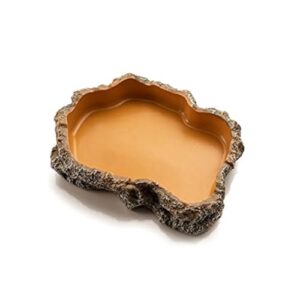
The RunXF takes a different approach — it’s built to look like actual rock.
Unlike slick plastics, its textured surface pairs well with non-porous snake water bowl options that won’t trap bacteria the way porous materials do.
The 9.06 × 6.69 × 1.97-inch resin bowl has that rough, textured exterior that your snake can press against during a shed, while the interior stays smooth for safe soaking. snag points.
The food-grade resin is non-porous, BPA-free, and easy to rinse clean.
At 13.4 oz, the high-density base keeps it planted even when a ball python decides to rearrange things mid‑soak.
| Best For | Reptile owners with medium-to-large snakes or lizards who want a hide and water dish that actually looks like it belongs in a natural habitat. |
|---|---|
| Material | Resin |
| Interior Surface | Smooth |
| Exterior Finish | Soil-like tone |
| Tip Resistance | Low center of gravity |
| Dimensions (LxWxH) | 11x8x2.4 in |
| Weight | 3.35 lb |
| Additional Features |
|
- The rough exterior doubles as a shedding aid — snakes can rub against it naturally
- Heavy enough to stay put even when a ball python or bearded dragon climbs in for a soak
- Smooth interior means food and grime wipe out easily with just a rinse
- Only comes in one yellow-brown color, so it might clash with certain terrarium setups
- Resin can chip or crack if it takes a hard drop during cleaning
- One bowl per pack — you’ll need to buy a second if you want separate food and water stations
4. Penn Plax Fossil Rock Food Water Dish
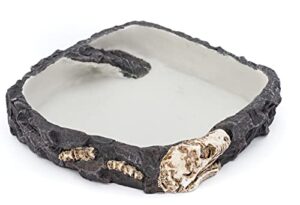
If the RunXF leans into rugged texture, the Penn Plax Fossil Rock goes full terrain — and it works surprisingly well as a dual-purpose dish. At 7 × 7 × 1.5 inches and just 1.32 lb, it’s compact but sturdy enough to stay put.
The food-grade resin interior is non-porous and smooth, so cleaning takes seconds.
That 1.5-inch depth won’t suit full-body soaking, but for daily hydration and feeding in one spot, it earns its place in smaller setups.
| Best For | Reptile and small animal owners who want a natural-looking, low-maintenance dish that pulls double duty for food and water. |
|---|---|
| Material | Resin |
| Interior Surface | Smooth |
| Exterior Finish | Brown-yellow rock texture |
| Tip Resistance | High-density base |
| Dimensions (LxWxH) | 9.06×6.69×1.97 in |
| Weight | 13.4 oz |
| Additional Features |
|
- Realistic rock texture blends right into any terrarium setup
- Heavy enough to stay stable even with active animals bumping around
- Quick to clean — just rinse, wipe, and you’re done
- Too shallow for soaking, so it won’t replace a proper soak tub
- Determined climbers may find ways to escape during feeding time
- Resin can chip or fade if you use harsh cleaners over time
Best Materials for Soaking
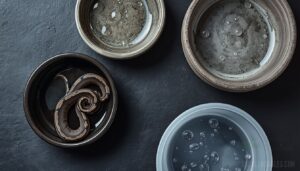
material your bowl is made from matters more than most people think. It affects how easy cleanup is, how long the dish lasts, and whether bacteria quietly take hold between washes.
Here’s a look at the four material types worth knowing before you buy.
If you’re prioritizing protection without sacrificing dexterity, heavy-duty gloves designed specifically for large constrictor handling offer a great real-world benchmark for what each material can withstand.
Ceramic Bowls for Easy Sanitation
Ceramic is hard to beat for a snake water dish. The nonporous surface resists bacterial growth prevention issues that plague softer materials, and dishwasher sanitization at high heat keeps things genuinely clean.
Watch for chips — glaze integrity matters because exposed clay absorbs moisture and harbors bacteria fast.
A weighted base prevents tipping. Odor resistant and easy to clean, ceramic earns its place.
Ensuring lead‑free glaze safety is essential for food‑contact compliance.
Glass Dishes for Odor Resistance
Glass is quietly one of the best materials for a snake water dish. Its nonporous surface shuts down bacterial biofilm before it starts. Unlike plastic, there’s no Mineral Accumulation staining over time.
BPA-Free Glass stays chemically inert through High-Temp Rinses, so your cleaning protocol stays simple.
Surface Smoothness means odors rinse away completely — genuine Odor Neutrality, no deodorizers needed.
Food-grade Resin for Lightweight Durability
Food-grade resin hits a sweet spot most keepers overlook. Its nonporous resin surface resists biofilm just like glass — but weighs far less. That high Weight Strength Ratio means bigger bowls stay manageable.
- Impact Resistance beats ceramic when your snake bathes hard.
- Heat Tolerance manages warm-side placement without warping.
- Chemical Stability survives alcohol-based cleaning routinely.
- UV Stabilization prevents yellowing under enclosure lighting.
- Nontoxic food-grade material certified safe for water contact.
Avoiding Porous Materials That Trap Bacteria
Porous materials are basically bacteria hotels — rough surfaces give biofilm somewhere to anchor and hide. That’s why Surface Smoothness matters so much.
Porous surfaces are bacteria hotels — rough textures give biofilm exactly the foothold it needs
Nonporous materials like food‑grade resin score high on Hardness Selection, keeping Microbial Adhesion low even after aggressive cleaning and disinfection protocols.
Continuous Construction eliminates hidden crevices entirely. Pair that with Sanitizer Compatibility and antimicrobial coatings, and your bowl stays genuinely clean between uses.
Size, Shape, and Stability
Getting the size and shape right matters more than most people realize. A bowl that’s too big, too small, or too easy to tip can turn a simple soak into a stressful situation — for you and your snake.
Here’s what to look for before you buy.
Matching Bowl Diameter to Snake Size
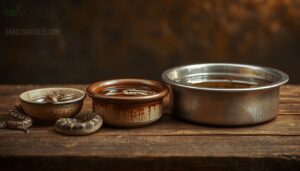
Sizing starts with one simple measurement: your snake’s midbody width. Match the bowl diameter to roughly one-third to one-half that width — that’s your diameter calculation formula in practice.
A 3-foot snake fits well in a 6–8 inch bowl; a 4–5 footer needs 9–12 inches.
Revisit water bowl size at each growth stage scaling checkpoint, especially as species width increases.
Choosing Shallow or Deeper Soaking Depths
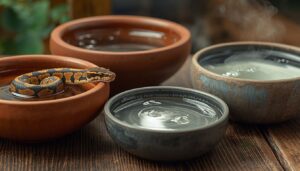
Depth isn’t just about volume — it directly affects Temperature Impact, Hydration Benefits, and Shedding Efficiency.
A shallow dish heats fast but cools just as quickly, so check it every 10 minutes. A deep water dish retains warmth longer, supporting extended soaks during shed cycles.
Match bowl size and depth considerations for snakes to Species Preference, and watch for Stress Indicators like coiling or hissing.
Oval and Sloped Sides for Comfort
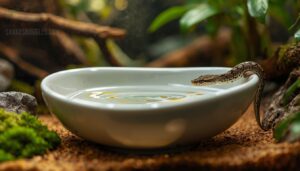
Once you’ve nailed depth, shape becomes the next variable worth sweating. Oval bowls and gentle slopes aren’t cosmetic — they directly support stress‑free soaking.
- Curved edge benefits reduce scale snagging during entry and exit
- A gentle incline flow guides your snake into position naturally
- Even water distribution along curved walls improves snake hydration
- Low sides with a gentle slope ease mobility-limited snakes in
- Nonporous material on rounded interiors resists biofilm in curved transitions
Non-slip Bottoms and Tipping Prevention
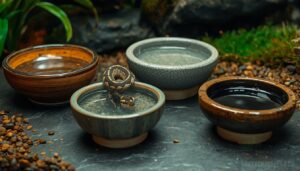
Shape gets your snake in comfortably — stability keeps the water where it belongs.
A nonslip bottom with rubberized traction grips the tank floor even when wet. Weighted base design and low center of gravity prevent tipping mid-soak.
Suction cup attachment locks shallow bowls onto smooth glass.
Textured rim grip makes lifting easier.
Wide rim, low sides, and gentle slope round out a bowl that stays put.
Placement and Cleaning Tips
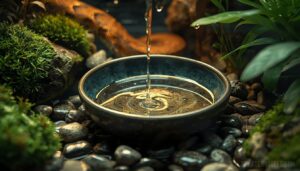
Where you put the water dish and how you clean it matters more than most keepers realize.
Small adjustments can make a real difference in your snake’s health and your enclosure’s humidity.
Here’s what you need to know before we break it down.
Warm-side Placement for Humidity Support
Where you place the bowl matters more than most keepers realize. Set it on the warm side — that heat gradient optimization turns simple evaporation surface area into a localized humidity halo around your snake’s space.
Positioning it just right can make a surprising difference, as explored in this guide on whether a snake’s water bowl belongs on the warm or cool side.
Here’s how to nail warm-side placement:
- Position the bowl near, not over, the heat source.
- Keep water shallow — 1–2 cm maximizes evaporation efficiency.
- Raise slightly for microclimate gradient control.
- Refill once or twice daily for humidity stabilization.
- Watch enclosure walls for condensation management — wipe if needed.
Keeping Bowls Away From Vents
Warm-side placement helps humidity, but vent distance guidelines matter just as much. A bowl sitting too close to a vent invites rapid evaporation, temperature swings, and spills from airflow management issues.
Keep at least 12 inches of airflow clearance between your bowl and any vent opening. Draft-resistant placement and a simple barrier shield can protect your snake’s hydration needs without disrupting heat draft mitigation.
Daily Water Changes for Cleanliness
Change your snake’s water daily — no exceptions. Replacing 10–20% of the soaking water keeps ammonia at negligible levels, and full daily water changes prevent bacterial biofilm before it takes hold.
Match water temperature to your enclosure (25–28°C) to avoid stress, and always run it through a dechlorination process first.
Consistent hygiene scheduling makes water quality management almost easy.
Preventing Biofilm, Mold, and Spills
Even the cleanest routine breaks down if you skip the details. After each daily water change, dry the bowl completely — bacterial biofilm can’t establish itself on dry surfaces.
Run a Sealant Inspection Routine monthly to catch cracks early. Good Anti-Mold Ventilation keeps ambient moisture low.
Nonporous resin water dishes resist buildup, and weighted bowl stability reduces spills. Always allow full Sanitizer Contact Time before rinsing.
Frequently Asked Questions (FAQs)
Can snakes drown in their water dish?
Yes, snakes can drown — though they’re surprisingly good swimmers. Deep water dish setups pose real Drowning Risk, especially for older snakes showing Age-Related Drowning vulnerability.
Keep depths shallow and Exit Accessibility easy.
How often should soaking dishes be replaced?
Replace soaking dishes every one to two weeks with daily use. Visual inspection matters — swap them immediately if you spot cracks, mineral buildup, soap residue, or dullness.
Bacterial biofilm doesn’t wait.
Should hatchlings have separate soaking dishes?
Hatchlings absolutely need their own soaking dishes. Separate bowls support individual hydration monitoring, cross-contamination prevention, and stress reduction.
Match bowl size to each snake’s width for growth-adjusted sizing and simplified cleaning protocols.
Is tap water safe for snake soaking?
Tap water can work, but prep it first. Chlorine removal and chloramine neutralization are both essential — a quality tap water conditioner manages both.
Skip the conditioning step, and you’re risking skin irritation.
Do soaking dishes affect shedding success?
Absolutely. The right dish directly boosts molting efficiency by maintaining shedding hydration and skin elasticity. Poor placement disrupts your humidity gradient, and bacterial biofilm signals stress indicators fast.
Conclusion
The bowl you’ve been overlooking might be the one thing quietly undermining your snake’s health. Snake water dishes for soaking aren’t an afterthought — they’re infrastructure.
Get the size wrong, use a porous material, or plant it in the wrong corner, and your snake pays the price.
But when you nail it, everything clicks: better sheds, stable humidity, a calmer animal.
One bowl. That’s the difference between a setup that looks right and one that actually works.