This site is supported by our readers. We may earn a commission, at no cost to you, if you purchase through links.
Most reptile owners notice something’s wrong only after appetite disappears, skin looks dull, or movement slows—by that point, the animal has often been metabolically compromised for days.
Unlike mammals, reptiles generate no internal body heat, so every biological process—digestion, immune response, tissue repair—runs on borrowed warmth from the environment. Drop the enclosure temperature by five degrees, and enzyme activity stalls, gut motility crawls, and pathogens gain ground while the immune system loses it.
Knowing how thermometers help prevent reptile illness isn’t a minor husbandry detail; it’s the difference between catching a problem on day one and treating a sick animal on day ten.
Table Of Contents
- Key Takeaways
- Why Reptiles Get Sick Fast
- How Thermometers Catch Temperature Drift
- Where to Place Thermometers
- How Readings Prevent Reptile Illness
- Tools and Calibration That Help
- Frequently Asked Questions (FAQs)
- How does temperature affect reptiles?
- What does a thermostat do for reptiles?
- Can humidity affect reptile temperature readings?
- How often should thermometer batteries be replaced?
- Which reptile species need the widest thermal gradients?
- Do substrate types influence enclosure heat distribution?
- Are smart thermostats worth the cost for beginners?
- Conclusion
Key Takeaways
- Reptiles can’t generate body heat, so even a five-degree drop in enclosure temperature stalls digestion, suppresses immune response, and lets pathogens gain ground before any visible symptoms appear.
- A single daily temperature check isn’t enough—consistent logging across basking and cool zones exposes overnight dips, heater failures, and hidden cold spots that a snapshot reading will always miss.
- Sensor placement matters as much as the sensor itself: thermometers must be positioned at your reptile’s actual resting height, not hovering in mid-air, or the data you’re trusting is quietly misleading you.
- Hatchlings have almost no thermal buffer, so tight temperature control during the growth window isn’t a precaution—it directly determines long-term immune, digestive, and developmental outcomes.
Why Reptiles Get Sick Fast
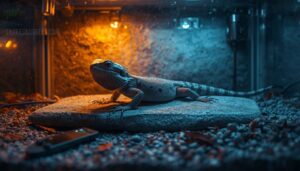
Reptiles don’t get sick slowly — when their environment goes wrong, their body follows fast. Unlike mammals, they can’t generate their own heat, so every internal process depends on what’s happening outside their enclosure.
That’s why keeping a close eye on temperatures is non-negotiable — a reptile thermometer guide for kids and beginners can help you catch dangerous drops or spikes before your animal even shows symptoms.
Here’s why temperature control matters more than most keepers realize.
How Temperature Controls Metabolism
Unlike mammals, your reptile has no internal thermostat — its metabolic rate is entirely driven by external temperature. Enzyme kinetics, ATP production rate, and mitochondrial efficiency all shift in lockstep with enclosure heat.
Hormonal energy regulation follows suit, coordinating digestion, immune response, and tissue repair. Thermal activity matching breaks down fast when temperatures drift — which is exactly why precise temperature monitoring and control aren’t optional.
Why Low Heat Slows Digestion
Drop the enclosure temperature, and digestion stalls almost immediately. Enzyme kinetics slow — your reptile’s gut can’t break down proteins, fats, or carbohydrates efficiently. Gut motility reduction follows, leaving food sitting longer than it should.
Blood flow redistribution away from digestive tissues compounds this. Thermal stress hormones further disrupt microbial fermentation decline in the gut. Temperature-dependent digestion doesn’t forgive fluctuations — temperature monitoring catches drops before constipation sets in.
How Overheating Causes Dehydration and Stress
Heat stress flips a dangerous chain reaction. Your reptile starts losing fluids through surface moisture — fluid loss mechanisms kick in fast, and electrolyte depletion follows when sodium and chloride leave with that water.
Cardiovascular strain builds as circulation struggles under reduced blood volume. Hormonal stress response surges, triggering cellular heat damage before visible symptoms appear.
Temperature monitoring — especially smart sensors — catches this spiral early, making preventive care genuinely possible.
Why Immune Function Drops With Temperature Drift
Temperature drift doesn’t just stress your reptile—it directly suppresses immune response through enzyme kinetics. When body temperature slips out of range, signal timing in immune pathways shifts, slowing activation and creating an Adaptive Immunity Delay that leaves your animal vulnerable.
Pathogen Proliferation accelerates. Microbiome Disruption weakens gut barriers.
Temperature monitoring with consistent sensor calibration catches this immune suppression window before a low-grade infection turns clinical.
Why Hatchlings Need Tighter Control
Hatchlings don’t have the body mass to buffer temperature swings the way adults do—and that’s the core problem. Low Thermal Inertia means heat loss happens fast, leaving little Recovery Time before digestion stalls and immune response weakens.
- Body Mass Constraints shrink the hatchling thermal window to just a few degrees
- Heat Shock Protein production spikes under heat stress, diverting energy from growth
- Microhabitat Choice depends on a stable gradient being available consistently
- Temperature monitoring catches overnight dips before lethargy sets in
- Temperature stability during the growth window directly shapes long-term health outcomes
Maintaining the optimal incubation temperature is critical for embryo health.
How Thermometers Catch Temperature Drift
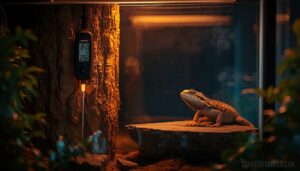
A thermometer doesn’t just tell you what the temperature is right now — it tells you what’s been happening while you weren’t watching.
Tracking humidity alongside temperature helps you catch the conditions behind a bad shed, and albino ball python care guides often highlight exactly why that pairing matters.
A thermometer doesn’t just read the present—it reveals everything that happened while you weren’t watching
Small drifts, equipment failures, and hidden cold zones rarely announce themselves until your reptile is already struggling. Here’s how consistent monitoring catches those problems early.
Spotting Day and Night Fluctuations
Most keepers check once a day and assume everything’s fine — but a single snapshot misses everything. Nighttime Low Peaks and Daytime Heat Spikes tell the real story, and only consistent temperature logging reveals them.
Substrate Heat Retention and Thermal Inertia Indicators mean your enclosure keeps drifting hours after lights-out.
Strategic sensor placement turns invisible temperature fluctuations into clear, actionable data — before your reptile starts showing it.
Finding Thermostat or Heater Failures Early
A failing thermostat rarely announces itself — it shows up in your data first. Watch for heater runtime patterns that stretch longer than usual, basking temperatures that never quite reach their setpoint, or rapid on/off cycling.
Power Supply Checks and Electrical Safety Interlocks rule out wiring issues fast. Redundant Heat Sources buy time when a primary unit fails silently.
Your thermometer catches it before your reptile does.
Detecting Hot Spots and Cold Zones
Not every thermal problem announces itself — some creep in quietly through uneven heat distribution.
Heat Distribution Mapping with digital probes reveals exactly where Thermal Hotspot Flagging and Cold Spot Identification matter most:
- Basking zone — Spot Temperature Sampling catches surface heat spikes above target range
- Mid-enclosure — Gradient Deviation Tracking flags thermal drift between zones
- Cool retreat — sensor placement confirms the escape zone stays within safe limits
Comparing Readings Across The Enclosure
Side-by-side Mapping tells you something a single thermometer never can — whether your temperature gradient design is actually holding. Multi-Probe Correlation across warm and cool zones reveals heat distribution analysis in real time.
Vertical Stratification Comparison matters too; heat stratifies, so probes at the same height give meaningful data. Temporal Temperature Tracking across heater cycles catches drift before your reptile feels it.
Warning Signs Before Illness Appears
Your thermometer data often flags trouble before your reptile does. Appetite Drop comes first — reduced food interest signals thermal stress before anything visible appears.
Lethargy Signs follow: slow movement, prolonged hiding. Then Diarrhea Onset from impaired digestion, Sunken Eyes from dehydration, and Breathing Changes from suppressed immune cell function.
Temperature drift quietly elevates stress hormone levels and opens the door to pathogen growth. Temperature monitoring closes it.
Where to Place Thermometers
Knowing what to measure matters — but so does knowing where to put the thermometer. reading from the wrong spot can give you false confidence while your reptile quietly struggles.
placements make the difference between data that helps and data that misleads.
Basking Zone Placement at Resting Height
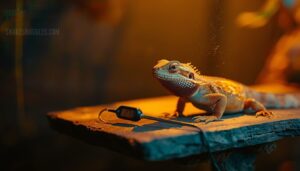
Place your thermometer at the exact height your reptile rests — not hovering in mid‑air above it. Basking area temperature is only meaningful when measured at the contact point.
Platform Dimensions, Basking Surface Materials, and Heat Source Distance all affect what your animal actually feels. Proper placement of reptile thermometers means accounting for Vertical Gradient Tuning and Secure Perch Positioning, so your basking spot reading reflects biological reality.
Cool-side Placement for Accurate Contrast
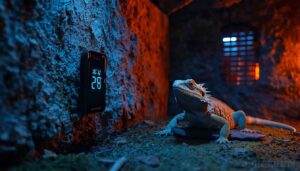
Your cool-side sensor belongs at your reptile’s actual resting height — not on the floor, not clipped to the wall. Sensor Height Consistency matters here: the same spot every day keeps your temperature gradient readings meaningful.
Watch for Airflow Interference from vents and Hide Proximity Effects that skew readings.
Proper placement of reptile thermometers on the cool side ensures real thermal contrast, not a false one.
Using Probes for Ambient Temperature Checks
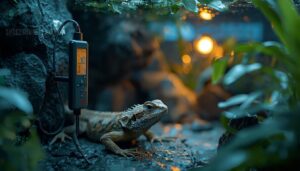
Once your cool-side contrast is established, ambient temperature probes tell the fuller story. A temperature probe measures actual air conditions at your reptile’s level — not just near heat sources.
Mounting Stability keeps readings consistent; a swinging probe drifts. Manage Cable Heat Management by routing cables away from basking lamps.
Watch for:
- Sensor Baseline Calibration drift affecting reptile health readings
- Battery Life Monitoring failures causing silent gaps in temperature monitoring
- Signal Interference Mitigation in sensor calibration for wireless units
Using Infrared Tools for Surface Readings
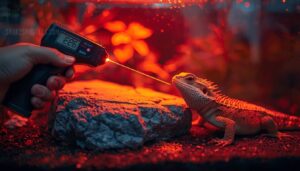
Probes handle the air — but surface temperature readings tell you what your reptile is actually sitting on. An infrared thermometer reads without contact, so you get instant basking spot data without disturbing your animal.
Keep Distance Consistency tight; a wider spot from farther away blurs hotspots. Mind Emissivity Settings for dark versus reflective surfaces, and use Scan Mode Optimization to catch uneven heating across rocks or pads.
Adjusting Placement for Arboreal Versus Terrestrial Reptiles

Where your reptile lives determines where your sensors go.
Arboreal species demand Branch Height Monitoring — a Vertical Thermometer Array tracking the Climbing Path Temperature from floor to canopy captures real microhabitat thermoregulation.
Terrestrial setups shift focus to Floor vs Canopy ground-level gradient accuracy.
Either way, placement of temperature probes for accurate readings must follow the animal, not the hardware — because Microclimate Zoning only works when sensors calibrate to actual behavior.
How Readings Prevent Reptile Illness
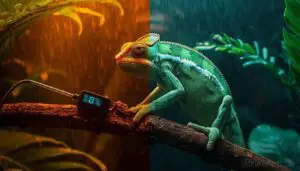
Getting the temperature right isn’t just about comfort — it’s what stands between your reptile and a cascade of preventable health problems. Every reading you take is a small act of protection, catching drift before it becomes disease.
Here’s what consistent monitoring actually defends against.
Maintaining Safe Thermal Gradients
stable temperature gradient isn’t optional — it’s the foundation everything else depends on. Without proper Heat Source Zoning and Cool Zone Insulation, your enclosure loses Microhabitat Diversity fast.
Thermal Gradient Monitoring through consistent sensor calibration catches temperature drift before it compounds. Gradient Width Design — ideally 1–1.5 meters — gives your animal real choice.
That choice is thermoregulation. Don’t remove it.
Supporting Healthy Digestion and Appetite
Feeding your reptile matters little if digestion can’t follow through. Temperature-dependent digestion means Enzyme Activity stalls the moment your thermal gradient slips — slowing metabolic rate, disrupting Meal Timing, and reducing Feeding Frequency over time.
Track these five through consistent temperature monitoring and logging temperatures:
- Basking duration before meals
- Post-feed behavior changes
- Hydration Status daily
- Stool consistency
- Weight Tracking weekly
Reducing Respiratory and Skin Problems
Stagnant air and temperature drift are a fast track to respiratory infections. When your enclosure swings between too warm and too cool, condensation builds — and that damp, stale microclimate is where bacteria thrive. Humidity Management and Airflow Optimization both depend on temperature monitoring staying tight.
| Problem | Thermometer Role |
|---|---|
| Respiratory infections | Detects drift causing damp cold zones |
| Skin Hydration Monitoring | Flags overheating that strips moisture |
Surface Temperature Uniformity prevents the hot-dry, cool-damp cycling that stresses skin shedding in reptiles. Mold Prevention follows naturally — stable heat means fewer condensation spikes. Temperature drift detection catches it before your reptile does.
Preventing Shedding Issues and Retained Skin
Shedding goes wrong faster than most owners expect. Humidity Control and consistent Soaking Access are only half the equation — temperature fluctuations quietly set the stage for shedding issues before skin even starts lifting.
temperature gradient lets your reptile move between zones and self-regulate through a predictable shedding cycle.
Temperature monitoring catches drift early, giving Retained Skin Prevention a real foundation before stuck patches become a circulation problem.
Protecting Growth in Young Reptiles
Hatchlings don’t get second chances the way adults do. Their hatchling thermal window is narrow — step outside it, and temperature-dependent digestion stalls, stress hormones spike, and immune cell function drops fast.
Weight tracking reveals these setbacks before they compound.
Pair temperature monitoring with your Feeding schedule, UVB exposure, Calcium supplementation, and Humidity control, and growth optimization becomes something you can actually measure.
Tools and Calibration That Help
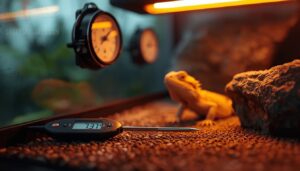
Getting accurate readings is only half the job — the tools you use and how well you maintain them determine whether those readings actually mean anything. A poorly calibrated thermometer or a single sensor in the wrong spot can give you false confidence while your reptile quietly struggles.
Here’s what to focus on.
Choosing Digital Probe and Infrared Thermometers
Two tools dominate reptile temperature monitoring — digital thermometers and infrared thermometers — and each does something the other can’t. Digital probes excel at ambient readings through direct contact; infrared thermometers give you instant, noncontact surface temperatures anywhere in the enclosure.
Prioritize measurement range, build quality, and a clear user interface.
For infrared models, verify emissivity adjustment capability and watch for probe drift detection in digital units.
Using Multiple Sensors for Better Coverage
One thermometer tells you a single story. Multiple sensors tell you the whole truth.
Sensor redundancy benefits you by catching zone-specific temperature drift before it reaches your animal — a mispositioned probe or failing heater shows up quickly when you’re running multi-height profiling across the basking and cool sides.
Using multiple thermometers for temperature gradients also allows data fusion analysis, confirming whether a reading reflects real enclosure conditions or sensor error.
Logging Temperatures to Spot Trends
Multiple sensors give you coverage — but turns that coverage into a timeline.
Set your data logger to record every 1–5 minutes. That interval analysis catches what a glance never will:
- Timestamp correlation links temperature drops to exact feeding or misting events
- Trend visualization exposes nightly cool-down patterns signaling heater degradation
- Anomaly detection flags thermostat overshoots before they become health crises
- Data averaging reveals chronic drift invisible in single-point readings
Recalibrating Devices for Accuracy
Trend data only holds up if your sensors are honest. Probe Tip Wear, loose mounts, and dropping Battery Voltage all quietly skew readings over time.
Run a calibration routine every 3–6 months — compare each probe against Calibration Reference Standards at a stable test point, perform Thermostat Setpoint Mapping to confirm heat cycles hit targets, then use Data Log Validation to verify temperature accuracy holds post-calibration.
Pairing Thermometers With Alerts and Backup Heating
Accurate readings mean nothing if no one acts on them. Pair your thermometers with Alert Threshold Settings and Smart Thermostat Integration so the system responds before you notice a problem:
- Temperature alarms push instant notifications via remote monitoring apps.
- Backup Heater Logic activates multiple heating sources automatically on drop.
- Automated Escalation Protocols separate minor drift from critical failure.
Multi-sensor Redundancy with smart sensors closes every blind spot.
Frequently Asked Questions (FAQs)
How does temperature affect reptiles?
As the old saying goes: an ounce of prevention is worth a pound of cure.
Reptile physiology runs entirely on external heat — get it wrong, and metabolic rate crashes, behavioral thermoregulation fails, and hormonal stress response follows fast.
What does a thermostat do for reptiles?
A reptile thermostat runs a continuous temperature feedback loop — monitoring, cutting power, restoring it — so setpoint regulation happens automatically.
Automatic heat cycling removes guesswork, and fail-safe shutdown prevents dangerous spikes before they harm your animal.
Can humidity affect reptile temperature readings?
Yes — humidity shifts readings through the Evaporation Cooling Effect, Condensation Sensor Bias, and Misting Airflow Influence.
Surface Moisture Impact and Humidity Driven Drift can skew your reptile thermometer, undermining temperature sensor accuracy and humidity regulation without warning.
How often should thermometer batteries be replaced?
Replace batteries every 6–12 months under regular usage frequency. Daily use shortens battery life to 3–6 months.
Watch for low battery indicators — sluggish readings signal failing power before temperature sensor accuracy drops completely.
Which reptile species need the widest thermal gradients?
Desert baskers, alpine reptiles, nocturnal specialists, burrowing species, and large-bodied reptiles all need the widest thermal gradients — their species-specific temperature requirements for reptiles demand broad ranges to support healthy reptile physiology through effective temperature monitoring.
Do substrate types influence enclosure heat distribution?
Absolutely. Substrate type shapes heat distribution in ways most keepers overlook.
Conductivity Variance, Moisture Retention Effects, Thickness and Mass, Porosity Impact, and Color and Reflectivity all shift your thermal gradient — making microclimate monitoring and smart heat source selection essential.
Are smart thermostats worth the cost for beginners?
For most beginners, smart thermostats offer real value — remote monitoring and automated alerts justify the initial investment.
Skip feature-heavy models early on. Basic digital control beats learning curve overwhelm every time.
Conclusion
It’s no coincidence that the reptiles thriving longest in captivity belong to owners who check temperatures daily—not because they’re lucky, but because they caught the drift before it became damage. Understanding how thermometers help prevent reptile illness isn’t about being cautious; it’s about being precise.
Your animal can’t tell you it’s cold. The thermometer does. Trust the reading, adjust before symptoms appear, and you stay ahead of every illness that temperature neglect invites.