This site is supported by our readers. We may earn a commission, at no cost to you, if you purchase through links.

Most household cleaners will hurt your reptile before the enclosure ever gets clean. Bleach off-gases chlorine that settles low—right at basking-shelf height—and those fumes linger far longer than the label suggests. The same goes for Pine-Sol, alcohol sprays, and scented wipes, which leave hormone-disrupting residue on every surface your animal touches.
Small spaces concentrate the problem. In a studio apartment with one cracked window, fumes persist far beyond their claimed dissipation time. Choosing the right reptile cleaning sprays for such environments isn’t optional—it’s critical to preventing slow, invisible poisoning.
The seven products below earn their place on this list.
Table Of Contents
Key Takeaways
- Common household cleaners like bleach, Pine-Sol, and alcohol sprays off-gas fumes and leave toxic residues at enclosure level—in a small apartment, that exposure is constant and cumulative, not occasional.
- Enzyme-based and probiotic sprays (like Absolutely Clean and No Scent) break down waste at the source, while oxidizer-based options like Oxyfresh act faster—knowing the difference helps you pick the right tool for routine cleaning versus odor control.
- Your cleaning routine matters as much as your product choice: daily spot cleaning, weekly wipe-downs, and monthly deep cleans each serve a distinct purpose, and skipping any tier lets pathogens and biofilm fill the gap.
- Surface compatibility isn’t optional—acrylic cracks under alcohol, PVC degrades with harsh disinfectants, and porous wood can’t be reliably sterilized, so matching your spray to the material protects both the enclosure and your animal.
7 Best Reptile Cleaning Sprays
Not every cleaning spray on the market is worth bringing into a small apartment with a reptile inside. These seven options earned their spots based on safety, surface compatibility, and how well they work in tight, low-ventilation spaces.
If you’re also navigating heat setup in a cramped space, reptile heat mats designed for apartment setups solve the same outlet and space problems without overwhelming your enclosure area.
Here’s what made the cut.
1. Oxyfresh Reptile Amphibian Terrarium Cleaner
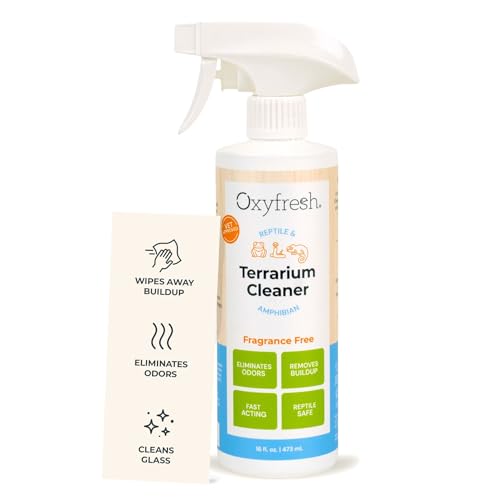
Oxyfresh earns its spot at the top for one straightforward reason: it’s built around stabilized chlorine dioxide—the same oxidizing agent used in the Oxyfresh Terrarium Cleaner line—which breaks down sulfur waste compounds directly rather than masking them with fragrance. Spray it on, wait two to three minutes, rinse, and you’re done.
It’s Leaping Bunny certified, free of bleach, dyes, and parabens, and safe across reptiles, amphibians, and fish. For a small apartment, that’s exactly the clean you need without the chemical overhead.
| Best For | Reptile, amphibian, and fish owners who want a quick, chemical-free way to keep their tanks clean and odor-free without worrying about harming sensitive pets. |
|---|---|
| Non-Toxic Formula | Yes, Leaping Bunny certified |
| Odor Elimination | Oxidizing agents break down odors |
| Surface Compatibility | Glass, acrylic, plastic, carpet |
| Spray Application | Yes, ready-to-use spray |
| Animal Safety | Safe for reptiles, amphibians, fish, cats |
| Product Volume | ~540 g / 1.19 lb |
| Additional Features |
|
- Breaks down pet waste odors at the source instead of just covering them up, so the enclosure actually smells fresh
- Leaping Bunny certified and free of bleach, dyes, and parabens—safe for a wide range of species including frogs, lizards, and fish
- Leaves glass and acrylic surfaces streak-free with a quick spray-and-rinse routine that takes just a few minutes
- Not a disinfectant, so it won’t replace a proper sanitizing cleaner when you need to eliminate pathogens
- Struggles with heavy mineral or hard-water deposits—you’ll need an acidic cleaner for that
- Some bottles have a small plastic component that can detach, so it’s worth giving the sprayer a quick check before use
2. Absolutely Clean Reptile Terrarium Cleaner Deodorizer
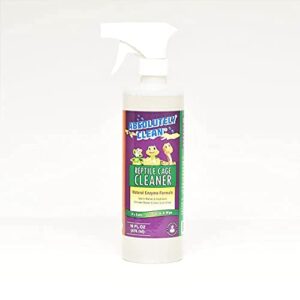
Absolutely Clean distinguishes itself from Oxyfresh’s chemistry-driven approach by using natural enzymes that physically break down protein-based messes like urate, shed skin, and waste, rather than oxidizing them.
The application process involves spraying the surface, waiting three to five minutes, scrubbing if necessary, and rinsing thoroughly with hot water. It is veterinarian-approved, free of bleach, sulfates, and caustics, and safe for use on glass, PVC, wood, and plastic.
Priced at $16.99 for 16 ounces, it costs more than generic alternatives. However, the formula earns it, justifying the premium with its effectiveness and safety profile.
| Best For | Reptile and amphibian owners who want a safe, chemical-free cleaner that actually tackles tough odors and protein-based messes without putting their pets at risk. |
|---|---|
| Non-Toxic Formula | Yes, veterinarian-approved |
| Odor Elimination | Enzyme formula eliminates odors on contact |
| Surface Compatibility | Metal, wood, glass, vinyl, plastic |
| Spray Application | Yes, spray-and-wipe |
| Animal Safety | Safe after full rinse and dry |
| Product Volume | ~0.52 kg / 1.15 lb |
| Additional Features |
|
- Natural enzyme formula breaks down waste, shed skin, and urate without harsh chemicals or fumes
- Vet-approved and safe for a wide range of surfaces including glass, wood, PVC, and plastic
- Works across multiple enclosure types — terrariums, amphibian tanks, small-mammal cages, and more
- At $16.99, it’s pricier than most generic cleaners on the market
- Animals must be fully removed before use, and the enclosure needs to be rinsed and dried before they can return
- Stubborn stains still need manual scrubbing — the spray alone won’t do all the heavy lifting
3. No Scent Reptile Odor Eliminator
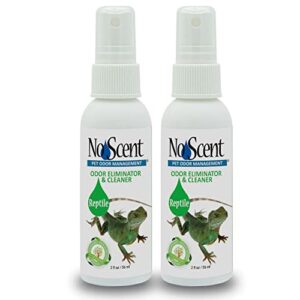
Where Absolutely Clean leans on enzyme chemistry, No Scent Reptile Odor Eliminator takes a different route—probiotics. The formula contains millions of non-pathogenic bacteria that activate on contact with waste, releasing enzymes that starve and eliminate odor-causing bacteria within seconds.
It’s pH-matched to common species like bearded dragons, geckos, and snakes, ensuring it won’t irritate their skin or senses. You can spray directly on substrates and decor without relocating your animal.
Two 2-oz bottles cost $12.99.
| Best For | Reptile owners who want a pet-safe, probiotic-based cleaner they can use without pulling their animal out of the enclosure. |
|---|---|
| Non-Toxic Formula | Yes, probiotic-based |
| Odor Elimination | Probiotic units neutralize odor at source |
| Surface Compatibility | Hard and porous surfaces, substrate, bedding |
| Spray Application | Yes, mist or spray |
| Animal Safety | Safe with animals present |
| Product Volume | 4 fl oz (two 2-oz bottles) |
| Additional Features |
|
- Probiotics and enzymes attack odors at the source instead of just covering them up
- PH-matched for common reptiles, so it’s safe to spray directly in the habitat
- Works on pretty much any surface—substrate, sand, decor, carpet, you name it
- Four ounces total goes fast if you’re maintaining more than one enclosure
- Stubborn messes might need a second application or some extra scrubbing
- The faint mint scent in the bottle could be a turn-off for scent-sensitive keepers, even if it fades after drying
4. No Scent Reptile Tank Cleaner
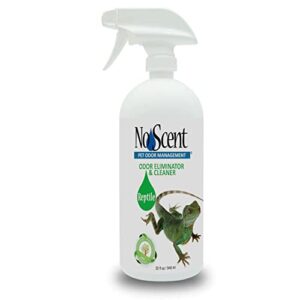
Same brand, different job. While the No Scent Odor Eliminator neutralizes smells at the microbial level, the No Scent Reptile Tank Cleaner focuses on surface maintenance—targeting waste, stains, and residue on enclosure walls, substrate, and décor.
The cleaner’s probiotic formula is pH-matched to reptile physiology, allowing safe use even with animals present. Simply mist it directly in the enclosure.
At $34.99 for a 32 oz spray bottle, it’s practical for daily revitalizing in apartment setups, avoiding chemical fumes buildup.
| Best For | Reptile owners who want a safe, animal-friendly cleaner they can use daily without moving their pets or worrying about harsh chemical exposure. |
|---|---|
| Non-Toxic Formula | Yes, biodegradable |
| Odor Elimination | Probiotic units neutralize odor at source |
| Surface Compatibility | Hard and porous surfaces, substrate, bedding |
| Spray Application | Yes, mist or spray |
| Animal Safety | Safe with animals present |
| Product Volume | 32 fl oz / 946 mL |
| Additional Features |
|
- PH-matched to reptile physiology, so it’s safe to spray directly in the enclosure without removing your animals
- Probiotic formula keeps working after it dries, making it great for daily upkeep between deep cleans
- Unscented and biodegradable—no chemical fumes, which is a real plus in smaller living spaces
- Only available in a single 32 oz size, which can go fast if you’re managing multiple enclosures
- Focuses on odor and surface maintenance, not disinfection—so it won’t tackle harmful pathogens
- Heavily soiled spots may need scrubbing or a second application to fully clear up
5. Dynamic Element Reptile Odor Eliminator Spray
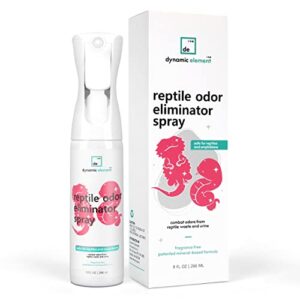
Active Element takes a different angle—mineral-based chemistry instead of probiotics or enzymes. The active formula targets protein-based waste odors at the molecular level, breaking them down rather than masking them. It’s completely fragrance-free, which matters in a small apartment where synthetic perfumes accumulate quickly.
The formula relies on stabilized chlorine dioxide—you can explore the full range of bleach-free reptile cleaning supplies built around the same odor-neutralizing chemistry.
The ready-to-use spray works directly on tank walls, substrate, hides, and hammocks without dilution. At 9 fl oz, the bottle is compact enough to be tucked beside your enclosure. Allow it to fully dry before returning your animal.
| Best For | Reptile owners in small spaces who want a fragrance-free way to knock out tank odors between deep cleans. |
|---|---|
| Non-Toxic Formula | Yes, certified non-toxic |
| Odor Elimination | Mineral-based ingredient targets protein odors |
| Surface Compatibility | Tank walls, substrate, sand, fabrics |
| Spray Application | Yes, ready-to-use spray |
| Animal Safety | Safe for reptiles and amphibians |
| Product Volume | 9 fl oz / ~266 mL |
| Additional Features |
|
- Mineral-based formula actually neutralizes protein odors instead of covering them up
- Safe to spray directly in the enclosure—no risk to your pet or you
- Works on pretty much any surface: walls, substrate, hides, hammocks
- Has to fully dry before your animal goes back in, which can be a hassle
- May not cut it if your tank is already heavily soiled
- Pricier than generic cleaners, which stings if you’re keeping up with regular cleanings anyway
6. DBDPet Reptile Terrarium Cleaner
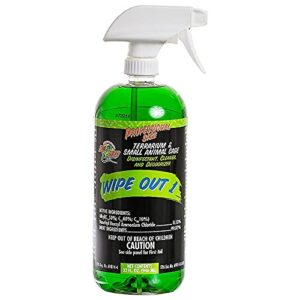
DBDPet’s terrarium cleaner is a dual-purpose antibacterial disinfectant and deodorizer in a 32 oz bottle. It is lab-tested against Salmonella and Pseudomonas aeruginosa, two pathogens commonly found in reptile enclosures.
To use, remove your animal and all substrate first, then spray surfaces and allow them to dry completely before reintroducing inhabitants. Some users note a mild Windex-like odor, so ensure proper ventilation by cracking a window if airflow is limited.
The packaging includes a Pro-Tip Guide to simplify application, eliminating guesswork for optimal results.
| Best For | Reptile and small-animal owners who want a reliable, lab-tested cleaner to keep terrariums and enclosures free of harmful bacteria and odors. |
|---|---|
| Non-Toxic Formula | Yes, pet-safe formula |
| Odor Elimination | Antibacterial deodorizer |
| Surface Compatibility | Terrarium and small-animal cage surfaces |
| Spray Application | Yes, spray bottle |
| Animal Safety | Safe after drying and ventilation |
| Product Volume | 32 fl oz / ~946 mL |
| Additional Features |
|
- Kills serious pathogens like Salmonella and Pseudomonas aeruginosa, so you’re not just masking germs — you’re actually eliminating them.
- Comes with a printed Pro-Tip Guide right on the packaging, which makes it easy to use correctly without digging through instructions online.
- Backed by a buy-back guarantee, so if it doesn’t work for you, you’re not stuck with it.
- Animals and all substrate have to be fully removed before each use, which adds time to your cleaning routine.
- Some users have reported leakage from the bottle, which could be messy to deal with.
- The mild Windex-like smell isn’t overwhelming, but you’ll still need good ventilation before putting your animals back in.
7. Zilla Terrarium Glass and Acrylic Cleaner
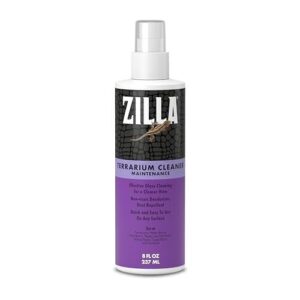
Zilla’s Glass and Acrylic Cleaner manages one job—keeping your viewing panels spotless—and it does that well.
The non-toxic, unscented formula delivers a streak-free shine with an anti-static finish that actively repels dust buildup between cleanings.
For best results, spray onto a cloth first, not directly into the enclosure, then wipe and let it dry—no rinsing needed.
At $6.13 for 9.6 oz, its compact size fits any shelf.
Just remember: it’s a surface cleaner, not a disinfectant.
| Best For | Reptile owners who want a safe, no-fuss way to keep their terrarium glass or acrylic panels crystal clear without worrying about chemical exposure to their pets. |
|---|---|
| Non-Toxic Formula | Yes, allergen-free |
| Odor Elimination | Anti-static deodorizing agents |
| Surface Compatibility | Glass, acrylic, hard non-absorbent surfaces |
| Spray Application | Yes, spray-on application |
| Animal Safety | Safe for reptiles and other pets |
| Product Volume | 9.6 oz / ~285 mL |
| Additional Features |
|
- Leaves a streak-free, anti-static finish that actually slows down dust buildup between cleanings
- Non-toxic and unscented, so it’s safe around reptiles and won’t bother sensitive noses—yours or theirs
- No rinsing needed, making quick cleanups genuinely quick
- Not a disinfectant, so you’ll still need a separate sanitizing product for a deep clean
- Some bottles reportedly come underfilled by around 25%, which stings a little at any price
- Needs to be sprayed on a cloth first rather than directly into the enclosure, adding a small but real extra step
What to Avoid
Not every cleaner in your cabinet is safe near a reptile enclosure—some are genuinely dangerous, especially in a small apartment where fumes have nowhere to go. A few common household products can harm your snake within hours of a single exposure.
Here’s what you need to keep off your cleaning shelf.
Bleach and Chlorine Gas Risks in Small Apartments
Bleach—sodium hypochlorite—is the wrong tool in a small apartment. Chlorine gas off-gassing occurs immediately upon contact with surfaces, and this gas sinks low, precisely where a reptile breathes. Poor ventilation allows rapid accumulation, exceeding exposure thresholds that harm reptile respiratory tissue. Residue crystallization on enclosure walls further compounds the risk.
If use is unavoidable, strict dilution guidelines and maximum airflow are non-negotiable. Always perform thorough cleaning before disinfection to ensure safety.
Quaternary Ammonium Residue on Enclosure Surfaces
Quaternary ammonium compounds—QACs, found in sprays like Lysol—appear effective on paper but create a hidden problem: residue persistence on glass, PVC, and porous materials like cork. Chemical residue testing often detects active compounds days after application. Material adsorption runs deep on textured surfaces, and rinsing efficacy is limited.
Chronic toxicity builds as reptiles lick treated walls, exacerbated by the difficulty of removing residues. This persistent exposure poses risks to animals interacting with treated surfaces.
Microbial disruption follows, favoring resistant strains over beneficial ones. The long-term ecological imbalance undermines sanitation efforts, as harmful microbes dominate environments stripped of natural microbial diversity.
Pine-oil Cleaners and Reptile Toxicity Concerns
Pine-Sol is a definite no for reptile enclosures. Its pine oil—loaded with terpenes like α-terpineol—causes respiratory irritation, dermal absorption, and neurotoxic effects in reptiles after even a single exposure. In small apartments, VOC accumulation lingers for hours after cleaning.
Reptiles lick surfaces repeatedly, making toxic residue avoidance critical. Stick to nontoxic cleaning solutions and safe disinfection practices for reptile enclosures instead.
Alcohol-based Sprays and Lingering Fumes
Rubbing alcohol—isopropyl alcohol specifically—feels like a quick fix for glass surfaces, but vapor toxicity is a real problem in small apartments. Ethanol concentrations can hit 6,000–8,000 ppb immediately after spraying, and fume accumulation in low-airflow spaces lingers for hours. Reptiles lack the enzymes to process these vapors, triggering respiratory irritation fast. Without serious ventilation strategies, that "clean" smell is quietly doing damage.
Rubbing alcohol’s clean smell in small apartments is quietly damaging reptile lungs with every spray
Scented Wipes That Leave Harmful Residues
Scented wipes seem convenient, but phthalate buildup from fragrance stabilizers absorbs through your reptile’s skin, disrupting hormones at surprisingly low levels.
Formaldehyde exposure follows—quaternium-15 releases it slowly over hours, posing additional risks.
Surfactant films trap bacteria, while microfiber contamination adds plastic particles your snake may ingest.
For chemical residue safety, always choose a fragrance-free, nontoxic cleaning solution instead.
Why Strong Household Cleaners Are Worse Indoors
Strong household cleaners create VOC accumulation that lingers for hours—exacerbating indoor air pollution, which already carries two to five times more pollutants than outside. Spray cleaners accelerate this degradation rapidly.
Poor ventilation further traps chlorine gas off-gassing and surface residue in confined spaces like apartments. This stagnation intensifies exposure risks.
Respiratory irritation in reptiles can set in before you notice anything wrong—a critical danger of indoor air pollution that most keepers underestimate.
Apartment-Friendly Spray Features
Not every cleaning spray is built for tight spaces—and in an apartment, the wrong formula can cause more problems than the mess you’re cleaning up.
The features that matter most come down to how a spray behaves in a confined room, not just what it does to bacteria. What to look for before you buy includes factors like ventilation safety, surface compatibility, and residue control in small spaces.
Fragrance-free Formulas for Low-ventilation Spaces
In a small apartment, fragrance is a fume problem waiting to happen. Low-ventilation rooms trap off-gassing hazards fast—even "light" scents accumulate quickly.
Fragrance-free pet cleaning sprays built on Enzyme Action, Oxidizing Cleaner, or Mineral Deodorizer technology neutralize waste at the molecular level without releasing VOCs. These solutions prioritize safety for sensitive environments.
Low VOC formulas with Rapid Evaporation profiles—under 0.1% volatile emissions—are genuinely nontoxic alternatives to bleach and ammonia, keeping air safe for sensitive pets and keepers alike.
Targeted Spray Bottles for Controlled Application
The right bottle matters as much as what’s inside it. An adjustable nozzle lets you switch from fine mist to stream control instantly—broad coverage for weekly wipe-downs, pinpoint accuracy for spot waste.
A precision dip tube draws every last drop at any angle, while an ergonomic trigger cuts hand fatigue during routine maintenance.
Aerosol reduction keeps overspray off nearby furniture—critical in tight living spaces.
Non-corrosive Cleaners for Glass, PVC, and Plastic
Your enclosure materials cannot all take the same hit. Glass panels, PVC walls, and acrylic fronts each react differently to harsh chemicals—so surface compatibility isn’t optional.
- pH-neutral formulas prevent glass etching and keep acrylic clear
- Alcohol-free compositions stop micro-cracking on plastic and PVC
- Chlorhexidine spray and vinegar cleaning offer noncorrosive, reptile-friendly cleaning agents for every surface type
Low-residue Formulas That Dry Cleanly
Sticky residue in a small apartment isn’t just annoying—it’s a slow-building hazard. Formulas based on Volatile Chlorine Dioxide and Enzyme Self-Degradation leave no greasy residue once they dry. Simply spray and rinse, and you’re done.
| Formula Type | Residue Behavior | Dry Time |
|---|---|---|
| Chlorine Dioxide | Volatile Chlorine Dioxide breaks down to water and salt | Under 5 minutes |
| Enzyme-based | Enzyme Self-Degradation eliminates organic traces | Under 5 minutes |
| pH-Neutral | pH-Neutral Drying protects surfaces | Under 5 minutes |
That Zero Film Finish means no film left behind on glass or PVC—just clean, Minimal Moisture Residue surfaces. The formulas are fast-acting and eco-friendly by design.
Fast-drying Options for Quick Enclosure Upkeep
Time matters when your reptile needs its home back fast. Thin-film Sprays and Quick-evaporation Solvents cut drying time after disinfection to under 15 minutes—sometimes 5—on glass and PVC.
- Ventilation Boost from one small fan reduces dry time by 30–50%
- Contact Time Reduction means spray and rinse, no soaking required
- Temperature-Assisted Drying speeds evaporation without heat lamps interfering
- Fast-acting, nontoxic formulas leave no film left behind
Compact Bottles That Are Easy to Store
Storage space in a small apartment is currency—spend it wisely. Flat Bottle Design formats slide neatly against walls, while a Collapsible Silicone Bottle folds flat once empty. Lightweight Plastic Materials keep bins manageable, and Leak‑Proof Caps prevent spills near pet supplies. Clear Size Labels enable quick identification in tight cabinets.
| Bottle Feature | Why It Matters |
|---|---|
| Flat Bottle Design | Wastes no shelf space |
| Collapsible Silicone Bottle | Folds flat when empty |
| Lightweight Plastic Materials | Easy to store overhead |
| Leak‑Proof Caps | Safe near electronics and fabrics |
| Clear Size Labels | Quick identification in tight cabinets |
Oxyfresh Terrarium Cleaner, Zilla’s Terrarium Cleaner, and Exo Terra’s Terrarium Decor Cleaner all come in compact formats—practical, safe cleaning products for exotic pets that support non-toxic terrarium cleaning without cluttering your space.
Safe Cleaning Routines
A good spray means nothing without a routine behind it. How you clean—and when—makes the difference between a healthy enclosure and one that looks clean but isn’t.
Here’s what a practical schedule actually looks like in a small apartment setup.
Daily Spot Cleaning for Waste and Feeding Messes
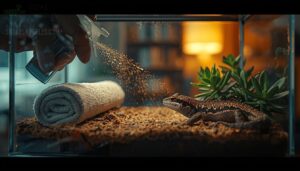
Spot clean daily — no exceptions. Feces left even a few hours accelerates microbial growth, leading to prevention failures quickly.
Use a litter scoop for solid waste, then a plastic card for urates removal. Paper towel blotting lifts fresh messes without smearing.
Follow with Zilla’s Terrarium Cleaner or Oxyfresh, allowing spot spray to sit for 2–3 minutes.
Remove uneaten feeding debris before bacteria colonize overnight.
Weekly Spray-and-wipe Maintenance for Small Enclosures
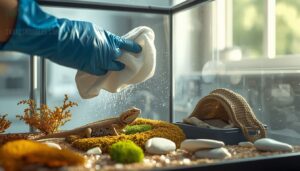
Daily spot cleaning manages the visible mess, but a weekly spray-and-wipe stops biofilm and mineral buildup. Every seven days, move your reptile to a secure container, then clean top-to-bottom across glass, PVC, and plastic hides. Timing consistency matters—keeping the same day weekly makes surface prioritization automatic.
Spray Oxyfresh Terrarium Cleaner or HOCl onto a cloth, not directly into the enclosure. Prioritize ventilation strategies by opening a window. Allow surfaces to dry fully before returning your animal to the habitat.
Monthly Deep Cleaning for Non-bioactive Setups
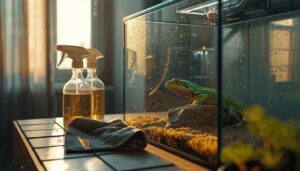
Weekly maintenance holds the line, but non-bioactive setups need a full reset monthly—or every two to three months for low-waste species.
Pull all substrate for disposal, scrub surfaces with Zilla’s Terrarium Cleaner or Exo Terra’s Glass Cleaner, then apply Oxyfresh Terrarium Cleaner with proper disinfectant contact time.
Ventilation control matters here—crack a window. Equipment air-drying and post-clean humidity checks close the process.
Safe Drying Time Before Returning Your Snake
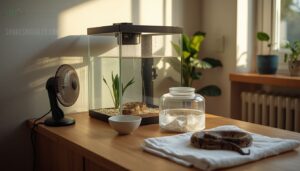
After proper drying time after disinfection, do not rush the return—it protects your snake more than the cleaning itself.
Specific drying requirements include:
- Glass walls: 15 minutes with microfiber
- Plastic decor: 30 minutes air-dry minimum
- Ceramic bowls: 45 minutes to prevent pooling
- Porous hides: 2–4 hours, overnight if possible
Run surface dryness checks, enhance airflow with a fan, and monitor humidity. Return items only when zero chemical scent remains.
Cleaning Water Bowls, Hides, and Decor
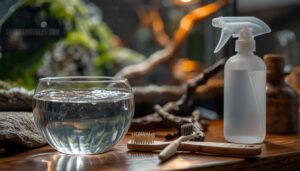
Once your surfaces are fully dry, shift attention to the individual accessories—each one needs a customized approach.
| Accessory | Method | Tool |
|---|---|---|
| Water Bowl | Temperature Rinse + targeted nozzle spray | Dedicated brush |
| Hides | Hide Soak + Residue Inspection | Nylon brush |
| Decor | HOCl spray dwell 2–5 min | Soft-bristled toothbrush |
Brush selection matters: never share tools between items.
When to Use Soap, Spray Cleaner, or Both
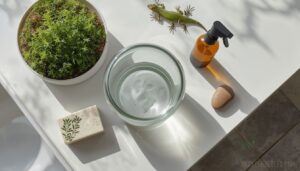
Your choice between soap, a cleaning spray, or both comes down to four factors: Light Soil Build‑up, Pathogen Presence, Surface Material, and Ventilation Constraints.
For routine smudges, soap alone manages the job.
Confirmed illness or parasites demand a safe disinfectant for reptile enclosures after soaping.
Glass and PVC tolerate both; porous wood gets soap only.
When Ventilation Constraints limit airflow, prioritize choosing nontoxic cleaning agents for reptiles for a safe quick turnaround.
Choose The Right Spray
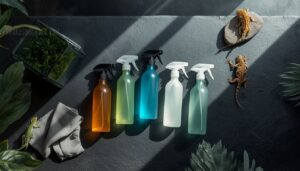
Not every spray does the same job, and the gap matters more than most keepers realize. The sections below break it down by what you actually need—routine cleaning, glass tanks, sensitive animals, and real-world cost.
Find your situation, match it to the right product, and you’re set.
Odor Control Versus True Enclosure Cleaning
These aren’t the same job. An odor neutralizer—enzyme versus oxidizer—targets smell; a cleaner removes the waste causing it. Enzymes digest ammonia proteins over days, while oxidizers like Oxyfresh act instantly. Odor control alone allows microbial load reduction to stall, letting pathogens hide in crevices.
Masked odors return within 24 hours if waste remains. Fragrance-free formulas reduce air quality implications in low-ventilation apartments. Residual odor persistence signals incomplete cleaning, not product failure. Long-term health effects worsen when reptile-friendly cleaning agents are not paired correctly.
- Masked odors return within 24 hours if waste remains
- Fragrance-free formulas reduce air quality implications in low-ventilation apartments
- Residual odor persistence signals incomplete cleaning, not product failure
- Long-term health effects worsen when reptile-friendly cleaning agents are not paired correctly
Best Options for Routine Apartment Use
For routine apartment use, three options cover most needs. Oxyfresh’s stabilized chlorine dioxide spray manages daily spot cleaning—no rinse required, dries in under five minutes.
A diluted chlorhexidine solution serves as a Chlorhexidine Quick-Dry option for weekly wipe-downs, safe on PVC and plastic.
Round out your kit with a probiotic spot cleaner for organic waste between deeper cleans. Choosing nontoxic cleaning agents for reptiles doesn’t get more practical.
Best Sprays for Glass and Acrylic Tanks
Glass and acrylic tanks each have specific needs. Exo Terra’s Glass Cleaner gel tackles stubborn hard water removal and lime stains without scratching. Zilla’s Terrarium Cleaner delivers a streak-free finish with an anti-static coating that slows dust re-accumulation—particularly useful in small apartments.
Oxyfresh Terrarium Cleaner works safely on both surfaces with its acrylic-safe formula.
All three qualify as safe cleaning products for reptiles.
Best Picks for Sensitive Snakes and Keepers
Some snakes—and their keepers—simply can’t tolerate harsh chemicals. Respiratory safety and skin irritation aren’t minor concerns; they’re dealbreakers. Here are four reptile-safe products built for chemical sensitivity considerations:
- Oxyfresh — low VOC, fragrance-free, broad species compatibility
- No Scent Odor Eliminator — probiotic cleaning that targets ammonia at the source
- Absolutely Clean — enzyme-based allergen reduction, rinses residue-free
- No Scent Tank Cleaner — ready-to-use; choosing nontoxic cleaning agents for reptiles has never been simpler
Surface Compatibility Before You Buy
Not every spray plays well with every surface—and using the wrong one can crack acrylic, corrode mesh, or compromise silicone seals before damage is noticed.
| Surface | Compatible Options |
|---|---|
| Glass panels | Oxyfresh, Zilla, Exo Terra Gel |
| Acrylic (scratch-sensitive) | Oxyfresh, Zilla—avoid abrasives |
| PVC/plastic | Chlorhexidine, F10SC—skip alcohol |
| Screen mesh | 3% hydrogen peroxide, fragrance-free sprays |
Check labels for acrylic-safe and silicone seal compatibility before buying.
Value, Bottle Size, and Refill Practicality
Surface compatibility narrows your shortlist—now cost per ounce and bottle longevity close the deal. Mid-size 500–750 ml bottles hit the sweet spot for shelf space optimization in tight apartments.
Oxyfresh Terrarium Cleaner and Zilla’s Terrarium Cleaner both offer refill savings through concentrate formats, cutting long-term spend. Prioritize trigger durability—a clogged sprayer wastes product fast.
A quick cost analysis of reptile disinfectants often reveals refillable systems win.
Frequently Asked Questions (FAQs)
Is Dawn dish soap okay for reptiles?
No. Dawn dish soap isn’t reptile-safe—methylisothiazolinone and phenoxyethanol leave residue toxicity on surfaces, pose inhalation risks, and cause skin irritation. Vets recommend safe disinfectants for reptile enclosures instead.
Can I clean a bioactive enclosure with spray?
Yes, but only on hard surfaces. Use enzyme sprays or HOCl sprays on glass and décor—never the substrate. Microfauna safety depends on substrate protection from all disinfectants.
How do reptile sprays affect isopods and springtails?
Most reptile sprays hit isopods and springtails hard — quaternary ammonium residues alone can wipe 70% of populations within days. Oxyfresh is the rare exception, sparing microfauna at proper dilutions.
Which disinfectants kill Cryptosporidium in reptile tanks?
Only a few disinfectants reliably kill Cryptosporidium: 6% hydrogen peroxide, F10 CL, peroxygen blends, and steam sterilization. Each requires strict contact time.
Bleach, Chlorhexidine Solution Nolvasan, and Hydrogen Peroxide 3% won’t cut it.
Is steam cleaning safe for terrarium components?
Steam cleaning works well on glass, as its heat tolerance withstands high heat without issue. However, watch silicone seam integrity; direct steam degrades old seals.
Plastic warping risks are real, as materials may deform under steam exposure.
Wood moisture retention makes full sterilization unreliable, as prolonged dampness compromises effectiveness.
How often should I deep clean after illness?
Illness-driven timelines vary: strip the enclosure within 24 hours of a parasite diagnosis, every 72 hours during active digestive issues, and weekly for four weeks post-viral exposure.
Conclusion
A beekeeper wouldn’t spray pesticide near a hive and call it maintenance—the same logic applies here. Your reptile can’t crack a window or leave the room. Every product choice you make inside a small apartment lands directly in their air, on their skin, and on every surface they press against.
The confined space means every product choice has direct consequences. What you use to clean their habitat isn’t just a convenience upgrade—it’s essential for their survival.
The right reptile cleaning sprays for small apartments are the difference between a thriving animal and one quietly absorbing harm with every breath.