This site is supported by our readers. We may earn a commission, at no cost to you, if you purchase through links.

One wrong grab and a nonvenomous rat snake can still leave you bleeding, tagging your hand as prey instead of threat. Hooks exist for exactly this reason, keeping your fingers out of striking range while giving you control over an animal that reads sudden movement as danger. Most bite injuries happen not from venom but from poor technique: grabbing too close to the head, or hesitating mid-lift.
Knowing how to pick up a snake with a hook means understanding the animal’s body language before your equipment even touches it. Get the approach wrong, and the best hook in the world won’t save you from a strike. Get it right, and you’ll move a snake with the same steady confidence a farrier shows a nervous horse.
Table Of Contents
- Key Takeaways
- Use a Hook With Full-Body Support
- Choose The Right Snake Hook
- Prepare Yourself and The Handling Area
- Position The Hook Under The Snake
- Lift and Support The Snake Slowly
- Set Down and Clean Up Safely
- Frequently Asked Questions (FAQs)
- How are you supposed to pick up a snake?
- What tool is used to pick up snakes?
- How to use a snake hook correctly?
- Do snake grabbers hurt snakes?
- What gloves work best for snake handling safety?
- Should you wear eye protection while handling snakes?
- What are snake gaiters and why use them?
- Are aluminum or steel snake hooks better overall?
- Is handling wild snakes legal in my area?
- Conclusion
Key Takeaways
- Always confirm a snake’s species and watch its body language before you ever bring a hook near it, since most bites come from poor technique, not venom.
- Match your hook’s length and width to the snake’s size, and use two hooks together for longer or heavier snakes to keep weight and control balanced.
- Slide the hook under the front third of the body, never the head or tail, and lift straight up slowly so the snake can drape naturally without feeling trapped.
- Have a secure, ventilated container ready and your escape route clear before you approach, then finish by disinfecting your hook and washing your hands thoroughly.
Use a Hook With Full-Body Support

A hook keeps your hands out of striking range, but it only works if you follow the right groundwork first. Before you ever touch a hook to scales, you need to know what you’re dealing with and where that snake is headed next. Here’s what to check before you make your move.
If your grip is smaller than average, this guide to choosing the right snake hook for small hands walks through the handle length and lift capacity you’ll want to check first.
Handle Only Known Nonvenomous Snakes
Before your snake hook ever touches a body, confirm the species. Identify venomous traits like triangular heads, vertical pupils, or heat pits, and never assume based on color alone.
- Confirm species visually at a safe distance
- Use reliable ID guides for your region
- Consult local experts when unsure
Handling a nonvenomous snake demands certainty, not guesswork. Avoid risky assumptions entirely. Even among harmless species, defensive tactics like mimicking rattlesnake tail vibrations can cause handlers to mistake a nonvenomous snake for a dangerous one, so proper identification remains essential.
Watch for Defensive Warning Signs
ID confirms species, but the snake’s mood still calls the shots. Watch for a coiled alarm posture, flattened neck, or gaping mouth, all signs it’s ready to strike.
Tail thrashing, body tremors, and hissing mean back off. If it’s tucked against cover with limited escape path, give it room, cornered snakes bite fast.
Prepare a Secure Destination
Before that hook ever touches scales, know where the snake’s headed. Set up your escape-proof container with a vented lid, latched and locked, on a stable, level surface, away from clutter and direct sunlight. A pillowcase works for short transport, but a rigid container beats it for real security.
Never Hook Unknown Wild Snakes
That container’s useless if you can’t safely get the snake into it. If you can’t identify the species from a safe distance, stop. Don’t approach, don’t corner it, and don’t reach for a hook.
Visual species identification comes first, always. No ID, no hook. Retreat down your escape path and call your local wildlife professionals instead.
Choose The Right Snake Hook

Not every hook works for every snake, and grabbing the wrong one can cost you control fast. Your gear needs to match the animal in front of you, from length to width to weight capacity. Here’s what to check before you ever step toward the snake.
If you’re unsure where to start, this guide on using a snake hook for enclosure cleaning breaks down sizing and technique in more detail.
Match Hook Length to Snake Size
Picking the wrong length is like wearing boots two sizes off, you’ll fumble the whole job.
Proper hook sizing starts with body length ratio: 24-36 inches for snakes under 3 feet, 36-48 for 3-6 footers, 48-60 for anything bigger. This hook length matching keeps your grip ergonomic and your control steady from the first lift.
Use Wider Hooks for Heavy Bodies
A heavy-bodied python or boa needs more than length, it needs surface.
Wider hooks distribute weight across the midsection, cutting focal pressure that could snag scales.
Go stainless steel for strength and corrosion resistance.
Rounded edges cradle the body without digging in, giving you steady midsection support while the snake drapes naturally during the lift.
Before you even reach for the hook, check signs your snake is ready for handling so the whole lift stays low-stress for both of you.
Reserve Mini Hooks for Hatchlings
Tiny snakes need tiny gear.
Mini hooks under 12 inches suit hatchlings under 2.2 lb, looping gently under the body without compressing the spine. The blunt tip won’t snag delicate scales, and lightweight aluminum construction resists fatigue. Pair the hook with gloves for scent control, and always work over a tray in case the hatchling struggles free.
Consider Two Hooks for Large Snakes
One hook rarely cuts it once a snake outgrows your reach.
For large snakes, dual hook coordination matters: a steel hook holds the front third, while a second controls tail support technique at the rear. This balanced lift prevents coiling and keeps hook weight distribution even.
Steel hooks handle load limits near 25 lbs, so choose wider hooks for heavy-bodied snakes.
Inspect Hooks Before Every Use
A weak hook fails fast, so check yours before every trip out.
Run your fingers along the shaft for rust detection, then check the coating integrity and grip. Look for bend deformation near the shank, since a warped hook won’t hold weight right. Confirm load rating validation for the snake’s size, and wipe away dust or oil before use.
Prepare Yourself and The Handling Area

Picking up the snake is only part of the job, your prep work matters just as much. Before you ever touch that hook, you need your body, your space, and your gear all set up right. Here’s what to check before you make a move.
Wash Away Food and Prey Scents
Smell like the last meal you fed a rodent-eater and you’re asking for trouble. Snakes strike by feeding response, not malice, so soap and warm water on hands and gear matters before you ever reach for a hook.
- Wash with soap and warm water
- Air dry gear naturally
- Use charcoal absorption on containers
- Sprinkle baking soda on surfaces
Never handle a snake showing digestive stress indicators; post-feeding regurgitation risk is real.
Clear Obstacles and Escape Routes
Clean gear won’t save you if you trip mid-retreat. Before you approach, walk your space: clear pathways, working floor markings, functional lighting checks. Identify a clear escape route in two directions, not one.
| Check | Why It Matters |
|---|---|
| Clutter removed | Faster retreat |
| Exit accessibility | No blocked doors |
| Lighting checks | Prevents tripping |
| Multiple routes | Backup direction |
Approach slowly, safe distance, maintain visual contact, step backward slowly if needed.
Ready a Secure Ventilated Container
Your escape route means nothing if you’ve got nowhere to put the snake. Set up your secure container before approach, not after.
- Rigid polycarbonate body resists punctures
- Vented lid with one-way filters keeps air flowing
- Snug gasket controls humidity and odor
Confirm the latch holds firm without over-tightening, and check that clear side panels let you monitor without opening.
Keep Movements Calm and Predictable
With the container ready, your own body language matters just as much. Snakes read motion, not intention, so a steady pace and calm voice keep stress low.
Move your hands slowly, space out each action, and monitor your breathing. Predictable movements near the handling zone stop sudden darting before it starts.
Position The Hook Under The Snake
Once your area’s clear and your gear’s ready, it’s time to get the hook under the snake itself. This is where precision matters most, since a clumsy approach can spook the snake or throw off your control. Follow these steps in order to get it right.
Approach Slowly From The Side

Snakes read the world through vibration, so a straight-on charge reads as a threat every time. Approach from the side, small steps, steady pace, staying in its peripheral view without triggering a strike.
- Keep a safe distance matching your hook length
- Watch for coiling or hissing
- Step back if it tenses
- Maintain your escape route
- Move with calm, quiet purpose
Touch The Body Gently First
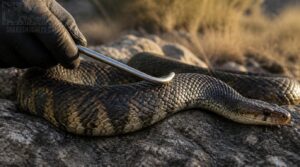
Before sliding the hook underneath, make first contact with the curved surface, not the tip. Rest it lightly along the midbody anchor, one third back from the head, using even pressure application and gentle downward pressure reducing force.
Watch for tensing or arching. If the snake stays relaxed, you’re clear to slide the hook smoothly along the scale alignment next.
Slide Under The Front Third

Once the snake stays relaxed, slide the hook smoothly beneath the front third of its body, just behind the head, for proper body alignment and midbody pickup.
- Keep gentle contact throughout the slide
- Move slowly to avoid startling
- Apply gentle downward pressure reducing force
- Let the body settle into natural drape
- Confirm head is angled away from people
This controlled lift sets up a balanced, safe capture.
Avoid The Head and Tail

Where you place the hook decides whether this stays calm or turns chaotic. Never grab a snake by the head, jaw clamping and sudden thrashing follow fast. Keep the head angled away from people at all times.
Skip the tail too. Grabbing near the tip invites writhing and escape attempts, throwing off balance control right when you need a smooth, gentle lift.
Keep The Hook Facing Upward
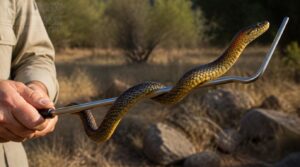
Angle matters more than most handlers think. Keep the hook tip pointing up as it passes under the body, this hook angle consistency uses gravity-assisted control to cradle the snake naturally against the shaft.
An upward angle protects scales, prevents slipping, and keeps the head safely away from your hands, that’s the whole point of the body cradle method.
Lift and Support The Snake Slowly

Once the hook is set, the lift is where control really gets tested. Your hands, your pace, and your next few moves all matter here. Here’s exactly how to raise and support the snake without spooking it.
Raise Smoothly Without Sideways Motion
Straight up, steady, done: that’s the whole trick to a clean lift.
- Keep lift alignment vertical, no drifting sideways
- Hold even pressure at the midbody
- Rise in smooth increments, pausing to check trajectory
- Watch the head for strike posture
- Keep contact constant until controlled release
A steady ascent beats a fast one every time. Rushed lifts spook snakes and invite trouble.
Let The Body Drape Naturally
A rigid snake fights you. A relaxed one just settles.
A rigid snake fights you, but a relaxed one simply settles into place
Once lifted, don’t force straight lines. Let the natural drape technique take over so the body curves along the hook on its own terms. Keep your grip loose, your protective gear on, and let gentle body alignment happen naturally, weight spread evenly, spine unbothered, coils forming soft and loose instead of tight and defensive.
Support Longer Snakes With Another Hook
One hook rarely spans a long snake’s full length. That’s when dual hook coordination earns its keep.
- Add a second hook under the mid to hind body
- Anchor the midbody with steady scale contact
- Balance the center of gravity between both points
- Guide the posterior smoothly, no hand tailing needed
This keeps weight distribution even and control steady throughout the lift.
Never Squeeze or Pin The Snake
Two hooks give you control, but pressure ruins it. Keep contact gentle, never pinning or pressing down.
Let the spine curve naturally along the hook. A loose grip beats a tight one, tight holds cause scale damage and panic. Support the midbody ventral scales without squeezing, guide sideways rather than pushing down, and always leave a clear escape path.
Move Directly Toward The Container
Once the body settles on the hook, approach calmly, steadily, no zigzagging. Maintain hook alignment, parallel to ground, snake draped naturally. Make sure container ready, latch open, ventilation clear, before you move.
Avoid sudden movements that spook the animal mid-transfer. Guide it directly over the opening, then confirm snake entry fully before lowering the hook away.
Set Down and Clean Up Safely

Getting the snake into the container is only half the job. What you do in the next few minutes matters just as much for your safety and the animal’s wellbeing. Here’s how to finish the process the right way.
Lower The Snake Before Removing Hook
Getting the snake down is just as important as picking it up. Once you reach the container, lower slowly, keeping the hook angled to control the snake’s descent. Ease gentle downward pressure until the body settles fully inside, then reassess balance before hook release timing, sliding the hook smoothly free without snagging scales, confirming full release.
Confirm The Container is Secure
A latched lid isn’t proof of anything. Check the lid, seams, and any vents for gaps a nose or tail could wedge through.
For permanent or repeated use, confirm seal integrity with the serial number logged during installation, so tamper detection stays traceable.
Only trust the container once you’ve fully verified it, temporary or secure, before walking away.
Clean and Disinfect The Hook
A dirty hook carries bacteria from one snake to the next, so don’t skip this step.
Rinse off debris first, then spray a mild soap solution and wipe the shaft clean, working into joints and grooves. Apply an EPA-registered disinfectant for the label’s full contact time, rinse again, and let it air dry completely. Finish with a light mineral oil coat.
Wash Hands With Soap and Water
Once the snake’s secure, turn to your own hands. Wet them under clean, running water, work in soap, and scrub for a full 20 seconds, covering nails, between fingers, and wrists. Time it by humming "Happy Birthday" twice. Rinse, then dry vigorously with a paper towel. This step guards against bacteria picked up during reptile handling.
Contact Professionals for Unknown Snakes
Not sure what’s slithering in your yard? Don’t guess. Call animal control or a reptile specialist trained to handle unknown snakes.
Keep distance from the snake, describe its location clearly, and follow responder instructions once they arrive. Verify wildlife permits before hiring anyone.
Professional snake removal keeps you, your family, and the snake safe.
Frequently Asked Questions (FAQs)
How are you supposed to pick up a snake?
Pick it up right by sliding a hook under the midbody anchor, one third from the head, then lift steadily at 2-4 inches per second. Keep contact gentle, movement controlled, and the container ready.
What tool is used to pick up snakes?
Bare hands won’t cut it here. A snake hook, a lightweight shaft with a curved head, lets you lift safely from a distance. Hook length, grip comfort, material durability, and visibility all matter for safe capture.
How to use a snake hook correctly?
Grip the hook properly, slide it under the front third, staying clear of the strike zone. Use a gentle lifting motion, let the body drape, and support longer snakes with the hookandtail method for steady, damage-free control.
Do snake grabbers hurt snakes?
Can a tool built to help actually cause harm? Not when used right. Proper hook contact and gentle lifting technique spread pressure along the body, avoiding compressed ribs and reducing the force that leads to injury.
What gloves work best for snake handling safety?
Go with puncture-resistant gloves blending leather and Kevlar, snug enough for dexterity, gauntlet-length for forearm coverage. Check ANSI ISEA 105 ratings, inspect before each session, and never trust thin fashion gloves for real reptile handling safety.
Should you wear eye protection while handling snakes?
Yes, treat it like a seatbelt: non-negotiable. Wear ANSI Z1 rated eyewear that seals snugly, guarding against venom splash and debris. Clean lenses after every handling session, and swap them out the moment they’re scratched.
What are snake gaiters and why use them?
Snake gaiters cover ankle to knee, using puncture-resistant layers like 600D nylon over boots and pants.
Wear them alongside puncture-resistant gloves whenever you enter snake habitat, ensuring a snug fit and regular maintenance for reliable protective gear.
Are aluminum or steel snake hooks better overall?
Picture wrestling a fire hose that bites back: that’s a heavy snake on a flimsy aluminum hook. For load capacity, steel wins, though aluminum’s lighter weight eases handler fatigue during long sessions outdoors.
Is handling wild snakes legal in my area?
Local wildlife laws vary widely. Check state wildlife statutes for permit requirements, since protected species and venomous snake restrictions differ by jurisdiction. When unsure, call a licensed reptile specialist or your local wildlife agency before handling anything wild.
Conclusion
A thousand snakes could pass through your hands, and one bad grab is all it takes to teach you humility. That’s why how to pick up a snake with a hook isn’t just technique, it’s discipline.
Slow hands, steady eyes, and a hook held with purpose turn a nervous animal calm. Respect the warning signs, master the approach, and every lift becomes routine instead of risky.
Confidence comes from practice, not luck.