This site is supported by our readers. We may earn a commission, at no cost to you, if you purchase through links.

Watch a rattlesnake stretched across a sun-warmed boulder at dawn and you’re witnessing something far more calculated than it looks. That snake isn’t lounging—it’s working, pulling heat from the rock’s surface the way a battery draws a charge, calibrating its body temperature with a precision most people never associate with reptiles.
Cold blooded snake warmth isn’t a contradiction in terms. It’s a finely tuned biological strategy where behavior replaces the internal furnace that mammals rely on. A snake’s muscle function, digestion, immune response, and even its ability to detect a mate all hinge on hitting the right thermal window—usually somewhere between 28 and 34°C.
Understanding how snakes find, absorb, and regulate that heat changes how you see them entirely.
Table Of Contents
- Key Takeaways
- Are Snakes Really Cold-Blooded?
- Why Snakes Need Warmth
- How Snakes Find Heat
- How Snakes Avoid Overheating
- Snake Warmth and Metabolism
- Brumation During Cold Weather
- Pet Snake Heating Basics
- Frequently Asked Questions (FAQs)
- Do cold-blooded snakes need heat?
- Is there a cold-blooded snake?
- Can snakes sense temperature changes in prey?
- Do snakes warm each other by physical contact?
- How does altitude affect a snakes body temperature?
- Can snakes regulate warmth during swimming or diving?
- Do snakes in captivity lose natural thermoregulation instincts?
- Conclusion
Key Takeaways
- Snakes aren’t passively cold — they actively hunt for the right temperature by shuttling between sun-soaked rocks, shaded soil, and underground burrows with remarkable precision.
- Heat isn’t comfort for a snake; it’s the engine behind every biological process, from digesting a meal to fighting off infection and completing a clean shed.
- When winter hits, snakes enter brumation — a state distinct from mammalian hibernation where they can briefly wake to drink on warm days, driven by environmental cues rather than internal metabolic controls.
- Whether you keep a pet snake or simply observe wild ones, understanding their thermal needs reveals that every behavior is a finely tuned survival calculation, not sluggishness.
Are Snakes Really Cold-Blooded?

The term "cold-blooded" gets thrown around a lot, but it tells only half the story of how snakes actually manage their body temperature. Unlike you, a snake’s internal warmth is entirely borrowed from its surroundings — and that changes everything about how it lives. Here’s what’s really going on beneath the scales.
This dependency on external heat sources shapes nearly every behavior a snake displays, from basking to hunting — and it also explains why some regions have evolved landscapes with no native snake populations at all.
Ectothermy Explained Simply
Think of a snake’s body as a living thermometer — its temperature rises and falls with the world around it. That’s ectothermy in action.
Here’s what that means biologically:
- No internal furnace generates heat
- Body temperature mirrors the environment
- Body mass stores thermal energy like a capacitor
- Metabolic rate runs roughly 1/7th that of mammals
- Warmth must come from external environment through basking or conduction
These animals rely on external sources of heat to regulate their body temperature.
Why Cold-blooded is Misleading
The label "cold-blooded" is genuinely misleading. Snakes don’t passively accept whatever temperature surrounds them — they actively hunt for warmth through behavioral thermoregulation, shuttling between sun-soaked rocks and cool shade with real precision.
Snakes don’t accept their temperature — they hunt for it, shuttling between sun and shade with precision
That word "cold" implies sluggish, fixed, even inferior. But ectothermic reptilian physiology is a finely tuned system, not a limitation — one that operates across a surprisingly wide thermal range.
Body Temperature Changes
Your own body temperature holds steady around 36.5 to 37.5°C, even when your environment shifts dramatically — your hypothalamus controls that automatically.
A snake’s body temperature, by contrast, tracks directly with ambient temperatures, rising and falling with every microclimate it enters. That’s ectothermic physiology in practice: no internal thermostat, just biology shaped entirely by the heat around it.
Heat From Surroundings
Since a snake’s temperature tracks its surroundings, the heat sources available to it define everything. Snakes rely on several overlapping mechanisms:
- Radiative heat absorption from sun-warmed rocks and dark soil emitting infrared energy
- Convective airflow channeled through sheltered microclimate air pockets
- Substrate thermal conductivity transferred directly through ground contact
- Surface color influence — dark substrates radiate far more heat than pale ones
Together, these pathways make behavioral thermoregulation remarkably precise.
Why Snakes Need Warmth

Warmth isn’t just comfort for a snake — it’s the engine that keeps every biological process running.
Use this boa habitat temperature control guide to create the stable thermal gradient your snake needs for digestion, immunity, and activity.
Without the right temperatures, a snake can’t properly digest food, move efficiently, fight off illness, shed its skin, or even reproduce. Here’s a closer look at exactly why heat plays such a critical role in each of these areas.
Digestion and Metabolism
Warmth isn’t a luxury for snakes — it’s the engine that drives digestion and metabolism. Without adequate heat, the enzymes your snake’s body releases to break down proteins and fats simply can’t function efficiently.
Pepsin needs the right thermal conditions to cleave proteins into peptides, and pancreatic enzymes stall in cold tissue. A meal can rot rather than nourish.
Movement and Hunting
Temperature dictates every strike. When muscle tissue cools, lateral undulation slows, reaction time drops, and a snake that would otherwise ambush prey with precision becomes sluggish and exposed.
At just the right warmth, sensory systems sharpen — the tongue flicks faster, Jacobson’s organ processes scent trails more efficiently, and infrared heat detection in pit vipers locks onto warm-bodied prey with unsettling accuracy.
Immune System Support
Heat doesn’t just power movement — it actively helps immune cell function. Without sufficient body temperature, a snake’s pathogen defense mechanisms weaken a lot, leaving it vulnerable.
Thermoregulation helps sustain:
- White blood cell circulation
- Cytokine signaling efficiency
- Skin barrier integrity
- Gut microbiome balance
- Stress hormone regulation
Cold-stressed snakes face suppressed immunity, making consistent basking far more than a simple comfort.
Without adequate warmth, a snake’s defenses weaken quickly — understanding the full effects of heat deprivation on snake health helps owners recognize early warning signs before sluggishness or appetite loss sets in.
Healthy Shedding Cycles
Shedding isn’t just skin-deep — your snake’s thermal environment directly governs how cleanly each shed completes. When body temperature drops below the preferred range, the follicle-like structures beneath scale layers can’t cycle efficiently, producing patchy, incomplete sheds.
| Shedding Condition | Temperature Factor |
|---|---|
| Clean, full shed | 28–34°C sustained warmth |
| Stuck shed (dysecdysis) | Insufficient ambient heat |
Consistent basking keeps the process on track.
Reproductive Activity
Reproduction demands more from a snake’s body than almost any other life event. Pheromone detection, ovulation timing, and sperm storage duration all depend on sustained warmth to function correctly.
Without adequate heat, the hormonal signals that trigger courtship and egg incubation environments never fully activate — meaning your snake’s fecundity is directly tied to the thermal conditions you provide.
How Snakes Find Heat
Snakes are surprisingly resourceful at tracking down warmth — and their methods go well beyond simply lying in the sun.
Each strategy they use reflects an almost instinctive understanding of their environment, down to the exact surface or patch of light that will serve them best. Here are the key ways snakes find the heat they need.
Basking in Sunlight

Sunlight is a snake’s most reliable heat source. As an ectothermic animal, it depends entirely on solar radiation to reach its preferred body temperature. Diurnal species usually bask between 10 AM and 2 PM, when warmth rises steadily without dangerous peaks. Key benefits include:
- Full-spectrum infrared warming
- Rapid surface temperature gains
- Access to thermal microclimates within sun patches
Resting on Warm Rocks

Rocks do what sunlight can’t sustain — they store heat through rock thermal mass and release it steadily for hours. An ectothermic snake pressed against warm stone absorbs warmth through radiation and conduction simultaneously, a far more efficient exchange than ambient air alone.
| Rock Trait | Why It Matters |
|---|---|
| Dense, dry surface | Stable heat diffusion without burn risk |
| Medium to large size | Broader contact area for warmth transfer |
Behavioral strategies like choosing the right surface aren’t random — they’re precision thermoregulation.
Choosing Heated Surfaces

Wild snakes don’t choose randomly — they read thermal cues and select surfaces that match their physiological needs precisely. In captivity, replicating this means offering clear options:
- Radiant panels — direct infrared warmth transferred to exposed skin
- Heat mats — uniform substrate heating beneath the snake’s body
- Heated rocks — stored warmth released slowly through conduction
- Ceramic heaters — steady, shielded output without dangerous hot spots
- Heating cables — floor-level warm zones supporting digestion
Moving Between Microclimates

Surfaces alone don’t tell the whole story. Snakes are constantly reading their environment as ectothermic navigators, shifting between sun-warmed rock, shaded vegetation, and humid soil depressions throughout a single day.
These microtopography heat pockets can differ by several degrees Celsius across just a few meters, giving a snake precise thermal control without ever generating its own warmth.
Flattening for Heat Absorption

Once a snake locks onto a warm patch, it doesn’t just sit there — it actively shapes itself to pull in more heat. By flattening its body, it maximizes surface area gains, pushing more skin against the heat source and boosting contact interface efficiency dramatically.
This flattening trick is exactly how the European adder survives near the Arctic Circle, as detailed in this guide to how snakes adapt to extreme cold habitats.
This behavioral adaptation works through:
- Increased thermal flux density at the contact zone
- Enhanced micro-convection effects along the warmed surface
- Improved geometry heat transfer from external heat sources
- Faster body warming through ectothermic basking strategies
How Snakes Avoid Overheating
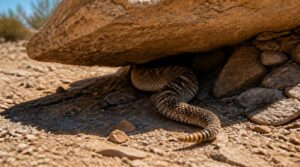
Finding warmth is only half the equation — knowing when to escape it is just as important. Snakes are surprisingly skilled at reading their environment and pulling back before things get dangerously hot. Here are the key ways they keep their body temperature from tipping over the edge.
Seeking Shade
When the sun climbs too high, shade becomes a snake’s most critical thermal refuge. Shaded microclimates can run several degrees cooler than exposed ground — enough to prevent fatal overheating above 36°C.
You’ll find snakes tucked beneath dense canopy cover, leaf litter, or rock overhangs, where microclimate temperature differences give precise control that no amount of basking can offer.
Hiding Underground
Below ground, a snake finds something shade alone can’t offer — subterranean thermal stability that barely shifts regardless of what the surface temperature does.
Camouflaged den entrances hidden beneath roots or debris lead into burrow systems where soil insulation benefits buffer extreme heat. Four reasons snakes go underground:
- Stable cool microclimates
- Natural tunnel exploitation via root channels
- Burrow ventilation shafts maintain breathable air
- Concealment from predators
Soaking in Water
Water offers snakes a fast, reliable reset when ambient temperatures push past safe limits. Immersion pulls heat from the body center, dilates peripheral blood vessels, and eases muscle tension — all without any metabolic expenditure.
For ectotherms, this behavioral adaptation is elegantly efficient: the environment does the work. Even brief soaks help stabilize center temperature before tissue damage becomes a real risk.
Reducing Daytime Activity
Between 11 am and 3 pm, ambient temperatures can exceed a snake’s preferred range by 6 to 12 degrees Fahrenheit — enough to trigger heat stress. Staying still isn’t laziness; it’s precision.
Daytime inactivity cuts metabolic heat gain by up to 35 percent, preserving hydration and reducing predator exposure until cooler, safer windows return.
Cooling Body Posture
Posture is a snake’s quietest thermostat. When heat climbs past comfortable thresholds, lateral surface contact with cool shade or soil pulls warmth away from its body through direct conduction.
Flattening the body simultaneously maximizes heat dissipation to surrounding air, while lowering the head reduces cranial heat intake — three precise adjustments working in concert to hold temperature within survivable range.
Snake Warmth and Metabolism

Warmth isn’t just about comfort for snakes — it’s the engine that keeps every biological process running. Temperature directly shapes how efficiently a snake burns energy, digests food, and moves through the world. Here’s a closer look at exactly how heat and metabolism work together.
Low-energy Survival Strategy
Snakes are truly masters of doing more with less. Because their ectothermic metabolic rate runs at roughly one-seventh that of a comparable mammal, they don’t need to eat often — or move much.
Your average snake conserves energy through minimalist movement and passive warming, letting the environment do the heavy lifting while its body quietly maintains the biological minimum needed to survive.
Digestion Raises Metabolism
That low baseline shifts sharply the moment a meal arrives. Enzyme activity surges, and the metabolic rate can quadruple as the body works to process prey.
- Glucose fuels immediate muscle activity
- Proteins supply amino acids for tissue repair
- Fats deliver gradual, sustained energy intake
- Nutrient absorption rates pace overall energy release
- Post-meal energy spikes demand elevated body temperature
Without sufficient warmth, digestion stalls entirely.
Cold Slows Body Functions
When ambient temperature drops, the cascade is immediate. Metabolic rate crashes because, as an ectothermic animal, your snake’s body temperature tracks its environment directly — and metabolic slowdown isn’t subtle. Reduced nerve conduction dulls sensory signals; slower enzyme activity stalls digestion. Decreased muscle force and cardiac output decline follow. Diminished sensory processing compromises temperature regulation, rendering the snake effectively inert.
| Body Function | At Ideal Warmth | In Cold Conditions |
|---|---|---|
| Nerve conduction | Rapid and responsive | Slowed, reflexes dulled |
| Enzyme activity | Efficient digestion | Near-stalled processing |
| Muscle force output | Full contraction strength | Much lower |
| Cardiac output | Normal circulation | Declined blood flow |
| Sensory processing | Sharp and accurate | Diminished and sluggish |
Warmth Supports Activity
Flip that picture around. When your snake reaches its preferred body temperature, enzyme activity accelerates, glycolysis efficiency climbs, and the nervous system signaling that controls strike timing sharpens considerably.
Muscle endurance follows — warmer tissue contracts more fully and recovers faster. For an ectothermic animal whose metabolic rate is tightly coupled to external heat, basking in direct sunlight isn’t leisure; it’s physiological preparation.
Energy Conservation Benefits
That efficiency carries a broader payoff. An ectothermic metabolic rate running at roughly 1/7th of a mammal’s means your snake doesn’t burn resources it hasn’t earned — every calorie consumed goes toward long-term growth, tissue repair, or reproduction rather than constant internal heating.
These behavioral adaptations in thermoregulation strategies effectively make the snake’s energy budget self-balancing, sustaining survival across resource-scarce conditions without compromise.
Brumation During Cold Weather
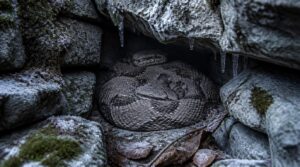
When winter arrives, snakes don’t just slow down — they basically press pause on life itself through a process called brumation. It’s not quite the same as hibernation, and understanding the difference tells you a lot about how remarkably adapted these animals are to surviving the cold. Here’s what actually happens when temperatures drop.
Brumation Versus Hibernation
Most people call it "hibernation" — but snakes don’t hibernate. They brumate.
Brumation versus hibernation hinges on one key difference in physiology: ectothermic snakes rely on environmental temperature triggers, while endothermic mammals use internal metabolic controls to sustain dormancy.
- Brumating snakes wake briefly to drink on warm days
- Hibernating mammals endure longer, uninterrupted torpor
- Hibernation demands far greater fat energy storage
Slower Breathing and Heart Rate
During brumation, a snake’s resting metabolic rate collapses to a fraction of its active baseline. Breathing slows dramatically, triggering vagal activation that pulls heart rate down through parasympathetic nervous system dominance — an autonomic balance shift that suppresses energy expenditure and preserves fat reserves across months.
| Brumation Metric | Change During Dormancy |
|---|---|
| Breathing rate | Drops to near-minimum breaths |
| Heart rate | Reduced via vagal activation |
| Metabolic processes | Fall to survival-only levels |
| Baroreflex sensitivity | Enhanced, stabilizing circulation |
| Energy expenditure | Sustained by stored fat reserves |
This respiratory sinus arrhythmia pattern — where heart rate couples tightly with each slow breath — reflects deep autonomic balance, keeping the snake alive without a single meal.
Underground Winter Shelters
When temperatures drop far enough to threaten survival, snakes retreat into communal underground hibernacula — shared shelters where thermal mass stability buffers against freezing conditions that would otherwise prove fatal.
These refuges rely on layered insulation and moisture barriers to maintain viable interior conditions across months of dormancy, while structural soil support and wind-shielded entrances preserve the stable microclimate snakes depend on entirely.
Occasional Winter Basking
Even deep in brumation, some snakes seize a clear winter morning to slip out and absorb what warmth they can.
Morning sun intensity peaks fast on bare rock or sun-warmed soil, allowing an ectothermic body to gain several degrees within 5 to 20 minutes — enough to sustain digestion and restore basic activity readiness before retreating to nearby thermal refuges.
Species Differences
Not every snake brumates on the same schedule. Garter snakes may be dormant for just two months, while some vipers endure eight.
These differences trace back to body size, scale pattern insulation, and sensory organ sensitivity to thermal cues. Larger species with greater heat capacity as ectotherms stay dormant longer, whereas smaller snakes respond faster to warming conditions and resume behavioral adaptations sooner.
Pet Snake Heating Basics

Keeping a pet snake healthy starts with getting the temperature right inside its enclosure. Unlike wild snakes that can roam freely to find warmth, your snake depends entirely on you to recreate those conditions. Here’s what you need to know to set things up properly.
Proper Temperature Gradients
Think of your enclosure as a thermal landscape your snake navigates by instinct. A well-designed gradient spans roughly 12 to 20°F between zones, giving your ectothermic snake meaningful choices rather than a single ambient temperature.
Without that range, behavioral thermoregulation breaks down — your snake can’t self-regulate, and temperature fluctuations become stressors instead of tools. Infrared thermometers confirm surface accuracy where digital sensors fall short.
Warm Side and Cool Side
Your enclosure needs two distinct thermal zones, not just one ambient setting.
- Digestion zone (warm side, 28–32°C): raises body temperature to support metabolism after feeding
- Recovery zone (cool side, 22–26°C): slows the ectothermic body between meals
- Thermal zone access: unobstructed paths between zones enable natural behavioral adaptations
- Enclosure gradient stability: a thermostat keeps surface temperature monitoring consistent
Safe Heat Sources
Selecting the right heat source shapes how well your snake can thermoregulate.
| Source | Benefit |
|---|---|
| Heat mat | 28–32°C beneath-enclosure warmth |
| Infrared panel | Radiant heat, no contact burns |
| Ceramic or hydronic | Even warmth, zero hotspot risk |
| Electric hot plate | GFI outlet required; surface risk |
As ectothermic animals, snakes depend entirely on external heat sources, making source selection a direct behavioral adaptation tool.
Thermostats and Monitoring
Choosing the right heat source is only half the equation — without a thermostat, you’re guessing. Digital sensor accuracy of ±0.5°C means your snake’s enclosure stays within its preferred thermal range consistently.
Wi-Fi models send remote app alerts the moment temperatures drift, while real-time data logging tracks patterns over days. Some units include automated safety shutoffs, cutting power before dangerous heat builds up.
Signs of Temperature Stress
Even with a thermostat running, your snake can still signal distress. Watch for abnormal heart rhythms, labored breathing, or persistent restlessness — signs that body temperature has drifted from the thermal optimum.
Skin elasticity changes, where lifted scales don’t retract smoothly, indicate dehydration from heat exposure. A snake pressing flat against the cool side isn’t exploring — it’s coping.
Frequently Asked Questions (FAQs)
Do cold-blooded snakes need heat?
Snakes survive solely by sourcing warmth from their surroundings. As ectothermic animals, they depend entirely on external heat sources to drive metabolism, digestion, and movement — making heat not a comfort, but a biological necessity.
Is there a cold-blooded snake?
Yes, every snake species is ectothermic — relying entirely on external heat sources rather than generating metabolic heat internally. There’s no such thing as a warm-blooded snake.
Can snakes sense temperature changes in prey?
Yes — through infrared pit organs, snakes detect the heat signature of warm prey with astonishing precision, sensing temperature differences as small as fractions of a degree to form a thermal image guiding accurate strikes.
Do snakes warm each other by physical contact?
Physical contact between snakes transfers heat passively — a byproduct of proximity, not affection. When temperatures drop, conspecific contact helps ectothermic thermal regulation, but the behavior is driven entirely by physiological need, not social bonding.
How does altitude affect a snakes body temperature?
Picture a mountain slope where thin air bites cold. At elevation, altitude oxygen constraints shrink a snake’s thermal window, slowing metabolic suppression and forcing longer basking bouts on sun-warmed rocks just to reach a functional body temperature.
Can snakes regulate warmth during swimming or diving?
When submerged, snakes rely on aquatic thermal exchange through their skin and cloacal regions to manage warmth. Cooler water slows stroke rate and reduces metabolic demand, while warmer water boosts locomotor performance and diving endurance.
Do snakes in captivity lose natural thermoregulation instincts?
No, captive snakes retain thermoregulation instincts but adapt to artificial cues. They still shuttle between warm and cool enclosure zones, demonstrating that behavioral ectothermy persists — though microclimate variety shapes how precisely those instincts express.
Conclusion
The next time you spot a snake coiled on sun-warmed stone, you’ll recognize the precision behind that stillness. Cold-blooded snake warmth isn’t a limitation—it’s an elegant solution refined across millions of years.
Every basking session, every retreat into shade, every sluggish winter pause has a biological purpose you now understand. That knowledge reshapes how you observe, keep, or simply appreciate these animals. They’re not surviving despite the cold. They’re mastering it.