This site is supported by our readers. We may earn a commission, at no cost to you, if you purchase through links.

A snake that can’t find proper cover stops eating, sheds poorly, and burns energy on chronic stress—even in an otherwise perfect enclosure. The hide isn’t decorative. It’s the psychological anchor of the entire setup.
Bioactive setups raise the stakes. Live substrate, cleanup crews, and fluctuating humidity create conditions that destroy the wrong hide within months—warped wood, crumbling seams, mold colonies thriving beneath a ball python that won’t come out. Choosing the wrong material doesn’t just compromise aesthetics; it dismantles the biological stability you built.
The right snake hide boxes for bioactive setups balance thermal mass, moisture resistance, and species-appropriate sizing. What follows breaks down exactly which materials hold up, how to size and place each type, and how to keep them functioning long-term.
Table Of Contents
Key Takeaways
- In a bioactive setup, the hide’s material—cork, ceramic, resin, or PVC—determines whether your living ecosystem thrives or quietly collapses under mold and moisture damage.
- Sizing isn’t flexible: snake’s hide must fit snugly around its girth, with species, sex, and life stage all shifting the exact dimensions that separate a calm snake from a stressed one.
- Placement drives thermoregulation—a warm-side hide over your heat source becomes a digestion chamber, while a cool-side hide and a humid hide together give your snake a genuine behavioral choice.
- Consistent maintenance—spot-cleaning waste immediately, keeping humidity below 60% between sheds, and replacing any cracked or compromised hide without delay—is what keeps the whole bioactive system stable long-term.
Best Bioactive Snake Hide Types
Not every hide earns a place in a bioactive setup — the material, shape, and design have to work with your cleanup crew, not against them. The good news is that a handful of hide types consistently hold up in living ecosystems, each with its own edge depending on your snake’s needs and your enclosure’s layout.
For a deeper breakdown of what actually works in practice, snake hides for bioactive enclosures covers material choices and design considerations that keep your living setup thriving long-term.
Here are the five best options to explore.
Cork Bark Rounds
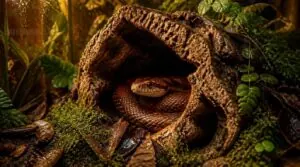
Few hide options integrate as seamlessly into a bioactive enclosure as cork bark rounds. Harvested from sustainably managed cork oak forests, each piece forms a natural tunnel without cutting or shaping — the hollow interior is ready to use.
That cellular structure also makes cork naturally mold-resistant, a genuine advantage in high-humidity setups where snake hide boxes often fail first. Its buoyancy also makes cork one of the lightest woods used in vivarium design.
Resin Rock Caves
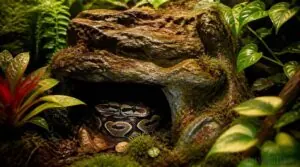
Where cork leans on natural origin, resin rock caves earn their place through engineered precision. Polyresin durability means these hides resist cracking, fading, and moisture damage that would compromise ceramic or wood alternatives over time.
Textured surfaces mimic crevices and ridges convincingly, so moss and substrate merge right against them. Small interiors — 3–5 cm — fit hatchlings snugly, while larger variants reach 12 cm for adults.
Ceramic Hide Boxes
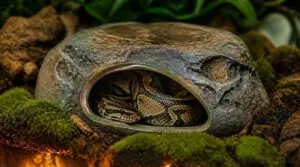
Ceramic trades resin’s lightweight flexibility for something more grounded — literally. Thermal mass stability means temperature swings near heat mats barely register inside, keeping your snake’s microclimate consistent without constant adjustment.
- Glazed surfaces resist mold and wipe clean with 70% isopropyl alcohol
- Substantial weight prevents tipping when snakes burrow near entrances
- Rock textures integrate naturally with bioactive moss and substrate
Inspect glaze regularly; chips harbor bacteria fast.
PVC Humid Hides
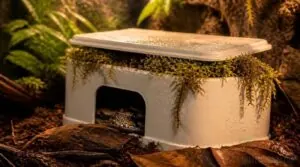
Where ceramic relies on mass, PVC humid hides rely on precision. Nonporous resin walls lock moisture in, maintaining 70–90% relative humidity for consistent shed support without soaking surrounding substrate.
| Feature | Benefit | Maintenance |
|---|---|---|
| Smooth interior | Easy wipe-down | 70% isopropyl alcohol |
| Removable lid | Quick moss refresh | Weekly rinse |
| Sealed seams | Stable humidity control | Inspect monthly |
Interior sizing matters — snug fit reduces stress fast.
Buried Tunnel Hides

Buried tunnel takes bioactive vivarium design a step further by placing entrances below substrate level, mimicking natural burrows with real functional depth.
Internal chambers sit 2–6 inches down, creating stable humidity pockets that misting cycles can’t easily disrupt.
Microfauna move freely around the structure, and gradual entry slopes keep snake movement smooth — no snags, no stress.
Choose Safe Hide Materials
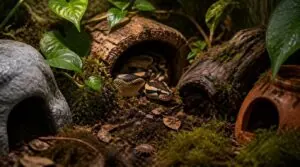
Material choice is the foundation of a safe, long‑lasting bioactive setup — get it wrong and you’re fighting mold, off‑gassing, or structural failure down the line.
Choosing breathable, inert substrates also helps maintain the stable humidity levels your snake needs — poor material choices can disrupt thermoregulation just as much as a faulty heat source, so it’s worth brushing up on signs your setup may be affecting your snake’s health.
Not every hide belongs in a bioactive enclosure, and knowing what to look for saves you time, money, and stress on your snake.
Here’s what actually matters when evaluating hide materials.
Mold-Resistant Surfaces
Moisture is the silent enemy of any bioactive hide. Non-porous surfaces — ceramic coatings, epoxy finishes, and fluorinated hydrophobic layers — block water ingress before mold can establish a foothold.
Ceramic-coated hides are particularly hard-wearing; they don’t absorb humidity even after repeated disinfection cycles. Paints with biocide additives take it further, actively suppressing fungal spores on the surface itself rather than just resisting water.
Non-Toxic Plastics
Not all plastics are created equal. For bioactive hides, HDPE and polypropylene are your benchmarks — both absorb virtually no moisture and tolerate reptile-safe disinfectants without degrading. Polypropylene’s thermal stability makes it especially reliable near heat mats.
Avoid additives: phthalate-containing formulations carry real chemical leaching risks that accumulate in humid microclimates. Stick with certified, additive-minimal polymers and your cleanup crew stays safe.
Natural Cork Benefits
Cork isn’t just decorative — its suberin-based antimicrobial barrier actively resists mold in humid bioactive enclosures. That cellular structure also buffers moisture swings, keeping humidity stable between sheds without saturating surrounding substrate.
Cork’s suberin barrier resists mold while its cellular structure keeps humidity stable between sheds
Thermal insulation slows heat transfer across temperature gradients, reducing stress during day-night cycles. Harvested every nine years without felling the tree, cork remains one of the most sustainable choices in any naturalistic enclosure build.
Ceramic Cleaning Advantages
Ceramic hides earn their place through sheer practicality. Nonporous surfaces resist bacterial buildup, staining from bioactive substrates, and microbial growth when kept dry — no absorption means nowhere for pathogens to hide.
They’re also compatible with reptile-safe disinfectants and even ultrasonic cleaning, surviving repeated cycles without pitting or warping. Surface abrasion durability means scrubbing won’t compromise fit or finish over time.
Avoid Porous Wood
Wood is a trap. Porous surfaces absorb moisture readily, creating conditions where biofilm and mold colonize fast in high-humidity bioactive setups.
Watch for these risks:
- Material warping from humidity fluctuations
- Biofilm growth in open pore structures
- Mold colonizing porous surface crevices
- No reliable moisture barrier effectiveness
Stick to polypropylene hides or nonporous alternatives instead.
Match Hides to Snake Size
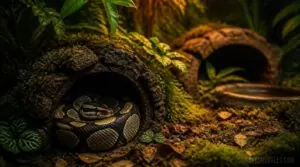
Getting the size right isn’t optional — it’s the foundation of a stress-free enclosure. A hide that’s too roomy leaves your snake feeling exposed; too tight, and entry becomes a struggle. Here’s what to look for across five key sizing factors.
Snug Interior Fit
The hide should fit your snake like a firm handshake — close, not crushing. Girth-based sizing drives every decision here.
| Stage | Interior Diameter | Entrance Width |
|---|---|---|
| Hatchling | Girth + 5–8 mm | 1.25–1.75 in |
| Juvenile | 1.2–1.5× girth | Rounded, smooth edges |
| Adult | Widest girth + clearance | 2.5–3 in |
Smooth interior surfaces prevent mucous membrane irritation and support microclimate consistency. Low ceilings let your snake curl without contact stress, eliminating the anxiety that loose-fitting snake hide boxes consistently create.
Hatchling Hide Dimensions
Hatchlings need even tighter tolerances. Target an interior length of 2.5–3.5 inches, height of 1.5–2 inches, and entrance width of 0.75–1 inch — small enough to block drafts, wide enough for clean entry.
- Ideal interior volume keeps body temperature stable
- Snug fit benefits reduce escape behavior and stress
- A 0.25-inch airflow gap around walls maintains humidity without flooding the hide
Adult Hide Dimensions
Once your hatchling grows out of that tight space, adult hide dimensions scale up. For ideal coiling space, target 13–16 inches long and 6–8 inches wide in a bioactive substrate setup.
| Dimension | Adult Target |
|---|---|
| Interior Length | 13–16 in |
| Interior Width | 6–8 in |
| Interior Height | 4–6 in |
| Entrance Width | 2.5–3 in |
| Width-to-Height Ratio | 2:1 |
The interior height ratio prevents dorsal stress.
Safe Entrance Openings
Dimensions matter right at the threshold. Hatchling openings run 12–16 mm; adults need 32–40 mm. Go tighter and you risk snout injury. Go wider and the snake feels exposed.
Every edge should carry a 2 mm minimum radius — smooth, not sharp. Cylindrical tunnel entrances distribute pressure evenly and prevent snagging mid-retreat, which flat-cut plastic simply can’t guarantee.
Species Size Differences
No two species share the same spatial needs. A corn snake juvenile and an adult ball python occupy entirely different size niches — and their hides should reflect that.
- Small (hognose hatchlings): 5–6 in interior
- Medium (juvenile ball pythons): 8–10 in interior
- Large (adult females): 13–16 in interior
- Dimorphic adults: females need wider entrances than males
Sexual dimorphism alone can shift entrance requirements by 10–15 mm between sexes of the same species.
Place Hides for Bioactive Success
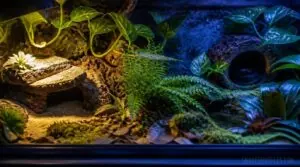
Where you put each hide matters just as much as which hide you choose. In a bioactive setup, placement drives thermoregulation, humidity balance, and how well your cleanup crew can do its job. Here’s how to position hides across warm, cool, and humid zones for a setup that actually works.
Warm-Side Hide Placement
Position the warm‑side hide directly over your heat source, so the interior floor hits 28–32 °C consistently. That thermal alignment turns the hide into a digestion chamber, not just a retreat.
Keep it away from water bowls to prevent pooling. A stable, wide base stops wobbling as your snake shifts substrate during its nightly movement.
Cool-Side Hide Placement
The cool side works as a thermal escape valve — place the hide at the enclosure’s far end, away from any heat source, so floor-level temperatures settle in the low-to-mid 70s °F.
- Use a digital probe inside the hide, not ambient readings
- Keep the entrance clear of substrate buildup
- Match the silhouette to the warm-side hide
- Avoid heat bleed by widening the gradient if needed
Your snake’s thermoregulation depends on that contrast being real and unobstructed.
Humid Hide Zones
Think of your humid hide box as a pressure valve for moisture — concentrated where your snake needs it, contained so your bioactive substrate stays balanced.
Place it on the warm side. Higher temperatures accelerate evaporation inside the hide, pushing interior humidity toward 70–90% during shedding cycles without saturating the surrounding enclosure. Pack it with damp sphagnum moss, and that microclimate holds steady even as ambient conditions shift.
Partially Buried Hides
Burying a hide halfway transforms it into a thermal buffer — the substrate insulates the lower chamber, smoothing temperature swings that exposed hides can’t prevent.
Your snake gets a transitional zone at the entrance: warm enough to digest, cool enough to retreat. That gradient encourages natural tunneling behavior and keeps the interior humidity stable without saturating the surrounding bioactive substrate.
Plant and Moss Blending
Wrapping hides in live moss and low-lying plants does more than look natural — it creates layered humidity pockets that slow evaporation and extend moisture between misting cycles.
Choose pleurocarpous moss with small ferns that share the same 70–90% humidity range. Their root systems support microfauna nutrient cycling, keeping the bioactive substrate active directly around your hide’s base.
Maintain Bioactive Hide Boxes
[ORIGINAL TEXT]
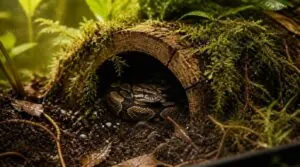
Keeping your bioactive hides in good shape isn’t complicated, but it does demand consistency. A few targeted habits protect your snake, preserve your cleanup crew, and keep the whole setup running the way it should. Here’s what actually matters regarding hide maintenance.
[/ORIGINAL TEXT]
Spot-Clean Waste Quickly
Waste doesn’t wait, and neither should you. The moment you spot feces or shed remnants near a hide, blot the area immediately with a dedicated microfiber cloth, working inward from the edges to contain the spread.
For organic waste, an enzyme cleaner applied to the cloth — never directly onto substrate — breaks down residue without disrupting your cleanup crew. Color-coded cloths prevent cross-contamination between zones.
Prevent Mold Growth
Even with prompt spot-cleaning, moisture lingers — and mold moves fast. Keep enclosure humidity below 60% between sheds, using a calibrated hygrometer in each zone to catch creeping condensation early.
Non-porous hide surfaces — sealed ceramic, polypropylene, resin — don’t absorb moisture, which starves mold before it starts. A thin drainage layer beneath hides channels water away, while gentle airflow prevents the stagnant pockets where spores thrive.
Support Cleanup Crews
Mold control and cleanup crew support go hand in hand. Isopods and springtails handle organic breakdown, but they need your help to work efficiently.
- Follow waste segregation protocols — separate substrate debris from inorganic waste
- Sanitize tools between stations using tool sanitation standards
- Log every maintenance event for maintenance log accuracy
- Schedule equipment replacement cycles before tools degrade
Protect your microfauna — they’re the engine of every bioactive vivarium kit.
Refresh Humid Hide Moss
Sphagnum moss is the workhorse of your humid hide, but it earns that role only when you stay ahead of its decline.
Aim to swap it every 4 to 8 weeks — sooner if you spot white or green specks signaling mold.
Rehydrate fresh moss fully, wring it gently, and pack it loosely so springtails can still move through the humidity pocket without getting trapped.
Replace Damaged Hides
A cracked hide is a liability — sharp edges catch scales, rough seams become snag risks, and compromised surfaces trap bacteria that no cleanup crew can handle.
Before swapping, run three quick checks:
- Press along seams for material integrity failures
- Test entrance edges for roughness that signals selecting continuous entrances
- Note any retreat avoidance as behavioral changes worth tracking
Replace with mold-resistant materials immediately.
Frequently Asked Questions (FAQs)
Are bioactive enclosures good for snakes?
Bioactive enclosures genuinely benefit snakes by mimicking wild habitats, stabilizing humidity, and reducing stress through naturalistic behavior opportunities. Microfauna handle waste cycling, supporting long-term snake health with minimal intervention.
Can snakes share a hide box safely?
Sharing a hide is like two rivals splitting one safe house — tension is inevitable. Most snakes are solitary; cohabitation increases stress, leads to rapid parasite transmission, and fuels territorial disputes. Separate hides are always the safer call.
If you’re introducing a new snake to your setup, going slow matters here too — this guide on using a snake hook without triggering defensive strikes shows how patience prevents lasting stress.
How many hides does one snake need?
Most snakes need at least two hides — one on the warm side, one on the cool side. A third humid hide aids shedding and reduces stress during blue cycles.
Before adding hides, use this guide to measuring enclosure size needs to make sure there’s still enough open floor space for your snake to move freely.
Since a snake’s enclosure setup will need upkeep for two to three decades, it’s worth reading this vet-reviewed guide to choosing the right pet snake breed before committing to one.
Do hides affect bioactive nitrogen cycling?
Yes — hide placement and material directly shape microbial biofilm diversity and redox zone creation in surrounding substrate, influencing how efficiently isopods, springtails, and nitrifying bacteria process ammonia through anoxic nitrogen pathways.
Should hides be moved during breeding season?
Breeding behavior demands stability. Relocate hides only when clear signals — prelay posturing, sustained temperature-seeking — justify the disruption. Sudden shifts spike stress and can delay mating or trigger dystocia in gravid females.
Can hatchlings use adult hides temporarily?
Yes, temporarily — but watch closely. A hatchling can use an adult hide briefly, though the lack of snug fit may disrupt thermal regulation and trigger stress. Monitor for signs of distress constantly.
Conclusion
A bioactive enclosure is only as stable as its weakest component—and the hide is rarely decorative. Every material choice, every placement decision, every maintenance habit either reinforces or quietly erodes the system you’ve built.
Snake hide boxes for bioactive setups demand the same precision you gave the substrate, the drainage layer, the lighting schedule.
Get the hide right, and everything else holds. Get it wrong, and no amount of cleanup crew will compensate for a snake that won’t settle.