This site is supported by our readers. We may earn a commission, at no cost to you, if you purchase through links.
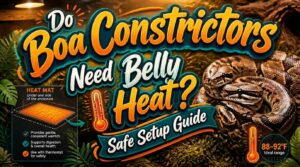
Most boa owners set up a heat mat under the enclosure, assume the job is done, and wonder why their snake refuses food or sits coiled in the corner for days. The setup looks right. The temperatures read fine. But the snake tells a different story.
Belly heat and basking heat aren’t interchangeable—they do different jobs inside the same animal. A heat mat warms a thin layer of substrate beneath your boa’s ventral scales. What it can’t do is drive the deep gut temperatures that protease and lipase enzymes need to actually break down a meal. That requires radiant heat from above, the kind that penetrates and raises internal body temperature the way a natural sun would.
Getting this right isn’t complicated, but the details matter—and a wrong call here can mean regurgitation, chronic poor digestion, or thermal burns your boa can’t escape.
Table Of Contents
- Key Takeaways
- Do Boas Need Belly Heat?
- Best Heat Sources for Boas
- Creating a Safe Heat Gradient
- Top 3 Boa Heating Tools
- Monitoring Boa Heat Safely
- Frequently Asked Questions (FAQs)
- Do boa constrictors get cold at night?
- How hot should a boa constrictor enclosure be?
- What temperature should a boa be at night?
- Should I buy a heat lamp for my Boa?
- What is the best heating for a boa constrictor?
- Do boas need belly heat?
- How often should boa enclosures be deep cleaned?
- Can boas cohabitate safely in one enclosure?
- What substrate works best for boa constrictors?
- How do seasonal changes affect boa feeding schedules?
- Conclusion
Key Takeaways
- Boas don’t need belly heat as a primary source — radiant overhead heat is what actually drives the deep gut temperatures required for proper digestion.
- Heat mats only warm the ventral surface and can cause thermal burns above 44°C (111°F), especially without a thermostat to regulate contact temperature.
- A functional thermal gradient — basking spot at 90–95°F, warm side at 80–85°F, cool side at 75–80°F — is the foundation of healthy digestion and self-regulation.
- Your boa’s behavior is the most reliable feedback loop: cool-side camping, basking avoidance, or lethargy signals a heating problem before your thermometer does.
Do Boas Need Belly Heat?
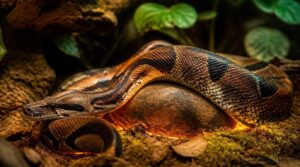
Belly heat is one of those topics that sparks real debate among boa keepers, and the answer isn’t as straightforward as you might expect. Whether you need it — and how to use it safely — depends on your setup, your snake’s age, and what you’re actually trying to achieve. Here’s what you need to know before picking a heat source.
If you’re just getting started, understanding how to choose the right snake as a first reptile can also help you build better instincts around heating before problems arise.
Belly Heat Versus Basking Heat
These two heat types work differently. Belly heat uses conduction from below, warming the ventral surface where the snake contacts substrate. Basking heat is radiant, from above, raising air temperature around a defined hotspot.
- Belly heat warms the bottom 1–3 inches of contact
- Basking heat creates overhead microclimate formation
- Both support metabolic warmth combined benefit
- Neither alone fully covers thermal needs
Digestion Heat Needs
After a meal, your boa’s gut needs internal deep warmth to keep enzyme activity rates high enough for protein breakdown. Protease and lipase work best within a narrow thermal window—drop below that, and digestion stalls.
That’s why a reliable basking spot matters post-feeding: it drives gut motility stimulation and improves nutrient absorption efficiency from the inside out.
Maintaining a steady deep temperature bolsters the internal digestive fire, ensuring enzymes work optimally.
Common Belly Heat Myths
Here’s a myth worth clearing up: localized fat reduction doesn’t apply to reptiles, and the same flawed logic shows up in boa care.
A heat mat under the belly won’t selectively drive digestion deeper.
Any warmth it adds is surface-level — water weight loss through mild sweating, basically.
Real digestive thermogenesis comes from a proper basking spot, not belly contact.
When Belly Heat Helps
That said, belly heat isn’t completely without merit in specific situations.
After a large meal, abdominal blood flow increases demand on digestive muscles. A heat pad set low — never above 88 °F — can support peristalsis stimulation and postprandial comfort by relaxing the gut wall slightly.
Use it sparingly, thermostatted, and only as a supplement to your basking zone — never a replacement.
When Belly Heat Risks Burns
Skin damage happens faster than you’d expect. Temperatures above 44 °C (111 °F) on direct abdominal contact can burn tissue within minutes — and substrate heat retention makes localized hot spots nearly invisible until the damage is done.
Three conditions that raise burn risk:
- Unregulated heat sources with no thermostat
- Dense substrate trapping radiant heat underneath
- Heat mat positioned beneath the enclosure without a barrier
Thermal skin breakdown is cumulative, silent, and serious.
Monitoring hot-spot temperatures and avoiding prolonged contact with warm surfaces becomes far easier when you start with the right enclosure setup for baby boas, where precise thermostats and day-night cycles reduce the risk before it starts.
Best Heat Sources for Boas
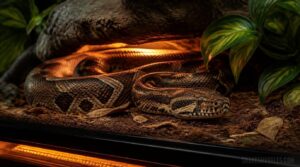
Not all heat sources are created equal — some work with your boa’s biology, and some quietly work against it. Choosing the right one comes down to how well it replicates the kind of warmth boas actually need to thrive. Here’s what you should know about each option before you buy.
If you’re keeping your boa in a tight space, pairing the right heat source with substrate liners designed for small apartments can help maintain even warmth without overheating the enclosure.
Overhead Heat Lamps
Overhead heat lamps are the go-to choice for most boa setups — and for good reason. They emit infrared radiation downward, mimicking the sun’s warmth and creating a natural basking spot without heating the whole enclosure.
Wattage usually runs 125–250W, with reflectors concentrating heat precisely where your boa needs it. Always pair them with a thermostat. Fixture safety ratings matter too — ceramic sockets handle prolonged heat without degrading.
Ceramic Heat Emitters
Unlike heat lamps, ceramic heat emitters produce no visible light — just steady infrared radiation that warms your boa without disrupting its day-night cycle.
They’re built to last tens of thousands of hours, resist moisture, and cover a defined basking zone efficiently.
Always wire one to a proportional thermostat; uncontrolled, they’ll overheat the enclosure fast.
Radiant Heat Panels
Radiant heat panels mount flush to the ceiling or wall, radiating infrared energy directly to your boa and enclosure surfaces — no air heating required. That’s why they’re so efficient.
Three reasons keepers choose them:
- Quick warm-up — panels reach working temperature within minutes
- Low surface temps — surfaces stay well below burn thresholds
- No moving parts — virtually maintenance-free
Heat Tape Safety
Heat tape works, but only when installed correctly. Never overlap it on itself — that traps heat, creates hot spots, and raises genuine fire risk.
If the plastic covering is cracked or charred, replace the whole unit immediately. Always pair it with a proportional thermostat, and cover with nonflammable fiberglass insulation only if the manufacturer explicitly permits it.
Avoid Heat Rocks
Skip the heat rock entirely — it’s one of the most dangerous "solutions" still sold in pet stores. These devices have no thermostat, which means surface temperature climbs unchecked while your boa sits directly on it.
Ventral burns can develop before you notice anything wrong. By then, tissue damage is already done.
Creating a Safe Heat Gradient
heat gradient is the backbone of a healthy boa setup — and it’s more specific than most keepers expect.
You need to nail the right temperatures on both ends of the enclosure, account for nighttime drops, and understand exactly where adult boas draw the danger line.
Here’s what each of those targets actually looks like in practice.
Warm Side Targets
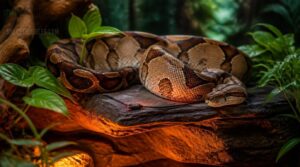
Your boa’s warm side needs to hit 28–32°C (82–90°F) during the day — enough heat to drive digestion without tipping into thermal stress. Juveniles need the higher end; adults sit comfortably at the lower range.
Seasonal tuning matters too. Nudge ambient up slightly in spring and summer, down in autumn and winter — never shifting more than 1–2°F per day.
Cool Side Targets
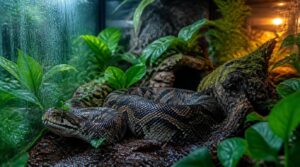
The warm side does the heavy lifting, but the cool side is what makes the gradient work. Without a proper drop, your boa can’t self-regulate — it just sits in uniform heat, which is stressful.
Aim for 75–85°F on the cool end. Keep ambient temperature above 68°F to prevent respiratory illness.
Seasonal adjustments to make:
- Spring/summer: raise ambient to 75–78°F
- Autumn/winter: lower to 72–75°F
- Shift no more than 1–2°F per day
- Never let the cool side drop below 68°F overnight
Night Temperature Drops
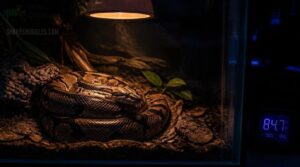
Once the cool side is dialed in, nighttime becomes its own variable. Boas tolerate a natural drop of 5–10°F after lights out — this mirrors radiative cooling in the wild and helps nocturnal metabolic shifts.
Turn off overhead heat at night, but if room temps fall below 68°F, run a ceramic heat emitter to prevent respiratory risk without disrupting the gradient.
Enclosure Size Matters

The thermal gradient you’ve built only works if your boa can actually move through it. For a 4-foot boa, a 4 × 2 × 2-ft enclosure is the minimum — anything smaller collapses the warm and cool zones into one overlapping mess.
Vertical space lets your boa self-regulate between elevated basking spots and cooler substrate-level hides, supporting both thermoregulation and natural enrichment behavior without crowding essential zones.
Adult Overheating Risks
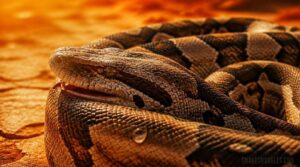
Adults should never be exposed to temperatures above 95°F — mortality risk rises sharply at that threshold. When the thermostat fails, ambient heat climbs fast, and a boa with nowhere cooler to retreat faces rapid hyperthermia.
Dehydration compounds the damage. Watch for lethargy, wheezing, and skin lesions; those are thermal stress telling you the setup has already gone wrong.
Top 3 Boa Heating Tools
Getting the right tools makes the difference between guessing and actually knowing your boa is comfortable. These three products cover the essentials — reliable heat delivery and accurate temperature readings — without overcomplicating your setup. Here’s what’s worth having in your enclosure kit.
1. Simple Deluxe Dual Reptile Light

The Simple Deluxe Dual Dome Fixture solves a common problem: running a heat lamp and a UVB bulb without doubling your cord clutter. Two independent switches let you control basking heat and ambient lighting separately — which matters when you’re trying to align each cycle with your boa’s natural rhythms.
Each socket aids up to 100 watts per lamp, enough for most standard halogen flood setups. The polished reflector directs heat downward efficiently, and the recessed dome design keeps bulbs away from curious snouts.
| Best For | Reptile owners who need to run a heat lamp and UVB bulb simultaneously without the hassle of managing separate cords or fixtures. |
|---|---|
| Primary Use | Dual lamp mounting fixture |
| Reptile Compatible | Yes, terrarium and tank setups |
| Power Source | AC outlet, 100W max per socket |
| Heat Function | Distributes heat via reflector |
| Animal Types | Reptiles |
| Enclosure Fit | Small to medium enclosures |
| Additional Features |
|
- Dual independent switches let you control basking heat and UVB lighting on separate schedules, making it easy to match your reptile’s natural day/night cycles
- The polished aluminum reflector pushes heat and light downward more efficiently, so your enclosure stays warmer and brighter without needing higher-wattage bulbs
- The heavy-duty stainless-steel hook and compact design make it easy to mount securely over small to medium tanks or terrariums
- Capped at 100W per socket, so it won’t support higher-power heating bulbs sometimes needed for larger or tropical species
- Bulbs must cool for 30 minutes before you can swap them out, which can be inconvenient if you need to make quick changes
- The size works best for small to medium enclosures — it may not be practical for larger setups that need broader heat coverage
2. Repti Zoo 75W Heat Lamp
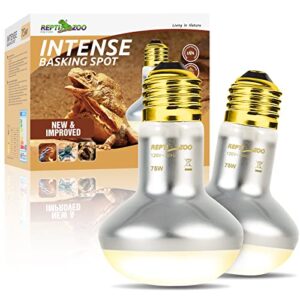
The Repti Zoo 75W Heat Lamp pulls double duty — delivering infrared heat and a subtle red glow through a standard E26 socket that fits most reptile fixtures without adapters.
That flat-bottom design concentrates the basking beam tightly, which helps you hit target temperatures without cranking the wattage.
Rated for roughly 3,000 hours, it’s a reliable overhead option for adult boas that need consistent warmth without bright white light disrupting nighttime behavior.
| Best For | Reptile and small pet owners who want a reliable heat source that doubles as a subtle ambient light without disrupting nocturnal behavior. |
|---|---|
| Primary Use | Basking heat source |
| Reptile Compatible | Yes, reptile enclosures |
| Power Source | AC outlet, E26 socket, 75W |
| Heat Function | Generates focused basking heat |
| Animal Types | Reptiles, amphibians, small pets |
| Enclosure Fit | Standard enclosures, not tiny or high-ventilation |
| Additional Features |
|
- The flat-bottom design focuses heat more efficiently, so you get a solid basking spot without needing a higher-wattage bulb
- Fits standard E26 sockets, meaning no adapters or special fixtures required
- Rated up to 3,000 hours, making it a dependable long-term option for consistent enclosure heating
- Must stay completely dry — any moisture nearby can shorten its life or cause failure
- Some buyers have noted inconsistent lifespan with newer production batches
- Not a great fit for small or heavily ventilated enclosures where heat tends to escape before it can build up
3. Etekcity Infrared Laser Thermometer
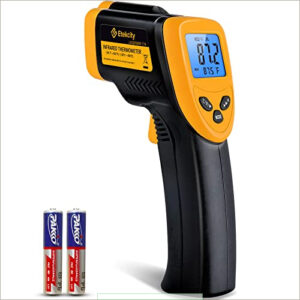
The Etekcity infrared thermometer is the fastest way to verify your basking spot without disturbing your snake. Point, pull the trigger, done — readings in 0.5 seconds.
Its 12:1 distance-to-spot ratio works best at around 36 cm, giving you a precise surface reading rather than an averaged guess. The adjustable emissivity setting matters here too; dialing it correctly prevents false lows on reflective substrate surfaces.
Celsius/Fahrenheit switching and a backlit LCD make quick nightly checks genuinely painless.
| Best For | Reptile keepers and home cooks who need instant, non-contact surface temperature readings for enclosures, ovens, or grills. |
|---|---|
| Primary Use | Surface temperature reading |
| Reptile Compatible | Yes, enclosure monitoring |
| Power Source | 2 AAA batteries |
| Heat Function | Measures surface heat levels |
| Animal Types | Reptiles |
| Enclosure Fit | Any enclosure size |
| Additional Features |
|
- Lightning-fast 0.5-second readings let you check basking spots or cooking surfaces without interrupting what you’re doing
- Adjustable emissivity setting ensures accurate reads across different surface types, from reflective substrate to cast iron
- Wide temperature range (–50 °C to 450 °C) covers virtually every home or reptile-keeping scenario
- Not suitable for measuring body temperature, so it won’t double as a medical thermometer
- Accuracy drops if your line of sight is blocked or the emissivity isn’t dialed in correctly
- Runs on AAA batteries with no rechargeable option, so you’ll want spares on hand
Monitoring Boa Heat Safely
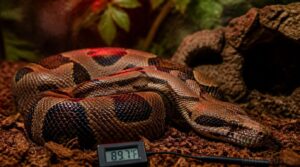
Getting the heat right is only half the job — knowing it’s actually right is the other half. A few simple tools and habits make all the difference between guessing and actually knowing what’s happening inside your boa’s enclosure. Here’s what to keep an eye on.
Thermostat Control
A proportional thermostat is non-negotiable — it compares the probe reading to your setpoint continuously, smoothing output to prevent temperature swings rather than just cycling on and off. That hysteresis deadband stops rapid cycling that wears out your heat source.
Smart digital thermostats with probe inputs offer remote app monitoring and scheduling, so you can catch sensor faults before your boa pays for it.
Probe Thermometer Placement
Your thermostat is only as accurate as where its probe sits. Place the sensor tip at substrate level inside the heated hide — where your boa’s belly actually contacts the floor.
For a safe, stable gradient, follow this guide to heating a snake terrarium properly.
If it hovers in air, you’re measuring nothing useful. Check placement after every cleaning or substrate shift, because even minor disturbances can cause probe drift that throws your readings off by several degrees.
Infrared Temperature Checks
Probe thermometers tell you what’s happening at one point. An infrared thermometer shows you the whole basking spot in seconds — no contact needed.
Hold it within a foot, minimize your angle, and check your device’s emissivity setting matches reptile scales. Surface readings run cooler than internal temp, so treat them as trend indicators, not absolutes. Calibrate monthly.
Humidity Near Substrate
Temperature tells half the story. Substrate humidity tells the other half.
Aim for 60–70% RH near the enclosure floor during normal activity, nudging to 70–80% around shed cycles. Coconut husk and cypress mulch retain moisture well without compacting. Place your hygrometer 1–2 inches above the surface — not at eye level. Anything above 85% invites mold, fast.
Heat Stress Warning Signs
Humidity gives you one lens into your boa’s comfort — behavior gives you another.
Lethargy, basking avoidance, and slowed shedding are your earliest thermal stress signals. Wheezing points to respiratory strain from sustained low temps. Skin lesions suggest the hotspot ran too hot, too long. A boa camping permanently on the cool side isn’t being shy — it’s telling you something’s wrong.
A boa hiding on the cool side is not being shy — it is telling you something is wrong
Frequently Asked Questions (FAQs)
Do boa constrictors get cold at night?
Yes and no. Boas tolerate safe nighttime drops to 68–75 °F without distress — that’s natural seasonal cooling at work. Problems only start when ambient temperature dips below 68 °F consistently.
How hot should a boa constrictor enclosure be?
Keep the basking spot at 90–95°F, the warm-side ambient around 80–85°F, and the cool end at 75–80°F — giving your boa a thermal gradient it can actively use.
What temperature should a boa be at night?
A keeper in Minnesota once woke to a lethargic boa after winter room temps crashed overnight. Nighttime ambient temperature should sit between 75–80°F, allowing a natural drop that helps digestion and metabolism without stress.
Should I buy a heat lamp for my Boa?
A heat lamp is a solid yes for most boa setups. It creates an accurate basking spot, produces beneficial infrared radiation, and pairs cleanly with a thermostat for precise temperature control.
What is the best heating for a boa constrictor?
Think of your boa’s enclosure like a solar landscape — one warm end, one cool end, and the snake moves between them to self-regulate.
Overhead infrared heating paired with a proportional thermostat delivers the most stable, controllable thermal gradient for a reptile enclosure heating setup.
Do boas need belly heat?
No — boas get what they need from overhead heat sources. A proper warm-side ambient of 85–90 °F aids digestion and thermal regulation without any contact heat underneath.
How often should boa enclosures be deep cleaned?
Deep clean every 4–6 weeks, or sooner if odor or visible mold appears. Spot clean waste weekly between full cleanouts. High humidity setups need more frequent turnovers to prevent microbial buildup in damp substrate.
Can boas cohabitate safely in one enclosure?
Cohabitation is rarely safe. Boas are highly territorial, and shared enclosures trigger stress, dominance conflicts, and feeding competition. For most keepers, individual housing is the only reliable way to protect long-term health.
What substrate works best for boa constrictors?
Coconut fiber is the top choice — it holds 60–70% humidity, encourages burrowing, and won’t compact. Cypress mulch works as a close second. Keep depth at 3 inches minimum for shedding support and moisture retention.
How do seasonal changes affect boa feeding schedules?
Seasonal shifts slow your boa’s metabolic rate, naturally reducing feeding urgency in winter. Extend intervals to every 14 days, offer smaller prey, and monitor weight closely. Spring warmth signals appetite return — resume normal frequency.
Conclusion
The devil’s in the details when dealing with thermal management—and now you have them. Do boa constrictors need belly heat? Not as their primary source.
Your boa needs radiant overhead heat to drive the gut temperatures that actually complete digestion. A heat mat alone leaves that job half-done. Build the gradient, verify it with a thermostat and infrared thermometer, and your boa’s behavior will confirm what the thermometer can’t: everything is working.