This site is supported by our readers. We may earn a commission, at no cost to you, if you purchase through links.

Most corn snakes spend their lives in a bare 10-gallon tank with a heat mat and a paper towel floor. They survive. But survival and thriving look completely different, and the right cage design changes everything.
Corn snakes burrow, climb, and thermoregulate with surprising precision. An enclosure that allows those instincts produces a snake that eats consistently, sheds cleanly, and uses its full space instead of hiding in one corner.
Whether you’re setting up a first enclosure or rebuilding an outdated one, good corn snake cage design isn’t decorative. It’s functional, measurable, and your snake will show you the difference.
Table Of Contents
- Key Takeaways
- Plan The Right Corn Snake Cage Size and Material
- 5 Creative Corn Snake Cage Layout Ideas
- Corn Snake Cage Decor and Enrichment Ideas
- Design Heating, Lighting, and Humidity Zones
- Choose Substrate and Maintain The Design
- Frequently Asked Questions (FAQs)
- What is the best enclosure setup for a corn snake?
- How to make an enclosure for a corn snake?
- What kind of cage does a corn snake need?
- What not to do with a corn snake?
- How do you decorate a corn snake enclosure?
- Do corn snakes need an enclosure?
- Do corn snakes need cage accessories?
- How do I choose the best corn snake enclosure setup?
- What size cage do corn snakes need?
- How do you keep a corn snake in a cage?
- Conclusion
Key Takeaways
- Size the enclosure to your snake’s stage—hatchlings in 12–18 gallons, juveniles in 24–40, and adults in 40–75 gallons minimum with length matching the snake’s body and width at half that.
- Build a temperature gradient of 85–90°F on the warm side and 72–75°F on the cool side, controlled by a thermostat and verified with digital thermometers and hygrometers calibrated monthly.
- Meet your snake’s instincts with two snug hides (one per temperature zone), climbing structures, and burrowing substrate like coconut fiber or cypress mulch at 2–4 inches deep, keeping humidity between 40–60%.
- Prevent escapes by keeping all gaps under 1/4 inch, using spring-loaded latches and four-point locking clamps, and monitor behavior for 7–14 days after any redesign to confirm the changes reduced rather than caused stress.
Plan The Right Corn Snake Cage Size and Material
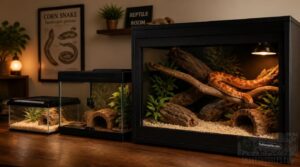
Getting the size and material right is the foundation every good enclosure decision builds on. The options below cover everything from hatchling starter tanks to adult-ready PVC builds, so you can match your setup to your snake’s actual needs. Work through each point before you buy anything.
For species-specific guidance on dimensions and materials, a custom snake enclosure build guide can save you from costly sizing mistakes as your snake grows.
Hatchling, Juvenile, and Adult Sizing
Three growth stages mean three different enclosures. Enclosure length should match your snake’s length, with width at half that measure.
Since an oversized tank can leave a young snake stressed, this guide to choosing the right snake terrarium size helps you upgrade at the right time.
Since sizing varies by species, consulting a detailed guide on snake enclosure setup and habitat requirements helps you fine-tune dimensions for your specific snake.
Measuring your snake accurately is the first step—a flexible tape works best, as outlined in this guide to snake cage sizing and enclosure layout.
Hatchlings start in 12–18 gallon terrariums, giving them secure space to feed and molt. Juveniles move into 24–40 gallon setups. Your adult corn snake needs 40–75 gallons minimum, with at least 6–8 square feet of usable floor space.
Glass, PVC, and Wood Compared
Once you’ve sized your enclosure, the material shapes how well you’ll hold a stable temperature gradient. Glass offers clear visibility but fogs without ventilation and weighs more than most keepers expect.
PVC resists moisture and cleans faster, keeping hiding spots sanitary between deep cleans. Wood looks natural but warps under humidity unless every panel is fully sealed before use.
Front-Opening Versus Top-Opening Access
Material choice affects enclosure durability and which access style works for you. Front-opening latches suit juveniles and compact setups. Top-opening access cuts escape risk and speeds up visual checks.
- Front openings allow single-point cleaning without disturbing the snake
- Top openings give instant full-habitat visibility
- Escape prevention improves with top-lid designs
- Front doors reduce reach distance for hatchlings
- Top lids lower accidental tip-over risk
Vent Placement for Healthy Airflow
Strategic vent placement keeps air moving through the full enclosure. Install vents on opposite ends, low for intake and high for exhaust. Two 5×3 vents create natural convection, cycling stale air out without drafting the basking zone.
| Vent Position | Airflow Benefit |
|---|---|
| Low front intake | Pulls in cool, fresh air |
| High rear exhaust | Removes warm, humid air |
| Corner placement | Eliminates stagnant zones |
| Mid-wall sides | Promotes even air mixing |
| Near heat source | Prevents hot-air stratification |
Proper airflow management prevents stagnant air, odor buildup, and respiratory stress.
Locks, Clamps, and Escape Gaps
Even a well-built enclosure fails if the latch gives. Front-opening latches need a spring-loaded mechanism that won’t release unless fully engaged. Cable hooks with grommets at corners deter pry attempts.
Keeping hides secure matters just as much inside the enclosure—understanding the difference between humid hide vs. dry hide setups for ball pythons helps you choose the right design so your cleaning routine stays simple and consistent.
Keep gaps under 1/4 inch. Cord holes sealed to pencil-diameter tolerance eliminate grip points. Four-point locking clamps and escapeproof lids complete a genuinely escapeproof enclosure.
5 Creative Corn Snake Cage Layout Ideas
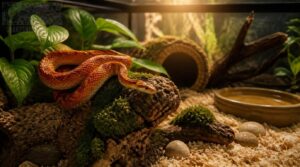
Your corn snake’s enclosure can be far more than just a box with a water bowl.
The five layouts below cover everything from low-maintenance bioactive builds to burrowing-focused naturalistic setups, so there’s a practical option no matter your experience level or budget.
Pick the one that fits your space, your snake’s habits, and how much hands-on upkeep you’re willing to do.
Bioactive Forest Floor Setup
Think of it as a self-cleaning terrarium. A bioactive setup uses a naturalistic soil mix of coconut fiber, topsoil, and sand. Add isopods and springtails as cleanup crews, then include live plants for cover. Manage humidity control to keep substrate moisture stable.
- Microfauna work while your snake thrives
- Leaf litter encourages natural burrowing behavior
- Live moss helps regulate surface moisture
Naturalistic Woodland Display
A naturalistic woodland display builds a layered forest your snake can freely explore. Cork bark, driftwood, and mixed leaf litter over a naturalistic soil mix form temperature pockets and hiding spots.
Unlike bioactive systems with live plants and cleanup crews, this skips microfauna. Add artificial ferns for cover. Branch placement should fork naturally to give your snake secure retreat points.
Vertical Climbing Adventure Layout
Your corn snake is a better climber than you might expect. A vertical layout stacks opportunity at every height using cork bark ramps, cable-guided vines, and perches.
- Mount staggered cork bark ledges at 6, 12, and 18 inches
- Line elevated sections with non-slip mesh panels for safety
- Position warm basking zones near upper perches to create a natural heat gradient
Minimalist Easy-Clean Setup
Less is more when maintenance is the priority. Paper towels replace loose substrate entirely, and daily spot cleaning removes waste in under two minutes. Keep decor to two hides and one water bowl maximum.
| Element | Minimalist Choice | Why It Works |
|---|---|---|
| Substrate | Paper towels | Fast swap, no loose particles |
| Decor | Two hides, one bowl | Reduces cleaning obstacles |
| Security | Fourpoint locking clamps | Resists prying and wiggling |
| Access | Frontopening latches | No vertical reach required |
| Cord gaps | Pencil-diameter sealed holes | Eliminates hidden escape routes |
Fourpoint locking clamps paired with frontopening latches secure the enclosure without complicated hardware. Seal cord holes to pencil-diameter tolerance so no gap becomes an exit.
Burrowing-Focused Leaf Litter Setup
A hidden tunnel gives your snake somewhere to disappear. Layer 2–4 inches of leaf litter over cypress mulch or coconut fiber and hold burrow humidity at 60–80%.
- Use pesticide-free hardwood leaves; cedar and pine irritate respiratory systems.
- Keep burrows 4–6°C cooler than the basking zone.
- Schedule substrate maintenance after waste buildup to block mold.
Corn Snake Cage Decor and Enrichment Ideas
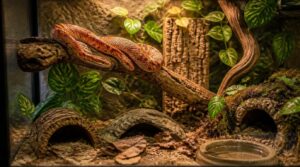
Good decor does more than fill space — it shapes how your corn snake moves, hides, climbs, and stays calm. The right mix of functional enrichment elements turns a plain enclosure into an environment your snake will actually use. Here’s what to add and how to place it.
The right decor doesn’t fill space — it shapes how your corn snake moves, hides, and thrives
Warm and Cool Side Hides
Because corn snakes thermoregulate by moving between zones, you need two hides — one on the warm side at 85–90°F and one on the cool side at 75–82°F.
Place each hide directly on the substrate, not raised. Use opaque, snug-fitting boxes so your snake feels secure. Line the warm hide with a non-porous insert to block moisture from the heat source.
Branches, Hammocks, and Ledges
Once your hides are set, add vertical climbing structures above each zone. Use branches with smooth, bark-free surfaces at varied angles so your snake can move between levels without crowding.
Position hammocks with full body clearance underneath to support natural pacing. Install ledges at different heights with non-slip surfaces to reduce fall risk and provide sheltered gaps beneath for hiding.
Safe Rocks, Logs, and Driftwood
Rocks and logs ground your layout the same way branches define the upper levels. Choose inert, non-porous rocks sized to prevent body gaps. Boil rocks for 10-15 minutes before placement.
Bake collected logs at 250°F for two hours to kill pathogens. Soak driftwood for 48-72 hours, rinse with reptile-safe disinfectant, and air-dry fully before use.
Live Versus Artificial Plants
Once your solid natural decor is placed, plants fill the remaining gaps. Live plants for snakes like pothos boost local humidity and support a bioactive substrate by feeding microfauna. They need routine trimming to prevent root rot.
Fake foliage requires no watering and won’t mold. Anchor silk or plastic pieces with cork bark decor so your snake can’t dislodge them.
Water Bowl Size and Placement
Since water bowl humidity influence extends beyond hydration, placement matters. A 6–8 inch ceramic bowl on the cool side limits evaporative humidity from water bowls. Between ceramic vs plastic reptile water bowls, ceramic wins for reptile biofilm prevention.
- Size up for adults; hatchlings need a shallow dish
- Place at ground level, away from heat
- Disinfect weekly with a reptile-safe cleaner
Design Heating, Lighting, and Humidity Zones
Getting the thermal zones right inside your corn snake’s enclosure is what separates a thriving snake from a stressed one. Temperature gradients, humidity levels, and lighting schedules each need deliberate placement, not guesswork. Here’s how to set up every zone correctly.
Positioning The Temperature Gradient
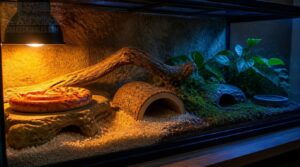
Think of your enclosure as a spectrum of heat. Place the basking spot on one end, targeting 85-90°F, with the cool side dropping to 72-75°F at the opposite end.
The warm zone should cover roughly one-third of total enclosure length. Positioning your heat source higher than the cool area creates a vertical thermal gradient that helps natural thermoregulation all day.
Thermostat-Controlled Heating Equipment
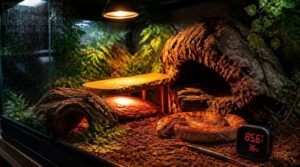
A thermostat prevents dangerous, unpredictable heat spikes. Connect ceramic heat emitters or deep heat projectors directly to it, and place the probe at snake level.
- Ceramic heat emitters provide dry overhead warmth
- Deep heat projectors warm substrate and tissue effectively
- A heat mat needs its own thermostat
- Digital hygrometers track moisture near the cool side
- Target 88°F warm, 75°F cool
Safe UVB Placement and Timing
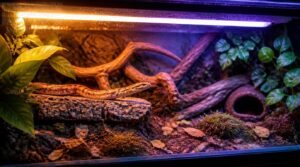
Corn snakes benefit from UVB even if they’ve survived generations without it.
Mount a T5 HO UVB bulb 6–12 inches above the basking area on the warm side 85–90°F zone, angling the fixture to avoid direct glare. Run it on a 12-hour photoperiod with a timer. Replace it every 6–12 months since output fades long before the bulb burns out.
Humid Hide for Shedding
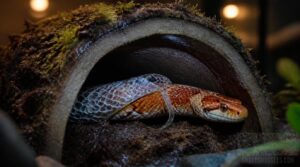
A snake mid-shed is working through a full-body glove removal. For shedding assistance, place a humid hide on the cool side to stabilize moisture. Fill it with damp coconut fiber or cypress mulch — moist, not soaked. Size it to your snake’s age: hatchlings need a 4–6 inch interior. In a bioactive setup, skip loose substrate inside to prevent entrapment.
Thermometers and Hygrometers
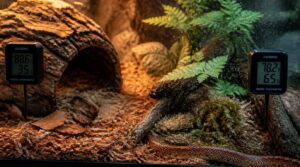
Accurate readings protect the temperature gradient you’ve built. Place digital hygrometers at both ends: warm side targets 85–90°F, cool side 75–82°F. Pair each with a shielded air probe for true ambient readings, and aim for ±1–3° accuracy.
Strategic vent placement maintains 40–60% humidity without saturating substrate. Calibrate sensors monthly; low batteries cause drift that makes safe conditions look dangerous.
Choose Substrate and Maintain The Design
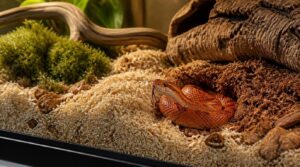
The substrate you choose does more than fill the bottom of the tank — it shapes how your corn snake burrows, retains moisture, and stays healthy over time.
Keeping that substrate clean and the overall layout fresh is just as important as the initial setup.
The five areas below cover everything from material choices to behavioral checkups after a redesign.
Burrowing-Friendly Substrate Options
Few substrates serve corn snakes as well as a coconut fiber and cypress mulch mix, which retains moisture without compacting into dense layers.
- Coconut fiber holds humidity during shedding cycles
- Cypress mulch resists mold and compaction naturally
- Aspen shavings offer clean, easy substrate maintenance
- Leaf litter adds bioactive benefits to naturalistic setups
Aim for 2–4 mm particle size for stress-free burrowing.
Spot-Cleaning and Deep-Cleaning Schedule
Good substrate makes spot-cleaning faster, but the schedule matters just as much. Daily waste removal prevents bacteria from building up. Pull out feces and shed fragments every day using tongs or a scoop.
Deep cleaning every 4–6 weeks means removing your corn snake, stripping the substrate, and wiping all surfaces with a reptile-safe disinfectant. Bioactive setups naturally reduce this frequency.
Mold Prevention and Moisture Control
After cleaning, moisture control starts with consistent monitoring. Keep humidity below 60% to stop mold from spreading. Check corners and under decor since those spots stay damp longest.
Coarser substrates like coconut fiber drain faster and reduce wet pockets. Bioactive setups benefit from microfauna that break down organic matter naturally. Change your water bowl daily to prevent reptile biofilm buildup.
Since some bowls tip easily or harbor bacteria in their crevices, it helps to compare beginner-friendly snake water dishes before choosing one for your enclosure.
Rearranging Decor for Enrichment
Once your snake terrarium setup is clean and dry, shift hides and branches to new spots every 3–4 weeks. This creates habitat enrichment that triggers fresh exploration and breaks predictable movement patterns.
Rotating climbing opportunities like branches and ledges adds 3D complexity your corn snake will notice immediately. Even a DIY reptile cage benefits from scheduled decor rotations timed with feeding days to lower stress.
Monitoring Behavior After Redesigns
After any layout change, watch your corn snake closely for 7–14 days. Monitoring behavior after redesigns reveals whether your habitat enrichment helped or caused stress.
Track these three signals:
- Patrol frequency — more exploration signals curiosity
- Zone preference shifts — excess hot-side time indicates insecurity
- Feeding response — skipping two meals means elevated stress
Tail coiling or repetitive pacing warrants a partial reset.
Frequently Asked Questions (FAQs)
What is the best enclosure setup for a corn snake?
The devil is in the details. A good corn snake enclosure must follow enclosure size guidelines, sustain a proper temperature gradient of 75–85°F, and manage humidity control carefully inside a naturalistic enclosure with front-opening access.
How to make an enclosure for a corn snake?
Building a corn snake enclosure starts with a 20–30 gallon front-opening tank. Use PVC or sealed wood for humidity control, set a warm side at 85–90°F, cool side at 75–82°F, and always place two hides.
What kind of cage does a corn snake need?
A corn snake needs a secure, escape-proof enclosure with front-opening access. Adults require at least a 4×2×2 ft of living space. PVC retains heat longer than glass, making your temperature gradient much easier to maintain.
What not to do with a corn snake?
What not to do with a corn snake starts with substrate: skip overly damp bedding that easily grows mold. Don’t block heat mats with decor, and always secure your corn snake enclosure’s lid against escapes.
How do you decorate a corn snake enclosure?
Think of it like furnishing a small Renaissance-era woodland terrarium. Use coconut fiber substrate as your base, place cork bark hides on both the warm and cool sides, then add driftwood branches for natural climbing.
Do corn snakes need an enclosure?
Yes. Corn snakes need a secure enclosure to survive in captivity. Without one, they escape through tiny gaps, lose thermal regulation, and face household hazards. Proper enclosure size also helps humidity control and reduces stress.
Do corn snakes need cage accessories?
Accessories aren’t truly optional. Hides, climbing structures, and water bowls support natural behaviors, reduce stress, and keep your snake physically active. Without them, captive corn snakes often show signs of chronic stress and poor welfare.
How do I choose the best corn snake enclosure setup?
Start with at least 48x24x24 inches. Match glass, PVC, or sealed wood to your specific humidity goals. Add hides on the warm side, climbing branches, and a substrate that lets your corn snake burrow naturally.
What size cage do corn snakes need?
Get the size wrong, and your corn snake pays for it. Hatchlings need a 20-gallon minimum; juveniles move to 40 gallons. Adults require 48L x 24W x 24H, where enclosure length matches your snake’s body.
How do you keep a corn snake in a cage?
Secure the lid with reliable latches, maintain a warm side of 85–90°F and a cool side of 75–82°F, spot-clean substrate daily, feed pre-killed prey every 10–14 days, and always handle gently with calm scooping motions.
Conclusion
A well-built enclosure is a blueprint for a thriving snake, not just a box with walls. These corn snake cage design ideas give you measurable targets: proper gradients, secure locks, and enrichment that honors burrowing and climbing instincts.
Start simple if you need to. Then improve. Watch how your snake moves, eats, and sheds, and let that behavior guide your next upgrade.
Design with purpose, and your snake will prove it worked.