This site is supported by our readers. We may earn a commission, at no cost to you, if you purchase through links.

You bring home a pencil-thin corn snake, and the cute little tub on the shelf feels perfect. Six months later, your snake presses its nose against the glass, pacing the same wall over and over.
That’s the trap of choosing the right snake terrarium size. Too small, and your snake can’t stretch, hide, or heat itself properly. Too big, and it may feel exposed and refuse to eat. Neither one is ideal for a pet you want thriving.
The good news is that you can get this right the first time. Start with a tape measure and your snake’s species.
Table Of Contents
- Key Takeaways
- Measure Your Snake to Estimate Terrarium Size
- Match Terrarium Dimensions to Your Snake’s Species and Habits
- Plan for Adult Size While Housing Juveniles Comfortably
- Check Usable Space for Hides, Movement, and Temperature Zones
- Watch Your Snake for Signs The Terrarium Size Needs Adjusting
- Frequently Asked Questions (FAQs)
- How big should a snake terrarium be?
- Can a ball python live in a 36x18x18?
- Is a 40 gallon tank big enough for a king snake?
- What’s the friendliest snake to own?
- How do I choose a snake terrarium?
- How big should a corn snake terrarium be?
- How do you keep a snake in a terrarium?
- How big should a snake tank be?
- How do you choose a snake tank?
- How big should my snake terrarium be?
- Conclusion
Key Takeaways
- Measure your snake from snout to tail, then size the enclosure so its perimeter matches or beats that length and its width is at least half the length.
- Match the shape to your species: ground dwellers like ball pythons need floor space, tree dwellers need 4 to 6 feet of height, and corn and king snakes do well in a 4×2×2 foot setup.
- Plan for adult size from the start, then use hides, leaf litter, and plants to keep a big tank from scaring a juvenile.
- Check that the space is actually usable, with snug hides on both the warm and cool ends and a 10 to 15°F temperature spread, and watch for glass-surfing, refusing meals, or constant hiding as signs the size needs adjusting.
Measure Your Snake to Estimate Terrarium Size
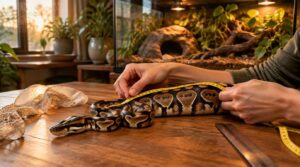
Every good terrarium starts with a tape measure. Measuring snake length is the essential first step, and it’s easier than you think. Take a flexible tape and run a snout-to-tail measurement along your snake’s back. Stretch gently, but don’t pull. Overstretching inflates the number.
Once you have that number, use it to plan the enclosure, and these corn snake cage design ideas show how layout and materials can keep temperatures steady.
Got a snake over a meter long? Measure in two sections, front half first, then the back half. Add them up. Is your snake wiggly? Photograph it next to a ruler, or measure a fresh, unbroken shed and add 20%.
Now use that number to set your enclosure size. The perimeter must equal or exceed body length, so your snake can stretch out along the walls. Width should be at least half that length. Simple, right?
Match Terrarium Dimensions to Your Snake’s Species and Habits
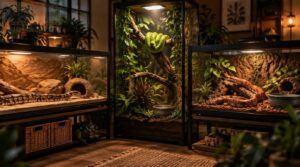
You’ve got your number. Match it to your snake’s habits, because species specific needs change the shape of the enclosure size you pick.
Arboreal species need height for climbing while ground-dwellers need floor space, and a bioactive snake habitat setup guide shows how substrate, plants, and hides can fit each type.
Ground dwellers like ball pythons and hognose snakes want floor space. Go long and wide, with 12 to 18 inches of height. Keep the minimum width ratio at 0.5 times body length, and meet the turning space requirement so your snake can stretch and turn freely.
Tree dwellers flip the rule. Green tree pythons and emerald tree boas want 4 to 6 feet of height and several perches. Small climbers need 24 inches.
Corn and king snakes sit in the middle. A 4×2×2 foot setup is ideal. Sand boas burrow, so deep substrate matters more than height.
Plan for Adult Size While Housing Juveniles Comfortably

Your hatchling is tiny now, but it won’t stay that way. Start with adult size prediction. Check the species and the parents’ length, then plan your enclosure size around that number.
Before you commit to a big constrictor, compare large pet snake breeds and how to keep them healthy so you know what each one needs as it grows.
Corn snakes usually need adult housing by 12 to 18 months. Ball pythons take 12 to 24 months to reach full size. Keep these species specific needs in mind and you’ll save money. A 4×2×2 foot tank skips two or three intermediate purchases and saves $50 to 150.
Big tanks scare babies, though. Fill the extra growth space with hides, leaf litter, and plants. Keep open floor under 30 to 40 percent. Then remove one decoration per month as your snake grows.
Good upgrading timing starts at two-thirds length.
Check Usable Space for Hides, Movement, and Temperature Zones
Big enclosure size doesn’t guarantee usable space. Open floor in the middle is wasted, because snakes hug walls and hunt for cover. Because snakes are strongly thigmotactic, they need cover and clutter across the floor before they’ll actually use the extra room.
Start with two snug hides. Put one on the warm end, right beside the heat source. Put the other at the cool end. Your snake should touch the sides and top while coiled inside. Bigger tanks need three or four hides, which add secure routes and visual barriers.
Now test movement. Your snake must stretch fully straight along one side. Corner to corner is ideal. Width and height around one-third of its length give room to turn and climb.
Check your temperature zones. Aim for a 10 to 15°F spread. Matching readings mean your tank is too small.
Watch Your Snake for Signs The Terrarium Size Needs Adjusting

How do you know your snake has outgrown its home? Your snake will tell you. Daily behavioral observation is essential, and it takes just a few minutes.
Watch for glass-surfing, nose rubbing, and pacing along the walls. These are escape attempts. Your snake isn’t exploring for fun. It’s frustrated. Check the nose for scrapes too.
Glass-surfing, nose rubbing, and pacing along the walls aren’t exploration, they’re a frustrated snake trying to escape its too-small home
Look at the setup next. If your snake’s body fills the floor, the temperature gradient collapses. Warm and cool sides end up within a few degrees. Humidity levels swing too, which can cause stuck sheds.
Refusing meals, lethargy, and constant hiding matter too. Rule out medical causes first, since snake health comes first. If the vet finds nothing, your enclosure size is the likely culprit.
Frequently Asked Questions (FAQs)
How big should a snake terrarium be?
Start with your snake’s adult length, not its current size. Your enclosure size should run at least two-thirds that long and about half as wide, with 2 feet of height.
Species specific needs change everything.
Can a ball python live in a 36x18x18?
Yes, for a juvenile. This enclosure size suits snakes under 3 feet or 1,500 grams.
Your ball python enclosure must still fit hiding spots and a temperature gradient. Adults need roomier terrarium dimensions, like 48x24x
Is a 40 gallon tank big enough for a king snake?
A 40-gallon tank works as a minimum enclosure size for adult king snakes. Check tank dimensions and species-specific needs against a terrarium size guide.
Your minimum width ratio matters, so go bigger if you can.
What’s the friendliest snake to own?
Corn snakes are the friendliest pick. This friendly snake is docile, curious, and tolerant of handling.
Ball pythons are calm but shy. Check species specific needs, your terrarium size guide, snake habitat, and enclosure size.
How do I choose a snake terrarium?
Want a home your snake loves? Match the enclosure size to your snake’s species and habits.
Check the temperature gradient, humidity levels, proper ventilation, and substrate safety. Add hides, climbing features, and a locking lid.
How big should a corn snake terrarium be?
Aim for an adult 4 by 2 by 2 foot enclosure size.
Perimeter must equal or exceed body length, with a Minimum Width Ratio of half.
Floor space, plus warm and cool zone access, matters.
How do you keep a snake in a terrarium?
Most escapes happen through loose lids. Pick the right terrarium size, then lock it down.
Ventilation is key. Add a temperature gradient, humidity levels, snug hiding spots, and clean substrate. Your snake will thank you.
How big should a snake tank be?
A 4-foot snake needs 48 by 24 inches. Start by measuring snake length, then plan terrarium size: floor space matches length, width is half, and vertical height hits 24 inches. Skip 15 times its length.
How do you choose a snake tank?
Your snake notices every single inch, so choose wisely.
Match snake terrarium size to length, favor floor space, use growth ratio planning, and honor species specific needs. Add secure locks, ventilation, hides, plus warm-cool gradients.
How big should my snake terrarium be?
Your snake terrarium size starts with floor space. Make the enclosure at least as long as your snake and half that length wide.
Pairing that floor space with front-opening doors keeps care easy, and these pet snake habitat ideas show how to arrange hides and decor inside.
Go 2 feet tall or more, with climbing room for arboreal species.
Conclusion
Meet Mia, who upgraded her ball python from a 20-gallon tank to a 4-foot enclosure with three hides. Within a week, her snake was exploring, eating, and basking like a tiny dragon.
That’s the payoff of choosing the right snake terrarium size. Measure your snake, match the species, and plan for adulthood. Then check your usable space for hides and heat zones.
Keep watching your snake. Get it right, and it won’t survive, it’ll thrive.