This site is supported by our readers. We may earn a commission, at no cost to you, if you purchase through links.

A snake that tips its water dish doesn’t just lose a drink. It floods the substrate, drowns your isopods, and turns a thriving environment into a swamp.
Most keepers grab a bowl, fill it, and move on. That’s the mistake. In a living terrarium, water dishes for bioactive enclosures do double duty: they hydrate your snake and quietly steer humidity, bacteria, and the survival of your cleanup crew.
A ball python needs room to soak. A boa needs weight. Your springtails need distance from the edge.
Here are five fixes that keep everyone in the enclosure safe.
Table Of Contents
- Key Takeaways
- Choose Safe Materials for Bioactive Water Dishes
- Size Water Dishes for Your Snake
- Position Water Dishes for Balanced Humidity
- Prevent Spills and Protect Cleanup Crews
- Keep Water Fresh and Dishes Clean
- Frequently Asked Questions (FAQs)
- How can I make a DIY water dish for my reptile enclosure?
- What can I use as a drainage layer for a bioactive terrarium?
- What type of water is best for terrariums?
- Can reptiles drink from a Flukers Mini Dripper?
- Does ReptiSafe work for bioactive water dishes?
- Can isopods and springtails survive inside water dishes?
- How does ammonia from waste affect dish water?
- Conclusion
Key Takeaways
- Choose a heavy, nonporous dish like glazed ceramic or fully sealed resin, and skip unsealed wood, raw stone, and bare metals that leach or harbor bacteria.
- Size the dish to your snake’s habits: ball pythons and boas need room for a full soak, while corn snakes rarely soak and do fine with a smaller bowl.
- Place the dish at the cool end or mid-enclosure, wedge it level, and fill it only halfway so it won’t tip, flood the substrate, or drown your isopods.
- Refill with dechlorinated water daily, scrub weekly to stop biofilm, and avoid harsh sprays near the substrate so your cleanup crew survives.
Choose Safe Materials for Bioactive Water Dishes
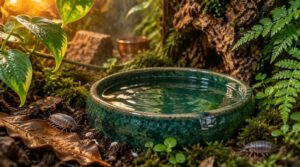
Pick nonporous materials first. Everything else about your water dish depends on that choice. Bioactive enclosures run warm, damp, and alive, so a dish with tiny pores becomes a bacterial hotel fast.
If you’re comparing options, this guide to reptile water dishes for bioactive terrariums shows which sizes and sealed materials hold up best around isopods and live plants.
Glazed ceramic dishes are the best choice. They’re heavy, easy to scrub, and chemically inert, so they won’t touch your water’s pH. Sealed resin bowls work too, as long as the sealing is complete. Look for nonporous surface technology that resists staining and slime. Anything labeled foodgrade material is a safe bet for plastic.
Skip unsealed wood, raw stone, and bare metals like copper or zinc. They leach, corrode, or harbor pathogens. Your isopods and springtails will pay for it first. Smooth interiors protect them from scrapes too. In a healthy setup, the clean-up crew of isopods and springtails breaks down waste and prevents mould, which is why keeping their environment free of harmful materials matters.
Size Water Dishes for Your Snake
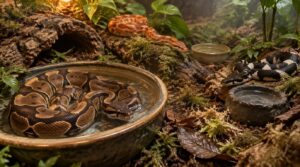
Your snake’s water dish needs to fit its body, not just your enclosure. Too small and it can’t soak; too big and it eats up floor space and spikes humidity. Here’s how to size the dish for three popular species.
Ball Python Water Dish Sizing
A ball python soaks to hydrate and shed, so your dish has to fit the whole snake. That’s speciesspecific sizing at work. In a 4’x2’x2′ bioactive terrarium, go with roughly 11"x8"x2.4" or bigger. Check dish diameter first, then water depth.
If your snake is still growing, this ball python water bowl size guide shows how to scale the dish as juveniles mature into adults.
Park it at the cool end, away from hides and plants. Skip anything smaller. Cramped dishes mean cramped, stressed snakes.
Corn Snake Water Dish Sizing
Corn snakes are the easier call. They rarely soak, so you’re sizing for drinking and the occasional pre-shed bath. That’s speciesspecific sizing again.
For an adult, go with a dish diameter of 6 to 8 inches. Keep water depth at 2 to 4 inches. Juveniles do fine with 3 to 4 inches across. In a bioactive vivarium, stay under 25%.
Boa Constrictor Water Dish Sizing
Boas flip the script. Unlike corn snakes, they soak often, so you’re sizing for a full bath.
Since boas need steady belly heat even in cooler rooms, a thermostat-controlled reptile heating mat for basement setups can help you hold that warm side without surprises.
Here’s what works in bioactive terrariums:
- Pick a heavy dish, about 18 liters, so it won’t tip.
- Match dish diameter to most of your boa’s body.
- Keep water depth shallow for young snakes.
- Choose cool-end placement for steadier humidity control and better thermoregulation.
Position Water Dishes for Balanced Humidity
A water dish’s placement decides more than where your snake drinks. In bioactive terrariums, it’s your main tool for humidity control, so choose the spot deliberately.
Warm side? Evaporation climbs fast, which suits dry rooms but risks overheated, stale water. Cool side? Humidity stays steadier and bacteria grow slower. Keep dishes away from vents, or you’ll refill constantly.
| Placement | What your snake feels |
|---|---|
| Warm side | Swampy, stifling air |
| Cool side | Calm, steady comfort |
| Near vents | Constant dry misery |
| Mid-enclosure | Even, easy breathing |
Middle placement balances both zones evenly. For best humidity regulation, set the dish over drainage layers so slow seepage keeps substrate damp without waterlogging. Then check water bowl stability: wedge it level, because a tipped dish floods everything.
Prevent Spills and Protect Cleanup Crews
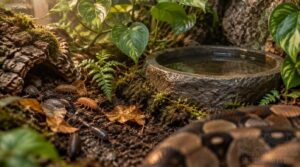
A tipped bowl does more damage than a soggy corner. Isopods can’t swim, so a puddle can drown your cleanup crew within minutes.
A tipped water bowl can drown your isopod cleanup crew in minutes, so secure it before you worry about anything else
Start with water bowl stability. Choose heavy, low-profile sealed resin bowls with wide bases, and skip deep, narrow containers that big boas shove around. Wedge the dish into a corner against stable decor, or sink it partway into the substrate.
Fill dishes only halfway. Overflow happens when a snake climbs in.
Placement matters for the crew. Keep damp refuges, like cork bark and leaf litter, well away from the dish, so isopods find moisture without risking a swim. Check levels daily and watch your hygrometer for sudden spikes, which signal a leak. Bioactive cleanup depends on it.
Keep Water Fresh and Dishes Clean
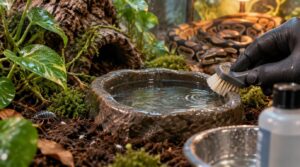
Imagine you glance at your ball python’s bowl and the water looks hazy, with a slick film along the rim. That’s biofilm, and it’s your cue to act now.
Make daily water conditioning your habit. Refill with dechlorinated water, and add ReptiSafe if your tap needs it. Remove waste and uneaten food every day, too.
Scrub weekly. For biofilm prevention, wipe sealed resin bowls with chlorhexidine, or soak them in a 10% bleach solution and rinse until no smell lingers. Skip harsh sprays near the substrate. They’ll wipe out your cleanup crew.
Cloudy water or visible algae? Dump it, clean it, refill it. That’s real water quality maintenance, and it keeps your snake safe. Trust your eyes and nose.
Frequently Asked Questions (FAQs)
How can I make a DIY water dish for my reptile enclosure?
Is DIY toxic? Not with inert materials. For your bioactive vivarium, build reptile water dishes from glass or ceramic, seal with aquarium-safe silicone, and choose a nonporous surface for biofilm prevention and water quality maintenance.
What can I use as a drainage layer for a bioactive terrarium?
Think of your enclosure’s floor as a sponge’s basement. Use Hydroballs, egg crate, or foam as a drainage system.
Their water retention keeps your bioactive substrate from drowning, protecting your bioactive habitat and bioactive habitat.
What type of water is best for terrariums?
Spring water wins for most terrariums. It’s consistent, mineral-rich, and safe to drink without treatment. Using tap? Condition tap water first, since chlorine and chloramines need ReptiSafe water conditioner. Skip softened water. Water quality matters.
Can reptiles drink from a Flukers Mini Dripper?
Yes, if they lick leaves. The Flukers Mini Dripper suits chameleons, geckos, and anoles in a bioactive vivarium. Snakes mostly need a bowl for reptile hydration safety. Watch your water quality; drips aid drowning prevention.
Does ReptiSafe work for bioactive water dishes?
Wondering if your cleanup crew can handle treated water? Yes. ReptiSafe experiences chlorine removal, so use one drop per cup. It maintains microbial balance, keeps springtails and isopods safe, and improves water quality between terrarium maintenance rounds.
Can isopods and springtails survive inside water dishes?
A water dish is a quiet trapdoor. Isopods drown fast if they fall in, since they breathe moist air, not liquid. Springtails ride the surface tension and float fine. Choose Reptile Water Dishes carefully, for microfauna protection.
How does ammonia from waste affect dish water?
Ammonia turns your water bowl into a toxic soup, fast. It spikes pH, harms your snake when it drinks, and starves microbial balance. Nitrites follow, and bioactive balance suffers, so spot-clean waste immediately.
Conclusion
Picture a keeper named Dana who swapped her ball python’s flimsy plastic bowl for a heavy ceramic dish, set it on the warm side, and rimmed it with stones. No more floods. No more dead isopods.
That’s what good water dishes for bioactive enclosures do. They protect your snake, your cleanup crew, and your substrate balance at once. Choose safe materials, size them right, place them smart, and keep them clean. Nail it, then relax.
- https://www.pangeareptile.com/blogs/blog/what-you-should-consider-before-building-a-bioactive-enclosure
- https://www.zenhabitats.com/blogs/reptile-care-sheets-resources/how-to-build-a-bioactive-enclosure-for-arid-reptiles
- https://postpods.co.uk/blogs/news/the-complete-guide-to-creating-a-bioactive-terrarium