This site is supported by our readers. We may earn a commission, at no cost to you, if you purchase through links.

A snake that can’t escape the heat will cook—and one that can’t find it will slowly shut down. Getting this balance wrong isn’t a matter of comfort; it’s a matter of survival.
Most keepers focus on the snake itself: the species, the feeding schedule, the humidity. The heating pad quietly runs underneath all of it, doing the real work.
Too small, and your snake never reaches proper digestion temperatures. Too large, and you’ve eliminated the cool side your animal depends on to regulate its own body temperature. Choosing the right snake heating pad size, wattage, and placement makes every other care decision work the way it should.
Table Of Contents
- Key Takeaways
- Choose The Right Heating Pad Size
- Top 5 Snake Heating Pads
- Frequently Asked Questions (FAQs)
- How to choose heating mat size for reptiles?
- What is the difference between 150w and 200w underfloor heating?
- What size reptile heat mat do I need?
- What size heating pad for corn snake?
- What is a standard size heating pad?
- What watt heat mat for snake?
- How big is a snake heating pad?
- Do snakes need heating pads?
- What is the best heating pad for snake enclosures?
- What is a good heat mat for a pet snake?
- Conclusion
Key Takeaways
- Your heating pad should cover roughly one-third of the enclosure floor — enough to create a warm zone without eliminating the cool side your snake needs to self-regulate.
- Pad size isn’t one-size-fits-all: a 6×8 inch mat suits 20-gallon tanks, while 40-gallon setups need something closer to 8×12 inches.
- Never run a heating pad without a thermostat — snakes can’t escape heat they can’t feel coming, and overheating creeps in quietly before you notice something’s wrong.
- Your snake’s age matters when sizing up: juveniles need one-quarter to one-third floor coverage, while adults do better with one-third to one-half.
Choose The Right Heating Pad Size

Getting the size right is honestly the most important step — everything else depends on it. A pad that’s too small won’t warm your snake properly, and one that’s too large creates heat your snake can’t escape.
Getting this measurement right is easier when you have a solid reference, like this snake heating pad buying guide that walks you through sizing for different enclosures.
Here’s what you need to know before you buy.
Measure The Enclosure Floor Correctly
Getting the measurement right is the foundation of everything else. Grab a flexible tape and run it across the longest and widest points of your enclosure floor — that’s your tape measurement technique in action. Always double-check from opposite corners for corner measurement validation. Ensuring a properly sized enclosure delivers clean‑room‑style protection for your equipment.
Follow these steps:
- Record length and width in square inches
- Note any irregular shape accounting for ridges or dips
- Factor in substrate thickness, since it affects heat transfer
- Use your square inch calculation to match size and wattage guidelines for heating pads
Follow The One-third Floor Coverage Rule
Once you’ve got your floor measurements, the one-third rule becomes your best friend. Your heat mat should cover roughly one-third of the enclosure floor — no more. This creates the gradient calibration your snake needs to self-regulate.
Too much coverage eliminates the cool side, causing thermal stress. Think of it like a built-in thermostat your snake controls with its own two feet.
Match Pad Size to Tank Gallons
Tank size and gallon benchmarks handle the main considerations here. Once you know your floor dimensions, matching the pad size becomes straightforward.
- 20-gallon tanks: use a 6″ × 9″ pad
- 40-gallon tanks: aim for 9″ × 12″
- 60-gallon tanks: choose around 12″ × 12″
- 100-gallon tanks: go with 16″ × 12″
- 120-gallon tanks: size up to 20″ × 12″
Dimension scaling ensures your area ratio guide remains consistent, maintaining roughly one-third coverage every time.
This same one-third principle applies across tank sizes, as explained in this reptile heating pad sizing and wattage guide covering everything from measurements to power requirements.
Size Pads for Glass Tanks Vs Tubs
Glass tanks and tubs heat differently, so pad sizing isn’t one-size-fits-all. For glass, edge load distribution matters — choose a pad that extends at least 2 inches beyond the tank base. Silicone adhesive benefits include better grip and reduced vibration-damping stress on glass seams.
For tubs, aim for 60–75% tub floor coverage, with pad material compatibility in mind.
Adjust Pad Size for Juvenile and Adult Snakes
Your snake’s age changes everything about heat mat sizing. Growth stage scaling means a hatchling and a full-grown adult have very different thermal gradient width needs.
- Juveniles: Cover one-quarter to one-third of the floor
- Adults: Scale up to one-third to one-half coverage
- Species-specific coverage: Match behavioral heat preference to warm-zone size
- Age-based wattage: Increase wattage as your snake grows
Avoid Oversized and Undersized Heat Mats
Size matters more than most keepers realize. A pad that’s too big creates thermal hotspots and wastes energy; one that’s too small leaves cold zones that your snake can’t escape.
Both harm long-term pad durability and consistent substrate warmth — key factors for stress-free shedding and overall health.
| Mat Fit | Problem |
|---|---|
| Oversized (>50%) | Overheating, energy waste |
| Undersized ( Overheating creeps in silently until your glass cracks and your snake stops moving |
That’s why thermostat redundancy and cut-off alerts aren’t optional extras; they’re your safety net.
| Risk | Prevention |
|---|---|
| Burns | Insulation barriers + thermostat safety |
| Glass stress | Size and wattage guidelines |
| Fire hazards | Data logging + cut-off alerts |
Top 5 Snake Heating Pads
Not all heating pads are built the same, and the one you pick can make a real difference for your snake’s health.
These five options cover a range of tank sizes, wattages, and features worth knowing about. Here’s what made the cut.
1. Aiicioo Reptile Terrarium Heating Pad
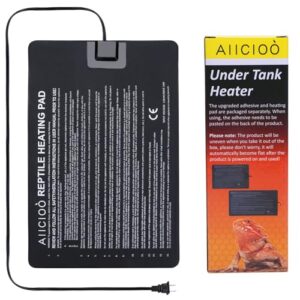
The Aiicioo Reptile Terrarium Heating Pad is a solid pick for mid-sized setups. It measures 8 by 6 inches and runs at either 8 or 16 watts, making it a good match for 10 to 20 gallon tanks.
The nichrome heating element delivers steady, even warmth — no hot spots, no guesswork. You’ll want to pair it with an external thermostat, since there’s no built-in controller.
Keep an eye on the adhesive edges over time, as they can lift with extended use.
| Best For | Reptile owners with medium-sized tanks (30–40 gal) who need reliable, fuss-free belly heat for geckos, snakes, or hermit crabs. |
|---|---|
| Wattage | 16 W |
| Pad Size | 14×8 in |
| Voltage | 120 V AC |
| Temp Range | 104–122 °F |
| Adhesive Backing | Yes |
| Waterproof | No |
| Additional Features |
|
- Nichrome heating element runs evenly with no hot spots, so your reptile gets consistent warmth across the mat
- Easy plug-and-play setup — adhesive backing and rubber feet mean no tools, no hassle
- Low 16W draw makes it practical to run 24/7 without stressing about your electricity bill
- No built-in thermostat, so you’ll need to buy one separately to avoid overheating risks
- Adhesive edges can start peeling over time and may need occasional re-pressing or full replacement
- Not safe for plastic, acrylic, or water-filled tanks, which limits where you can actually use it
2. Repti Zoo Adjustable Reptile Heat Pad
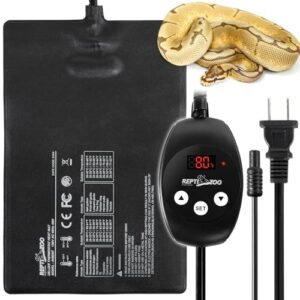
The Repti Zoo Adjustable Reptile Heat Pad gives you real control — and that matters when you’re keeping sensitive animals. Its built-in digital thermostat, adjustable from 68°F to 122°F, ensures precision, while the waterproof PVC surface effectively manages humidity. The 8 × 12 inch pad operates at 24 watts, making it efficient for maintaining warm zones.
One caveat: Some users report occasional temperature overshoot, so keep an independent thermometer on hand to verify accuracy. This precaution ensures safety despite the pad’s advanced features.
Pair it with a 20-gallon tank for optimal warm-zone results, balancing performance and reliability in your reptile’s habitat.
| Best For | Reptile owners and hobbyists who want hands-on temperature control for sensitive animals like geckos, bearded dragons, or snakes — and anyone dabbling in fermentation or seed germination who needs steady, reliable heat. |
|---|---|
| Wattage | 24 W |
| Pad Size | 12×8 in |
| Voltage | 120 V AC |
| Temp Range | 68–122 °F |
| Adhesive Backing | Yes |
| Waterproof | Yes |
| Additional Features |
|
- Wide temp range (68–122°F) gives you real flexibility for different species and uses
- Waterproof PVC surface holds up in humid terrariums and wipes down easily
- Runs continuously at 24W without hogging power
- Thermostat can overshoot by up to 10°F, so you’ll want a backup thermometer to stay safe
- The adhesive backing tends to lose its grip over time and may peel away from the glass
- Struggles to hit higher temps in cooler rooms, which could be a problem for baby reptiles needing extra warmth
3. BN Link Reptile Heating Pad
The BN-Link Reptile Heating Pad offers reliable heat without the bells and whistles, making it a straightforward choice for reptile owners. The 12 × 8 inch, 16-watt pad heats up quickly to 104°F–122°F, ideal for 10–20 gallon tanks. Its waterproof, flexible surface effectively manages humidity and adheres securely to glass bottoms, ensuring durability and ease of use.
However, the pad lacks built-in temperature control, so pairing it with an external thermostat is essential. This addition guarantees a safe and consistent warm side for your snake, preventing overheating and maintaining optimal conditions.
| Best For | Reptile and small animal owners who want a simple, affordable heating solution for 10–20 gallon tanks and don’t mind pairing it with a separate thermostat. |
|---|---|
| Wattage | 16 W |
| Pad Size | 12×8 in |
| Voltage | 120 V AC |
| Temp Range | 104–122 °F |
| Adhesive Backing | Yes |
| Waterproof | Yes |
| Additional Features |
|
- Heats up fast and holds a solid 104°F–122°F range, giving your pet a reliable warm spot
- Waterproof and flexible build makes it easy to clean and holds up well in humid setups
- Low 16W power draw keeps energy costs down without sacrificing warmth
- No built-in temperature control means you’ll need an external thermostat to avoid overheating
- Adhesive can weaken over time, especially along the edges, and may need reinforcing
- Some users have reported uneven heat distribution or section failures, so quality can vary
4. BN-LINK Reptile Heating Pad
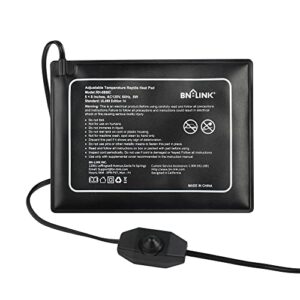
The BN-LINK Reptile Heating Pad delivers built-in temperature control right out of the box. The 6×8 inch, 8-watt pad fits 10–20 gallon tanks and includes a digital thermostat controller — no separate purchase needed.
Its waterproof silicone surface withstands humidity well, and the adhesive backing keeps it flush against glass.
One heads-up: The dial lacks clear markings, so always verify your temps with an infrared thermometer before your snake settles in.
| Best For | Reptile and small animal owners with 10–20 gallon tanks who want a simple, low-cost heating solution without a lot of setup. |
|---|---|
| Wattage | 8 W |
| Pad Size | 6×8 in |
| Voltage | 120 V AC |
| Temp Range | 104–122 °F |
| Adhesive Backing | 3M Adhesive |
| Waterproof | No |
| Additional Features |
|
- Flexible, waterproof silicone holds up well in humid enclosures
- Adhesive backing makes installation quick — no brackets or tools needed
- Energy-efficient 8W draw keeps electricity costs low over time
- Dial has no clear temperature markings, so you’ll need an external thermometer to dial in accurate temps
- Adhesive can lose grip on textured surfaces over time
- No built-in over-temperature protection — a separate thermostat is strongly recommended for safety
5. Lucky Herp Reptile Heating Pad
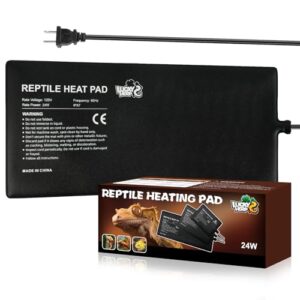
Lucky Herp Reptile Heating Pad offers enhanced coverage for medium enclosures. At 8×18 inches and 24 watts, it accommodates tanks ranging from 20 to 40 gallons.
Its waterproof PVC surface ensures easy cleaning, while the flexible build allows hassle-free positioning.
Note the single-use adhesive—careful placement is essential. For optimal temperature control, pair it with a separate thermostat.
| Best For | Reptile and amphibian owners with medium-sized enclosures (20–40 gallons) who want a low-cost, easy-to-install belly heat solution. |
|---|---|
| Wattage | 24 W |
| Pad Size | 8×18 in |
| Voltage | 120 V AC |
| Temp Range | Adjustable |
| Adhesive Backing | Double-sided |
| Waterproof | Yes |
| Additional Features |
|
- Wide 8×18-inch surface gives solid coverage for medium tanks without breaking the bank on energy costs.
- Waterproof, flexible PVC makes it easy to clean and simple to position during setup.
- Heats up fast and stays consistent, helping keep your reptile’s metabolism and appetite on track.
- The adhesive is single-use and can struggle to stick to glass, so one wrong placement and you’re tossing the whole pad.
- The built-in thermostat isn’t always accurate—you’ll really want a separate one to stay safe.
- Not powerful enough for large tanks; a 55-gallon setup will leave your animals hunting for warmth.
Frequently Asked Questions (FAQs)
How to choose heating mat size for reptiles?
Measure your enclosure floor, then cover one-third to one-half of it with a heating mat. That single rule creates a warm zone and a cooler retreat your reptile actually needs.
What is the difference between 150w and 200w underfloor heating?
The main difference is speed and power. A 200w mat heats up faster and suits larger spaces, while a 150w mat works well for smaller enclosures with good insulation.
What size reptile heat mat do I need?
Your heat mat should cover about one-third of the enclosure floor. For most setups, a 6×8 inch mat works for 20-gallon tanks, while 40-gallon tanks need an 8×12 inch mat.
What size heating pad for corn snake?
For a corn snake, a 6×8 inch heating pad works well for a 20-gallon tank. It covers roughly one-third of the floor, giving your snake a proper warm zone without overheating the enclosure.
What is a standard size heating pad?
A standard heating pad measures 12 by 24 inches and runs between 60 and 120 watts. That single size covers most back and shoulder areas — or roughly one-third of a typical reptile enclosure floor.
What watt heat mat for snake?
For most snakes, a 4–8 watt mat works in tanks up to 20 gallons. Go with 16–24 watts for 40-gallon setups. Cold rooms may need higher wattage to hold steady temps.
How big is a snake heating pad?
Size-wise, you’ve got options! Most snake heating pads range from small 4×5 inches to large 8×12 inches, designed to cover roughly one-third of your enclosure’s floor area.
Do snakes need heating pads?
Yes, your snake absolutely needs a heating pad. Reptiles can’t generate their own body heat, so belly warmth drives digestion, immunity, and metabolism. Without it, expect lethargy, refused meals, and real health risks.
Since dry air also pulls moisture from reptile skin and strains the kidneys, pairing that warmth with the right reptile humidity levels keeps your snake properly hydrated.
What is the best heating pad for snake enclosures?
Your best pick depends on your tank size and setup. The BN-LINK and Zoo Med ReptiTherm are reliable, thermostat-compatible choices that deliver steady, safe belly heat for most snake enclosures.
What is a good heat mat for a pet snake?
A good heat mat covers one-third of your enclosure floor, matches your tank’s wattage needs, and always pairs with a thermostat.
Brands like BN-LINK and Zoo Med are solid, reliable choices.
Conclusion
The theory that any heating pad will do falls apart the moment your snake stops eating or hides in the wrong corner for days. A proper snake heating pad size guide doesn’t just protect your animal—it makes every other care decision actually work.
Right size, right wattage, right placement. That combination gives your snake what it’s always doing anyway: choosing between warm and cool to keep itself alive. Now you’re just making that choice possible.