This site is supported by our readers. We may earn a commission, at no cost to you, if you purchase through links.

A ball python in a corn snake setup will struggle through every shed. A corn snake in a ball python setup will fight scale rot. The snakes aren’t the problem. The substrate is.
Ball pythons need 60-80% ambient humidity, boas hold at 55-75%, and corn snakes stay comfortable at 30-50%. Your terrarium substrate mixes for humid environments decide whether your enclosure hits those numbers or swings between swamp and desert.
Coconut fiber and cypress mulch hold moisture without molding. Sphagnum moss soaks up 15-20 times its weight in water. Layer them right, and your humidity stays steady, your snake sheds clean, and mold never gets a foothold.
Table Of Contents
- Key Takeaways
- Match Substrate Humidity to Your Snake
- Balance Moisture Retention, Aeration, and Drainage
- Top 4 Products for Humid Substrate Mixes
- Mix Substrates for Humid Snake Terrariums
- Layer Substrate to Create Safe Humidity Gradients
- Maintain Humid Substrates and Prevent Mold
- Frequently Asked Questions (FAQs)
- Conclusion
Key Takeaways
- Match your substrate to your snake’s humidity needs, since ball pythons want 60-80%, boas 55-75%, and corn snakes only 30-50%, and watch each shed to fine-tune from there.
- Pair moisture-holders like coconut fiber or sphagnum moss with orchid bark, perlite, or charcoal, because a mix that holds water without airflow turns sour while one that drains too freely leaves you dry.
- Build a humidity gradient with a damp zone covering about 30% of the floor and a drier zone covering 70%, so your snake can choose and you avoid standing water that causes scale rot.
- Keep mold away by checking weekly with a hygrometer, misting only specific zones, removing waste and shed skin promptly, and adding springtails as a natural cleanup crew.
Match Substrate Humidity to Your Snake
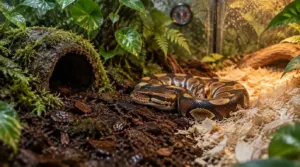
Species-specific humidity targets decide everything else in your setup, so start there. Ball pythons need 60-80% ambient humidity, boas run 55-75%, and corn snakes stay comfortable at just 30-50%. Each number points to a different substrate choice. Coconut fiber and cypress mulch offer strong moisture retention without molding easily, which suits ball pythons. Aspen dries fast and molds when wet, so keep it for corn snakes.
Once you’ve matched humidity to your species, this breakdown of the substrate that retains humidity best shows how each option holds up between misting sessions.
Your snake also has a say. Some ball pythons shed cleanly at 50-60%, while others demand 70-80% or a damp moss hide. Watch each shed and adjust your substrate moisture regulation to match, rather than trusting a fixed percentage.
Build a humidity gradient too, with one damp zone and one drier zone, so your snake can choose. Mix water into the substrate instead of leaving standing water in the enclosure, since preventing scale rot depends on it.
Balance Moisture Retention, Aeration, and Drainage
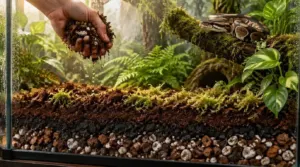
Humidity targets tell you what your snake needs. Your substrate decides whether you can deliver it. A mix that soaks up water but never breathes turns sour fast, and one that drains too freely leaves your ball python’s enclosure bone dry by Tuesday.
Your snake’s humidity needs mean nothing if your substrate can’t deliver them, because mixes that hold water without airflow turn sour, while those that drain too freely leave you bone dry
Aim for moisture retention that’s backed by air. Sphagnum moss holds 15-20 times its weight in water, while coir resists compaction. Pair them with orchid bark or perlite, and you’ve got the aeration and drainage balance that keeps roots, microbes, and scales healthy.
Build in this order:
- Start with a 2:1 ratio of coir or moss to bark or perlite.
- Add 10-15% charcoal to curb anaerobic pockets.
- Layer coarse material below, fine above.
- Test the humidity buffering capacity after a week.
Squeeze a handful. A few drops means you’re right.
Top 4 Products for Humid Substrate Mixes
Great humidity starts with the right base, and these four products give you a solid foundation. Each one earns its place by holding steady moisture without turning your enclosure into a swamp. Here’s what you’ll want to know before you start mixing.
1. Sukh Sphagnum Moss for Reptiles
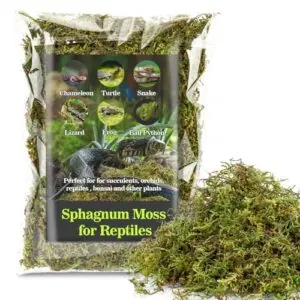
Picture a damp forest floor, soft and springy, holding moisture the way a sponge holds water. That’s what Sukh Sphagnum Moss gives your enclosure.
Pair it with a good hygrometer and a few smart habits, and you can keep humidity steady, as this guide to snake enclosure humidity control explains.
It absorbs up to 20 times its weight in water, so humidity stays steady between misting sessions. The fibrous structure lets air move through, and its natural antibacterial properties help keep mold in check.
Mix it with poplar shavings for snakes. Don’t use it alone, and keep it damp, not soggy. Some keepers dislike its odor.
| Best For | Keepers of tropical reptiles who want to maintain steady humidity in a terrarium and are willing to keep up with regular moisture maintenance. |
|---|---|
| Weight | 5.6 ounces |
| Dimensions | 12.68 x 8.9 x 0.51 inches |
| Moisture Retention | Highly absorbent, stable humidity |
| Animal Suitability | Tropical reptiles |
| Plant Use | Orchids, ferns, succulents |
| Main Drawback | Needs upkeep; mixed odor opinions |
| Additional Features |
|
- Absorbs and holds moisture well, which keeps humidity stable
- Gives reptiles soft, natural hiding spots and nesting material
- Provides a moist surface that helps reptiles shed
- Needs regular upkeep to stay clean and moist without becoming too wet
- Can’t be the only substrate for every reptile, since snakes need mixed substrates
- Some users find the odor unpleasant
2. Natural Sphagnum Moss Terrarium Substrate
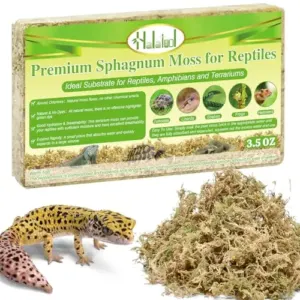
Halatool’s Natural Sphagnum Moss comes as a compressed brick, just 3.5 oz (100 g) and under half an inch thick. Add water and it expands into a fluffy, fibrous layer that holds humidity for your bearded dragons, geckos, snakes, and salamanders.
It’s dye-free and nearly odorless, which sets it apart from stronger-smelling picks.
Soak it, then squeeze out the excess water before use. You want it damp, never dripping. Customer feedback on its looks is mixed, so test it in a humid hide first.
| Best For | Reptile and amphibian keepers, including owners of bearded dragons, geckos, snakes, salamanders, box turtles, and hermit crabs, who want a natural, dye-free substrate that holds humidity. |
|---|---|
| Weight | 3.5 oz (100 g) |
| Dimensions | 8.46 x 5.2 x 0.47 inches |
| Moisture Retention | Holds moisture for humidity |
| Animal Suitability | Reptiles, amphibians, box turtles, hermit crabs |
| Plant Use | N/A |
| Main Drawback | Mixed appearance feedback |
| Additional Features |
|
- Compressed brick expands significantly when hydrated, so a small, lightweight 3.5 oz package goes a long way
- Natural, dye-free, and nearly odorless sphagnum moss
- Holds moisture well to keep terrarium humidity steady
- Needs to be soaked and squeezed out before use, so it takes a little prep
- Appearance gets mixed customer feedback
- Packaging dimensions may vary slightly
3. ZeeDix Coconut Fiber Reptile Substrate 2-Pack
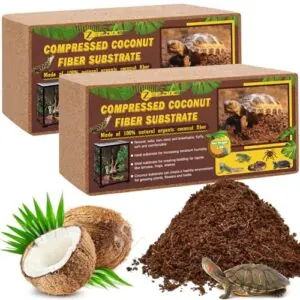
A compressed brick of coconut fiber substrate looks unremarkable until you soak it. Each ZeeDix pack measures 7.8 x 3.9 x 1.97 inches and weighs 1.4 lbs, then swells into a loose, fluffy bedding once hydrated.
Soak it for 15 to 30 minutes, break it apart, and fluff it. You’ll get roughly 8 to 10 quarts per brick.
It holds moisture without turning soggy, absorbs waste, and cuts odors. Rinse it first if your animal is sensitive to salt, and never use it dry.
| Best For | Reptile, amphibian, and invertebrate keepers, such as owners of snakes, frogs, tarantulas, or hermit crabs, who want a natural, biodegradable bedding that also works for gardening. |
|---|---|
| Weight | 1.4 LB per pack |
| Dimensions | 7.8 x 3.9 x 1.97 inches |
| Moisture Retention | Absorbs liquids and waste |
| Animal Suitability | Reptiles, amphibians, invertebrates |
| Plant Use | Plants, flowers, herbs, vegetables |
| Main Drawback | May contain salt; mixed durability |
| Additional Features |
|
- Absorbs liquids and waste while cutting down on odors in the enclosure
- Made from 100% natural coconut fiber that is low in EC, pH balanced, biodegradable, and compostable
- Works for many animals and can also be used to grow plants, herbs, and vegetables
- Must be soaked in water before use and can’t be used dry
- May contain salt, so rinsing is recommended for sensitive animals
- Durability feedback is mixed, with some users finding it hard to break apart
4. Riare 4 oz Natural Sphagnum Moss
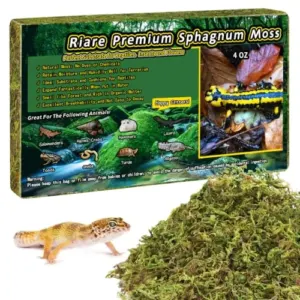
Riare’s 4 oz sphagnum moss arrives flat and lightweight, then expands when soaked into a fluffy, soft layer you can tuck into any humid mix.
It holds moisture and releases it slowly, which keeps your snake’s humid zone steady between misting sessions. Because it’s sun-dried forest moss, it’s low in dust and impurities, and it encourages natural digging and burrowing.
Buyers report an unnatural green hue, and reviews are mixed on authenticity, so inspect it on arrival and rinse it.
| Best For | Reptile, amphibian, and invertebrate keepers who want a soft, moisture-holding substrate that encourages natural burrowing in a naturalistic terrarium. |
|---|---|
| Weight | 4 ounces |
| Dimensions | 8.66 x 5.91 x 0.75 inches |
| Moisture Retention | Retains and slowly releases moisture |
| Animal Suitability | Reptiles, amphibians, invertebrates |
| Plant Use | Garden plants, potted decoration |
| Main Drawback | Unnatural color; mixed quality |
| Additional Features |
|
- Expands into a fluffy, soft layer when soaked in water
- Holds moisture and releases it slowly to keep humidity steady
- Made from sun-dried forest moss that is low in dust and impurities
- Some customers report an unnatural green hue
- Reviews are mixed on the durability and authenticity of the moss
- Feedback on long-term quality and consistency is mixed
Mix Substrates for Humid Snake Terrariums
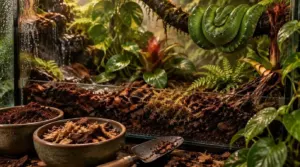
A humid snake enclosure is only as good as the mix beneath it. Below are two proven substrate recipes, one built for simplicity and one built to run itself. Pick the one that fits your setup, and you’ll hold humidity steady without the daily misting.
Simple Non-Bioactive Substrate Recipe
You don’t need a lab to nail humidity control. Mix coconut coir, topsoil, and play sand, then add sphagnum moss for moisture retention. Sand works as your drainage layer, so substrate layering stays optional here.
| Part | Share | Job |
|---|---|---|
| Topsoil | 40% | Burrowing base |
| Coir | 40% | Holds humidity |
| Play sand | 20% | Drains |
Mix thoroughly, mist lightly, and spot-clean weekly for easy upkeep.
Bioactive Mix With Leaf Litter
Picture a forest floor shrunk to fit your enclosure, damp and layered, alive with tiny workers. That’s what bioactive soil mixes do best.
Mix orchid bark, sphagnum moss, and charcoal, then top it with one to two inches of oak or magnolia leaf litter. It boosts moisture retention, feeds your microfauna, and needs updating every four to eight weeks.
Layer Substrate to Create Safe Humidity Gradients
Your snake shouldn’t have to choose between soaked and parched. Give it both, side by side.
To layer substrate for a gradient, start with 2-3 cm of gravel or clay balls for drainage. Add 5-8 cm of organic-rich mix on top. Cap the damp end with 3-5 cm of sphagnum moss, squeezed to wrung-out sponge consistency. Keep the moist zone to 30% of the floor and leave 70% dry. Build a slope or low dam so water can’t creep across.
Good substrate layering also needs a 10-15 cm buffer zone, so your snake can acclimate. Finish the dry side with 2-3 cm of leaf litter.
Vent low on the moist side, high on the dry, for a humid terrarium environment.
Maintain Humid Substrates and Prevent Mold
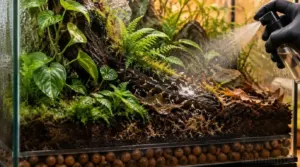
A humid substrate is a living system, and mold is what happens when you stop watching it. Your goal is steady moisture retention without a soggy base, so check the enclosure at least weekly. A digital hygrometer thermometer placed on the humid side lets you track humidity and temperature at a glance between weekly checks.
Spot clean any fuzz with a 1:1 mix of 3% hydrogen peroxide and water. Let it sit 10 to 15 minutes, then wipe it away.
Keep these habits in your routine:
- Remove shed skin, waste, and uneaten food before they rot.
- Mist specific zones only, never the whole tank.
- Keep a drainage layer clear so water can escape.
- Add springtails early for natural cleanup crews.
Sphagnum moss and coco coir give you strong mold resistance, while smart substrate layering keeps the dry side dry. Hold airflow steady, and your humid terrarium environment stays healthy.
Frequently Asked Questions (FAQs)
How often should humid terrarium substrate be fully replaced?
Swap non-bioactive humid substrate fully every 30 to 60 days. Bioactive setups rarely need it; refresh the top inches for substrate compaction avoidance and moisture retention.
Change sooner if mold, odor, or soggy soil appears.
Can orchid bark be mixed into humid substrates?
Yes, and you should. Orchid bark boosts aeration and drainage in humid mixes, but only as a partner. Mix it with moisture-retentive sphagnum or coconut fiber, so you keep humidity without soggy, moldy, compacted substrate.
What depth of substrate suits burrowing reptiles and amphibians?
You bought a burrower, then gave it a puddle of mulch. Substrate depth optimization starts with body height: dedicated burrowing species need 6 to 12 inches, while corn snakes and frogs do fine with 3 to
Do springtails and isopods help in humid enclosures?
Want a self-cleaning enclosure? Springtails and isopods deliver. Springtails graze mold while isopods shred leaf litter, so bioactive soil mixes stay fresh.
Pair them with terrarium humidity control, natural forest floor replication, microfauna population monitoring.
Can expanded clay drainage media be reused safely?
You’ll basically never wear out expanded clay. Boil it ten minutes or soak it in diluted peroxide, rinse well, and toss pieces with exposed cores. That keeps your drainage layer safe, clean, and ready for another build.
Conclusion
Picture a ball python named Juniper, sitting in a bin of dry aspen and stuck in a half-finished shed. Swap that bin for coconut fiber layered over damp sphagnum, and the problem vanishes within a shed cycle.
That’s why the right terrarium substrate mixes for humid environments matter. Match the mix to your species, keep the top layer drier than the bottom, and check for mold weekly. Get the layers right and it runs itself.