This site is supported by our readers. We may earn a commission, at no cost to you, if you purchase through links.

Sphagnum moss can hold up to 20 times its own weight in water—a property that makes it indispensable in humid terrariums, yet completely wrong for species needing drier zones between mistings. That single difference illustrates why substrate selection determines whether your enclosure thrives or declines.
The wrong material doesn’t just affect humidity readings; it shifts microbial activity, compaction rates, and the structural integrity of burrows your animals depend on. These factors collectively influence the enclosure’s stability and inhabitant health.
Coconut coir, cypress mulch, orchid bark, and bioactive soil mixes each manages moisture, aeration, and biological load differently. Understanding these distinctions gives you precise control over the microhabitat you’re building, ensuring tailored conditions for specific species requirements.
Table Of Contents
- Key Takeaways
- Best Substrates for Humid Environments
- Top 8 Humid Terrarium Substrates
- 1. Zilla Jungle Mix Terrarium Substrate
- 2. Josh Frogs ABG Bioactive Soil
- 3. Riare Coconut Coir Terrarium Substrate
- 4. Riare Expanded Clay Terrarium Substrate
- 5. Exo Terra Bioactive Volcanic Terrarium Substrate
- 6. Josh Frogs Tree Fern Substrate
- 7. Josh Frogs Tropical Bioactive Substrate
- 8. JOR Mahogany Leaf Litter for Frogs
- Moisture Retention and Drainage
- Bioactive Versus Standard Substrates
- Species-Specific Substrate Needs
- Maintenance, Mold, and Longevity
- Frequently Asked Questions (FAQs)
- What is the best substrate for humid hides?
- What substrate lowers humidity?
- What substrate reduces humidity?
- What is the best flooring for high humidity?
- What is the best material for high humidity walls?
- What materials are resistant to humidity?
- How often should I completely replace substrate?
- Can I mix different substrates together safely?
- What depth works best for burrowing species?
- Do substrates affect enclosure temperature control methods?
- Conclusion
Key Takeaways
- Substrate choice controls more than humidity — it shapes microbial activity, burrow stability, and long-term enclosure health in ways a hygrometer alone won’t reveal.
- No single material fits every setup: sphagnum moss excels in humid hides, coconut coir suits burrowing species, orchid bark improves drainage, and cypress mulch creates the moisture gradients that tropical species actually need.
- Layering substrates — pairing a chunky drainage base like expanded clay with an organic top layer — gives you precise control over moisture flow and prevents the anaerobic saturation that leads to scale rot and mold.
- Maintenance determines longevity: spot-clean twice weekly, fluff the top layer every one to two weeks, and replace non-bioactive bedding every one to two months, or stretch bioactive setups to 18 months with an active springtail and isopod crew.
Best Substrates for Humid Environments

Not every substrate pulls its weight in a high-humidity setup — the wrong choice can leave your enclosure bone-dry or waterlogged within days. Knowing those differences lets you match the right material to your specific species and setup.
A solid starting point is this breakdown of recommended snake enclosure materials, which covers how each option holds up under real humidity demands.
The options below each handle moisture differently, and understanding these variations ensures you select a substrate suited to your enclosure’s needs. Here’s what’s worth considering.
Coconut Coir for Strong Moisture Retention
Coco coir earns its reputation through raw physics: hygroscopic fibers absorb up to nine times their weight, giving reliable moisture retention without constant misting. Its high water retention capacity lets roots stay hydrated for up to 72 hours after watering.
- Absorption efficiency stays high even after drying
- pH buffering keeps conditions stable near neutral
- Salinity tolerance makes it forgiving with varied water sources
Structural longevity means coconut fiber outlasts peat in most humid builds.
Fine Coconut Husk for Burrowing Species
Where fine grade coconut husk elevates functionality for burrowing species, its fiber tunnel integrity ensures burrows retain shape after repeated digging. This material acts as a stable humidity buffer, gradually releasing moisture into burrows while preventing surface pooling.
It provides gentle scale protection and enables quick drying after spot-cleaning. The substrate’s natural foraging texture replicates forest floor conditions, encouraging instinctive behaviors.
Coarse Coconut Husk for Airflow and Structure
Coarse grade coconut husk shifts focus to airflow and structural integrity, unlike fine-grade husk, which aids burrowing. Its chunky, fibrous pieces create natural air pocket formation, maintaining substrate porosity even after repeated wetting.
This open structure ensures consistent root zone aeration, burrow stability, and long-term resilience. It serves as a reliable foundation for thoughtful substrate layering techniques and enables precise humidity control, balancing functionality with durability.
Cypress Mulch for Humidity Gradients
Cypress mulch offers superior control compared to coarse husk through its surface drying behavior, which establishes a natural humidity gradient—moist below and accessible above—essential for many tropical forest species. Its natural resins provide inherent antifungal resistance, effectively slowing mold growth without chemical additives.
Layer thickness directly influences gradient optimization and microclimate creation, particularly benefiting tropical frogs. Temperature interaction further modulates moisture release, either accelerating or slowing it depending on conditions.
- Surface drying keeps skin infections minimal
- Gradient optimization facilitates natural burrowing behavior
- Resin antifungal properties reduce mold without additives
- Temperature interaction accelerates or slows moisture release
- Substrate layering techniques become precise and predictable
Sphagnum Moss for Humid Hides
Packing long fibered sphagnum moss into humid hides offers precise humidity control through natural moisture buffering. It holds up to 20 times its own weight and releases water slowly, making it ideal for shedding support.
Its antimicrobial properties resist mold, ensuring a healthier environment.
The loose packing promotes microhabitat creation, sustaining microfauna habitats.
Easy rehydration makes this a practical, bioactive substrate choice.
Orchid Bark for Drainage and Durability
Orchid bark earns its place in humid setups through pH neutrality and structural longevity that few substrates can match.
Its chunky profile creates reliable drainage layer conditions, channeling excess water away from roots while maintaining humidity control above.
Mold resistance, cost efficiency, and sustainable sourcing make it a practical long-term choice.
Expect substrate longevity of one to three years with this lightweight bedding.
Bioactive Soil Mixes for Tropical Enclosures
Layered composition separates a true bioactive mix from standard bedding. ABG-style substrates—tree fern fiber, charcoal, orchid bark, sphagnum, and coco peat—replicate a tropical rainforest environment through pH buffering, carbon source balance, and nutrient cycling.
These components collectively mimic natural decomposition processes. Microfauna integration with springtails and isopods, alongside leaf litter, drives humidity regulation naturally.
The BioBedding Tropical Bioactive Substrate effectively implements this holistic approach, ensuring a self-sustaining ecosystem.
Top 8 Humid Terrarium Substrates
Picking the right substrate doesn’t have to feel like guesswork. These eight options cover the full range of humid terrarium needs, from bioactive mixes to drainage-focused layers and natural leaf litter.
Here’s what each one brings to the enclosure.
1. Zilla Jungle Mix Terrarium Substrate
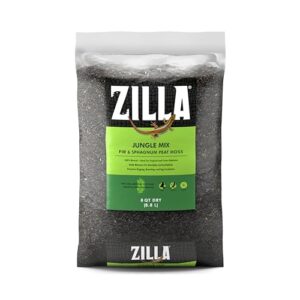
Zilla Jungle Mix earns its place in tropical setups by combining aged Douglas fir bark shavings with sphagnum peat moss — two materials that work together to hold moisture and mimic a forest floor texture. At 8 quarts and 5.8 lb, it is ideal for frogs, rainforest geckos, and humidity-dependent snakes. The soft, loamy composition facilitates burrowing and egg incubation.
Regular maintenance is required, as the substrate must be rewet every 24–30 hours. While functional for most reptiles, caution is advised regarding larger shavings near delicate species like salamanders.
| Best For | Tropical and forest terrarium owners keeping frogs, rainforest geckos, or humidity-loving snakes who want a natural, organic substrate that supports burrowing, nesting, and egg incubation. |
|---|---|
| Material Type | Fir bark & sphagnum peat |
| Humidity Support | High moisture retention |
| Bioactive Compatible | Yes, vivarium soil mixes |
| Biodegradable | Yes, fully biodegradable |
| Suitable Species | Frogs, snakes, rainforest geckos |
| Package Weight | 5.8 lb (8 qt) |
| Additional Features |
|
- Blends aged Douglas fir bark with sphagnum peat moss to hold moisture well and reduce how often you need to mist the enclosure.
- Soft, loamy texture encourages natural behaviors like digging, burrowing, and egg incubation — great for breeding setups.
- Fully biodegradable and can be mixed with other substrates or used as part of a vivarium soil blend.
- Dries out fast — you may need to re-wet it every 24 to 30 hours, which adds to daily upkeep.
- Larger fir shavings can be rough on delicate species like salamanders or small amphibians, so it’s not a great fit for everyone.
- Can stick to animal skin or feet, and bags have been known to tear during shipping, which makes for a messy unboxing.
2. Josh Frogs ABG Bioactive Soil
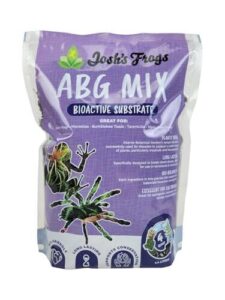
Josh’s Frogs ABG Bioactive Soil is built around the Atlanta Botanical Garden formula — a slow-degrading blend of fir bark, tree fern fiber, milled sphagnum moss, charcoal, and leaf litter that sustains tropical enclosures for months without replacement.
At 4 quarts and $24.99, it promotes vigorous plant growth, stable humidity, and thriving springtail and isopod colonies.
It’s well-suited for geckos, tree frogs, and tarantulas, but don’t use it for hermit crabs or Pac-Man frogs.
| Best For | Hobbyists building bioactive terrariums or vivariums for geckos, tree frogs, tarantulas, or other small reptiles and invertebrates who want a low-maintenance, plant-friendly substrate. |
|---|---|
| Material Type | Bark, moss & organic matter |
| Humidity Support | Long-term moisture retention |
| Bioactive Compatible | Yes, springtails & isopods |
| Biodegradable | Yes, organic matter base |
| Suitable Species | Geckos, tree frogs, tarantulas |
| Package Weight | 2.1 lb (4 qt) |
| Additional Features |
|
- Based on the trusted Atlanta Botanical Garden formula — great for keeping tropical plants healthy and humidity stable long-term.
- Supports springtail and isopod colonies right out of the bag, so your clean-up crew gets a solid head start.
- Slow to break down, which means less frequent substrate changes and reportedly only needing a deep clean twice a year.
- Four quarts won’t go far in tanks 15 gallons or larger — you’ll likely need to supplement with hydroballs, extra bark, or leaf litter.
- Hitchhikers happen: dormant eggs from snails, earthworms, or millipedes can show up after setup, which surprises some buyers.
- A bit pricey for the quantity, especially if you’re outfitting multiple enclosures or a bigger build.
3. Riare Coconut Coir Terrarium Substrate
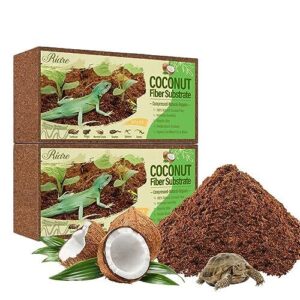
Riare’s coconut coir bricks offer a reliable moisture-holding base without synthetic additives. Each package includes two compressed bricks that expand into a soft, fluffy substrate when soaked — requiring no complex prep, just add water.
When expanded, the coir’s combined weight of 2.73 lb provides a breathable structure for burrowing species while retaining humidity between misting cycles.
The substrate is fully biodegradable, odor-resistant, and doubles as compost after use. For larger enclosures, additional bricks may be necessary to achieve the recommended 2–3 inch depth.
| Best For | Reptile and amphibian owners who need a natural, humidity-friendly substrate for tropical or burrowing species like ball pythons, tree frogs, or tarantulas. |
|---|---|
| Material Type | Coconut husk fiber |
| Humidity Support | Moderate moisture retention |
| Bioactive Compatible | Yes, general terrarium use |
| Biodegradable | Yes, compostable coco coir |
| Suitable Species | Frogs, ball pythons, turtles |
| Package Weight | 2.73 lb (2 bricks) |
| Additional Features |
|
- Expands from a compact brick into a soft, fluffy substrate with just water — no prep headaches
- Holds moisture well between misting sessions and naturally controls odor without any chemicals
- Fully biodegradable, so used substrate can go straight into your garden as compost
- Two bricks might not cut it for larger enclosures — you’ll likely need to buy extra
- Dries out fairly quickly and needs re-hydrating every 5–7 days to keep humidity levels up
- Can get sticky on your hands and tank glass when wet, which makes cleanup a bit messier
4. Riare Expanded Clay Terrarium Substrate
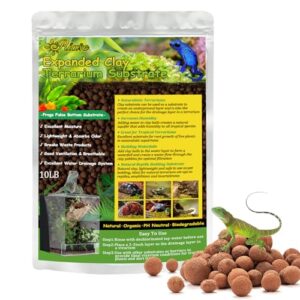
Where coir manages moisture at the surface, drainage beneath the substrate is equally critical—a role where expanded clay excels. Riare’s 10 lb bag of pH-neutral, 4–16 mm pellets forms a porous false bottom that pulls excess water away from upper layers, preventing anaerobic saturation.
The pellets resist compaction, maintain air gaps around roots and microflora, and won’t break down over time. Unlike organic substrates, they deliver lasting structural integrity in any setup.
Rinse the pellets before use and add a mesh barrier to maximize their longevity. With proper care, they outlast most organic substrates, ensuring consistent performance.
| Best For | Reptile and amphibian keepers setting up bioactive terrariums or aquaponic gardens who need a reliable, long-lasting drainage layer. |
|---|---|
| Material Type | Expanded clay balls |
| Humidity Support | Indirect drainage-based humidity |
| Bioactive Compatible | Yes, false bottom layer |
| Biodegradable | Yes, garden-disposable |
| Suitable Species | Reptiles, amphibians, invertebrates |
| Package Weight | 10 lb bag |
| Additional Features |
|
- Reusable and durable — these pellets won’t break down, so you get solid long-term value for the $22.79 price tag.
- PH-neutral and low-dust, making them safe for sensitive animals like reptiles, amphibians, and invertebrates.
- Creates excellent drainage and air pockets that keep roots healthy and prevent soggy, anaerobic substrate conditions.
- Needs a good rinse before first use to clear out fine particles — skip this step and you’ll have cloudy water or dusty mess.
- It’s a base layer only, so you’ll need to budget for additional top substrates like coconut husk or leaf litter to complete your setup.
- At 10 lbs, the bag is bulky and can be awkward to work with, especially when filling smaller or oddly shaped tanks.
5. Exo Terra Bioactive Volcanic Terrarium Substrate

Volcanic substrates take a different approach entirely. Exo Terra Sub Stratum pulls material straight from the foothills of Japan’s Aso Volcano, blending andesitic and rhyolitic tephra with active carbon and live Bacillus bacteria.
This combination delivers dual functionality: it cycles ammonia out of the environment while actively rooting plants. The substrate’s unique composition addresses challenges most alternatives cannot overcome.
Its porous, crumbly texture ensures optimal drainage without drying too quickly. At 4 kg per bag, it layers cleanly at a 2–5 cm depth, functioning effectively on its own or beneath an organic top mix.
| Best For | Reptile and amphibian keepers who want a planted, bioactive vivarium that largely takes care of itself. |
|---|---|
| Material Type | Volcanic tephra |
| Humidity Support | Moisture buffering with soaking |
| Bioactive Compatible | Yes, nitrifying bacteria |
| Biodegradable | Yes, natural volcanic origin |
| Suitable Species | Reptiles, frogs, terrarium plants |
| Package Weight | 4 kg (8.82 lb) |
| Additional Features |
|
- Volcanic minerals feed plant roots naturally, so your moss and succulents actually thrive instead of just surviving.
- Live Bacillus bacteria break down waste and knock out ammonia, keeping odors low without much effort on your end.
- The porous texture drains well and holds just enough moisture for high-humidity setups without turning into a swamp.
- The pellets dry out fast, so you have to soak them thoroughly before use or they won’t perform the way they should.
- It costs more per kilogram than basic potting mixes, which adds up quickly if you’re filling a large enclosure.
- It can get messy to handle, and the damp crackling sound it sometimes makes bothers some people more than you’d expect.
6. Josh Frogs Tree Fern Substrate

Where the volcanic substrate offers mineral precision, tree fern fiber brings something entirely different to your build. Josh’s Frogs Tree Fern Substrate is made from New Zealand tree fern stem fibers, and its slow decomposition rate keeps structure intact for months in humid setups.
The fibrous matrix resists compaction, promotes airflow, and nurtures springtails and isopods effectively. Its composition ensures consistent moisture without waterlogging, making it ideal for maintaining healthy microhabitats.
At 10 quarts per bag, it’s purpose-built for blending into ABG-style mixes or layered tropical vivariums. This substrate supports both structural integrity and biological activity, catering to specialized terrarium needs.
| Best For | Hobbyists building bio-active terrariums or tropical vivariums who need a fibrous substrate that holds structure, supports microfauna, and blends well into custom mixes. |
|---|---|
| Material Type | Tree-fern fiber |
| Humidity Support | Maintains moist on arrival |
| Bioactive Compatible | Yes, supports microfauna |
| Biodegradable | Yes, natural fiber |
| Suitable Species | Reptiles, amphibians, epiphytes |
| Package Weight | 3.05 lb (10 qt) |
| Additional Features |
|
- Resists compaction and keeps airflow going, so roots and critters aren’t suffocating in packed-down soil
- Plays nicely with springtails and isopods, making it a solid pick for self-sustaining bio-active setups
- Arrives consistently moist and filled to the full 10 quarts, so setup is straightforward right out of the bag
- No resealable packaging, so you’ll need another container handy if you’re not using it all at once
- Pure fiber with no nutrients, meaning plant-focused builds will need additional media mixed in
- Can dry out in low-humidity environments and needs occasional re-hydration to stay effective
7. Josh Frogs Tropical Bioactive Substrate
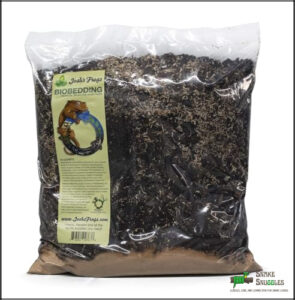
Where tree fern fiber focuses on structure, Josh’s Frogs Tropical Bioactive Substrate goes broader — this is a full-spectrum living soil designed to support an entire ecosystem.
The 10-quart bag contains a blend of organic plant material, inorganic minerals, and slow-decomposing bark that keeps microfauna populations healthy for years. It retains moisture without oversaturation, roots tropical plants directly, and accommodates springtails and isopods naturally.
At $34.99, it’s a solid foundation for any humidity-dependent tropical enclosure you’re building.
| Best For | Hobbyists building a self-sustaining bioactive enclosure for humidity-loving reptiles, amphibians, or invertebrates like tree frogs, geckos, and arboreal tarantulas. |
|---|---|
| Material Type | Mixed organic blend |
| Humidity Support | Moisture-retaining environment |
| Bioactive Compatible | Yes, full bioactive cycle |
| Biodegradable | Yes, organic substrate |
| Suitable Species | Geckos, tree frogs, tarantulas |
| Package Weight | 2.61 kg (10 qt) |
| Additional Features |
|
- Supports a living ecosystem — springtails, isopods, and live plants can all thrive directly in the substrate
- Holds moisture well without getting waterlogged, which is a big deal for tropical setups
- Cuts down on maintenance over time since the clean-up crew handles waste naturally
- Arrives dry, so you’ll need to rehydrate it with dechlorinated water before it’s ready to use
- Occasional hitchhikers like tiny snails can sneak in — not ideal if you didn’t ask for extra tenants
- One bag won’t cut it for larger enclosures, and micro-fauna tunneling can shift things around over time
8. JOR Mahogany Leaf Litter for Frogs

JOR Mahogany Leaf Litter does something the other substrates can’t — it replicates the actual forest floor your frogs evolved on. Each pack contains 50 two-inch leaves that decompose gradually, feeding springtail and isopod colonies while maintaining surface humidity between mistings.
The dense leaf layer also gives frogs clean, grippy footing and natural shelter.
At $5.93 per pack, it’s an affordable finishing layer that turns a functional enclosure into a functioning microhabitat.
| Best For | Dart frog and amphibian keepers who want a natural, bioactive vivarium that actually mimics the rainforest floor. |
|---|---|
| Material Type | Mahogany leaf litter |
| Humidity Support | Reduces substrate drying |
| Bioactive Compatible | Yes, microfauna food source |
| Biodegradable | Yes, natural leaves |
| Suitable Species | Frogs, amphibians, vivarium fauna |
| Package Weight | 1.44 oz (50 leaves) |
| Additional Features |
|
- Feeds your cleanup crew — springtails, isopods, and worms break down the leaves and keep the enclosure healthy on their own.
- Keeps humidity steady between mistings, which is a lifesaver for moisture-loving species and live plants.
- Gives frogs a clean, natural surface to move on — less grime on the glass, more natural behavior overall.
- Some batches have moldy leaves; worth boiling them for 15 minutes before adding to the tank.
- No sustainability certification, which is worth knowing if that matters to you.
- Small packs mean larger enclosures will go through them fast, and the cost adds up.
Moisture Retention and Drainage
Getting moisture retention right is what separates a thriving terrarium from a soggy mess.
Moisture retention done right is the difference between a thriving terrarium and a soggy, struggling mess
Every substrate processes water differently — some hold it deep, others let it breathe from the surface up.
Here’s what you need to know about how each option regulates humidity in real conditions.
How Coconut Coir Holds Water

Coconut coir works like a sponge engineered by nature — its capillary action pulls water deep into every fiber instantly. That fiber porosity creates micro-pockets holding moisture steadily without waterlogging.
A single brick can reach a weight-to-water ratio of nearly 8:1.
- Intra- and inter-fiber spaces regulate water release rate gradually
- Humidity regulation stays consistent between misting cycles
- Salt accumulation control remains naturally low
- Organic substrate composition resists rapid pH shifts
- Substrate moisture retention stays stable without anaerobic saturation
Why Chunky Substrates Improve Airflow

Particle size shapes how well your substrate breathes. Chunky types—orchid bark, coarse husk, expanded clay—create air channels that fine-textured materials cannot sustain. Their pore size distribution maintains air channel stability even when moisture levels rise, supporting oxygen diffusion and root aeration while delivering reduced waterlogging throughout the substrate bed.
| Substrate | Terrarium Airflow | Humidity Regulation |
|---|---|---|
| Orchid Bark | High | Moderate |
| Coarse Coconut Husk | Medium-High | High |
| Expanded Clay | Very High | Low-Moderate |
| Fine Coir | Low | Very High |
Distinct substrate texture prevents tight packing, keeping oxygen pathways open across all moisture conditions.
Balancing Damp Lower Layers With Dry Surfaces

Think of your substrate as a gradient, not a uniform block. Capillary action pulls moisture upward through your layers, creating a natural flow.
A dry top layer—what specialists call surface capping—interrupts this climb, preventing saturation from reaching the surface. This design maintains a moisture gradient, keeping subsurface zones damp for microfauna while avoiding surface oversaturation.
Ventilation strips ensure airflow above, complementing the gradient by maintaining humidity balance and preventing stagnation.
Smart substrate layering is foundational to terrarium design, directly addressing humidity and drainage needs through strategic material arrangement.
Using Drainage Layers Beneath Humid Substrates

A proper drainage layer acts as your enclosure’s pressure valve, pulling excess water down before it can saturate the substrate above. Expanded clay balls excel here—their material’s porosity creates reliable capillary breaks that regulate flow rate without compaction. Layer thickness usually runs 20–60 mm depending on enclosure size.
Lightweight drainage media like perlite or lava rock facilitates humidity and drainage considerations for terrarium habitats, balancing moisture retention and aeration in enclosures. This approach extends drainage longevity considerably while maintaining optimal conditions.
Preventing Oversaturation in Tropical Setups

Oversaturation sneaks up fast in tropical setups—capillary action pulls water upward even after misting stops. To balance moisture retention and aeration, combine absorbent additives like coco coir with a proper drainage layer. This controls water movement through the substrate, while surface evaporation and humidity buffering maintain equilibrium.
For automated mist systems, shorter cycles prevent mold growth in high-humidity habitats. This approach ensures stable humidity without compromising drainage considerations for terrarium habitats.
Choosing Substrates for Stable Humidity Ranges

Matching substrate to species isn’t guesswork — it’s about understanding how pH Buffering, Thermal Conductivity, and Substrate Longevity interact with your enclosure’s airflow.
Coconut coir holds surface humidity at 70–90% RH daily, while sphagnum moss sustains moisture 2–4 days in sealed setups.
For a deeper look at how each material performs across different setups, this guide to substrate materials for humidity control breaks down the tradeoffs between retention, airflow, and enclosure type.
For Cost Efficiency and Ventilation Integration, blending materials that balance moisture retention and aeration provides the tightest humidity and drainage considerations for terrarium habitats.
Bioactive Versus Standard Substrates

Choosing between bioactive and standard substrates isn’t just a preference — it shapes how much maintenance you’ll do and how well your enclosure sustains itself long-term.
Some setups thrive with living microfauna and layered soil mixes, while others call for simpler bedding you swap out on a schedule. Here’s a closer look at what each approach actually involves.
When Bioactive Substrate Mixes Make Sense
Bioactive mixes earn their place when long-term stability matters more than quick fixes. They support a self-regulating system of microfauna ecology that processes waste, controls odor, and drives nutrient cycling — reducing how often you intervene.
Consider going bioactive when:
- You’re maintaining 75–99% RH tropical enclosures
- Microbial activity can replace frequent substrate swaps
- Cost benefits justify the setup investment over time
- Enrichment value outweighs standard non-bioactive substrate options
Benefits of ABG-style Tropical Mixes
ABG-style mixes do something standard substrates can’t — they work with biology rather than against it. Josh’s Frogs ABG Mix combines tree fern fiber, sphagnum moss, orchid bark, and charcoal to deliver moisture buffering, structural resilience, and odor mitigation in one layer.
This blend fosters an environment where beneficial microbes and microfauna thrive, supporting plant compatibility across high-humidity bioactive terrarium setups year-round.
| Feature | ABG Mix | Standard Substrate |
|---|---|---|
| Moisture buffering | Capillary retention throughout layers | Surface-only absorption |
| Microfauna support | Active microbial + Isopod habitat | Minimal biological activity |
| Plant compatibility | Root aeration + humid zones | Limited or none |
Role of Expanded Clay Drainage Layers
Where Riare Expanded Clay Balls begin their quiet work underneath, their pore architecture pulls excess water downward, enabling gradual moisture release back into the root zone without saturation. This prevents waterlogging while ensuring consistent hydration.
The material’s inert pH neutrality guarantees no chemical interference with soil or plant health. Simultaneously, enhanced gas exchange within the substrate reduces anaerobic pockets, fostering a healthier root environment.
Long-term durability and resistance to substrate compaction make these clay balls a reliable drainage solution. They adapt seamlessly to terrarium habitats, addressing humidity and drainage needs across diverse conditions.
How Leaf Litter Protects Soil Moisture
Leaf litter does more than mimic a forest floor aesthetic — it functions as a functional evaporation barrier that captures rainwater during misting and releases it gradually through decomposition water release. This slow moisture cycling stabilizes microhabitat humidity far better than bare substrate can.
Thermal buffering from the litter layer also moderates soil temperature swings, directly supporting moisture retention and long-term humidity control in amphibian terrariums.
Supporting Springtails and Isopods
Springtails and isopods are the engine behind any functioning bioactive terrarium.
Springtails handle microfauna feeding on mold and fine organic debris, while isopods drive detritus recycling through leaf litter and larger decaying matter.
Supporting both requires maintaining microhabitat airflow, consistent humidity retention, and calcium supplementation for isopod molting.
Population monitoring keeps you ahead of imbalances before they destabilize the substrate ecosystem.
Replacement Needs for Non-bioactive Bedding
Unlike bioactive setups, non-bioactive bedding doesn’t self-correct — so you’re the system. Watch for odor indicators like sour or musty smells, and track moisture thresholds to catch compaction early.
- Replace every 1–2 months in tropical setups
- Use partial top-ups to extend cycles by 1–2 weeks
- Follow local disposal guidelines for spent organic substrate
- Sanitize the enclosure before stress-free replacement
- Compost plant-safe materials as eco-friendly substrate choices
Species-Specific Substrate Needs

Ball pythons, boas, corn snakes, and burrowing amphibians each have distinct moisture needs that can make or break their health.
Matching the right bedding to the animal you’re keeping is essential for their well-being.
Humid Substrate Options for Ball Pythons
Ball pythons thrive when you maintain humidity stability between 60–80%, and coconut husk is the most reliable reptile bedding option for achieving this. It supports natural humidity control, maintains substrate depth at 2–3 inches for burrowing comfort, and promotes skin health and shedding ease.
Cypress mulch and orchid bark also work well as alternatives, though a consistent cleaning routine is essential to prevent mold from compromising the setup.
Moisture-holding Bedding for Boa Constrictors
Boas require high humidity—consistently 60–70%—without substrate that remains soggy. Coconut fiber stands out as a robust reptile bedding option, effectively balancing moisture regulation, odor control, and shedding support.
Three key reasons for its effectiveness include:
- Burrow Depth remains stable at 2–3 inches
- Thermal Regulation improves through layered moisture zones
- Substrate Weight resists compaction, preserving airflow
Safer Humidity Zones for Corn Snakes
Corn snakes require a split environment with distinct humidity zones, not a uniformly damp habitat. Maintain the humid hide at 60–70% and the dry zone at 40–60%, using a dedicated hide hygrometer to monitor each microclimate.
Airflow channel design prevents stagnant pockets that can trigger escape responses. Adjust humidity through incremental shifts of 5% at a time to avoid stress.
| Zone | Humidity Target | Reptile Enclosure Substrate |
|---|---|---|
| Dry Activity | 40–60% | Cypress mulch |
| Humid Hide | 60–70% | Sphagnum moss |
| Intermediate | 50–55% | Coarse coconut husk |
Substrates for Burrowing Reptiles and Amphibians
Burrowing reptiles and amphibians require a substrate depth of at least 2–3 inches to ensure burrow stability and enable natural burrowing behaviors without tunnel collapse. Coconut fiber substrate and fine-grade soil mixes are ideal for maintaining pH balance and retaining consistent moisture.
Invertebrate symbiosis, such as springtails, plays a critical role in managing waste below the surface, which enhances humidity regulation and drainage in terrarium habitats. This approach ensures long-term compatibility with burrowing species by fostering a self-sustaining ecosystem.
Creating Wet, Dry, and Intermediate Zones
Once you’ve nailed burrowing-species substrate depth, the next layer of control is zoning. Designing wet, dry, and intermediate microclimates gives each animal the freedom to self-regulate.
- Barrier wall design separates wet and dry areas using glass dividers with 150 mm upturns.
- Sensor positioning above wet zones tracks vapor accurately without contact interference.
- Fan airflow arrangement extracts excess moisture while maintaining gradient substrate mix stability across the enclosure.
Avoiding Overly Wet Bedding for Snakes
Zoning solves gradients, but overly wet bedding creates its own problem — scale rot and respiratory stress in large snakes.
Use Substrate Moisture Sensors to catch saturation early, and rely on Temperature-Driven Airflow to dry damp patches naturally. Water Bowl Positioning on the warm side drives evaporation without soaking reptile bedding options throughout.
| Strategy | Method | Benefit |
|---|---|---|
| Preventing Water Pooling | Drainage layer beneath coco coir | Stops surface saturation |
| Adjusting Mist Timers | Reduce frequency per hygrometer data | Controls moisture regulation strategies |
| Humidity and drainage considerations | Combine cypress mulch with expanded clay | Balances airflow and retention |
Maintenance, Mold, and Longevity

Even the best substrate won’t do its job if you’re not keeping up with it. Maintenance isn’t complicated, but skipping steps — even small ones — can quickly lead to mold, odor, and a stressed animal.
Here’s what actually matters for keeping your humid setup clean, functional, and lasting as long as possible.
Spot-cleaning Humid Substrates Regularly
Spot cleaning isn’t optional in high-humidity enclosures — it’s your first line of defense against mold. Aim for a cleaning frequency of at least twice weekly, using sanitized tools and practicing proper waste segregation. Moisture spot checks help you catch problem areas early, ensuring proactive maintenance.
Protecting microfauna safety in bioactive setups requires vigilance. Remove feces and shed skin within 24 hours, and separate soiled substrate in sealed bags before disposal. Sanitize scoops after each use to prevent cross-contamination.
- Remove feces and shed skin within 24 hours
- Separate soiled substrate in sealed bags before disposal
- Sanitize scoops after each use to prevent cross-contamination
Removing Uneaten Food and Waste Quickly
Leaving uneaten food in a humid enclosure is effectively an open invitation for mold. Rapid Waste Extraction within 15 minutes of feeding prevents microbial hotspots from forming in your substrate.
Use Elevated Feeding Platforms and smart Feeding Station Placement to keep debris off damp bedding. This minimizes contamination risks at the source.
Timed Clean-up Protocols, Color-Coded Bins, and bioactive cleanup crews handle residual maintenance. Together, these measures ensure a spotless setup and consistent mold prevention.
Fluffing Substrate to Improve Airflow
Compacted substrate is a quiet enemy — it chokes airflow and creates anaerobic microzones before you notice.
Fluffing the top 2–3 cm every one to two weeks using a sterile hand fork facilitates terrarium airflow and substrate compaction avoidance without disturbing deeper layers or microfauna.
This light aeration increases surface evaporation, balancing moisture retention and aeration in enclosures while keeping substrate density at functional levels.
Monitoring Humidity With Accurate Gauges
Without reliable humidity monitoring, even the best substrate becomes guesswork. Place digital hygrometers at breathing height, away from misters and vents, for accurate sensor placement.
Data logging models track RH trends over hours or days, while remote alerts flag dangerous drops instantly.
Validate accuracy through calibration frequency checks every 6–12 months, keeping terrarium humidity control precise and your substrate choices genuinely effective.
Preventing Mold in Organic Bedding
Mold doesn’t just look bad — it signals a breakdown in microbial balance. Cypress mulch and orchid bark act as natural mold-resistant layers, forming a foundational defense against fungal growth.
Springtails and isopods provide critical microfauna control by consuming organic waste before fungi can take hold, disrupting the mold lifecycle at its source.
Pair these biological solutions with moisture sensors, proper air exchange, and calibrated dehumidifier settings to maintain consistent fungus growth inhibition and extend organic substrate longevity.
Knowing When to Replace Substrate
Even the best substrate has a lifespan. Recognize these replacement signals before they compromise your enclosure:
- Mold indicators — spreading fungal patches or persistent odor despite spot-cleaning
- Compaction warning — slow drainage, anaerobic zones, and collapsed burrow channels
- Microfauna decline — reduced isopod activity, nutrient buildup, or recurring pest outbreak
When maintenance stops working, replacement is your only reliable reset.
Reusing Drainage Media Responsibly
Drainage media doesn’t have to be single-use. Rinsing protocols matter here — rinse thoroughly to clear salt buildup, then run salinity testing before reuse. Contaminant screening keeps pests and pathogens out of your next setup. Reuse documentation tracks prior organisms and feed history, so nothing surprises you later.
| Step | Action | Purpose |
|---|---|---|
| Rinse | Flush with clean water | Remove salt buildup |
| Test | Check salinity levels | Protect humidity-sensitive species |
| Document | Log prior use history | Prevent contaminant transfer |
Reusable terrarium substrates support eco-friendly substrate choices while cutting waste by up to 40 percent — smart for your enclosure, lighter on the planet. When media compact or lose porosity despite cleaning, sustainable disposal and reuse of terrarium materials means knowing when to retire it responsibly.
Frequently Asked Questions (FAQs)
What is the best substrate for humid hides?
The best substrate for humid hides is sphagnum moss — it holds significant water relative to its weight, releases moisture slowly, and resists mold better than most organic options.
What substrate lowers humidity?
Substrates like silica sand, cedar shavings, perlite additive, paper towel, and rock wool actively reduce moisture. Choosing the right substrate for humidity control means prioritizing drainage over retention.
What substrate reduces humidity?
Ironically, the substrate doing the least holding is often doing the most work.
Porous Clay Pellets, Chunky Mulch Layers, and Low‑Moisture Fiber all increase evaporation rate and drainage, keeping surface moisture in check.
What is the best flooring for high humidity?
For high humidity spaces, Porcelain Tiles, Vinyl Plank, Engineered Wood, Quartz Surface, and Natural Stone all hold up well.
Each balances moisture retention and drainage considerations for terrarium habitats differently depending on your setup.
What is the best material for high humidity walls?
For high humidity walls, low-porosity concrete, fiber cement panels, magnesium oxide boards, ceramic tile backing, and metal cladding all resist moisture absorption effectively.
Keeping surfaces stable and mold-resistant in persistently damp conditions.
What materials are resistant to humidity?
Like a fortress built to outlast the rain, stainless steel, porcelain ceramic, polypropylene plastic, treated hardwood, and sealed concrete all resist moisture absorption and maintain structural integrity in humidity-heavy setups.
How often should I completely replace substrate?
Plan on a full replacement every 6 to 12 months for most humid setups. Bioactive enclosures with active cleanup crews can stretch that lifecycle standard to 18 months.
Can I mix different substrates together safely?
Yes, mixing substrates is safe when materials share compatible pH and moisture properties.
Start with Compatibility Testing and Contaminant Screening before blending. Follow Ratio Guidelines, use Layered Mixing, and maintain Ventilation Balance throughout.
What depth works best for burrowing species?
Aim for 2–3 inches of substrate depth. This range facilitates natural burrowing behavior, maintains a useful moisture gradient, and provides enough thermal stability without risking compaction layers that block digging.
Do substrates affect enclosure temperature control methods?
Substrate composition directly affects thermal conductivity, shaping how heat moves through your enclosure.
Moisture-rich bedding retains warmth longer, while chunky materials improve airflow, influencing heater placement and the temperature gradient your animal actually experiences.
Conclusion
The substrate beneath your animals functions like a foundation—invisible when right, catastrophic when wrong.
Every layer you choose shapes microbial balance, moisture flow, and structural stability in ways a humidity gauge alone can’t reveal.
Matching the right substrate options for humid environments to your species’ exact needs isn’t guesswork; it’s precision care.
Build that foundation deliberately, maintain it consistently, and your enclosure won’t just sustain life—it’ll replicate the conditions life actually evolved inside.