This site is supported by our readers. We may earn a commission, at no cost to you, if you purchase through links.

Your hygrometer reads 52% at noon and 81% at midnight, and you haven’t touched the tank. That swing isn’t always a sign your snake is in trouble. Often, it’s a sign your readings can’t be trusted.
Troubleshooting inconsistent humidity readings in snake tanks starts with a hard question: is the number wrong, or is the tank? A cheap dial can miss by 10 points, and a probe set beside the water bowl exaggerates every spike. Heat lamps, ventilation, and substrate depth push the real numbers around too.
You can sort out each cause in order, starting with the sensor itself.
Table Of Contents
Key Takeaways
- Check your hygrometer first with a salt test, since a cheap or drifting gauge can be off by 10 points and make a healthy tank look unstable.
- Mount the sensor at mid-height near the center of the enclosure, because readings beside the water bowl or damp glass will spike and mislead you.
- Expect humidity to dip while the heat runs and climb overnight as the room cools, so swings that follow your temperature are normal, not a sign of failure.
- Log readings for a week or two before you adjust ventilation, substrate, water, or misting (or automate anything), and change only one thing at a time so you know what’s actually working.
Verify Your Snake Tank Hygrometer’s Accuracy
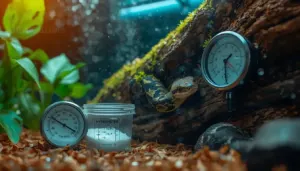
Before you change anything about your setup, make sure the number on your gauge is telling you the truth. A bad reading can send you chasing a humidity problem that doesn’t exist, or hide one that does. The two steps below help you trust your readings first.
If your gauge still seems off after testing it, this guide to understanding humidity needs for reptiles can help you judge whether the corrected number actually fits your animal.
Choose a Reliable Digital Hygrometer
A capacitive digital hygrometer is the best choice for a snake tank, since it usually reads within ±2-3% RH, while analog hair-tension dials drift and lag. Pick a dual-sensor unit that tracks temperature and humidity together, because that reduces cross-interference errors.
Look for a wide-angle LCD and a lithium coin cell. Those two details make real-time monitoring easier and steadier.
Check Calibration Before Adjusting Humidity
Even a good sensor can lie, so test it before you touch anything else. Seal a bottle cap of saturated salt solution and your hygrometer in a small airtight container for several hours. Keep the sensor and the slurry at the same steady temperature, because even a 0.5°C gap can skew the result, which is why the salt test needs stability of at least 12 hours.
- Mix table salt with a little water until it’s slushy.
- Place the cap beside the sensor.
- Close the lid.
- Wait.
- Read about 75% RH.
If yours is off, note the gap and adjust your readings accordingly.
Since each species needs a different range, a guide to snake humidity requirements helps you judge whether your corrected readings are on target.
Position Sensors for Representative Humidity Readings
Once you trust the gauge, check where it sits. Even an accurate sensor gives misleading numbers beside a water bowl, against damp glass, or buried in substrate.
Mount the probe at mid-height, about 1 to 2 inches above the substrate, near the center of the enclosure. A hook mount lets you place it where your snake actually travels, not where you like to look.
| Location | What it tells you |
|---|---|
| Mid-height, center | True air humidity |
| Inside humid hide | Moisture for shedding |
| Beside water bowl | Misleading spikes |
In a tall enclosure, humid air sinks, so use multiple hygrometers at different heights to see the gradient. If readings still swing wildly, move the probe a few inches and compare before changing anything else.
Once your readings are steady, aim to keep mid-height humidity between 50 and 70 percent, dipping toward 40 between mistings, as outlined in these green tree python humidity requirements.
Identify Temperature-Driven Humidity Fluctuations

Once your sensor sits in the right spot, watch what the numbers do across a full day. Humidity that seems erratic often follows your tank’s temperature like a shadow. Warm air holds more moisture, so relative humidity drops as the enclosure heats up. When the room cools overnight, the same moisture reads higher.
Your tank’s humidity isn’t misbehaving when it swings with the heat, because air that warms loses its apparent moisture and regains it as the room cools
Log readings from both a hygrometer and a thermometer at the same height, morning, afternoon, and late evening. If humidity dips whenever the heat comes on and climbs at night, your tank is behaving normally, not failing.
Look for these patterns:
- Midday dips while the basking lamp runs
- Overnight spikes as the room cools
- Lower readings near an under-tank heater
- Stagnant, damp air layered at the top
Spot the pattern first, then adjust.
Stabilize Snake Tank Humidity at Its Source
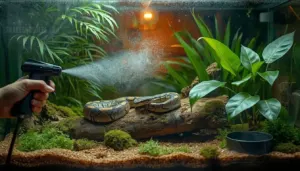
Once you know your readings are accurate, you can fix the cause of the swings instead of chasing the numbers. Three key adjustments control most of the humidity in your enclosure, and they work best when you handle them together. Start with the first one below, then move down the list at your own pace.
Knowing what happens when snake humidity is wrong makes it easier to see why steady levels matter as you work through each adjustment.
Balance Ventilation Without Sealing The Tank
Too much airflow strips moisture, but a sealed tank traps it and breeds mold. Aim for the middle. Cover part of a screen top with a rigid, heat-safe panel, starting small and adjusting as your readings settle.
Keep vents low on the cool side and high on the warm side. Watch the walls: persistent condensation means you’ve gone too far.
Manage Substrate Moisture and Water Sources
A deep bed of coconut fiber holds substrate moisture and releases it slowly, so readings stay steadier than they do over paper towels. Aim for 2-3 inches, and keep the top layer drier than the base to prevent scale rot.
Move your water bowl closer to the warm side, since a larger surface raises the water evaporation rate. Recheck readings.
Use Misting and Humid Hides Carefully
Give your hygrometer 30 to 60 minutes after misting before you trust a reading. A spike that fades in minutes tells you the spray, not the tank, caused it.
Mist lightly with dechlorinated water, and let the enclosure dry between sessions. Over-misting leaves condensation that drips onto your snake.
Keep humid hides damp, not soggy, and refresh the moss often.
Track Humidity Trends Before Automating Control

Picture a keeper who installs a fogger after one bad shed, only to watch the tank swing from 40% to 80% overnight. The device wasn’t the culprit. Without logged data, there was no way to know why.
Log morning and evening readings for two weeks first. Once hygrometer calibration is done, those numbers show your baseline and expose humidity fluctuations tied to heating cycles.
Skipping this step costs more than time:
- Your snake struggles through stuck sheds while you guess.
- You chase problems instead of preventing them.
- You blame the wrong fix and lose confidence.
- You watch a healthy animal decline despite your effort.
Set alerts for sustained drops, then automate once your logs prove genuine environmental stability, not luck.
Frequently Asked Questions (FAQs)
Can a faulty probe cable cause erratic humidity readings?
Yes, it can. A pinched, corroded, or fatigued cable disrupts the signal, so your hygrometer readings jump or freeze. Wiggle the cable while watching the display. If the numbers swing, replace the probe cable.
How often should I replace hygrometer batteries or sensors?
You might think a fixed schedule is easiest, but there isn’t one. Swap batteries when the low-battery icon appears or readings turn erratic, usually every 6 to 12 months. Check sensor accuracy yearly with a salt test.
Do different snake species need different humidity targets?
Would you keep a desert hognose and a rainbow boa in the same conditions? You shouldn’t. Species-specific humidity matters: corn snakes sit near 40–60%, ball pythons 50–60%, and rainforest species like rainbow boas 70–80%.
When should I consult a vet about humidity problems?
Call a reptile veterinarian right away if your snake breathes with its mouth open, wheezes, or makes clicking or gurgling sounds. Bubbles at the nostrils, or stalled sheds despite fixing humidity, also mean it’s time.
Why does my hygrometer reading jump after shedding?
Shedding releases trapped moisture into the air, and your hygrometer catches it. Damp skin, wet hides, and a snake moving around all create short spikes. They usually settle within 30 minutes.
Conclusion
Say your ball python’s tank reads 81% at midnight, but a second hygrometer, checked against a salt test, says 68%. The tank was never the problem.
That’s the pattern behind troubleshooting inconsistent humidity readings in snake tanks: confirm the sensor, place it where your snake actually lives, then look at heat, airflow, substrate, and water. Change one thing at a time.
Log your numbers for a week before automating. Steady data shows you what’s real.