This site is supported by our readers. We may earn a commission, at no cost to you, if you purchase through links.

Your green tree python sheds in pieces, and a ring of old skin clings to its tail like a stubborn sock. That one stuck patch usually traces back to a single number on a hygrometer.
Get the green tree python humidity requirements right, and sheds peel off clean in one piece. Get them wrong, and you risk wrinkled scales, sunken eyes, respiratory infections, or the opposite problem: mold and scale rot from constant dampness. The sweet spot sits between 50 and 70 percent, with brief dry-outs built in.
Here’s how to measure it, control it, and build an enclosure that holds it steady.
Table Of Contents
- Key Takeaways
- Ideal Humidity Range for Green Tree Pythons
- How to Monitor and Control Enclosure Humidity
- Enclosure Setup for Humidity Stability
- Top Substrates and Cleaning Products for Humidity Control
- Frequently Asked Questions (FAQs)
- How much humidity does a green tree python need?
- How to keep green tree pythons healthy?
- Do green tree pythons need a hygrometer?
- How deep should a green tree python substrate be?
- How to humidify a green tree python terrarium?
- What are the enclosure requirements for green tree pythons?
- How often should I mist my pythons enclosure?
- Can I use a humidifier for consistent humidity?
- What humidity level is best for hatchlings?
- Does nighttime humidity need to be different?
- Conclusion
Key Takeaways
- Keep your green tree python’s humidity between 50 and 70 percent, measured mid-height, and let it dip toward 40 percent between mistings so you get clean one-piece sheds without mold or scale rot.
- Run a digital probe hygrometer at mid-height, away from spray and the water bowl, and pair your misting with a hygrostat and good ventilation so you’re controlling humidity instead of guessing at it.
- Build a humidity gradient with 2 to 4 inches of moisture-holding substrate like coconut fiber over a drainage layer, plus a water bowl and live foliage, so your snake can choose between damp and dry zones.
- Don’t let humidity run too low or too high, because dry conditions bring stuck shed, dehydration, and respiratory infections, while constant dampness invites mold and bacterial problems.
Ideal Humidity Range for Green Tree Pythons
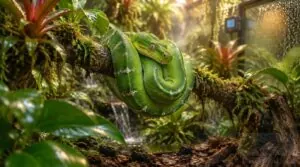
Getting humidity right is the foundation of keeping a green tree python healthy, and you’re about to see exactly how to do it. The points below cover the recommended humidity levels, what they do for shedding and overall health, and the risks of getting them wrong. Work through them in order, and you’ll know how to keep your snake comfortable.
For a fuller look at enclosure setup, misting routines, and daily upkeep, this green tree python care guide shows how to keep humidity steady.
Recommended Levels (50–70%)
The sweet spot for your green tree python sits at 50-70% humidity, measured at mid-height in the enclosure. Let it dip toward 40-50% between mistings so mold never gets a foothold. Most keepers maintain this range with a daily misting routine that leaves time for the substrate to dry out between sessions.
Three habits keep your humidity levels steady:
- Choose a moisture retention substrate like coco coir.
- Pair misting systems with solid enclosure ventilation.
- Build a humidity gradient with a water bowl at one cool end.
Shedding and Health Benefits
Right humidity makes shedding cycle management almost simple. Moist skin loosens evenly, so your snake slides out of its old layer in one piece instead of tearing and leaving a stuck shed on the tail or eye caps.
| Humidity | What You’ll See |
|---|---|
| 50-70% | Clean, single-piece shed |
| Below 50% | Stuck shed, torn skin |
Moisture-retentive substrates keep airways moist too. Watch behavioral indicators like calm tongue flicking.
Risks of Incorrect Humidity
Get humidity wrong and your snake pays for it fast. Too dry, and you’ll see dehydration risk in pythons show up as wrinkled scales and sunken eyes, plus another stuck shed. Dry airways crack too, inviting respiratory infections with wheezing or nasal discharge.
Too wet is just as bad. Constant dampness breeds mold, and scale rot follows. Good airflow and a dry-out between mistings handle bacterial growth prevention.
How to Monitor and Control Enclosure Humidity
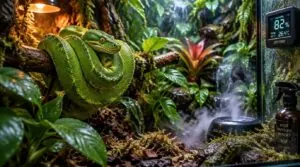
Getting your humidity right isn’t a guess-and-hope game, because you need to know your numbers and have the tools to change them.
Below, you’ll find three practical methods that work together to keep your enclosure humidity stable day after day.
Pick up each one, and you’ll gain the control your green tree python needs to thrive.
Using Digital Probe Hygrometers
Picture 82% after misting, so you ease off. Meanwhile your snake sits parched at dusk. The culprit? A probe beside the water bowl.
If your snake keeps soaking even when humidity looks fine, the reasons a snake soaks in its water bowl often trace back to uneven heat, not thirst.
A digital probe hygrometer reads only its own spot. Place yours:
- Mid-height, shaded, away from corners
- Clear of misting systems’ spray
- Read after enclosure ventilation changes
- Backed by a second probe for each humidity gradient
Log trends; greater substrate depth steadies them.
Misting Systems and Humidity Controllers
A good hygrostat turns your misting systems from guesswork into control. Pair automated misting systems with a controller, and the enclosure mists only when humidity drops below your set point. Aim for two to four brief sessions daily, roughly 30 seconds to two minutes each.
Verify hygrometer calibration, since probes drift. Point nozzles at foliage, and mind substrate depth so your humidity gradient stays intact.
Creating Humidity Gradients
Humidity gradients let your python choose between a damp hide and a drier perch. Build that enclosure microclimate like this:
- Mount water sources high, keeping lower zones drier.
- Aim misting systems at one side only.
- Heat basking spots to drive evaporation.
- Layer deeper substrate for better substrate moisture retention.
- Plant live foliage at several heights.
Check both ends daily to confirm your humidity levels hold.
Enclosure Setup for Humidity Stability
Humidity doesn’t hold steady by accident, and your enclosure is where you win or lose that battle. Get the physical setup right, and your misting routine gets far easier to manage. Here are the four setup choices that matter most, starting with what goes on the floor.
Choosing Moisture-Retentive Substrates
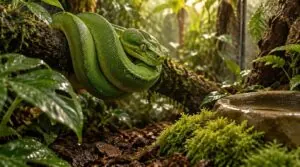
Your python’s humidity lives or dies in the ground beneath it. Choose moistureretentive substrates that hold water without turning soggy.
| Material | Best use |
|---|---|
| Coconut fiber | Stable base |
| Cypress mulch | Slow release |
| Sphagnum moss | Humid pockets |
| Avoid cedar | Toxic oils |
Mix coconut fiber with cypress mulch, and tuck sphagnum moss near the bowl. Nail the material before fussing over substrate depth.
Substrate Depth and Drainage Layers
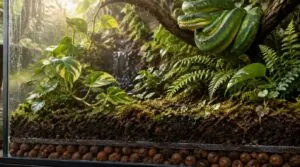
Picture a rainforest floor: damp, springy, and never swampy. That’s what you’re building underfoot.
You’re building a rainforest floor underfoot: damp and springy, never swampy
Aim for substrate depth of 2-4 inches, using moisture-retentive coconut fiber or sphagnum moss. Beneath it, lay a drainage layer so excess water can’t pool and sour your mix.
Check it weekly. Soggy bottom? Pull back your misting. You’re in control.
Ventilation and Enclosure Materials
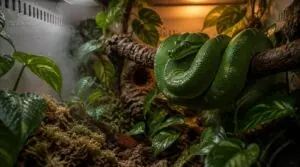
Your enclosure is a lung, and it needs to breathe without drying out. Choose hollow PVC or high-density polyethylene, since both hold humidity and heat far better than glass.
Aim for 18x18x24 inches minimum for one adult. Side vents near the top keep ventilation and airflow balance steady, while layered substrate and a naturalistic setup preserve your temperature gradient.
Water Source Placement Tips

Where your water bowl sits shapes your enclosure humidity more than most keepers realize. Set a wide, shallow, heavy bowl on a low perch, away from the basking lamp and out of direct airflow.
- Keep it clear of vents for better ventilation and airflow balance
- Anchor it so it can’t tip
- Let mist drift across it
- Layer substrate beneath it carefully
- Scrub it often for water bowl hygiene
Top Substrates and Cleaning Products for Humidity Control
Your enclosure is only as stable as the materials you put inside it. Below, you’ll find four moisture-holding substrates and one disinfectant that keep humidity steady and your setup clean. Pick the ones that fit your routine, and you’ll have far more control over your python’s environment.
1. Organic Coco Coir Brick 10lbs
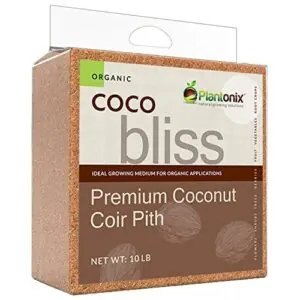
A 10-pound brick of organic coco coir gives you roughly 10 gallons of substrate once hydrated, and it’s OMRI-listed, pre-rinsed, and pre-screened, so you’re not picking out sand or rocks. It holds moisture well, which keeps your python’s enclosure steady between mistings.
Don’t use it alone, though. Coir can compact after watering, so mix in perlite or chunky material to keep air moving through the substrate layer. You’ll get stable humidity without a soggy base. That balance suits tree pythons.
| Best For | Gardeners and plant growers looking for a renewable, organic-friendly alternative to peat moss as a base for potting mixes and seed starting. |
|---|---|
| Weight | 10 pounds |
| Volume | Expands to ~10 gallons |
| Primary Material | Coconut husk |
| Model Number | N/A |
| Dimensions | N/A |
| Humidity Support | Excellent moisture retention |
| Additional Features |
|
- Holds moisture well thanks to its high cation exchange capacity
- Pre-rinsed and pre-screened, so it’s free of fiber, sand, and rocks
- OMRI-listed for organic use and expands to about 10 gallons from a 10-pound brick
- Can become compact after watering when used alone
- May need added perlite or chunky material to improve aeration, especially for seed starting
- Requires buffering for better nutrient availability in sensitive plants
2. Zoo Med ReptoSoil 24 Quart Substrate
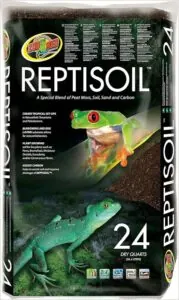
If plain coir feels too basic, Zoo Med ReptoSoil gives you a blended alternative. It mixes peat moss, soil, sand, and coconut carbon, so it holds moisture while still draining, and the carbon helps cut persistent odors. Your python’s tropical setup stays steady, and live plants root well in a bioactive terrarium build. Humidity-loving pythons thrive in this mix.
The 24-quart bag weighs 17 pounds. Check it for sharp wood or stone fragments, and rinse your hands after handling it.
| Best For | Keepers of tropical lizards, amphibians, box turtles, hermit crabs, tarantulas, and other invertebrates who want a humid, plant-friendly bioactive terrarium setup. |
|---|---|
| Weight | 17 pounds |
| Volume | 24 quarts |
| Primary Material | Coconut-based substrate |
| Model Number | N/A |
| Dimensions | 14″ L x 4″ W x 14″ H |
| Humidity Support | Maintains terrarium humidity |
| Additional Features |
|
- Coconut carbon helps reduce persistent odors.
- Supports natural burrowing and egg-laying behaviors.
- Maintains humidity and promotes plant growth in terrariums and paludariums.
- May contain sharp wood, stone, or rock fragments that need to be removed.
- Leaves residue, so you need to rinse your hands after handling it.
- Not recommended for species that need an exclusively dry, low-humidity environment.
3. Zoo Med Eco Earth 3PK Substrate
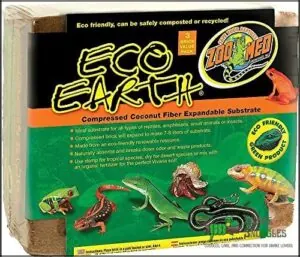
If you’d rather keep things simple, Zoo Med Eco Earth gives you pure coconut husk in three compact bricks. Each one expands to 7–8 liters when moistened, so a single pack goes a long way.
It holds humidity without mold or mildew worries, but only if you hydrate it properly. Don’t flood it. Soggy coir attracts gnats, so stir it regularly. Plan on a full replacement every 3–6 months for hygiene. Afterward, it still makes fine garden topsoil and fertilizer.
| Best For | Reptile, amphibian, small animal, and insect keepers who want a simple, natural coconut husk substrate that holds humidity and suits burrowing animals. |
|---|---|
| Weight | 3.9 pounds |
| Volume | 7–8 liters per brick |
| Primary Material | Coconut husks |
| Model Number | EE20 |
| Dimensions | 8 x 6.2 x 4.1 inches |
| Humidity Support | Maintains humidity |
| Additional Features |
|
- Each brick expands to 7–8 liters when moistened, so one 3-pack covers a lot of space
- Holds humidity without mold or mildew concerns when properly managed
- Absorbs odor and waste naturally, and works well for burrowing animals
- Easy to over-saturate, so it takes some care to hydrate properly
- Can attract gnats if kept too moist without regular stirring
- Needs full replacement every 3–6 months for hygiene
4. Exo Terra Plantation Soil 8 Quarts 3 Pack
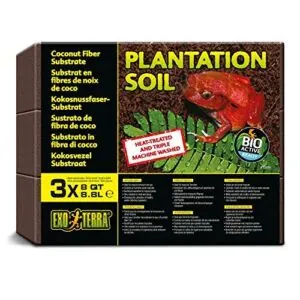
Exo Terra Plantation Soil is another coconut husk option, and it’s worth a look if you want more volume. You get three 8-quart bricks per pack, so you can fill a large enclosure without a second order.
It’s 100 percent natural coconut husk fiber, which raises humidity and encourages burrowing. Some bricks expand less than you’d expect when hydrated, so soak one first and check the yield. Some users report slow breakdown, so watch how it ages in your enclosure.
| Best For | Reptile and amphibian keepers who need a large amount of humidity-boosting, burrow-friendly substrate for big terrariums or planted enclosures with frogs, salamanders, or other burrowing animals. |
|---|---|
| Weight | 3.9 pounds |
| Volume | 8 quarts per brick |
| Primary Material | Coconut husk fiber |
| Model Number | PT2771 |
| Dimensions | N/A |
| Humidity Support | Increases humidity |
| Additional Features |
|
- Made from 100 percent natural coconut husk fiber, which raises humidity and is safe for frogs, salamanders, and burrowing animals
- Three 8-quart bricks per pack give you plenty of volume to fill a large enclosure
- Works for live plant planting and as an incubation medium thanks to its hygroscopic properties
- Requires soaking and drying before use in some applications
- Expansion varies, and some users report minimal expansion when hydrated
- Some users report slow breakdown or lack of disintegration over time
5. Rescue RTU Disinfectant Cleaner 32oz
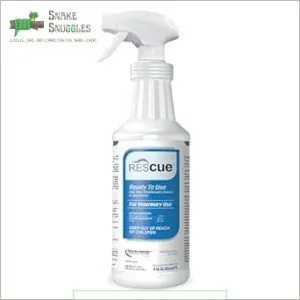
A clean enclosure is half the battle when you’re holding humidity at 60-70%, because warm, wet air breeds bacteria. Rescue RTU Disinfectant Cleaner comes ready to use, so there’s no dilution math. It kills canine parvovirus and ringworm with a 1-minute contact time, and it’s built for vet clinics and shelters.
Use it on hard, non-porous surfaces like plastics and stainless steel. Expect residue on clear panels, so wipe glass afterward. The 32-ounce bottle has no spray nozzle, so buy one separately.
| Best For | Reptile and amphibian keepers, vet clinics, and animal shelters who need a ready-to-use disinfectant for hard, non-porous enclosure surfaces, litter boxes, and whelping boxes. |
|---|---|
| Weight | N/A |
| Volume | 32 ounces |
| Primary Material | N/A |
| Model Number | 23101-6 |
| Dimensions | 8.4 x 6.5 x 11.38 inches |
| Humidity Support | N/A |
| Additional Features |
|
- Kills canine parvovirus and ringworm with a 1-minute contact time
- Ready-to-use formula means no dilution or mixing
- Safe for hard, non-porous surfaces like stainless steel and plastics
- Does not include a spray nozzle, so you need to buy one separately
- May leave visible residue on clear surfaces like enclosure panels
- Not recommended for natural stone like marble or granite without manufacturer approval
Frequently Asked Questions (FAQs)
How much humidity does a green tree python need?
Picture a rainforest canopy after a downpour: damp, then slowly drying. Keep humidity levels between 50% and 70%, letting your enclosure dip toward 40% between mistings. Check your hygrometer probe location, and don’t skip ventilation.
How to keep green tree pythons healthy?
Keep your humidity levels between 50 and 70 percent so sheds come off clean. Check them with a digital hygrometer, run a misting system sparingly, and spot clean your substrate daily.
Do green tree pythons need a hygrometer?
Guessing is the most expensive habit in snake keeping. Yes, you need a digital hygrometer, since analog ones drift 10-20%. Put the probe at perch level, and check humidity levels daily.
How deep should a green tree python substrate be?
Most keepers land on 2 to 4 inches of substrate, and that range holds up well. You’ll want the deeper end for humidity and fall cushioning, especially in a 3′ x 2′ enclosure.
How to humidify a green tree python terrarium?
Meet your humidity requirements by layering coconut fiber at a substrate depth of 2-4 inches, then running mist systems once or twice daily. Smart water bowl placement near warmth keeps enclosure humidity steady between mistings.
What are the enclosure requirements for green tree pythons?
Funny how a snake that never touches the ground demands so much floor plan. Give adults 48" × 24" × 36" minimum, juveniles 24" × 18" × 36". Keep humidity at 50–70%, substrate two inches deep, ventilation steady, and water bowls near perches.
How often should I mist my pythons enclosure?
Guessing at misting ruins sheds.
Mist twice daily, morning and evening, by hand or automatic system. Trust your digital hygrometer: let humidity cycling dip toward 40% before misting again; enclosure ventilation and substrate depth help.
Can I use a humidifier for consistent humidity?
A humidifier is a steady hand on the dial, and yes, you can use one. Pair a cool mist unit with a humidistat and a digital hygrometer mid-enclosure, and you’ll hold humidity steady without drenching your python.
What humidity level is best for hatchlings?
Sustained humidity below 60% risks bad sheds in hatchlings, so aim for 60-80% humidity levels. Pick your hygrometer probe location mid-enclosure, keep substrate depth 2-3 inches, and mind water bowl placement away from the vents.
Does nighttime humidity need to be different?
Myth: flat humidity works. It doesn’t. Your humidity levels should cycle, with a nighttime spike near 70% after misting, then drying toward 40% by day.
Substrate layering techniques and humidity cycling support reptile hydration levels.
Conclusion
Humidity is the quiet thermostat of your snake’s whole world, and you’re the one holding the dial. Nail the green tree python humidity requirements and everything else follows: clean sheds, bright eyes, steady breathing. Check your hygrometer daily, let the enclosure dry between mistings, and keep your substrate fresh.
Do that consistently, and your python stops surviving and starts thriving, draped across its branch like a living emerald ribbon, calm, glossy, and completely at home.