This site is supported by our readers. We may earn a commission, at no cost to you, if you purchase through links.

A slender body wrapped in black diamonds, gray-brown scales catching light along a rocky slope in Yunnan—this snake earns its keep as one of the more striking colubrids you’ll find in the hobby. Native to elevations from sea level to 3,000 meters across southern China, Taiwan, and Vietnam, it’s built for montane life, not a heated apartment.
That mismatch is exactly where most keepers stumble. Get the basking temperatures, humidity swings, and feeding schedule wrong, and you’re looking at stress, poor sheds, or worse.
This mandarin rat snake care sheet breaks down the specifics, from enclosure dimensions to shedding humidity, so you can replicate what evolution already perfected.
Table Of Contents
- Key Takeaways
- Mandarin Rat Snake Care Sheet Basics
- Mandarin Rat Snake Enclosure Setup
- Temperature, Lighting, and Humidity Needs
- Substrate, Water, and Habitat Maintenance
- Mandarin Rat Snake Diet and Health Care
- Frequently Asked Questions (FAQs)
- What is the best substrate for mandarin rat snakes?
- What size tank does a mandarin rat snake need?
- What temperature do mandarin rat snakes like?
- What is the best bedding for a rat snake?
- How do you care for a mandarin rat snake?
- Should I take my Mandarin rat snake to the vet?
- How do you heat a mandarin rat snake?
- How much humidity do Mandarin rat snakes need?
- Do Mandarin rat snakes need a heat source?
- How to choose a terrarium for a mandarin rat snake?
- Conclusion
Key Takeaways
- Since mandarin rat snakes come from cool mountain slopes, you need a basking spot of 82-85°F, a cool side of 72-78°F, and nighttime drops to 60-70°F rather than tropical heat.
- Your adult enclosure should measure at least 48"L x 24"W x 24"H with secure latches and a locking lid, since these snakes are notorious escape artists that exploit any gap.
- You’ll need to keep humidity between 50-70%, mist twice daily, and provide a humid hide with sphagnum moss to prevent stuck sheds during the 9-14 day shedding process.
- Feed juveniles frozen-thawed prey every 4-6 days and adults every 7 days, always matching prey size to jaw width and discarding uneaten food within 2 hours to avoid health issues.
Mandarin Rat Snake Care Sheet Basics

Before you set up a single tank, you need a clear picture of what you’re actually working with. Mandarin rat snakes come with specific physical traits, habitat instincts, and temperament quirks that shape every housing decision ahead. Here’s what to know before you get started.
Once you understand these traits, it’s worth mapping them against general snake habitat size guidelines to figure out the right enclosure dimensions for your mandarin rat snake.
Adult Size and Appearance
Picture a 4-6 foot snake with a slender, muscled build and an oval head—that’s your adult Mandarin rat snake. Females often edge out males in length. Base color runs gray-brown to reddish, overlaid with bold black diamond blotches.
Quick specs:
- Length: 4-6 feet
- Build: slender, cylindrical
- Head: oval
- Base color: gray-brown/reddish
- Pattern: black diamond blotches
Key Identification Markings
That gray-brown or reddish base sets the stage, but confirming a Mandarin rat snake means checking specifics: black diamond-shaped blotches each holding a yellow spot, dark head bands, and smooth scales.
Look for faint neck collar visibility, broad black bands along the dorsal saddle, dark eyes, and crisp ventral scale contrast.
Juveniles show sharper color intensity than adults.
Natural Habitat and Range
Once you’ve nailed identification, look at where this species actually lives. Euprepiophis mandarinus spans southern China, Taiwan, Myanmar, Laos, Vietnam, and northeastern India, favoring montane habitat and shrubby rocky slopes over steamy lowlands.
Elevation range runs from sea level to 3,000 meters, though farmland and fields host stable populations too. Riparian corridors with leaf litter drive prey availability and seasonal activity spikes during rainy months. Replicating this humid, cool-leaning niche—not a tropical terrarium—is the goal for natural habitat replication in captivity.
Typical Temperament
Beyond habitat, temperament matters just as much. Mandarin rat snakes show a calm demeanor once acclimated, tolerating handling with minimal defensive behavior.
They’re crepuscular, most active at dawn and dusk. Watch body language closely—hissing or neck-flattening signals handling stress. Age affects this too: younger snakes startle easier, while mature adults settle into steadier, more predictable patterns.
Keeper Experience Level
Since mandarin rat snakes tolerate handling well, they suit intermediate-level pets territory rather than true beginner stock. Novices need entry level supervision while learning feeding cues and shedding checks. Once comfortable, you’ll handle daily care independently—the experienced keeper requirements center on managing the seasonal cooling period and reading handling stress correctly, skills that separate confident reptile wellness practice from guesswork.
For those interested in animal care careers, understanding the financial realities of zookeeping can provide valuable context for pursuing work with reptiles in zoological settings. financial realities of zookeeping
Mandarin Rat Snake Enclosure Setup
Getting the enclosure right matters more than most keepers realize, since this species is a notorious escape artist with specific spatial needs. Before you buy anything, you need to understand how size, security, and setup change as your snake grows. Here’s what to think about, from adult dimensions down to enrichment details.
Adult Enclosure Size
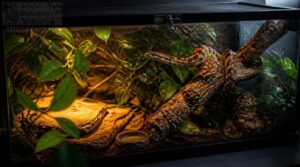
Think of the adult enclosure as non-negotiable real estate: 48L x 24W x 24H minimum, with floor space and vertical climbing area both factored in.
Skimping on space or UVB exposure can quietly stress your snake’s calcium levels, so it’s worth understanding the warning signs of metabolic bone disease in snakes before it becomes a problem.
For multi-snake housing, don’t shortcut square footage.
- Secure, escape-proof design (these snakes push lids relentlessly)
- Basking zone at 82-85°F
- Cool side holding 72-78°F, humidity 50-70%
Hatchling Starter Setup
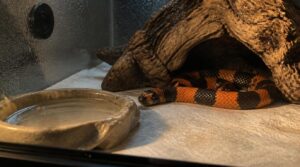
Small footprints work best for hatchlings: a 10-20 liter faunarium keeps them feeling secure.
Use paper towel or reptile carpet substrate, an off-center water dish, and one warm-side hide.
Maintain a 28-30°C basking gradient, dropping to 22-24°C nightly, with humidity at 50-60%.
Feed pinky mice every 5-7 days.
Escape-Proof Security
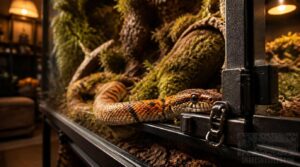
Mandarin rat snakes are escape artists, plain and simple, so don’t skimp on hardware.
Mandarin rat snakes are natural escape artists, so their enclosure hardware deserves no shortcuts
Choose glass front-opening terrariums or PVC enclosures with reinforced frames and secure latches—never sliding doors alone. Add a secure lid with locking clips, since these snakes exploit any gap. Consider monitoring systems with door sensors for real-time alerts, giving you genuine escape prevention and peace of mind.
Hide Placement

Where you put hides matters as much as how many you offer. Keep them in the lower third of the terrarium, entrances angled away from airflow—cork tubes and half logs work well here.
Anchor one on the warm side, one cool, using non-toxic materials. Clean weekly, rotate occasionally, and inspect monthly for cracks or wear.
Climbing and Enrichment

Given a semi-arboreal build, your snake needs vertical relief, not just floor space. Offer:
- Sturdy low branches and rolling limbs for grip practice
- Cork tubes and half logs with varied bark texture
- Live tropical plants for shade and handholds
Anchor everything securely—loose décor causes falls. Hanging enrichment adds movement incentive without overcrowding the enclosure.
Temperature, Lighting, and Humidity Needs

This species evolved in cool mountain terrain, and your climate control needs to reflect that heritage precisely. Getting the gradient wrong stresses the immune system faster than most keepers realize. Here’s what your thermostat, bulbs, and mister need to be doing, day and night.
Basking Spot Temperature
Skip the thermometer guesswork—press an infrared gun right onto the basking surface. You want 82-85°F there, not ambient air. Mount heat sources overhead, never near glass, to build a true gradient for thermal regulation.
| Tool | Purpose |
|---|---|
| IR thermometer | Surface checks |
| Probe | Constant monitoring |
| Thermostat | Prevents overshoot |
| Log | Tracks seasonal drift |
| Dimmer | Steadies output |
Cool Side Range
That basking reading only tells half the story. The opposite end needs a genuine cool zone, holding 72-78°F, so your snake can retreat and cool its body.
Overnight, let temperatures ease down to 68–72°F, and check this corn snake temperature control guide for tips on keeping the whole gradient stable.
Position sensors low, away from airflow vents, for accurate ground-level data. Avoid heat-retentive substrate here—it undermines the thermal gradient your snake depends on for real thermal regulation.
Safe Nighttime Drops
Once your cool zone holds steady, let nighttime temperatures drop naturally to 60-70°F, mimicking mountain evenings. Maintain ventilation balance so humidity doesn’t spike as heat sources cycle off.
This gentle temperature gradient shift aids genuine thermal regulation, signaling rest without stressing your snake’s system.
UVB and Photoperiod
Once nights cool properly, light cycling matters just as much. Run low-level UVB lighting like a Zoo Med Reptisun T5 HO 5.0 or Arcadia Forest 6% bulb, 13 hours daily in summer, 11 in winter. Replace bulbs every 12 months—output degrades before it visibly dims.
Position them 11-16" above the enclosure, creating a proper basking gradient without overexposing your snake.
Humidity and Misting
Rarely does humidity get the attention it deserves, yet it’s central to healthy shedding.
Keep humidity levels between 50-70%, dipping toward 40-50% between misting sessions. Mist the terrarium twice daily using purified water, and position your water bowl away from basking zones.
Choosing a terrarium with built-in ventilation and drainage makes maintaining these humidity levels much easier — explore the best snake terrariums of 2026 to find setups designed with moisture control in mind.
A digital hygrometer beats guesswork—log readings daily to catch drift before it triggers respiratory trouble.
Substrate, Water, and Habitat Maintenance
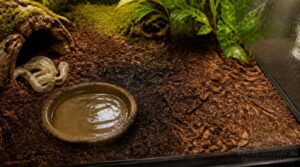
Getting the temperature and humidity right only takes you halfway there. Underneath your snake’s feet, substrate choice and cleaning habits do just as much work in preventing illness. Let’s walk through the five essentials you need to get right.
Best Substrate Options
Skip kiln-dried pine—those shavings irritate respiratory tissue.
Your best bets: Zoo Med Eco Earth, ReptiSoil, or cypress bark blends, layered with sphagnum moss for moisture balance and low dust control. These odor-reducing, cost-effective substrates retain humidity without turning soggy, satisfying your mandarin rat snake’s need for both hydration and clean air.
Burrowing Substrate Depth
Depth matters as much as material. Give juveniles 2-4 inches of substrate, adults 4-6 inches, in loose, grainy blends that resist compaction.
Deeper beds stabilize humidity at ground level and create cooler microclimates for thermoregulation. Watch burrowing behavior closely—persistent digging to the tank floor signals it’s time to add depth, gradually, while tracking moisture levels.
Water Bowl Size
A shallow dish won’t cut it here. Match bowl size to your snake’s life stage: hatchlings need 30-60ml, adults 250-500ml. Choose a heavy, chew-resistant stainless steel bowl, placed away from heat.
- Cracked bowls harbor bacteria
- Tipped water invites shed problems
- Undersized dishes stress growing snakes
- Poor placement causes dehydration
- Neglected bowls breed pathogens
Spot Cleaning Routine
A urine spot left overnight breeds bacteria fast. Blot immediately with a clean white cloth, never rub, then treat with reptile-safe cleaner.
Your snake’s substrate holds moisture and waste in equal measure, so daily checks in high-traffic corners matter. Keep microfiber towels, a spray bottle, and pH-balanced cleaner stocked. Dry thoroughly—damp substrate under a secured lid invites mold, not just odor.
Full Substrate Replacement
Some jobs demand a total reset. After a spill or disease outbreak, spot cleaning won’t cut it—bacterial contamination runs too deep into the substrate.
Use a sealed transfer method to move your snake without escape risk. Sanitize hides, bowls, and containers thoroughly. Let the enclosure stabilize 24-48 hours before reintroduction, then monitor humidity and temperature closely for 72 hours to ease re-establishment.
Mandarin Rat Snake Diet and Health Care
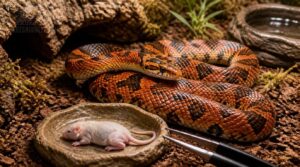
Feeding your mandarin rat snake correctly does more for its long-term health than almost anything else in its care.
Get the prey, schedule, and safety steps wrong, and you’ll see it show up in poor sheds or a thin body condition down the line.
Here’s what you need to know to keep your snake eating well and staying healthy.
Sticking with frozen-thawed rodents warmed to that 100–105°F sweet spot keeps feedings safe and stress-free, and this guide on what blood pythons eat breaks down portion sizes and feeding schedules by age.
Before committing, it’s worth reading a full Burmese python care guide to understand the space, feeding schedule, and handling needs a snake this size demands.
Prey Types and Variety
A dozen prey options keep your mandarin rat snake thriving. Stick with frozen-thawed mice as the staple, then rotate in quail chicks, geckos, and anoles for dietary variety.
- Reptile prey (lizards, young snakes)
- Bird prey (chicks, nestlings)
- Invertebrate supplements (roaches, crickets)
Match prey size to jaw width. Use soft-tipped feeding tweezers with live prey to prevent injury.
Feeding Schedule by Age
Prey variety matters little without correct timing. Juveniles should be fed once every 4-6 days, matching rapid growth stages; adults shift to once every 7 days as metabolism slows.
| Age Stage | Feeding Frequency |
|---|---|
| Juvenile | Every 4-6 days |
| Adult | Every 7 days |
Match prey size to jaw width—never wider than the snake’s thickest point.
Frozen-Thawed Prey Safety
Getting frequency right means nothing if the meal itself is unsafe. Submerge prey in 100-110°F water for 20-40 minutes, checking internal temp hits 77°F before offering.
- Never microwave or boil prey
- Discard uneaten prey within 2 hours
- Never refreeze thawed prey
- Clean feeding tongs after each use
- Use soft-tipped tweezers for picky eaters
Shedding and Skin Health
Ecdysis runs 9-14 days, dulling skin and pinking bellies before the old layer peels off whole.
| Signal | Normal | Problem |
|---|---|---|
| Skin tone | Dull, then glossy | Dry, cracked |
| Eyes | Clear post-shed | Cloudy caps |
| Belly | Uniform pink | Patchy |
| Shed | One piece | Fragmented |
Humidity control (60-75%) plus a humid hide with damp sphagnum moss prevents retained sheds.
Parasites and Vet Care
A snake that seems fine can still harbor trouble internally. Fecal testing catches ascarids, hookworms, and protozoal cysts like Entamoeba invadens before symptoms hit.
Your quarantine protocol matters: isolate new snakes 30 days, testing weekly. Treatment usually means:
- Fenbendazole or levamisole for worms
- Metronidazole for amoebiasis
- Follow-up fecals 14 days post-dose
Environmental sanitation and annual vet checkups protect digestive health long-term.
Frequently Asked Questions (FAQs)
What is the best substrate for mandarin rat snakes?
Skip paper towels. Choose moisture-retentive substrates like Eco Earth, ReptiSoil, or coconut husk blends, 3-4 inches deep, for a naturalistic setup that helps with burrowing, retains humidity, and mimics forest floor conditions your snake evolved to thrive in.
What size tank does a mandarin rat snake need?
Think of it as a studio apartment, not a closet: your adult needs floor space to stretch fully. Minimum 40 gallon equivalent (36"×18"×18"), but 48L x 24W x 24H is the true escape-proof standard.
What temperature do mandarin rat snakes like?
Cool mountain air, not tropical heat, is what these snakes crave. Keep the basking spot at 82–85°F, ambient zones 70–78°F, and nights 60–70°F—a true thermal gradient supporting healthy digestion and metabolism.
What is the best bedding for a rat snake?
A burrow that collapses mid-dig stresses your snake fast. Layer coconut fiber or Zoo Med ReptiSoil 4+ inches deep, mixing in Eco Earth or Exo Terra Plantation Soil to hold 50-70% humidity while supporting natural tunneling.
How do you care for a mandarin rat snake?
Caring for a Mandarin Rat Snake means dialing in a temperature gradient of 70-85°F, humidity control at 50-70%, a secure 48"L enclosure, proper substrate depth, consistent feeding schedule, gentle handling, and regular veterinary checkups.
Should I take my Mandarin rat snake to the vet?
A silent snake can be a loud alarm bell. Book a vet visit for wheezing, open-mouth breathing, weeks-long food refusal, swollen gums, mucus, weight loss, or shedding trouble that persists despite correct husbandry.
How do you heat a mandarin rat snake?
Run a thermostat-controlled ceramic heat emitter or under-tank heat mat to build a real temperature gradient: basking zone at 82-85°F, cool side down to 72-78°F. Verify readings nightly with an infrared thermometer, not guesswork.
How much humidity do Mandarin rat snakes need?
Aim for humidity levels between 50-70 percent by day, rising slightly at night. Track readings with a digital hygrometer, run a proper misting routine, and add a humid hide for shedding support and stable substrate moisture.
Do Mandarin rat snakes need a heat source?
Yes. Set up a thermal gradient with a basking area of 82–85°F, a cool side between 72–78°F, thermostat-controlled heat bulbs, and nighttime cooling into the 60s to mirror mountain conditions.
How to choose a terrarium for a mandarin rat snake?
Think of it less as a cage, more as a snake’s permanent apartment. Go no smaller than 48"L x 24"W x 24"H, with secure latches, front-opening glass or PVC doors, solid ventilation, and reliable humidity control throughout.
Conclusion
A Yunnan mountainside doesn’t negotiate on temperature, and neither should your terrarium. That basking gradient, that humidity swing, that varied prey list—each detail mimics a slope this species has climbed for generations.
Follow this mandarin rat snake care sheet closely, and you’ll see a snake that feeds readily, sheds in one clean piece, and moves with visible confidence. Skip the details, and stress finds the cracks. Precision isn’t optional here. It’s the whole job.