This site is supported by our readers. We may earn a commission, at no cost to you, if you purchase through links.

A hatchling Burmese python fits in your palm. Give it three to five years, and you’re managing an animal that can stretch past 12 feet and outweigh a grown adult. That gap between "cute enclosure pet" and "apex-sized constrictor" catches new owners off guard more than any other factor in reptile ownership.
Owning a Burmese python pet isn’t a casual hobby decision, it’s a multi-decade commitment involving custom enclosures, strict handling protocols, and permits that vary sharply by state. Florida bans private ownership outright. Virginia caps length at 6 feet.
Understanding what you’re really signing up for, before the eggs hatch or the adult arrives, changes everything about how you prepare.
Table Of Contents
- Key Takeaways
- Burmese Python Pet Ownership Overview
- Housing and Environmental Requirements
- Feeding, Health, and Safe Handling
- Top 5 Burmese Python Care Products
- Frequently Asked Questions (FAQs)
- Can a Burmese python be a pet?
- Is it legal to own a Burmese python in the US?
- Is a Burmese python aggressive?
- Where do Burmese pythons live?
- Are Burmese pythons invasive?
- How big is a Burmese python?
- What do Burmese pythons eat in Florida?
- What do Burmese pythons eat?
- Can Burmese pythons live with other snakes?
- How often should I clean the enclosure?
- Conclusion
Key Takeaways
- A hatchling Burmese python grows into a 12-16 foot, decades-long commitment, so you need to plan for its adult size and 20-25 year lifespan before you bring one home.
- Legal rules vary widely by state (Florida bans ownership outright, Virginia caps length at 6 feet), so you must check permits and local laws before buying.
- Proper housing means building a room-sized enclosure (10x6x6 feet minimum for adults) with strict temperature, humidity, and escape-proof security, not just a large tank.
- Safe ownership depends on consistent feeding schedules, regular vet checkups, and multi-person handling protocols once your python passes 8 feet long.
Burmese Python Pet Ownership Overview

Owning a Burmese python isn’t a decision you make on impulse — it’s closer to committing to a horse, or perhaps a gorilla, regarding space and long-term responsibility.
Before bringing one home, it helps to see the full picture of how big Burmese pythons get and how long it takes them to grow, so your space and feeding plans grow with the snake instead of playing catch-up.
Before you bring one home, you need a clear picture of what you’re actually signing up for, from size and lifespan to legal fine print.
Here’s what every prospective keeper should know first.
Adult Size, Lifespan, and Temperament
A twelve-foot constrictor-type isn’t a pet, it’s a lifelong commitment: 20-25 years, occasionally 30, with adults reaching 12-16 feet and 25-150 pounds.
- Growth continues 3-5 years
- Females outsize males
- Calm when undisturbed, defensive if startled
- Rough handling breeds distrust
- Gentle early handling shapes temperament
That rectangular head hides real power. Respect it accordingly. Research on companion animals shows that early socialization influences temperament well into adulthood, underscoring why consistent, gentle handling matters from the start.
Legal Restrictions and Required Permits
That power comes with paperwork. Lacey Act compliance is federal law since 2012, banning interstate transport without permits.
State rules vary wildly: Florida bans private ownership outright, New York prohibits all subspecies, Virginia caps length at 6 feet.
Check grandfathered ownership rules and licensing before buying. Ignorance won’t shield you from confiscation.
Costs and Long-Term Commitment
Permits solve the legal problem, not the budget one. Hatchlings run $40 to $200, but adults with proven lineage climb past $1,000.
Annual upkeep adds $300 to $800 for heating, substrate, and vet checkups. Multiply that across a 20 to 25 year lifespan and you’re funding a long-term financial commitment, not an impulse buy.
Sex Differences and Dwarf Localities
That budget math shifts fast once sex enters the picture. Female Burmese pythons outweigh males substantially, though length gaps stay modest, males top out near 12 feet, females past 15. This sexual dimorphism means females need extra female egg space for clutches.
Dwarf localities, Java, Bali, Sulawesi, cap around 8 feet, an easier fit for space-limited keepers.
Common Pet Ownership Misconceptions
Why do so many new keepers underestimate this animal? Most picture a manageable pet snake, not a 12 to 16 foot constrictor living 20 to 30 years. Permit requirements, cost underestimation, and handling risks catch owners off guard constantly.
Exotic pet ownership demands real enclosure size and reptile husbandry knowledge, plus legal restrictions many skip researching beforehand.
Housing and Environmental Requirements
Housing a Burmese python isn’t like setting up a tank for a corn snake — you’re building a room, not a cage. Get the enclosure wrong, and you’re looking at stress, illness, or a python strong enough to test every weak seam it finds.
Since a python’s enclosure directly affects its shedding, humidity, and overall health, it’s worth reviewing this ball python care and handling guide for setup fundamentals that carry over across large constrictor species.
Housing a Burmese python means building a room, not a cage, or risking a snake strong enough to find every weak seam
Here’s what your setup actually needs to get right, starting with size.
Minimum Enclosure Size by Age

Sizing a python’s home wrong invites disaster, so match enclosure to growth stage.
- Hatchling tank size: 10-gallon or 20x11x13 inches
- Juveniles: upgrade every 6-8 months
- Adult space needs: 10x6x6 feet minimum
- Dwarf subspecies housing: roughly half that footprint
- Growth-based sizing prevents stress and escape attempts
Undersized enclosures stunt growth and trigger stress-related illness. Size up before your snake outgrows its quarters, not after.
Escape-Proof Design and Security

Because a loose adult can flatten fencing or vanish into a neighbor’s yard, escape-proof enclosures are non-negotiable. Demand two-stage locking latches rated to 1500 newtons, welded seams under 2mm, and magnetic reed alarm triggers on every door.
Check hinge security, swaged pins resist prying, plus 3mm chamfered edges. Consider double-door systems, secondary containment, and your local zoning laws before bringing one home.
Temperature and Humidity Gradients
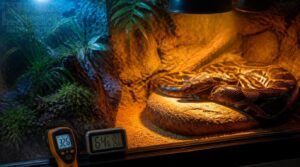
Get the thermal gradient wrong and you’re looking at respiratory infections or worse. Basking zones need 30-34°C with an 8-12°C drop to the cool side.
Keep humidity at 60-80%, drier near heat sources, humid in shaded corners. Infrared thermometers and digital hygrometers aren’t optional, they’re how you catch drift before it becomes a vet bill.
Substrate, Hides, and Furnishings
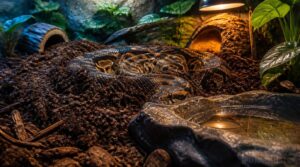
What’s under your python’s belly matters as much as the temperature above it. Coconut husk or cypress mulch hold humidity without dust; skip sand, it causes impaction.
Substrate depth runs 4-6 inches for adults, shallower for juveniles.
Place dual hides on opposite thermal zones, clean furnishings weekly, and avoid aromatic woods that irritate skin.
Space and Household Considerations
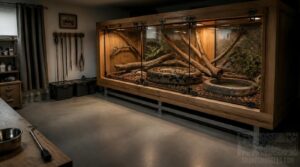
Where does a 100-pound constrictor actually live in your house? Not a closet corner.
- Floor reinforcement for tanks exceeding 200 lbs
- Low-traffic room placement, away from noise
- Lighting control, no direct sun
- Clear access planning for feeding and cleaning
- Secure locking mechanisms preventing escape-proof failures
Check zoning laws first. Some apartments simply won’t allow it.
Feeding, Health, and Safe Handling
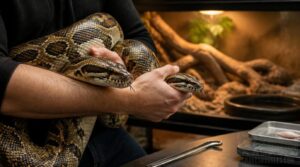
Once the enclosure is squared away, your attention has to shift to what’s happening inside your python’s body. Feeding, health, and handling aren’t separate chores — they’re connected, and getting one wrong often shows up in the others. Here’s what you need to know to keep your snake thriving and yourself safe in the process.
Diet and Feeding Schedules
Feeding frequency shifts dramatically with age: juveniles need meals every 5-7 days, while adults settle into a 1-2 week schedule, prey sized at 1-1.5 times body girth.
Always use pre-killed prey and feeding tongs, never live rodents unattended.
Watch for regurgitation or swelling; both signal improper prey size, not just a picky appetite.
Preventing Common Health Problems
Once feeding’s dialed in, health problems mostly trace back to environment. Respiratory infections stem from poor thermal gradients, wheezing and head-lifting are early tells.
Keep humidity 50-60%, quarantine new snakes 3-6 months, inspect for mites and stuck shed each handling session.
Watch stress indicators like refusal to feed. Weekly substrate changes prevent scale rot and bacterial buildup.
Veterinary Care and Health Records
An annual exam with a reptile-savvy vet catches problems before they become emergencies.
Push for biannual fecal testing, fenbendazole treatment when parasites turn up, and routine weight checks.
Ask your vet to maintain a proper problem list, documenting exam findings and treatment plans.
You’re entitled to those records, so request copies for continuity of care.
Multi-Person Handling Safety
That paperwork means little once you’re lifting 15 feet of muscle.
Multiperson handling isn’t optional past 8 feet: use the Buddy System Protocol, a Head Avoidance Grip, and a Weight Distribution Lift. Run your Tool Inspection Routine first. Watch for Behavioral Pause Signals, coil tightness, hissing, before handling stress escalates into a bite or constriction event.
Emergency and Rehoming Plans
Owning a snake this size means planning for the day you can’t keep it. Build an emergency contacts list: vet, python rescue, two backups.
Line up shelter or breeder options for temporary housing. Keep health records current.
Follow a two-week rehoming process, screening adopters for experience and secure, escape-proof enclosures before transfer.
Top 5 Burmese Python Care Products
Owning a Burmese python means committing to gear that actually holds up under 15 feet of muscle and constant humidity. The wrong substrate, thermometer, or cleaning product can cost you money, or worse, your snake’s health. Here are five products worth having on hand before your python ever comes home.
1. ReptiChip Coconut Reptile Substrate Bedding
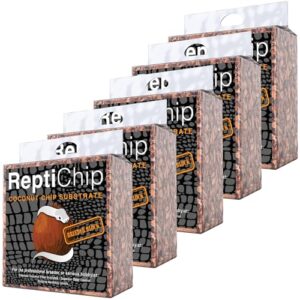
A 72-quart brick of ReptiChip expands into roughly 10 lbs of coconut husk bedding, retaining humidity without turning soggy underfoot, critical for a species prone to shedding complications. Its odor-absorbing properties encapsulate waste between changes, and the soft texture reduces abrasion risk for a heavy-bodied burrower.
Hydrate it fully and let it dry before use. Skipping that step invites mold in a high-humidity enclosure, and initial dust means you’ll want ventilation or a mask during prep.
| Best For | ball pythons, leopard geckos, bearded dragons, and hermit crabs that need stable humidity and support for burrowing or bioactive setups. |
|---|---|
| Pet Safe | Yes |
| Weight | 51.5 lbs |
| Primary Material | Coconut Husk |
| Reptile Use | Yes |
| Easy Cleanup | Yes |
| Odor Control | Yes |
| Additional Features |
|
- Expands to a generous 10 lbs of bedding that holds humidity well without getting soggy
- Odor-absorbing properties help encapsulate waste and reduce buildup between changes
- Soft, husk-based texture supports burrowing behavior with less abrasion risk
- Needs thorough hydration and drying before use, or mold can develop in humid enclosures
- Can be dusty during prep, so ventilation or a mask is recommended
- Some users have noted sharp or rigid fibers that could pose an ingestion risk for burrowing species
2. Etekcity Lasergrip Infrared Thermometer Gun
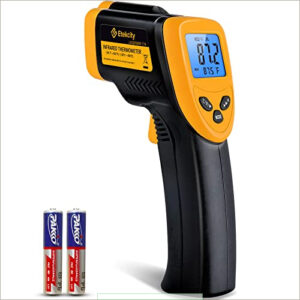
Since basking spots must hold 88-92°F and the cool side 75-80°F, guessing with your palm isn’t good enough for a constrictor-type this size.
The Etekcity Lasergrip reads surface temps from -58°F to 1130°F with a 12:1 distance-to-spot ratio, letting you scan hides and basking sites from 14 inches away in half a second. Adjustable emissivity (0.1-1.0) improves accuracy across wood, stone, or glass. Non-contact means zero risk near a heat lamp or an irritated python.
| Best For | Reptile owners who need precise, non-contact temperature checks for basking spots, cool zones, and enclosures without disturbing their pet. |
|---|---|
| Pet Safe | Yes |
| Weight | N/A listed |
| Primary Material | Plastic/ABS |
| Reptile Use | Yes |
| Easy Cleanup | N/A |
| Odor Control | No |
| Additional Features |
|
- Fast 0.5-second readings with a large backlit display that’s easy to check even in dim setups
- 12:1 distance-to-spot ratio lets you measure basking sites and hides from about 14 inches away
- Adjustable emissivity (0.1–1.0) helps improve accuracy on different surfaces like wood, stone, or glass
- Cannot measure through glass or plastic accurately without adjusting emissivity settings first
- Not designed for checking human or pet body temperature directly
- Measurement spot size grows with distance, so readings can be less precise if the target doesn’t fully fill the spot
3. Bon Tool Heavy Duty Mixing Tub
A 15-foot female python doesn’t care that you’re mixing rat bedding or soaking a soiled hide, she needs a basin she can’t tip.
The Bon Tool tub’s 3.5 cubic foot polypropylene shell resists mortar, lime, and temps down to -20°F, which means it shrugs off feces, disinfectant, and repeated scrubbing without cracking. At 36"L x 24"W x 8"H, it’s wide enough for soak sessions or substrate turnover. Some keepers find the walls thin under full loads, so support it on a stand.
| Best For | Reptile keepers, breeders, and hands-on DIYers who need a tough, oversized basin for soaking large snakes, cleaning enclosures, or mixing small batches of mortar and cement. |
|---|---|
| Pet Safe | Yes |
| Weight | N/A listed |
| Primary Material | Polypropylene |
| Reptile Use | Yes |
| Easy Cleanup | Yes |
| Odor Control | No |
| Additional Features |
|
- Polypropylene shell resists mortar, lime, and temperature extremes down to -20°F
- Leak-proof, non-stick surface makes cleanup and repeated use easy
- Generous 3.5 cubic foot capacity and 36"L x 24"W footprint fit large soak sessions or mixing jobs
- Walls can feel thin and flex when the tub is fully loaded
- May need sawhorses or risers for stable elevated use
- Priced higher than some buyers expect given the material thickness
4. Python Aquarium Maintenance System
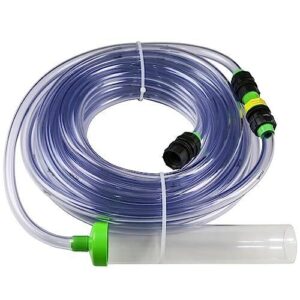
Water changes on a stock tank sized for a 15-foot python aren’t optional, they’re a weekly battle against ammonia buildup from waste and shed skin.
The Python system attaches to your faucet in under five minutes, using water pressure alone to drain and refill without buckets or siphoning. Its 10" gravel tube and included hose handle debris removal without disturbing decor. Just match water temperature before refilling and dechlorinate immediately, since this system doesn’t treat water on the way in.
| Best For | Aquarium owners who want to skip the buckets and siphoning hassle and get quick, frequent water changes done right at the faucet. |
|---|---|
| Pet Safe | Yes |
| Weight | 2.9 lbs |
| Primary Material | Plastic, Vinyl |
| Reptile Use | No |
| Easy Cleanup | Yes |
| Odor Control | No |
| Additional Features |
|
- Sets up in under five minutes and works on most faucet styles
- Drains, fills, and vacuums gravel using just water pressure, no heavy lifting
- Cuts maintenance time way down while keeping decor undisturbed
- Doesn’t dechlorinate water automatically, so you’ll need to treat the tank right after filling
- Needs matching water temps beforehand to avoid stressing your fish
- Longer hose runs can weaken flow and suction over distance
5. F10 All Purpose Disinfectant Spray
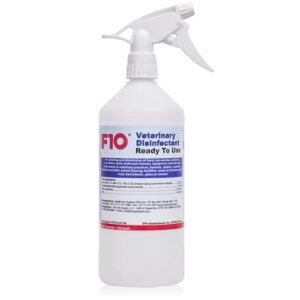
Bacteria and fungal spores don’t care how clean your enclosure looks, they thrive in warm, humid habitats exactly like the one your python calls home.
F10 is an EPA-registered veterinary disinfectant, ready to use straight from the bottle, no dilution or measuring required. It kills bacteria, viruses, fungi, and spores while staying biodegradable and unscented, safe for use around reptiles once surfaces air dry completely. Apply after routine cleaning, never as a substitute for it, and always allow full drying before returning your snake to its enclosure.
| Best For | Reptile owners, veterinary clinics, shelters, and breeders who need a broad-spectrum disinfectant that’s safe for sensitive animals and their habitats. |
|---|---|
| Pet Safe | Yes |
| Weight | 2.65 lbs |
| Primary Material | Biodegradable Formula |
| Reptile Use | Yes |
| Easy Cleanup | Yes |
| Odor Control | Yes |
| Additional Features |
|
- Ready to use straight from the bottle with no dilution or measuring
- EPA-registered and effective against bacteria, viruses, fungi, and spores
- Biodegradable and unscented, making it safe around reptiles and other sensitive pets
- Higher cost compared to standard household disinfectants or concentrates
- May be overkill for routine household cleaning needs
- Ready-to-use version may face shipping restrictions in some states
Frequently Asked Questions (FAQs)
Can a Burmese python be a pet?
Yes, but only with serious commitment: these constrictors demand permits in many jurisdictions, escape-proof enclosures, and years of dedicated husbandry. They’re legal companions for prepared keepers, not casual pets, given their size, strength, and 15-25 year lifespan.
Is it legal to own a Burmese python in the US?
Legality depends entirely on your jurisdiction: federal law classifies them as injurious wildlife, restricting interstate transport, while states like Florida and Georgia ban private ownership outright. Always verify state and local codes before acquiring one.
Is a Burmese python aggressive?
Funny enough, most bites trace back to handler error, not temperament. True aggression is uncommon; defensive thrashing or hissing happens when startled or grabbed. Calm handling and a quiet environment keep even a large constrictor-type reliably manageable.
Since snakes rely heavily on scent cues like ammonia and fur residue to identify prey, washing your hands beforehand is one of the simplest safeguards, alongside other ball python bite prevention techniques that reduce misdirected strikes.
Where do Burmese pythons live?
In the wild, they favor tropical forests, mangroves, and riverine floodplains across Southeast Asia. In Florida, an invasive population thrives in Everglades wetlands, canals, and dense vegetation, always staying close to water for hunting and thermal regulation.
Are Burmese pythons invasive?
In southern Florida, this species has formed a breeding population across the Everglades, preying on marsh rabbits and raccoons while disrupting native food webs, prompting state removal programs and strict federal transport regulations under the Lacey Act.
How big is a Burmese python?
That horse-or-gorilla comparison isn’t hyperbole once you’re feeding an adult. Expect 12 to 16 feet in captivity, occasionally topping 18, with females outsizing males and full growth taking 12 to 15 years to reach.
What do Burmese pythons eat in Florida?
In the Everglades, wild pythons take birds, mammals, and reptiles, from wading birds and raccoons to opossums and alligators. Prey size varies widely, matching whatever crosses their path near canals, marshes, and cypress sloughs.
What do Burmese pythons eat?
Picture an ambush predator coiled motionless for days, then striking. Diet centers on mammals, from rodents to rabbits, plus birds, lizards, and amphibians. Adults use thermal pits to target warm prey, then constrict before swallowing whole.
Because Mojave rattlesnake venom can affect nerves and breathing with little visible swelling, this Mojave rattlesnake species profile explains why every bite needs urgent antivenom care.
Can Burmese pythons live with other snakes?
No, not safely. These are solitary constrictor-types prone to feeding interference, bite wounds, and territorial stress. Cohabitation demands 50% more space, separate hides, and constant monitoring, so most experienced keepers house each animal alone.
How often should I clean the enclosure?
Clean sweep, not once and done: spot clean daily for waste, refresh substrate weekly, then commit to a deep clean every one to three months, with full disinfection monthly or whenever illness signs appear.
Conclusion
A python’s coils close slowly, deliberately, teaching patience to anyone who underestimates them. That’s the real lesson behind every burmese python pet decision: strength demands respect, not romance.
You’re not just feeding a snake, you’re managing a 150-pound predator’s lifetime needs, from custom enclosures to permit paperwork.
Skip the shortcuts and the guesswork disappears. Owners who master husbandry basics, humidity, handling, health checks, gain genuine command over a powerful animal. That mastery, earned through discipline, is what separates responsible keepers from cautionary tales.