This site is supported by our readers. We may earn a commission, at no cost to you, if you purchase through links.

Hold a Brazilian Rainbow Boa under sunlight and the whole snake ignites, throwing rainbow arcs across your hands. No pigment does that. Microscopic ridges on each scale bend light like a prism, and once you’ve seen it, ordinary snakes start looking a bit dull.
That’s the magic hiding inside snake breeds with unique patterns. Some wear their art on the surface, like the Eastern Diamondback’s cream-edged diamonds or the Piebald’s splashes of pure white. Others engineer color from physics itself, layering guanine crystals into living mirrors.
You’re about to meet fifteen of the most stunning, from canopy dwellers to morph-bred stunners, plus the genetics and care know-how behind each one.
Table Of Contents
- Key Takeaways
- 15 Snake Breeds With Unique Patterns: Species and Morphs
- Brazilian Rainbow Boa: Rainbow Sheen
- Sunbeam Snake: Mirror-Like Iridescence
- Boelen’s Python: Blue-Black Shimmer
- Emerald Tree Boa: Lightning Marks
- Green Tree Python: Color-Changing Camouflage
- Blood Python: Brick-Red Blotches
- Piebald Ball Python: White Patches
- Axanthic Ball Python: Monochrome Contrast
- Lavender Albino Ball Python: Pastels
- Scaleless Ball Python: Unbroken Markings
- Palmetto Corn Snake: Speckled White
- Tessera Corn Snake: Dorsal Stripe
- California Kingsnake: Bold Black Bands
- Honduran Milk Snake: Tricolor Rings
- Eastern Diamondback Rattlesnake: Dark Diamonds
- How Genetics Create Rare Snake Morphs and Patterns
- How Iridescent Snake Scales Produce Rainbow Colors
- How Habitat and Camouflage Shape Snake Patterns
- How to Choose and Care for a Uniquely Patterned Pet Snake
- Frequently Asked Questions (FAQs)
- What is the rarest snake breed?
- Can you identify snakes by patterns?
- What is the most unique snake?
- What is the prettiest snake breed?
- What are the most patterned snakes?
- Do snakes have a pattern?
- Which snake breed is best for a beginner?
- What are the cutest pet snake breeds?
- How many types of snakes are there?
- What is the most beautiful snake pattern?
- Conclusion
Key Takeaways
- Snake patterns come from two sources: physical structure, like the Brazilian Rainbow Boa’s microscopic scale ridges that refract light into rainbows, and genetics, like recessive mutations producing piebald, albino, axanthic, and scaleless morphs.
- Most patterns serve survival, not just beauty—canopy species like the Emerald Tree Boa use disruptive lightning marks for camouflage, while banding and blotching help ground species break up their silhouette in grassland or leaf litter.
- Morph beauty can carry health costs: scaleless snakes lose protective barriers and need soft substrate with precise humidity, pale albino morphs require UV caution, and buyers should demand documented lineage and health testing from breeders.
- Husbandry should follow the snake’s wild origins, not its appearance—rainforest species like emerald tree boas need 85–95% humidity while corn snakes prefer drier air, and corn snakes remain the top beginner choice for their docile, forgiving nature.
15 Snake Breeds With Unique Patterns: Species and Morphs
From wild iridescent species to captive-bred genetic morphs, the snake world offers patterns that genuinely stop you in your tracks. These 15 breeds represent the full visual spectrum, and each one comes with its own fascinating backstory. Get ready to meet some of the most striking patterned snakes on the planet.
If you’re curious about how these genetics actually work, this guide to snake morphs breaks down the science behind every color and pattern.
Brazilian Rainbow Boa: Rainbow Sheen
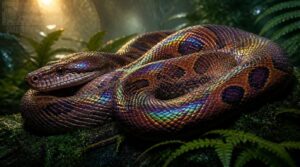
The Brazilian Rainbow Boa doesn’t owe its beautiful look to color morphs or selective breeding. Those colors come entirely from scale nanostructures, microscopic ridges that bend light into a shimmering spectrum across the dorsal scales.
This iridescent scales effect is pure light refraction, with no pigment involved. Keep humidity above 60% and temperatures around 78-82°F, and the display intensifies beautifully.
A reliable reptile humidity gauge makes it easy to keep those levels steady and the shimmer at its best.
Sunbeam Snake: Mirror-Like Iridescence
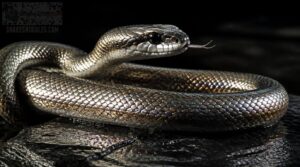
The Sunbeam Snake replaces refracted rainbows with something like liquid mercury. Its mirror-like iridescence comes from guanine platelets arranged in precise layers beneath each scale.
These scale nanostructures reflect light almost perfectly rather than scattering it into color. Tilt the snake and the sheen shifts. Genetic variations in platelet regularity mean a well-fed specimen under direct light looks genuinely unreal.
Boelen’s Python: Blue-Black Shimmer
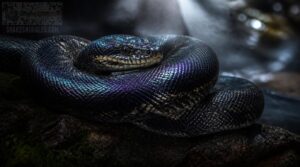
Where mercury gives way to something deeper, Boelen’s Python hits differently. Its blue-black shimmer comes from melanin-dense dorsal scales interacting with guanine-crystal iridophores underneath. Tilt it and the sheen shifts exactly like the Sunbeam, but richer, almost velvety.
Genetic variations across breeding lines affect shimmer consistency, and specialized captive care, particularly humidity, keeps those iridescent scales at their most dramatic.
Emerald Tree Boa: Lightning Marks
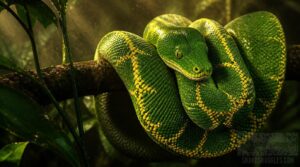
Swap velvety shimmer for jagged electricity. The Emerald Tree Boa carries Lightning Marks, pale-yellow streaks branching perpendicular to the spine. These aren’t iridescent scale patterns; localized pigment disruption fixes them at hatching. Humidity in specialized captive care keeps contrast vivid.
- Marks shatter the dorsal silhouette for camouflage
- Brightness amplifies under basking light
- Pattern genetics lock the design through every molt
Green Tree Python: Color-Changing Camouflage

Scale architecture in the Green Tree Python is nothing short of impressive. Ontogenetic Coloration shifts juveniles from vivid yellow or red to electric adult green, tied directly to their Arboreal Lifestyle and vertical canopy perches.
That Color-Changing Camouflage isn’t passive, and you can watch it happen. Iridophores modulate hue based on light angle and stress, making Rainforest Camouflage a living, observable spectacle.
Blood Python: Brick-Red Blotches
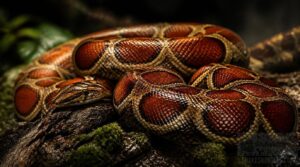
The Blood Python wears brick-red blotches like stained-glass saddles, each crimson center edged in lighter scales down the dorsal midline.
Under pattern genetics, expressivity varies by clutch, and captive breeding programs have intensified contrast dramatically.
These striking color morphs don’t change husbandry: hold 88–92°F basking, 60–70% humidity, and inspect skin closely, since dense blotches can hide subtle lesions.
If you’re weighing which boa fits your setup best, our guide to different boa species breaks down how arboreal varieties like the emerald tree boa differ from cool-climate keepers’ favorites like the rubber boa.
Piebald Ball Python: White Patches
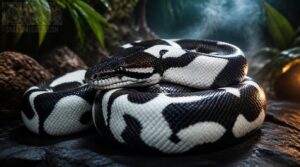
Imagine a snake that looks dipped in spilled milk, midnight scales interrupted by blazing white continents. That’s the Piebald Ball Python, the most theatrical of Genetic Morphs. Its White Patches stem from Recessive Gene Mutations blocking melanocyte migration, so patterns range from speckled islands to near-total white. Captive Breeding Programs have refined coverage dramatically. Care’s standard ball python fare: warmth, humidity, patience.
Axanthic Ball Python: Monochrome Contrast
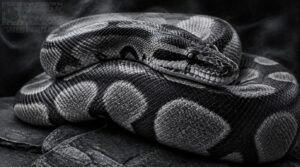
Picture a snake dipped in charcoal, every blotch and stripe rendered in pure grayscale. That’s the Axanthic Ball Python, and it’s stunning. Recessive Gene Mutations strip yellow and red pigment, leaving crisp Monochrome Contrast. Here’s what you should know:
- Axanthic Patterns range from silver-gray to near-black.
- Three distinct Color Morphs strains exist.
- Lighting reveals subtle iridescence.
- Care matches standard ball pythons.
- Albino combos produce striking whites.
Lavender Albino Ball Python: Pastels
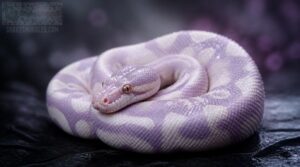
Some Color Morphs look painted by hand. The Lavender Albino Ball Python isn’t one of them; it’s pure genetics.
| Feature | What You’ll See |
|---|---|
| Base tone | Soft lavender-gray |
| Pattern | Pastel saddles, blurred edges |
| Eyes | Pale amber irises |
Albinism strips melanin, lavender genetics tint what remains, and Pastels brighten the purple. Keep humidity at 50–60% for clean sheds.
Scaleless Ball Python: Unbroken Markings
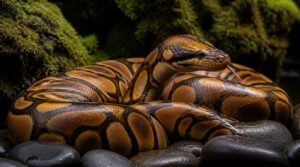
What happens when you strip a Ball Python of its scales? Magic. The Scaleless Ball Python wears its Unbroken Markings like poured paint, pigment flowing seamlessly across skin that’s smooth as river stone.
This recessive trait demands two carrier parents, so verify genetic test results before buying.
Without keratin armor, you’ll need soft substrate, precise humidity, and gentle handling.
Palmetto Corn Snake: Speckled White
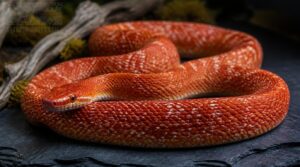
From smooth, scaleless skin to a living starfield: the Palmetto Corn Snake flips the script. Its Speckled White freckles scatter across a red-orange canvas like paint flecks, and they often intensify with age.
- Speckles are pigment clusters, not raised scales
- Pattern Genetics run polygenic, rarely simple
- No dorsal stripe or banding appears
- Standard Corn Snake husbandry applies
Unlike Leucistic Patterns, you’ll see normal scalation beneath every speckle.
Tessera Corn Snake: Dorsal Stripe
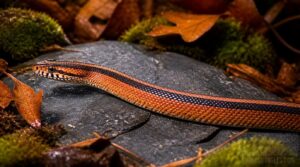
From scattered speckles to a clean racing line: the Tessera Corn Snake trades freckles for a razor-straight Dorsal Stripe. This Tessera Morph runs one to three scales wide from neck to tail, darker or lighter than the body depending on the morph.
Pattern Inheritance here is allele-linked, so heterozygous animals show faint, broken stripes while homozygous carriers display that satisfying, unbroken line.
California Kingsnake: Bold Black Bands
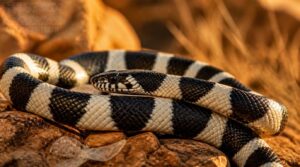
Where the Tessera draws a line, the California King Snake paints in blocks. Those Bold Black Bands ring the body in high-contrast cream, crisp as piano keys. Pattern Genetics keep the motif locked in wild-type, while Selective Breeding sharpens edges further. Striped Patterns exist, but banded locals steal the show. Fresh from a shed? Stunning.
Honduran Milk Snake: Tricolor Rings
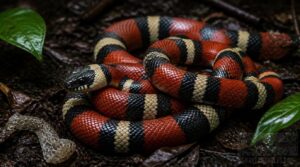
If the kingsnake plays piano keys, the Honduran Milk Snake plays fire. Those tricolor rings of red, black, and cream blaze down the body in irregular widths, a pattern that shreds its silhouette in leaf litter. Pattern genetics make this combo rare; homozygous pairings give the boldest contrast.
For captive care, think warm, humid, dimly lit, and stress-free shedding.
Eastern Diamondback Rattlesnake: Dark Diamonds
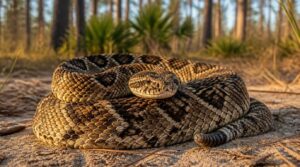
The Eastern Diamondbacked Rattlesnake wears the boldest Dark Diamonds in the serpent world: elongated, pointed blotches edged in cream, marching in a consistent zig-zag down a yellow-brown back. These Diamondback Patterns sharpen with age, disrupt your eye in pine flatwoods, and matter more than rattle or facial scales for identification.
Its potent Venom Composition commands respect, while Habitat Destruction threatens this impressive ambush hunter.
How Genetics Create Rare Snake Morphs and Patterns
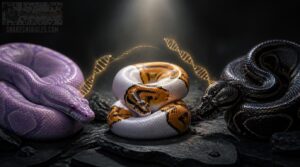
Ever wonder why a lavender albino glows or a piebald ball python wears those wild white patches? The answer lives in the genes, and it’s simpler than you’d think. Let’s break down the three big mutations behind the most stunning morphs you’ll ever see.
Axanthic and Albino Genetics
Ever wonder what happens when you strip color from a snake? Axanthic patterns shut down yellow pigment production, leaving stunning black-and-gray monochrome. Albino genetics block melanin instead, gifting you pink eyes and pastel lavenders. Stack both genetic variations and you’ll get ghostly grayscale with shimmering irises.
These color morphs shift pigment production dramatically, so keep careful breeding records and test-cross to confirm stability.
Piebald and Leucistic Traits
Picture a snake split down its spine: one half blazing orange, the other pure porcelain white. That’s piebald genetics at work, scattering pigment cells unevenly across the body.
Leucistic traits go further, stripping nearly all melanin for a ghostly, pearlescent look. Combine them, and you get High White Piebald stunners. These Genetic Variations are recessive, so breeders pair hets patiently.
Leucistic Patterns stay chalky-bright under broad-spectrum light, and lighting angle shifts their contrast dramatically.
Scaleless Genetic Mutations
Run a fingertip down a scaleless ball python’s back: glass-smooth, warm, unbroken. That’s what happens when genetic mutations knock out scale-forming keratin pathways, erasing placodes before scales form.
You’ll see:
- Fully smooth phenotypes with crisp, borderless markings
- Patchy mosaics retaining vestigial scales
- Lineage-variable inheritance in reptile genetics
- Pattern genetics driven by pigment, not texture
Care matters: these scaleless morphs need humid, gentle handling.
How Iridescent Snake Scales Produce Rainbow Colors
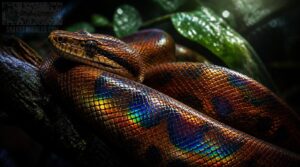
That rainbow gleam on a Brazilian rainbow boa isn’t pigment. It’s physics.
Iridescent scales work like tiny prisms. Here’s what’s happening on the surface:
- Microscopic ridge formation etches parallel grooves into each scale’s keratin, acting as a diffraction grating.
- Slit-like gaps between overlapping scales split white light into its component wavelengths.
- Plate-like beta-keratin lamellae scatter light internally, shifting hues as your viewing angle changes.
- Polished, smooth scale morphology amplifies constructive interference, so well-hydrated, healthy snakes practically glow.
Move your head and the colors swap along a single scale row. That’s the tell.
Iridescence genetics matter too: hypomelanistic animals keep their shimmer, but irregular keratin structure can dull it. Watch for photophobia in pale morphs, and diffuse bright light to see the full spectrum.
How Habitat and Camouflage Shape Snake Patterns

A snake’s pattern isn’t vanity; it’s survival math. Every blotch, band, and stripe is camouflage adaptation sculpted by habitat influence, then locked into place by pattern genetics.
Look closer and the logic snaps into focus:
- Canopy dwellers like emerald tree boas wear lightning-white marks that mimic sunlit leaf gaps.
- Grassland hunters show linear, checker-like patterns that imitate blade shadows.
- Rock specialists carry contrasting blotches matching lichen and mineral speckle.
- Juveniles sport tighter pattern elements for close-range concealment in low shrubs.
Scale structure matters too. Microscopic ridges on each scale bend light, producing iridescent effects that disrupt motion cues when predators give chase. Humidity, seasonal foliage, and substrate can even nudge pattern plasticity, letting some species fine-tune their disguise over weeks.
Evolution, it turns out, is the original graphic designer.
Evolution turns out to be nature’s original graphic designer, sculpting every snake pattern as survival art
How to Choose and Care for a Uniquely Patterned Pet Snake
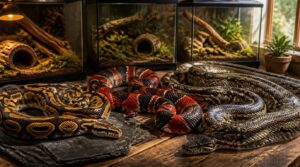
So you’ve fallen for a showstopper pattern, and who could blame you? That shimmer, those blazing stripes, that jaw-dropping contrast: it’s love at first slither. Before you bring one home, though, you’ll need the right setup for success, and the enclosures below will get you there.
Species And Temperament
Because temperament varies more by species than by color morph, match personality to your lifestyle before falling for a pattern.
A Brazilian Rainbow Boa stays shy and secretive, while a California Kingsnake forages boldly and investigates everything. Honduran Milk Snakes tolerate gentle handling, but Sunbeam Snakes prefer minimal contact.
Consider an Arboreal Lifestyle commitment too; Emerald Tree Boas reward observation over interaction.
Habitat And Humidity
Personality picked? Now build the world your snake lives in. Habitat And Humidity make or break patterned species.
Emerald Tree Boas demand 85–95% humidity, misted twice daily, because their Arboreal Lifestyle depends on canopy moisture, not damp substrate. Blood Pythons from Humid Woodlands thrive at 70–80%. Corn snakes prefer drier air, 40–60%.
Whatever your Genetic Variations suggest visually, wild origins dictate care. Rainforest Camouflage species need hygrometers, moss, and nightly humidity spikes. Get it right, and colors stay vivid.
Morph-Specific Health Risks
Here’s the truth: beauty has a price tag. Some genetic mutations carry health baggage.
- Piebald genetics and leucistic traits can ride alongside recessive defects.
- Scaleless morphs lose barrier protection; dehydration and abrasions follow.
- Albino and color morphs with reduced pigment need UV caution.
Ask breeders for lineage history. Healthy patterns start with honest genetics.
Feeding And Handling
You’ve vetted the genetics, now feed the animal right. Offer prey about 75–100% of the widest body point, every 7–10 days for juveniles, every 1–2 weeks for adults. Thaw frozen prey fully, wait 24–48 hours after meals before handling, and support the whole body with slow movements.
Good Herpetoculture means Diet Specialization matters; rainbow boas and tree pythons aren’t interchangeable. Calm, consistent routines make even dazzling morphs Beginnerfriendly Care.
Ethical Breeder Selection
When you’re ready to buy, demand documented lineage and proof of health testing before money changes hands. Ethical breeding practices mean transparent disclosure of pattern inheritance, inbreeding coefficients, and any morph-specific risks.
Inspect enclosures, quarantine protocols, and veterinary access yourself. Reputable sellers offer written genetic guarantees, return policies, and genuine after-sales support.
Skip anyone dodging questions; great breeders welcome scrutiny.
Frequently Asked Questions (FAQs)
What is the rarest snake breed?
What is the rarest snake breed? Most herpetologists point to axanthic-pied ball pythons, where two recessive Genetic Variations collide. Leucistic and Scaleless Patterns also rank among the rarest snake breed contenders.
Can you identify snakes by patterns?
Yes, you can. Scale patterns reveal species: rainbow sheen signals a Brazilian Rainbow Boa, bold black bands a California Kingsnake. But genetic variations overlap, so confirm lineage before trusting color morphs alone.
What is the most unique snake?
What is the most unique snake? You’ll find it in Boelen’s python, whose black scales shimmer blue-purple under light. Native to New Guinea’s misty mountain forests, this rare jewel captivates dedicated collectors worldwide.
What is the prettiest snake breed?
Beauty is subjective, but the Brazilian Rainbow Boa wins most votes. Its iridescent scales split light into living rainbows, it stays a manageable five to seven feet, and it’s hardier than its delicate looks suggest.
Other serpents dazzle too, as seen in the most beautiful snakes, like the paradise tree snake whose bold green, yellow, and black markings form a mesmerising pattern.
What are the most patterned snakes?
What are the most patterned snakes? You’ll marvel at the Brazilian Rainbow Boa’s iridescent scales, the Green Tree Python’s emerald camouflage, and the Emerald Tree Boa’s white lightning bolts, plus Leopardlike Spots and Diamondback Patterns.
Do snakes have a pattern?
Absolutely, snakes are patterned. Nearly every species displays scale patterns shaped by genetic variations: diamonds, bands, blotches, or swirls. Color morphs and albino genetics can transform these designs, but camouflage-driven markings remain the norm.
Which snake breed is best for a beginner?
Which snake breed is best for a beginner? Corn Snake, hands down. Docile, adaptable, and forgiving, it thrives on simple Beginner Care. A calm Ball Python runs second, but Corn Snake wins for easy feeding and handling.
What are the cutest pet snake breeds?
What are the cutest pet snake breeds? You’ll fall hardest for the Ball Python and Corn Snake. Both are docile, beginner-friendly, and endlessly photogenic. Try a High White Piebald or Leucistic morph, and you’re done for.
How many types of snakes are there?
Picture a library where new books appear yearly: that’s snake taxonomy. You’ll find over 3,700 species, from threadsnakes to anacondas, and scientists still describe new ones as habitat destruction threatens unexplored tropical diversity.
What is the most beautiful snake pattern?
What is the most beautiful snake pattern? Most herpetologists crown the Brazilian Rainbow Boa. Its Iridescent Scales, born from Microscopic Ridge Formation, scatter light into liquid rainbow bands, outshining even a High White Piebald or Lavender Albino.
Conclusion
Picture your terrarium at dusk: a Piebald’s white blaze catching the last light, or a Rainbow Boa scattering tiny rainbows across your palm. That’s the real reward of choosing among snake breeds with unique patterns.
You’re not just keeping a pet; you’re living with a masterpiece millions of years in the making. Pick wisely, match the habitat to the snake, and your living artwork will outshine anything framed on a wall.