This site is supported by our readers. We may earn a commission, at no cost to you, if you purchase through links.
Walk into any reptile expo and you’ll hear the same advice recycled for every python on the table: "keep it humid." That’s not wrong, exactly—but it flattens real differences that matter.
A ball python (Python regius) thriving at 70% relative humidity would leave a carpet python (Morelia spilota) sitting in conditions that invite scale rot. These animals come from ecosystems thousands of miles apart, and their moisture tolerances reflect that.
Getting python species humidity differences right isn’t about chasing a single number—it’s about matching your enclosure to a habitat your snake’s biology already expects.
Table Of Contents
- Key Takeaways
- Python Humidity Range Comparison
- Habitat Type Shapes Humidity Needs
- Humidity Mistakes by Python Species
- Measuring and Adjusting Humidity
- Top 3 Humidity Control Tools
- Frequently Asked Questions (FAQs)
- Do blood pythons live in water?
- Are short tailed pythons venomous?
- Are pythons venomous?
- Are Python snakes monotypic?
- Is 40% humidity ok for a ball python?
- What are signs of too much humidity for pythons?
- Is 70 degrees too cold for a ball python at night?
- Can snakes absorb water through their skin?
- How does altitude affect python enclosure humidity?
- Do hatchling pythons need higher humidity than adults?
- Conclusion
Key Takeaways
- Ball pythons need 60–80% humidity while carpet pythons thrive at 40–60%, so copying one species’ setup for another is a fast track to scale rot or respiratory infections.
- Your substrate does more humidity work than your misting bottle ever will — deep coconut husk or cypress mulch maintains steady moisture passively, without the spike-and-crash cycle that frequent misting creates.
- Watch your snake’s shed: retained eye caps and patchy skin aren’t bad luck, they’re direct feedback that your humidity missed the window when it mattered most.
- Your home’s seasonal climate is the variable most keepers ignore — winter heating can gut enclosure humidity down to dangerous lows, so adjusting substrate depth and water bowl size seasonally isn’t optional, it’s basic husbandry.
Python Humidity Range Comparison
Not all pythons want the same air around them — and getting that wrong shows up fast. Humidity needs to shift quite a bit depending on where a species evolved, so what works for one snake can stress out another.
A ball python, for instance, needs far more moisture in the air than a carpet python does — species-specific humidity guides for warm snakes can save you a lot of guesswork.
Here’s how the most common python species compare.
Ball Python Humidity Needs
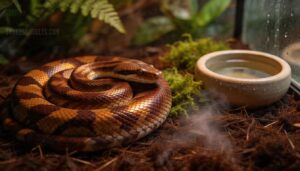
Ball pythons (Python regius) do best at an ideal RH range of 60–80%, though many keepers find the sweet spot closer to 70%.
Shedding spike timing matters — bump humidity during that window, then pull it back.
Your substrate evaporation rate and water bowl influence daily readings more than misting ever will.
Remember to provide a secure screened lid to prevent escapes.
| Factor | Recommendation |
|---|---|
| Baseline RH | 60–80% |
| Shedding Period | 70%+ temporarily |
| Humidity Sensor Calibration | Digital probe, centered |
| Substrate Type | Deep moisture-retaining mix |
Humidity management for ball pythons isn’t complicated — it just requires consistency.
Green Tree Python Humidity Needs
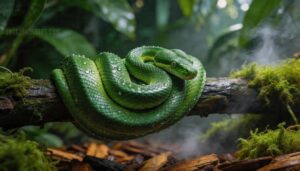
Green tree pythons (Morelia viridis) operate differently. Where ball pythons tolerate steady baseline humidity, M. viridis thrives on a cycle — misting frequency matters more than static numbers. Target 40–70% daily, letting enclosures dry between sessions.
| Factor | Recommendation | Purpose |
|---|---|---|
| Baseline RH | 40–70% | Microclimate Zoning stability |
| Misting System | Morning/evening cycles | Humidity gradient simulation |
| Substrate Moisture Retention | Cypress or coconut husk | Substrate Moisture Capacity buffer |
| Hide Humidity Buffer | Damp sphagnum moss | Juvenile dehydration prevention |
| Humidity Sensor Calibration | Digital probe, centered | Accurate gradient tracking |
Constant wetness isn’t humidity — it’s a problem.
Carpet Python Humidity Needs
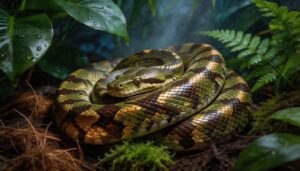
Carpet pythons (Morelia spilota) land closer to the middle of the spectrum. Most do well between 40–60% relative humidity—stable, not soggy.
Moss Lining Benefits show up here: a humid hide with damp sphagnum gives them a microclimate for shedding without saturating the whole enclosure. Coconut Substrate Retention helps regulate ambient moisture steadily.
| Factor | Recommendation | Purpose |
|---|---|---|
| Baseline RH | 40–60% | Humidity gradient stability |
| Substrate | Coconut husk/cypress | Substrate moisture retention |
| Humid Hide | Moss-lined, cool side | Shedding and hydration support |
Blood and Short-tailed Python Humidity Needs
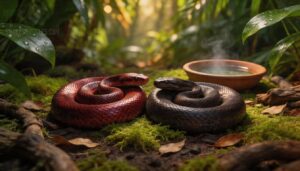
Step down from the carpet python’s forgiving midrange, and you’re into different territory. Python brongersmai and Python curtus want 60–70% as their Target RH Level day-to-day — bumping toward 75% during shed cycles.
| Humidity Factor | Recommendation |
|---|---|
| Baseline RH | 60–70% |
| Shed Cycle RH | 70–75% |
| Substrate Moisture Retention | Humid but not soggy |
| Water Bowl Evaporation | Moderate contribution |
| Sensor Calibration Routine | Verify monthly |
Children’s and Spotted Python Humidity Needs
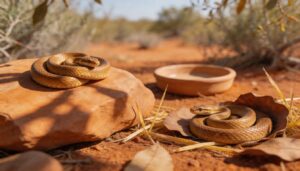
Now we’re at the easier end of the spectrum. Antaresia childreni and Antaresia maculosa are both low-maintenance regarding humidity — 40–60% covers them well, with room to flex.
A humid hide with moist moss makes it easy to keep that range steady without micromanaging your whole enclosure.
| Factor | Children’s Python | Spotted Python |
|---|---|---|
| Target RH | 40–60% | 45–55% |
| Water Bowl Size | Medium | Medium |
| Shed Support | Humid hide | Humid hide |
Humidity fluctuation patterns matter less here than keeping the enclosure dry enough between sessions.
Habitat Type Shapes Humidity Needs

Where a python comes from tells you almost everything about what it needs from its enclosure. A green tree python from the Aru Islands and a ball python from the West African savanna aren’t just different animals — they’re built for completely different moisture environments.
A python’s native habitat tells you everything — because evolution already wrote the care sheet
Here’s how habitat type should shape the way you set things up.
Arboreal Rainforest Python Setups
Arboreal rainforest setups aren’t just about looking impressive — they’re functional ecosystems.
For green tree pythons, Vertical Branch Networks create Temperature Gradient Zones that let the snake self‑regulate. A solid Canopy Lighting Strategy drives evaporation from below while Live Plant Moisture and Water Bowl Microclimate effects stabilize humidity gradients throughout.
Run a mist system on a timer, and the tropical rainforest microclimate practically regulates itself.
Terrestrial Tropical Python Setups
Terrestrial setups for tropical species like blood pythons flip the arboreal logic on its head — you’re building moisture from the ground up. Deep coconut fiber or cypress mulch manages enclosure substrate moisture regulation passively, while smart Water Bowl Placement near your heat gradient drives ambient humidity without soaking everything.
Microclimate Zoning matters here: the warm side evaporates, the cool side retains. Balance that with Ventilation Slot Design, and you won’t sacrifice airflow for humidity.
Semi-arid Python Environments
Semi-arid species like Stimson’s, carpet, and spotted pythons don’t need moisture-heavy setups — they need smart ones. Substrate Drainage keeps things dry without risking dry shed syndrome, while Burrow Depth Design and Heat Source Positioning create natural Microclimate Zones, your snake actually uses.
- Keep ambient humidity at 40–55%
- Use a humid hide, not whole-enclosure misting
- Place Water Bowl Placement away from the hot end
- Prioritize ventilation to prevent a humidity crash
Daytime Versus Nighttime Humidity
Humidity doesn’t stay flat across a 24-hour cycle — and that matters. As lights drop and temperatures fall, Daytime Evaporation Dynamics reverse: cooler air holds less vapor, so relative humidity climbs without any misting.
Temperature Humidity Interaction drives real humidity fluctuations, your hygrometer will confirm overnight. Nighttime Condensation Risks follow. Ventilation Timing Strategies and Misting Schedule Sync help you maintain a stable humidity gradient control across species.
Seasonal Humidity Shifts in Captivity
Your home’s climate is your python’s biggest invisible variable. Winter heating can drag indoor humidity down to 15–25%, and your enclosure feels it fast. Summer flips the script — rooms hit 50–60% naturally. Adjust accordingly:
- Winter Drydown Strategies: thicker substrate, larger water bowls
- Summer Humidity Boost: increase ventilation, reduce misting frequency
- Seasonal Monitoring Protocols: check mid-enclosure readings weekly
Seasonal humidity management for captive snakes isn’t optional — it’s foundational.
Humidity Mistakes by Python Species
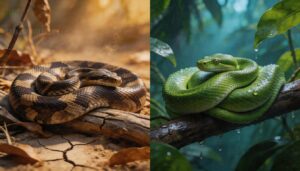
Even small humidity miscalculations can snowball into serious health problems for your python. Each species has its own breaking point — what’s fine for a ball python might be dangerous for a green tree python.
Here’s what to watch for across the most common mistakes keepers make.
Too-low Humidity Warning Signs
When the air in your enclosure drops too low, your python starts sending signals — you just need to know what to look for.
| Warning Sign | What It Means |
|---|---|
| Flaky Skin | Dehydration risk is climbing |
| Cracked Lips | Moisture loss accelerating |
| Retained sheds | Classic low-humidity failure |
| Nasal Irritation | Respiratory infections incoming |
| Dry Eyes | Stress of dehydration setting in |
Static shocks from handling and shedding problems confirm it: humidity’s too low.
Too-high Humidity Warning Signs
Too-dry enclosures get attention, but too-wet ones are sneakier — and often more damaging. Scale rot, respiratory infections, and fungal infections in reptiles all trace back to excess moisture that never gets a chance to clear.
Watch for these red flags:
- Condensation indicators like persistent water beads on glass walls or vents
- Musty odor changes after misting that don’t fade
- Surface dampness on substrate that stays soggy for hours
- Airflow stagnation — that heavy, closed-in feeling when you open the enclosure
- Visible mold growth on cork, branches, or bedding corners
Humidity spikes are normal. Staying there isn’t.
Shedding Problems Across Python Species
Shedding tells you everything. Eye Cap Retention and Tail Tip Retention are your clearest signals that the humidity requirements for snake species aren’t being met.
Ball pythons handle Molt Frequency Differences better than blood pythons do — miss their shed cycle moisture window and you’ll get Patchy Skin Shedding fast.
Misting Timing Strategies matter here: mist before the shed loosens, not after retained sheds have already set in.
Respiratory and Scale Rot Risks
Retained sheds aren’t the only thing humidity gets wrong — poor conditions hit deeper.
Persistently high moisture with weak ventilation creates the ventilation vs humidity tradeoff nobody talks about enough: scale rot spreads fast, and respiratory infections follow.
Watch for open-mouth breathing and nasal discharge.
Pathogen contamination builds in wet substrate, so scale rot prevention means drying out and cleaning up before quarantine protocols even become necessary.
Stress Behaviors Linked to Poor Humidity
When humidity management breaks down, your python tells you — just not in words.
Excessive hiding, restless pacing along the glass, and soaking obsession in the water dish all signal something’s wrong.
Defensive hissing from a normally calm animal? Pay attention.
Skin rubbing against décor, and a snake that doesn’t shed well, round out the picture.
These behavioral adaptations precede scale rot and respiratory infections.
Measuring and Adjusting Humidity
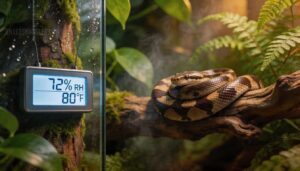
Getting humidity right comes down to two things: knowing what’s actually happening inside the enclosure and having the right tools to fix it. A bad reading from a cheap hygrometer can send you in the wrong direction fast.
Here’s what you need to know to measure accurately and keep humidity where it belongs for your specific python.
Digital Hygrometer Placement Tips
Where you place your digital hygrometer matters more than most keepers realize. A sensor shoved in a damp corner or parked near a heat lamp won’t reflect what your plant actually experiences.
Follow these humidity sensor placement rules:
- Mid-level Position — Center airflow zone, away from heat sources and microclimates
- Avoid Water Sources — Keep it clear of dishes and misting nozzles
- Regular Calibration — Verify accuracy with a salt test periodically
Ventilation and Moisture Balance
Ventilation and moisture balance is basically a tug-of-war — and vent placement determines who wins. Low intake vents paired with high exhaust points create a natural airflow gradient that moves stale air without stripping humidity.
Timing your misting when airflow slows matters too. Use retention materials like glass panels or tape to dial back airflow by 30–50% when humidity keeps drifting low.
Substrate Choices for Steady Humidity
Your substrate is doing half the humidity work — or none of it, if you chose wrong.
Three materials dominate tropical python setups:
- Orchid bark benefits: slow moisture release, stays usable for months
- Cypress mulch absorption: soaks water fast, raises ambient RH steadily
- Coconut husk retention: holds the most moisture of the three
- Substrate mixing strategies: blend these to dial in your target range
Packaged substrate sizes matter too — deeper substrate means more soil capillarity and evaporation surface area working for you around the clock.
Humid Hides for Species-specific Needs
A humid hide isn’t a luxury — it’s a microclimate tool, and how you set it up depends entirely on the species.
Ball pythons need ground-level hides packed with damp sphagnum moss on the warm side. Green tree pythons need elevated, enclosed moisture zones.
Hide size guidelines matter too: snug but comfortable. Clean it weekly.
Hide temperature integration and hide moisture materials directly shape your humidity management success.
Misting Versus Baseline Enclosure Humidity
Misting and baseline evaporation aren’t rivals — they serve different jobs. Before reaching for the spray bottle, consider what actually works:
- Misting Frequency spikes RH to 90–100% for 15–30 minutes, then drops quickly in well‑ventilated setups.
- Baseline Evaporation holds steady 55–70% passively — no energy consumption, no automated misting systems required.
- Ventilation Interaction determines how quickly spikes dissipate, directly affecting your cost analysis between manual misting and automation.
Top 3 Humidity Control Tools
Getting humidity right comes down to having the right tools — not guesswork. A few well-chosen pieces of equipment can mean the difference between a thriving snake and a chronic husbandry problem.
Here are three that consistently earn their place in a serious keeper’s setup.
1. Etekcity Infrared Thermometer Laser Gun
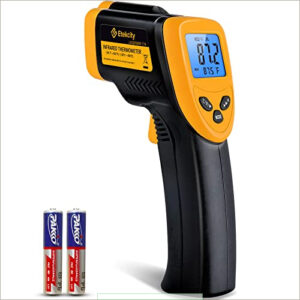
Humidity is only half the equation — temperature gradients matter just as much, and that’s where the Etekcity Infrared Thermometer earns its place in your kit. Point it at any surface, and you get a reading in under half a second, no contact needed.
The 12:1 distance-to-spot ratio means you can check your basking zone accurately from about 36 cm away. It reads from -50°C to 450°C, so cold spots and hot zones alike are covered.
Simple, fast, and genuinely useful.
| Best For | Reptile keepers, home cooks, and DIY enthusiasts who need quick, no-fuss surface temperature readings without breaking the bank. |
|---|---|
| Primary Use | Surface temperature measurement |
| Reptile Suitability | Yes, habitat monitoring |
| Temperature Support | °C and °F display |
| Power Source | 2 × AAA batteries |
| Display Type | Backlit LCD |
| Device Form Factor | Handheld gun-style |
| Additional Features |
|
- Reads in under half a second, so checking basking spots or grill temps is genuinely instant
- Wide range (-50°C to 450°C) covers everything from a cold reptile enclosure to a screaming-hot cast iron pan
- Adjustable emissivity means you can dial it in for different surfaces, not just shiny ones
- Only reads surface temp, so you still need a probe thermometer to check if your roast is actually done inside
- Accuracy sits around ±2%, which is fine for most tasks but won’t cut it for anything precision-critical
- Reflective or shiny surfaces can throw off the reading if emissivity isn’t set correctly
2. REPTI ZOO Basking UV Heat Lamp
Temperature readings tell you what’s happening — lighting shapes how your python behaves in that environment.
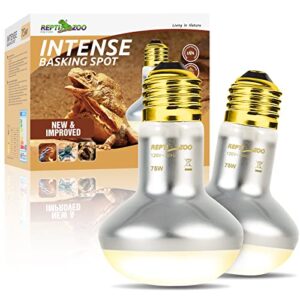
The REPTI ZOO 75W Basking UV Heat Lamp does more than warm a spot. Its flat-bottom design concentrates the beam, delivering roughly 35% more focused heat than standard reflector bulbs.
It simulates sunrise and sunset through gradual warm-up cycles, which matters for appetite and natural behavior.
UVA output promotes psychological well-being too.
Just note: no UVB here, so species requiring D3 synthesis need separate lighting.
| Best For | Reptile owners keeping bearded dragons, ball pythons, or baby chicks who need a reliable basking spot with focused heat and UVA light. |
|---|---|
| Primary Use | Reptile basking heat source |
| Reptile Suitability | Yes, basking spot heat |
| Temperature Support | °C and °F compatible |
| Power Source | Standard E26 socket |
| Display Type | No display |
| Device Form Factor | Screw-in bulb |
| Additional Features |
|
- Flat-bottom design concentrates heat about 35% more than standard reflector bulbs, so your reptile actually gets a proper basking spot.
- Simulates gradual sunrise and sunset cycles, which helps with natural behavior and keeps appetite on track.
- Standard E26 base makes swapping it in a breeze — no special fixtures needed.
- No UVB output, so species that need D3 synthesis (like bearded dragons) will still need a separate UVB bulb.
- Some users report early burnout well before the 2,000-hour rating, and the replacement window is only 3 months.
- At 75W with a fixed output, it may not cut it for larger enclosures or colder rooms.
3. Inkbird Digital Temperature Humidity Controller Thermometer
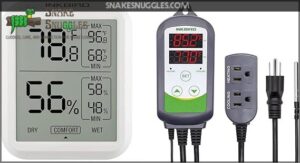
Once you’ve dialed in your lighting, the next piece is active humidity control — and the Inkbird IHC-200 manages that cleanly. It monitors relative humidity from 5% to 99% RH with ±3% accuracy, automatically switching between a humidifier and dehumidifier through its dual relay output. No guesswork, no constant manual adjustments.
The 2-meter sensor cable lets you position the probe exactly where your python spends most of its time.
Want remote monitoring? The WiFi version pairs with a free app.
| Best For | Hobbyists and small-scale growers who want simple, automatic temperature and humidity control without the hassle of constant manual monitoring. |
|---|---|
| Primary Use | Temperature and humidity control |
| Reptile Suitability | Yes, enclosure climate control |
| Temperature Support | °C and °F switchable |
| Power Source | Plug-in relay controller |
| Display Type | Split LCD screen |
| Device Form Factor | Tabletop or wall-mount |
| Additional Features |
|
- Dual-relay output handles both heating and cooling, so one device does the job of two
- Clear LCD display shows temperature and humidity at a glance, with handy "DRY," "COMFORT," and "WET" icons
- Flexible setup — prop it on a table or mount it on the wall, whatever works for your space
- No WiFi or app support, so you have to be physically present to make any adjustments
- Temperature range tops out at 50°C and bottoms at -10°C, which won’t cut it for extreme environments
- Relay load limits aren’t listed, so you’ll need to do your own homework before connecting any heavy equipment
Frequently Asked Questions (FAQs)
Do blood pythons live in water?
No, blood pythons don’t live in water. They’re ground-dwelling snakes from Southeast Asia’s humid lowlands — swamps, forest floors, marshy edges. Water’s available to them, but it’s not home.
Are short tailed pythons venomous?
Short-tailed pythons are purely, positively nonvenomous. Python breitensteini and Python brongersmai kill prey through constriction alone — no venom glands, no venom fangs. A bite means wound care, not antivenom.
Are pythons venomous?
No, pythons aren’t venomous. They’re constrictors — they grab prey with their teeth, then squeeze. No toxins involved.
A bite can still hurt and cause infection, but there’s no venom to worry about.
Are Python snakes monotypic?
Not quite — that’s a bit of a python problem to untangle. The family Pythonidae spans 10 genera and roughly 39 species, so no, pythons are far from monotypic as a group.
Is 40% humidity ok for a ball python?
Not ideal. Ball pythons do best between 55–65% humidity, so 40% sits below the preferred range. A one-time dip won’t hurt, but if it stays there, expect shedding problems and dry skin.
What are signs of too much humidity for pythons?
Like a greenhouse gone wrong, too much humidity shows fast. Watch for wheezing breaths, belly blisters, heavy condensation on the glass, and bedding that never dries out.
Is 70 degrees too cold for a ball python at night?
Not quite. Ball pythons handle 70°F nights just fine — it’s actually within their comfort zone. Just don’t let it drop much lower, or digestion slows and stress creeps in.
Can snakes absorb water through their skin?
No — snake skin is nearly waterproof. Water loss happens mainly through respiration, not the skin.
Snakes drink through their jaw folds instead, using capillary action to pull water straight into the mouth.
How does altitude affect python enclosure humidity?
Altitude lowers air pressure, which means your enclosure loses moisture faster after misting. If you’re keeping pythons above 5,000 feet, expect to retain humidity through substrate choice, not spray frequency.
Do hatchling pythons need higher humidity than adults?
Generally, yes — hatchlings need the upper end of their species’ humidity range. Their smaller bodies lose moisture faster, making them less forgiving of dry spells, especially during shedding.
Conclusion
What separates a thriving python from a struggling one often comes down to a single overlooked variable—moisture. Mastering python species humidity differences means you’re no longer guessing; you’re making decisions grounded in ecology, not expo floor advice.
Your ball python doesn’t need what your green tree python needs, and treating them the same is where problems start. Match the enclosure to the habitat, trust the biology, and your snake will show you the difference.