This site is supported by our readers. We may earn a commission, at no cost to you, if you purchase through links.

A corn snake can squeeze through a gap the width of a pencil eraser. Owners learn this the hard way, usually at 2 a.m., usually while checking under the couch with a flashlight.
A secure, tightly fitted lid and well-sealed seams are the best defense, so check out these escape-proof reptile terrariums for corn snakes before your snake finds the weak spot.
Good corn snake habitat tips start with that reality. Your snake needs room to stretch, a heat gradient it can move through, and humidity that keeps every shed intact. Get one of those wrong and you’ll see stress, stuck skin, or an empty enclosure.
Each fix is simple once you know the numbers. Start with the one that keeps your snake safe: the enclosure itself.
Table Of Contents
- Key Takeaways
- Choose a Spacious, Escape-Proof Corn Snake Enclosure
- Add Safe Substrate, Hides, and Climbing Branches
- Set Corn Snake Temperatures and Lighting
- Maintain Corn Snake Humidity and Habitat Cleanliness
- Top 3 Corn Snake Habitat Supplies
- Frequently Asked Questions (FAQs)
- What is the best habitat setup for a corn snake?
- What makes a corn snake happy?
- What are the downsides of owning a corn snake?
- Do baby corn snakes like to be held?
- How often should I clean my corn snakes enclosure?
- What plants are safe for corn snake habitats?
- Can corn snakes live together in same enclosure?
- How do I handle a corn snake safely?
- What are signs of illness in corn snakes?
- How often should I feed my corn snake?
- Conclusion
Key Takeaways
- Size your corn snake’s enclosure for its adult length (at least 48"L x 24"W x 24"H, larger for snakes over 48 inches) and lock it with no gaps wider than 1/8 inch, because these snakes are skilled escape artists.
- Build a thermal gradient by heating only one end, with a warm side around 80–85°F, a cool side in the low-to-mid 70s, and a basking spot near 90°F, all controlled through a thermostat.
- Keep humidity at roughly 65–75% (a bit higher during shedding) with a humid hide of damp sphagnum moss, but never let the substrate get soggy, since stale, wet conditions cause scale rot and respiratory infections.
- Spot-clean waste daily, disinfect weekly, replace substrate every few months, and give every snake its own enclosure to prevent disease and stress.
Choose a Spacious, Escape-Proof Corn Snake Enclosure
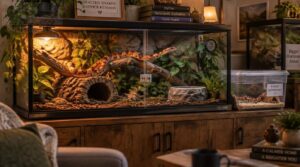
Pick an enclosure that fits your snake’s adult size, not its current size. Adults need at least 48"L x 24"W x 24"H (a 120-gallon footprint), and snakes over 48 inches need 60"L x 36"W x 36"H. This is enclosure size scaling: as your snake grows, the habitat must grow too. For a roomier setup, aim for an enclosure length that matches your snake’s full adult length, with the width at half that length.
Choose a front opening enclosure with a secure lock. Corn snakes are escape artists, so an escape-proof enclosure has no gaps wider than 1/8 inch. Clip or weigh down any screen top.
Once the lock is sorted, make sure the tank is big enough too, since this recommended terrarium size for corn snakes changes as your snake grows from hatchling to adult.
A ventilated plastic lidded bin works for a hatchling, but expect to upgrade within a year. Move from 10 gallons to a 20-gallon long, then a 40-gallon breeder. Plan bigger if you want a bioactive substrate kit.
Add Safe Substrate, Hides, and Climbing Branches
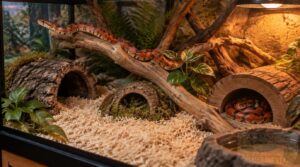
Once your enclosure is secure, fill it with things your snake can use. Start with the floor.
Spread at least 3 inches of Aspen wood shavings so your corn snake can burrow. Aspen suits dry setups, but it molds when wet, so practice careful substrate moisture control. Spot-clean waste right away. Never use cedar, pine, sand, or walnut shells.
Add two snug hideout box options, one on the warm end and one on the cool end. Your snake should touch the sides when coiled. Include a humid hide with damp sphagnum moss for shedding.
Secure sterilized oak or maple climbing branches diagonally or horizontally. Make sure they hold your snake’s weight. Branches add simple enclosure enrichment that encourages natural exploring.
Set Corn Snake Temperatures and Lighting
With the furnishings in place, give your snake the heat it needs. Corn snakes can’t regulate their own body temperature, so you have to build a proper thermal gradient (a warm end and a cool end).
Aim for a warm side around 80–85°F and a cool side near 72–78°F, and if you’re still weighing the commitment, this corn snake care and pet ownership guide covers what daily life with one looks like.
Corn snakes can’t regulate their own body heat, so you must build a thermal gradient with a warm end and a cool end
Put your heat source on one end only. Keep the warm side at 80-85°F, the cool side at 70-75°F, and a basking spot near 90°F. This helps basking behavior and digestion.
Follow these steps:
- Run the heater through a thermostat to prevent dangerous swings.
- Check air and surface temperatures with a digital probe and an infrared thermometer before your snake moves in.
- Set a 12-hour UV lighting cycle with a 2-5% T5 tube.
- Replace UVB bulbs every 12 months, and never place them over glass.
Skip red bulbs. Snakes see them, and they cause stress.
Maintain Corn Snake Humidity and Habitat Cleanliness
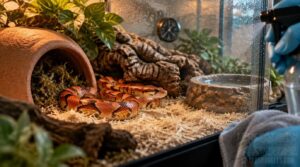
Heat dries the air, so humidity needs attention next. Aim for a humidity range of 65-75%, and check it with a hygrometer (a humidity gauge) placed mid-enclosure. Mist once or twice daily, and keep a humid hide on the cool side lined with damp sphagnum moss. Bump it to about 70% during shedding.
Good ventilation matters just as much. Stale, soggy air invites scale rot and respiratory infections, so never let the substrate waterlog.
Scoop feces and urates daily and change the water. Once a week, disinfect with a 3% bleach cleaning solution (10 minutes of contact), then rinse and dry completely. Replace substrate every 3-4 months. Wash your hands before and after handling. Follow a quarantining protocol for newcomers.
Top 3 Corn Snake Habitat Supplies
You’ve set up the space, the heat, and the cleaning routine, so now it’s time to gather the gear. These three products cover the essential habitat needs for a healthy corn snake. Check each one below and match it to your setup.
If you ever plan to expand beyond a single pet, browsing reptile breeding supplies early helps you understand what a larger setup will require.
1. REPTI ZOO 34 Gallon Reptile Terrarium
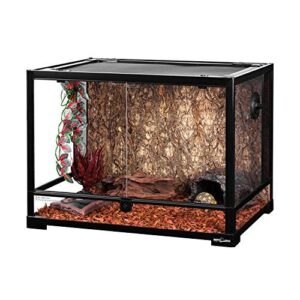
Your corn snake needs room to roam, and the REPTI ZOO 34 Gallon Reptile Terrarium delivers it. At 24" x 18" x 18" (about 34.7 gallons), it has tempered glass walls and a black frame. Its raised bottom frame fits a substrate heater and keeps things waterproof.
If you’re still weighing species, this guide to keeping a milk snake as a pet shows how its care needs compare with a corn snake’s.
Two front doors open separately, so you can feed or clean without reaching in from above. Assembly takes about five minutes, though you’ll need patience aligning the glass panels. Check the doors often.
| Best For | Keepers of reptiles, amphibians, or humid plant setups, such as corn snake owners, who want a glass enclosure with front-opening doors and room for a substrate heater, as long as they aren’t housing ball pythons. |
|---|---|
| Material | Tempered glass, black frame |
| Model Number | N/A |
| Size | 24″ x 18″ x 18″ (34.7 gallons) |
| Pet Use | Reptile and amphibian habitat |
| Ease of Use | Assembles in about 5 minutes |
| Main Drawback | Doors may become non-operable |
| Additional Features |
|
- Two separate front doors make feeding and access easy without reaching in from above
- Raised bottom frame fits substrate heaters and gives a waterproof base
- Screen top lets UVB and infrared through, and it suits both desert and rainforest setups
- Not suitable for ball pythons because of the door design
- Some customers find it hard to line up the glass panels during assembly
- The front doors may stop working over time, according to user feedback
2. REScue One-Step Ready-to-Use Disinfectant
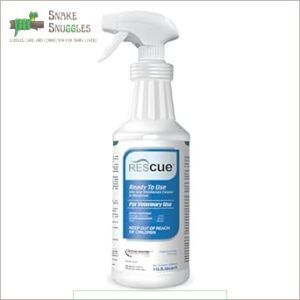
Disinfectant matters as much as heat or humidity, and REScue One-Step is a practical pick. This 32-ounce ready-to-use liquid needs no dilution, and it’s effective against ringworm with a 1-minute contact time.
Pre-clean heavy mess first, then spray from 6-8 inches away and keep surfaces wet for 1 minute. It’s safe on glass, plastic, and sealed wood, but skip natural stone like granite. Let everything dry completely before your snake goes back in.
Expect to buy a spray nozzle separately.
| Best For | Pet owners, foster families, and shelter or kennel staff who need a ready-to-use disinfectant that kills parvovirus and ringworm on hard, non-porous surfaces. |
|---|---|
| Material | N/A |
| Model Number | 23101-6 |
| Size | 32-ounce bottle |
| Pet Use | Veterinary clinics, shelters, kennels |
| Ease of Use | Ready-to-use, no dilution |
| Main Drawback | Expensive versus alternatives |
| Additional Features |
|
- Kills canine parvovirus and ringworm with a 1-minute contact time
- Ready to use, so there is no dilution or mixing
- Works on hard, non-porous surfaces like stainless steel, plastic, and porcelain, and is suitable for litter boxes
- Not recommended for natural stone such as marble, granite, or quartz, because it can etch the surface
- The spray nozzle is not included, so you need to buy one separately
- Some users find it expensive compared to other options
3. JohnBee 16oz HDPE Spray Bottle 2Pack
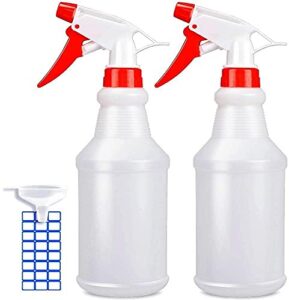
Think of a spray bottle as your humidity thermostat, a small tool that decides whether your enclosure stays comfortable or turns dry.
The JohnBee 16oz HDPE Spray Bottle 2Pack gives you two bottles of BPA-free, chemical-resistant plastic. Rotate the adjustable nozzle to a fine mist for light humidity boosts. Keep one bottle for plain water and label the other for cleaning mixes. Some users report leaks, so test it over a sink first. Rinse the nozzle with warm water afterward.
| Best For | Households and hobbyists who want an affordable two-pack of spray bottles for light cleaning, plant and lawn misting, DIY air fresheners, pet care, or car detailing, and who don’t mind testing for leaks before regular use. |
|---|---|
| Material | HDPE, PP, stainless steel |
| Model Number | JohnBee-122 |
| Size | 16oz per bottle |
| Pet Use | Pet care applications |
| Ease of Use | Adjustable spray nozzle |
| Main Drawback | Leakage and durability issues |
| Additional Features |
|
- Made from BPA-free HDPE plastic that resists chemicals, so it works with cleaning solutions and DIY essential oil mixes
- The adjustable nozzle lets you switch between spray patterns, from a fine mist to a stronger stream
- The two-bottle set comes with a funnel and extra sprayer accessories, so you can dedicate one bottle to water and the other to cleaners
- Some users report leakage, so it’s worth testing over a sink before filling it with anything important
- Spray performance can be inconsistent for some buyers
- Some bottles have broken after short-term use, and reviews are mixed on overall value for money
Frequently Asked Questions (FAQs)
What is the best habitat setup for a corn snake?
Start with a 4x2x2 foot enclosure, and use enclosure size scaling as juveniles grow. Build a temperature gradient with a 90F 32C basking surface, add a hideout box, and hold your humidity range at 40-50%.
What makes a corn snake happy?
Give your snake choices. A thermal gradient encourages natural basking behavior snakes enjoy, and a snug hideout box brings security.
Keep the humidity range near 40-60%. Offer meals with feeding tongs for calm, safe feedings.
What are the downsides of owning a corn snake?
Corn snakes can live 20 years, so long-term commitment matters. Expect escape prevention duty, whole rodent feeding, Salmonella bacteria risks, careful handling of captive snakes for stress reduction, and a quarantine protocol if illness strikes.
Do baby corn snakes like to be held?
You might expect a snake to hate handling, but most don’t. Baby corn snakes tolerate it well. Keep sessions short, support the body, and watch for stress. Skip handling after meals.
How often should I clean my corn snakes enclosure?
Is monthly cleaning enough? Not alone. Spot-clean waste daily for substrate safety and humidity control.
Monthly, move your snake to a tub (your quarantine protocol container works), then wash, apply terrarium disinfectant, rinse, and dry.
What plants are safe for corn snake habitats?
Choose non-toxic, pesticide-free plants like snake plant and Boston fern, as ReptiFiles suggests. For a bioactive setup, pair a Bio Dude Glow Grow LED with leaf litter substrate and the corn snake plant pack v
Can corn snakes live together in same enclosure?
Housing two is possible, but it’s rarely wise. Each Corn Snake is solitary by nature, so sharing invites stress, feeding fights, and disease. Give every snake its own escapeproof enclosure, and you’ll handle captive snakes more safely.
How do I handle a corn snake safely?
A corn snake can feel like a tiny dragon when you grab it wrong. Scoop it from below, support its whole body with both hands, and never restrain the head. Wash up first for snake handling safety.
What are signs of illness in corn snakes?
Watch your snake’s respiratory health first: wheezing, bubbles at the nostrils, or open-mouth breathing mean trouble. Also check scale health for red belly scales, stuck shed, or mites, and call a vet if your snake stops eating.
Travel can stress a snake and make these warning signs worse, so it helps to know what your snake needs when traveling to stay warm, secure, and calm.
How often should I feed my corn snake?
Your feeding frequency depends on age. Hatchlings eat every 7-10 days, juveniles every 7-14 days, and adults every 14-21 days.
Since adult milk snakes range from under 3 feet to over 6, it helps to compare milk snake types for pets before choosing one that suits your space.
Since a boa’s appetite and prey size change as it grows, this boa constrictor growth and feeding plan helps you match each meal to your snake’s stage.
Weigh monthly, then adjust your snake feeding schedule to match your snake’s current body condition.
Conclusion
Picture your corn snake at dusk, sliding from a warm basking spot to a cool, shaded hide, then settling into a damp shelter before a clean, complete shed. That’s a habitat working the way it should.
These corn snake habitat tips come down to three habits: a secure, roomy enclosure, steady temperatures, and humidity you check often. Keep everything clean, and your snake will reward you with calm behavior, healthy sheds, and quiet, uneventful nights.