This site is supported by our readers. We may earn a commission, at no cost to you, if you purchase through links.
That "feeding response" strike doesn’t care that your hand isn’t a rat. Your ball python’s heat pits can’t tell the difference between dinner and fingers, especially when prey scent lingers on your skin hours after handling frozen-thawed mice. Most bites I treat in clinic trace back to this exact mix-up, not aggression.
Once you understand what triggers a strike, prevention gets a lot simpler. Ball python bite prevention techniques rest on reading body language and removing the confusion before it starts.
From S-coils to scent-free handling routines, the signs are there if you know where to look.
Table Of Contents
- Key Takeaways
- Identify Why Ball Pythons Bite
- Spot Warning Signs Before a Strike
- Handle Your Ball Python Safely
- Prevent Ball Python Bites During Feeding
- Build a Low-Stress Handling Routine
- Frequently Asked Questions (FAQs)
- How to get a ball python to stop biting?
- How common is it for a ball python to bite?
- What do you do if a ball python bites you?
- How to make a snake stop biting you?
- What are the four preventive measures of snake bite?
- Will my ball python bite me if I pick it up?
- Can ball python bites transmit diseases to humans?
- How do you treat a ball python bite?
- Do ball pythons bite more at night?
- Are some ball python morphs more aggressive?
- Conclusion
Key Takeaways
- Most ball python bites happen because leftover prey scent on your hands confuses your snake’s heat pits, not because it’s aggressive, so washing up and going scent-free before handling prevents most incidents.
- Your snake tells you it’s stressed before it strikes, watch for S-coils, rigid muscles, hissing, frozen tongue flicks, and tight balling, and back off the moment you spot them.
- Safe handling means approaching slowly from the side, supporting the whole body with two hands, and never grabbing near the head, since that reads as a predator attack.
- Keeping feeding and handling clearly separate, using long tongs, staying 12 inches back, and pausing contact for 24-48 hours before and after meals, cuts feeding-related bites way down.
Identify Why Ball Pythons Bite

Why does a calm ball python suddenly strike? The reasons usually fall into a few clear categories, from feeding mix-ups to genuine pain. Let’s break down what’s really driving that bite.
Understanding these triggers is key, and this guide on what causes ball pythons to bite walks through each cause in more detail.
Feeding Versus Defensive Strikes
Not every bite means aggression. Feeding strike response involves a closed mouth aimed at prey scent, while defensive strikes happen when your python feels restrained. Watch body language closely: coiling tighter signals a boundary, not hunger. Defensive bites strike your forelimbs or torso fast, like poking a bear that just wants space.
This same principle of careful observation applies to reading any behavioral cue, much like students trained with a data-centered reading approach learn to focus closely on details rather than skimming past them.
Food Scents and Prey Confusion
Your python’s tongue flicking works overtime when prey scent lingers on your hands. Odor trails carry ammonia, lactic acid, fur, and gland secretions, a complex mixture snakes track closely.
Scent transfer from feeding sessions can trigger genuine feeding bites during handling.
- Wash with unscented soap
- Skip lotions near enclosures
- Change gear between tasks
- Keep feeding schedule consistency
- Use scent-free feeding stations
Hide Intrusion and Sudden Movement
Scent isn’t the only trigger. Hide intrusion ranks high too, since reaching past a hide without clearance sparks strike reflexes.
| Trigger | Safer Approach |
|---|---|
| Hand blocks hide | Approach from the side |
| Fast reach | Slow, steady motion |
| Blocked retreat path | Keep escape route open |
| Shadow movement | Diffuse, steady lighting |
| Multiple hides disturbed | Limit handling frequency |
Shedding, Pain, or Illness
Not every bite traces back to territory or scent. Shedding sensitivity and pain drive plenty of strikes too.
Watch for:
- Cloudy eyes with refused meals signaling shed stress
- Yellow discharge or facial swelling pointing to mouth rot
- Wheezing or bubbling nostrils flagging respiratory illness
Post-shed hunger fuels aggression fast. Handling then is like poking a bear, give it space until fed.
Temperament Myths About Morphs
Think an albino or piebald guarantees a calmer snake? That’s a myth. Color pattern doesn’t predict temperament, individual history and early socialization do.
If you’re choosing a hognose based on looks alone, this hognose snake morph guide is worth a read before you decide.
Handling influences behavior more than genetics ever will. Follow handling frequency guidelines, weekly routine planning, consistent gentle contact, and you’ll shape a steadier snake regardless of morph.
Spot Warning Signs Before a Strike
Ever notice your ball python go still right before things escalate? That pause isn’t random, it’s your snake telling you exactly how close you are to a strike. Here are the five warning signs every handler needs to recognize, before hands get too close.
S-Coil and Head Tracking

Ever notice your snake’s head locking onto you like radar? That’s SCoil formation, true head tracking before a strike:
- Head raised, eyes fixed
- Neck pulled into tight coils
- Body stilled, alert
Read this body language fast. It’s your enhanced spatial coverage for danger, sharpen your own defensive behavior awareness now.
Rigid Body or Defensive Curling
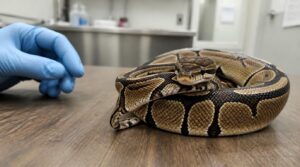
A board-stiff snake is telling you something. Muscle rigidity locks the spine straight, tail anchors down, ribs flatten to look smaller.
| Sign | Meaning |
|---|---|
| Rigid spine | Threat assessment |
| Tail anchoring | Bracing to strike |
| Tight curling | Overwhelm, no contact |
| Slow uncoiling | Recovery beginning |
| Loose tongue flicks | Calm returning |
Give it space. Rushing proper handling now only prolongs the standoff.
Hissing and Escalating Agitation

That hiss isn’t background noise, it’s a warning. Rising hiss volume paired with tighter coils signals real escalation signals, not a bluff.
Watch for faster breathing and enclosure reactivity, hovering near the front, striking at glass. Don’t push through it. Back off, respect the handling reset warning, and let the agitation drop before trying again.
Freezing or Stopped Tongue Flicking
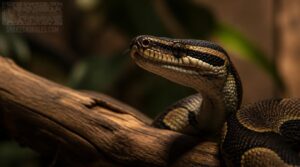
A sudden stillness means something shifted. Tongue flick freeze stops scenting entirely, mouth closed, for seconds up to a minute.
Watch eyes and head position, both go rigid while jaw mechanics loosen slightly to limit bite force. Stable temperature helps maintain this threat response. Once danger passes, recovery signs appear as tongue flicking slowly resumes.
Tight Balling and Retreating
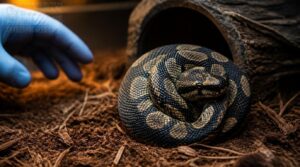
Picture a fist closing tight. That’s tight coiling, your snake’s last line of defense before a strike.
Tight coiling is your snake’s last line of defense, a closing fist before the strike
Watch for:
- Increasing coil tightness around the head
- Retreat toward hides (vibration response)
- Compressed ribs, taut muscles
- Tail anchoring the coil
Retreat trigger factors like bright light or quick hands demand you back off immediately.
Handle Your Ball Python Safely

Once you understand why ball pythons bite, safe handling becomes second nature. Good technique protects both you and your snake, turning tense moments into calm ones. Here are five habits worth building into every handling session.
Wash Away Prey Scents
Why do so many feeding bites happen hours later? Residual prey scent lingers on hands and gear, confusing your snake’s heat pits. Wash hands with unscented soap, sanitize tongs, and neutralize the enclosure within 60 minutes.
| Step | Purpose |
|---|---|
| Hand washing | Removes human/prey scent |
| Tool sanitation | Prevents cross-contamination |
| Neutralizer spray | Binds residual odors |
| Substrate swap | Eliminates trapped compounds |
| Airing enclosure | Clears airborne scent |
Approach Slowly From The Side
Once hands are clean, how you approach still matters. Ball pythons have side vision advantages, so a direct hand from above reads as predator, not friend.
Angle your torso away, bend your knees, and move in a slow, flat arc. Pause after first contact. Watch for defensive curling, tail thrashing, or a stiffening body. Those signs mean stop and reassess before continuing.
Support The Entire Body
Once you’re in contact, distribute the weight. Use two-point contact, one hand under the middle third, one near the tail base, so nothing dangles.
For longer snakes, add a third hand under the rear third. This full body support keeps the spine’s natural S-curve intact and cuts stress-driven strikes.
Avoid Grabbing The Head
That full-body support only works if you leave the head alone. Grabbing near the jaw reads as a predator strike, triggering instant defense.
Instead, rest your palm behind the head for neck support, letting it rest in a neutral position. Watch for head retreat, that’s your cue to ease off before things escalate.
Use Snake Hooks When Necessary
Some snakes just don’t want a hand near them, and that’s fine. A snake hook creates distance while you gauge mood.
Match hook sizing to your snake’s weight, use a firm hook grip, and rest it mid-body, never the head. Clean and store hooks scent-free after every feeding session.
Prevent Ball Python Bites During Feeding
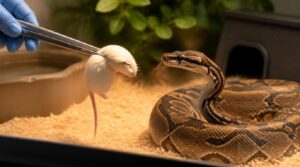
Feeding time triggers the strongest bite risk you’ll face with your ball python. Hunger, instinct, and quick movement combine fast, so your technique matters most right here. Let’s walk through the habits that keep your hands safe and your snake calm at mealtime.
Use Long, Secure Feeding Tongs
Good tongs do half the work for you. Choose 12- to 24-inch hemostat-style tongs with stainless steel tips for durability and non-slip grips for secure grip, even with damp scales. Angled tips aid precision, targeting your snake’s mouth accurately.
Wash tongs and hands first to eliminate prey scent, since confused feeding responses cause most bite incidents at mealtime.
Keep Hands Outside Strike Range
Distance saves fingers. Measure snout to fingertip, keeping at least 30 cm (12 inches) for adults and 20 cm for juveniles, since strikes launch fast and without warning.
Feeding tubs and gloves add backup protection. Even calm snakes surprise you, so treat every mealtime like poking a bear and never assume familiarity means safety.
Avoid Overstimulating Prey Movement
Ever wonder why a calm snake suddenly lunges mid-feed? Erratic prey motion triggers chase drive. Use feeding tool technique with long tongs, moving prey in one smooth line, not stop-and-go jerks.
Three fixes matter most:
- Prey presentation height stays consistent
- Vibration minimization through steady enclosure layout
- Avoid lighting changes or food scents lingering nearby
Separate Feeding and Handling Cues
Why does a well-fed snake still strike at handling time? Mixed signals. A Nighttime Feeding Schedule paired with daytime handling builds clear Temporal Handling Separation.
| Cue Type | Signal Sent |
|---|---|
| Warmed prey | "This is food" |
| Bare hand, daylight | "This is safe contact" |
| Tongs at night | Feeding trigger |
| Slow side approach | Handling trigger |
Consistency teaches your snake what’s coming, not confusion.
Pause Handling Around Meals
Timing matters as much as technique. Once your snake locks onto food, that’s not the moment for a cuddle.
Respect the handling suspension period: no contact for 24-48 hours before meals, 48-72 hours after. This digestive rest period prevents regurgitation and keeps your Nighttime Feeding Trigger separate from daytime trust-building.
Patience here pays off in fewer surprise strikes.
Build a Low-Stress Handling Routine

Bite prevention isn’t just about handling technique, it’s about the environment you build around it. A snake that feels secure, comfortable, and unbothered day to day is far less likely to strike when you reach in.
Here are five habits that keep stress low and trust high, long before your hands ever enter the enclosure.
Provide Snug Hides and Cover
A hide that fits snugly, covering 60 to 70 percent of your snake’s body length, does more for bite prevention than any handling trick.
Corner placement behind rocks or driftwood limits visual exposure.
Offer a warm and cool hide so your python can choose freely, with entrances wide enough to enter but narrow enough to keep the tail tucked in.
Maintain Proper Heat and Humidity
A snug hide means little if the enclosure around it runs too hot or too dry. Keep your temperature gradient between 78°F and 92°F, calibrate the thermostat monthly, and hold humidity at 50-60%, rising to 70% during sheds.
Poor humidity control or uneven heat turns a calm python defensive fast.
Limit Vibrations and Abrupt Lighting
Heat and humidity aren’t the only invisible stressors at play. Vibration stress from footsteps or equipment can rattle a calm snake fast, so add vibration dampening substrate and structural decoupling like foam padding under racks.
For lighting, use lighting change timers with gradual light dimming and low-intensity day lighting instead of sudden switches.
- Add thick substrate
- Use foam padding
- Install timers
- Dim lights gradually
Avoid Handling During Shedding
Cloudy, blue eyes mean impaired vision, and a startled snake strikes first. Wait until eyes clear and skin sheds fully, then give it 24 hours before handling resumes.
| Sign | Action | Why |
|---|---|---|
| Blue eyes | No handling | Vision loss |
| Dull skin | Reduce contact | Pre-shed stress |
| Shed complete | Wait 24 hrs | Trust building |
Stop When Stress Signs Appear
Every session ends the moment stress signs appear, no exceptions. Watch for these four red flags:
- Tight balling with the head fully tucked
- Rapid breathing or audible hissing
- Freezing behavior and stopped tongue flicking
- Head pulling toward the body’s center
Spot any of these? Return your python to its hide immediately. Consistent handling frequency builds trust; ignoring body language breaks it.
Frequently Asked Questions (FAQs)
How to get a ball python to stop biting?
Funny enough, most bites trace back to timing, not temperament. Combine bite prevention strategies like scent washing, slow approach, and warning sign recognition, plus consistent handling frequency optimization, and biting habits fade within weeks.
How common is it for a ball python to bite?
Rarer than most new owners expect. With experienced handling, bites happen less than once every few months. Juvenile bite patterns run higher as they test boundaries, while adult bite rarity reflects calmer, routine-based temperaments.
What do you do if a ball python bites you?
Like a pinprick that surprises more than it hurts, a bite calls for quick basics: clean the wound, apply a sterile dressing, immobilize the area, and seek medical care for antibiotic therapy or tetanus consideration.
How to make a snake stop biting you?
Stopping bites starts with hand hygiene, a slow approach, and full body support. Pause handling for 48 hours after meals, read body language closely, and use a hook for defensive snakes needing mid-body control.
What are the four preventive measures of snake bite?
Four essential measures cut your risk fast: habitat cleanup to remove hiding spots, protective footwear with thick, closed-toe boots, sharp environmental awareness through noise alerts and flashlights, and household safeguards sealing gaps snakes might slip through.
Will my ball python bite me if I pick it up?
Wondering if lifting your snake risks a bite? Rarely, if handling is calm. Body language signals, hand scent, and timing near feeding matter more than mood. Skip these cues, and even docile snakes may strike.
Can ball python bites transmit diseases to humans?
Yes, though venom isn’t the concern. Bacteria transmission risk from mouth flora and Salmonella exposure possibility matter more. Watch for infection signs like redness or swelling, wash bites promptly, and call your doctor if symptoms worsen.
How do you treat a ball python bite?
A bite stings, but your response next matters most. Rinse thoroughly with warm water, scrub with antibacterial soap, dab antiseptic, and cover it. Watch for infection signs daily, and consult a doctor about antibiotics or tetanus.
Do ball pythons bite more at night?
Temperament isn’t the culprit. Their nocturnal sensory instincts drive stronger evening activity patterns, so nighttime bite triggers spike when feeding cues, dim light misreads, or rushed handling collide with a snake that’s already primed to strike.
Are some ball python morphs more aggressive?
Morph temperament myths run deep, but there’s no proven genetic aggression link in ball pythons. Color morph reactivity varies by individual, not pattern. Handling history, husbandry, and stress reduction shape temperament far more than genetics ever could.
Conclusion
Trust, but verify, that old adage applies here: your snake’s calm demeanor today doesn’t erase tomorrow’s feeding instincts. Ball python bite prevention techniques work because they respect biology instead of fighting it.
Wash your hands, read the coils, and give your snake space during vulnerable moments. Bites aren’t personal attacks, they’re communication you learn to read. Master that language, and handling becomes routine, not roulette.
Confidence comes from preparation, not luck.