This site is supported by our readers. We may earn a commission, at no cost to you, if you purchase through links.

Your snake’s enclosure reads 72% humidity. The gauge on the glass says so. But the substrate near the water bowl sits at 90%, and the top shelf hovers closer to 55%. One cheap, drifting sensor just gave you a number that matches nothing your animal actually feels.
In a live-planted setup, constant misting and condensation wreck weak electronics fast. Accuracy slips, contacts corrode, and your plants and isopods pay for it.
The best humidity gauges for bioactive enclosures hold ±3% RH, shrug off moisture, and track more than one zone. Here’s which six earn a spot in your tank.
Table Of Contents
- Key Takeaways
- How to Choose Bioactive Humidity Gauges
- Top 6 Humidity Gauges for Bioactive Enclosures
- Compare Moisture Resistance and Monitoring Features
- Where to Place Bioactive Humidity Gauges
- How to Check Gauge Accuracy
- Match Humidity Readings to Your Snake
- Frequently Asked Questions (FAQs)
- What is the best hygrometer for a terrarium?
- What is the best humidity controller for a terrarium?
- How to measure humidity in a terrarium?
- What is the ideal humidity level for a terrarium?
- What humidity level do springtails need to thrive?
- Why does my hygrometer constantly read 100% humidity?
- How often should I replace my humidity gauge?
- Does enclosure ventilation affect humidity gauge readings?
- Can I safely clean a hygrometer inside the tank?
- Conclusion
Key Takeaways
- A single gauge can’t tell you the truth about your enclosure, since humidity can swing 35 points between the water bowl and the top shelf, so place at least two gauges at opposite ends and add a third in the humid hide if you can.
- The best gauges hold ±3% RH, resist constant misting with sealed housings, and let you calibrate them, because cheap units drift up to 5% within months and can even read 5% off right out of the box.
- Check your gauge with a salt test (it should read about 75% RH), recheck it every 3 to 6 months, and replace it every 12 to 24 months, or sooner if you mist heavily.
- The six gauges reviewed are budget magnetic or adhesive models with limited accuracy and no moisture ratings, so treat them as starter options and judge humidity by how your snake sheds, hides, and behaves, not by the screen alone.
How to Choose Bioactive Humidity Gauges
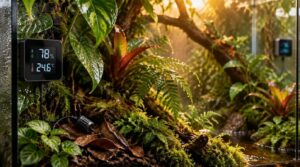
A humidity gauge that lies to you is worse than no gauge at all.
Checking your readings against a second device every few weeks, as outlined in this guide to reptile humidity gauges for boa constrictor keepers, catches drift before it harms your snake.
A faulty humidity gauge misleads you into confident mistakes, which makes it more dangerous than having no gauge at all
Six factors separate the reliable ones from the junk: accuracy and calibration, moisture-resistant design, flexible sensor placement, power and display, multi-zone monitoring, and misting controller compatibility. Check each one below before you spend a dime.
Accuracy and Calibration
Check your gauge’s accuracy tolerances first. Cheap units swing ±2–5% RH, which wrecks humidity accuracy for your snake.
Here’s what to look for:
- Sensor calibration support
- Low sensor drift
- Calibration stability over time
- Stated tolerance of ±1–3% RH
- Offset adjustment option
Recalibrate every 3–6 months, or when sensor drift passes 3% RH in 24 hours. Skip that, and you’re guessing.
Moisture-Resistant Design
Accuracy means nothing if humidity kills the gauge. Bioactive enclosures run wet, so you need moisture-resistant electronics.
Look for an IP67 housing or at least sealed housings with silicone gaskets. Waterproof-looking plastic isn’t enough. Pick a water-resistant design with a coated circuit board, plus corrosion-resistant contacts so misting doesn’t eat the terminals. Skip these, and your calibration drifts within weeks.
Flexible Sensor Placement
A tough gauge still lies if it’s in the wrong spot. Flexible sensor placement fixes that. Mount one on the warm side and one on the cool side, since warm side monitoring and cool side monitoring rarely match.
Sensor placement tips: keep units well out of direct mist. Use external probe sensor placement with short leads along tank edges.
Power and Display
Once your gauges sit in the right spots, power them wisely. Battery life and power matter most in sealed, humid tanks, where swapping cells is a pain. Battery units run 6 to 12 months. USB-powered monitoring devices suit logging, needing 5V, up to 1A.
Choose large easy to read, 75 tall LCD numerals and a resettable minmax display. Catch swings.
Multi-Zone Monitoring
Because humidity never sits still, Multi-Zone Monitoring matters. Pair dualzone temperature tracking with warm and cool side monitoring, and you’ll see where moisture actually pools.
Follow sensor placement guidelines: keep units 15–30 cm apart. Then try enclosure vertical gradient mapping, with sensors at the top, middle, and bottom. Spot stratification early, and you’ll fix problems much faster, every time.
Misting Controller Compatibility
Because misting controller compatibility decides whether your readings actually drive action, check these five things:
Pairing your controller with one of these reptile thermometers for nighttime monitoring means a sudden temperature or humidity drop gets flagged before your animal ever feels it.
- Digital output, not just a visual display.
- Response time under one second.
- Interchangeable sensor modules for automated terrarium systems.
- Hysteresis of ±2–5% for terrarium humidity regulation.
- Fail-safe off after any lost communication.
Pass all five and humidity control in terrariums respects your habitat moisture gradients.
Top 6 Humidity Gauges for Bioactive Enclosures
You’ve got the criteria, so now it’s time to put them to work. Below are six humidity gauges picked for bioactive setups, where moisture runs high and accuracy matters. Check each one against your own enclosure, and you’ll know which fits.
Since high humidity breaks down substrate faster, it also helps to know how often to change snake bedding based on your species and enclosure size.
1. BamiriX Magnetic Temp Humidity Monitor 2PCS
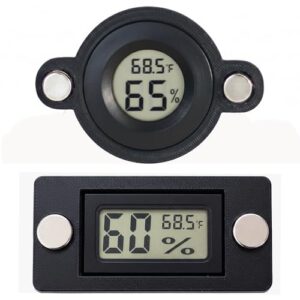
Want two readings from two spots in one tank? This pair makes it easy. You get one square unit and one round unit, each with a bright LCD, and both stick to enclosures with a built-in magnet. No tools needed.
The range is wide: -58°F to 158°F, and 20% to 90% RH. That covers gecko, bearded dragon, and chameleon setups, plus jumping spider enclosures.
Catch: some users report readings off by 20%. The square unit grips better than the round.
| Best For | Reptile and jumping spider keepers who want to monitor temperature and humidity at two spots in one enclosure without any tools or drilling. |
|---|---|
| Temperature Range | -58°F to 158°F |
| Humidity Range | 20%–90% RH |
| Mounting Method | Magnetic |
| Display Type | LCD |
| Units Included | 2 (square, round) |
| Power Source | N/A |
| Additional Features |
|
- Built-in magnets let you attach each unit to an enclosure with no tools
- Wide range of -58°F to 158°F and 20% to 90% RH suits gecko, bearded dragon, chameleon, and jumping spider setups
- Two units (one square, one round) with bright LCD screens let you compare readings from different spots
- Some users report humidity readings that are off by up to 20%
- The round unit has large holes in the back that may make it less secure
- Magnet strength can vary, and the square unit holds better than the round one
2. BamiriX Magnetic Thermometer Hygrometer 2-Pack
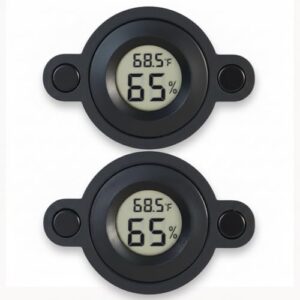
Picture a jumping spider enclosure on your shelf and a gecko tank right beside it. One gauge each, no drilling, no fuss.
The BamiriX 2-pack uses magnetic attachment on glass or acrylic, though you’ll need a ferromagnetic surface, meaning metal backing. Each round unit measures 3.2" wide and shows temperature from -58°F to 158°F on a digital display. Humidity runs only 20% to 90% RH, so extreme conditions fall outside its reach. Still, for monitoring two enclosures easily, it works.
| Best For | Reptile and invertebrate keepers, such as owners of jumping spiders, geckos, or tarantulas, who want to monitor temperature and humidity in two enclosures without tools or drilling. |
|---|---|
| Temperature Range | -58°F to 158°F |
| Humidity Range | 20%–90% RH |
| Mounting Method | Magnetic |
| Display Type | Digital |
| Units Included | 2-pack |
| Power Source | N/A |
| Additional Features |
|
- Magnetic attachment mounts on glass or acrylic enclosures without tools
- Digital display gives clear temperature and humidity readings
- The 2-pack makes it easy to monitor multiple enclosures
- Humidity readings are limited to 20% to 90% RH
- Temperature range may not cover extreme environmental conditions
- Needs a ferromagnetic surface, such as glass or acrylic with metal backing, to attach magnetically
3. BamiriX 2PCS Magnetic Thermometer Hygrometer
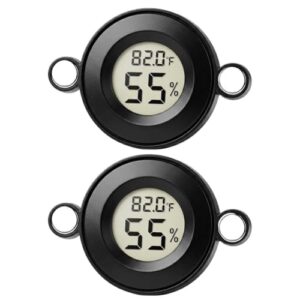
Small tanks don’t leave room for bulky gear. This two-pack hygrometer solves that.
Each unit measures 2.75 x 1.88 x 0.59 inches, so it barely registers inside a jumping spider or reptile enclosure. The LCD shows temperature and humidity together. Temperature spans -58°F to 158°F, and humidity runs 20% to 90% RH.
Since a gauge that drifts can quietly harm your animals, it helps to compare humidity gauges for multiple enclosures and recheck each one weekly with a salt test.
Mount it on metal or glass with the magnetic back, or add an external magnet. Here’s the catch: no calibration, logging, or alarms are listed. Verify readings yourself.
| Best For | Jumping spider and reptile keepers who need a compact, affordable way to track temperature and humidity in small terrariums. |
|---|---|
| Temperature Range | -58°F to 158°F |
| Humidity Range | 20%–90% RH |
| Mounting Method | Magnetic |
| Display Type | LCD |
| Units Included | 2 |
| Power Source | N/A |
| Additional Features |
|
- Compact size of 2.75 x 1.88 x 0.59 inches fits small habitats without taking up space
- Magnetic mounting works on metal or glass surfaces
- Comes as a two-pack with an LCD that shows temperature and humidity together
- Needs a metal surface nearby or an external magnet to stay securely in place
- No calibration or adjustment feature is listed, so you have to verify readings yourself
- No data logging or alarm functions are listed
4. BamiriX Reptile Tank Monitor
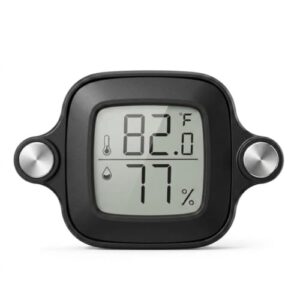
Need a quick-attach gauge for your tank? The BamiriX Reptile Tank Monitor uses a magnetic mount for fast setup.
It’s compact, at 2.87 x 1.88 x 0.57 inches and 32.8 grams. The clear digital display shows temperature and humidity. Temperature runs from -58°F to 158°F, while humidity reads 20%-90% RH.
Here’s the catch. The unit needs an external magnetic surface, and the small magnets are easy to lose during handling. Accuracy may also drift outside that humidity range. Stash spares.
| Best For | Owners of bearded dragons, leopard geckos, crested geckos, snakes, turtles, or jumping spiders who want a compact, quick-attach gauge for tracking temperature and humidity in their enclosures. |
|---|---|
| Temperature Range | -58°F to 158°F |
| Humidity Range | 20%–90% RH |
| Mounting Method | Magnetic |
| Display Type | LCD |
| Units Included | 2 (square, round) |
| Power Source | 2x LR44 |
| Additional Features |
|
- Magnetic mount lets you attach it to a tank quickly
- Compact, lightweight design (2.87 x 1.88 x 0.57 inches, 32.8 grams)
- Clear digital display shows both temperature and humidity, with a temperature range of -58°F to 158°F
- Requires an external magnetic surface for mounting
- Small magnets can be easily lost during handling
- Humidity accuracy may vary outside the 20%-90% RH range
5. Meggsi Mini Digital Hygrometer 2 Pack
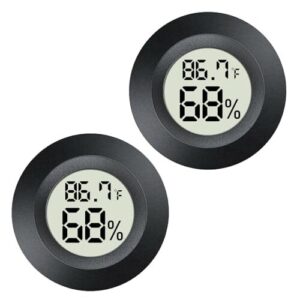
Tired of hunting for lost magnets? The Meggsi Mini Digital Hygrometer 2 Pack ships with two units and an LR44 battery in each.
Readings refresh every 10 seconds, so you’ll catch swings fast. Temperature accuracy is ±1.8°F, and humidity is ±3~5% RH. It works from 0°C to 70°C.
Now the real catch. Adhesive mounting may not stick to some surfaces, and some users report inconsistent temperature readings between units. Also, humidity won’t read below 20% RH, despite the 10% claim.
| Best For | Hobbyists who want a small, affordable way to keep an eye on temperature and humidity in tight spaces like reptile terrariums, guitar cases, or 3D printer filament spools. |
|---|---|
| Temperature Range | -58°F to 158°F |
| Humidity Range | 20%–90% RH |
| Mounting Method | Magnetic |
| Display Type | Digital |
| Units Included | N/A |
| Power Source | N/A |
| Additional Features |
|
- Readings refresh every 10 seconds, so you can spot changes quickly.
- Each pack comes with two units and an LR44 battery in each, so you can start using them right away.
- It shows temperature in Fahrenheit or Celsius and works from 0°C to 70°C (32°F to 158°F).
- The adhesive mounting may not stick well to some surfaces.
- Some users report inconsistent temperature readings between units.
- Humidity won’t read below 20% RH, even though the spec claims 10% RH.
6. Reptile Thermometer Humidity Gauge Set
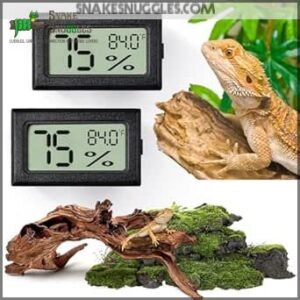
Adhesive trouble again? The Reptile Thermometer Humidity Gauge Set from Vodolo uses adhesive backing too, so installation takes seconds.
The set includes dual thermometers, so you can watch two zones at once. A high-precision chip claims 0.9°F accuracy, and the LED display switches between ℉ and ℃. It runs on a replaceable battery and suits snakes, bearded dragons, leopard geckos, and lizards.
The catch. Accuracy feedback is mixed, some units stick poorly to glass, and several broke within 30 days.
| Best For | Reptile keepers with bearded dragons, leopard geckos, snakes, or lizards who want an affordable way to watch two zones of a terrarium at once and don’t mind replacing it if it wears out. |
|---|---|
| Temperature Range | 32°F to 158°F |
| Humidity Range | 20%+ RH (min 20%) |
| Mounting Method | Adhesive |
| Display Type | N/A |
| Units Included | N/A |
| Power Source | LR44 per unit |
| Additional Features |
|
- Dual thermometers let you monitor two different areas of the tank at the same time
- LED display switches easily between ℉ and ℃
- Adhesive backing makes installation quick and tool-free
- Customer feedback on temperature accuracy is mixed, despite the claimed 0.9°F precision
- Some units stick poorly to glass surfaces
- Several units broke within 30 days, raising durability concerns
Compare Moisture Resistance and Monitoring Features
Not every gauge controls a wet, foggy enclosure the same way. Below, you’ll see how each one stacks up on moisture resistance, accuracy, zone coverage, alerts, and misting control. Use it to spot which features matter for your setup before you buy.
Moisture-Resistant Construction
Picture a fog of mist rolling over your cage, then seeping into a cheap gauge. Dead display. Dead data.
Look for a moisture-resistant sensor housing with gel-potted electronics and corrosion-resistant contacts. IP67/IP68 housings are ideal, but few budget gauges carry them. Most rely on sealed seams. Verify water contact protection before you buy, because your misting schedule won’t forgive shortcuts.
Sensor Accuracy And Calibration
Even a sealed gauge is worthless if it lies. Sensor accuracy decides whether your readings mean anything.
Most budget digital hygrometer thermometer combo units swing ±3–5% RH, and sensor drift adds another ±5% within a year. Check for calibration options, ideally two-point adjustment at 30% and 75%. Without them, humidity accuracy slips quietly. Recheck every 3–6 months, quarterly for breeding.
Multi-Zone Sensor Placement
shows you what one gauge never will. Follow these sensor placement tips: put one unit inside the hide at animal eye level for humid hide placement, and another 2–3 cm above the substrate for substratelevel sensor placement.
Keep every probe 10–20 cm from lamps. That’s simple heat source interference avoidance, and it keeps your readings honest.
Remote Alerts And Logging
Because humidity can crash while you’re asleep, remote alerts for sensitive species aren’t optional. Set custom threshold notifications to fire when readings drift ±5% for three minutes. Wireless monitoring then pushes the warning straight to your phone.
Logging matters just as much. MINMAX data logging records your daily extremes, while one-minute CSV samples reveal trends your smart controller alone can’t.
Misting Controller Integration
Your mister hisses, fog rolls across the substrate, and the controller keeps spraying because nobody told it the air’s already soaked. That’s the cost of skipping Misting Controller Connection.
For humidity control in terrariums, pair your gauge with a habitat automation system that reads it directly. Follow sensor placement guidelines, and you’ll get realtime environmental tracking that stops overmisting.
Where to Place Bioactive Humidity Gauges
Picture a gauge dripping under a mist plume, reading 100% while your snake sleeps in dry air. That’s a useless number. Good sensor placement tips fix it.
Mount one gauge on a vertical surface about 25 cm above substrate, shaded, with airflow and clear of direct spray. Keep it 6 inches from heat sources so warm lamps don’t skew the reading.
Now map the gradient. Put a second gauge 2 to 4 inches above the soil, away from damp contact. Tuck a third inside the humid hide microclimate, behind foliage or moss, with corrosion-resistant contacts. Keep one outside the misting plume for baseline.
Use clip-on or magnetic mounts so you can easily relocate gauges when your misting schedule changes.
How to Check Gauge Accuracy
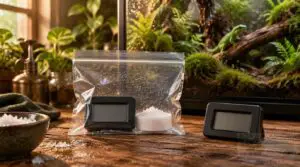
Can you trust the number on your screen? Not until you’ve tested it.
Sensor accuracy verification takes one afternoon, and it protects your animals for months. A fresh digital hygrometer can read 5% off right out of the box, so don’t skip this step.
Run the salt test at enclosure temperature, using sensor placement guidelines:
- Seal the gauge in a bag with a bottle cap of damp NaCl slurry.
- Wait 24 hours, then read it. It should show about 75% RH, within ±5%.
- Note the offset, then recheck after one week. Drift beyond ±2% means trouble.
- Compare against a second reference unit to confirm temperature accuracy too.
Good humidity accuracy isn’t a one-time win. Log drift monthly, replace outliers.
Match Humidity Readings to Your Snake

Does your snake actually care what the gauge says? It cares what the air feels like where it sleeps.
That’s why species specific humidity requirements matter more than any number on a screen. A climber that thrives at 60 to 70% won’t forgive a gauge that’s off by ten points, so check your humidity accuracy first.
Next, watch the animal. Note shedding quality, hiding habits, and venting alongside each reading. Stuck shed or constant soaking means your range needs adjusting.
Then adjust your sensor placement by moving one probe nearer the hide.
Good reptile enclosure monitoring is a feedback loop. Log, observe, tweak. Soon, your terrarium climate control settles into a window built around your snake, not a care sheet.
Frequently Asked Questions (FAQs)
What is the best hygrometer for a terrarium?
Cheap hygrometers can drift ±5% RH within months. For reptile habitat monitoring, pick moisture-resistant electronics, proven hygrometer accuracy, and two probes for smart sensor placement. That’s real terrarium climate control, and it’s worth paying for.
What is the best humidity controller for a terrarium?
A good humidity controller is a thermostat for moisture, quietly correcting every swing.
For terrarium humidity control, pick one with a closed-loop setpoint, an external probe, and 12V or 24V relay output.
It prevents over-wetting.
How to measure humidity in a terrarium?
Picture mist drifting over moss while a dial lies. How to measure humidity in a terrarium? Park a calibrated sensor 1–2 cm above moist substrate, well away from heat lamps, for honest terrarium humidity regulation.
What is the ideal humidity level for a terrarium?
Think there’s one magic number? There isn’t. Species-specific humidity requirements rule: tropical setups run 55–70% RH, arid ones 40–50%.
Build habitat moisture gradients for microclimate creation in vivariums; reptile habitat humidity regulation needs humidity accuracy.
What humidity level do springtails need to thrive?
Your colony stalls at 55% humidity, booms after a week at 70%. That’s the 60–75% sweet spot.
Springtails humidity requirements are simple: keep substrate damp, avoid readings above 80%, and verify with humidity accuracy sensors.
Why does my hygrometer constantly read 100% humidity?
Your hygrometer is lying a million times over. Condensation pins it at 100%.
Dry it. Recalibrate every 6-12 months for sensor drift prevention. Buy moisture-resistant electronics with corrosion protection in sensors for humidity swings detection.
How often should I replace my humidity gauge?
Replace your gauge every 12 to 24 months. Recalibrate every 6-12 months in your sensor maintenance routine. Humidity sensor calibration helps prevent sensor drift and ensures long-term sensor reliability. Heavy misting? Replace sooner, within 6-12 months.
Does enclosure ventilation affect humidity gauge readings?
Is your gauge faulty? Probably not. Enclosure ventilation affects humidity gauge readings by pulling moist air past the sensor.
Wait 30 to 60 minutes after changes, and follow sensor placement guidelines for microclimate tracking.
Can I safely clean a hygrometer inside the tank?
Think of your sensor as a watch, not a diver.
Wipe it, don’t soak it. Unplug first, use a barely damp cloth, and only trust sealed housings. Dry it fully before it goes back in.
Conclusion
A 35-point humidity swing between your water bowl and top shelf is normal, which is exactly why one gauge never tells the truth. The right humidity gauges for bioactive enclosures hold ±3% RH, survive constant misting, and watch more than one zone.
Pick two, place them at opposite ends, and test them against a salt kit. Then trust the numbers, not the guesswork. When your snake sheds clean and moves easy, you’ll know it’s right.